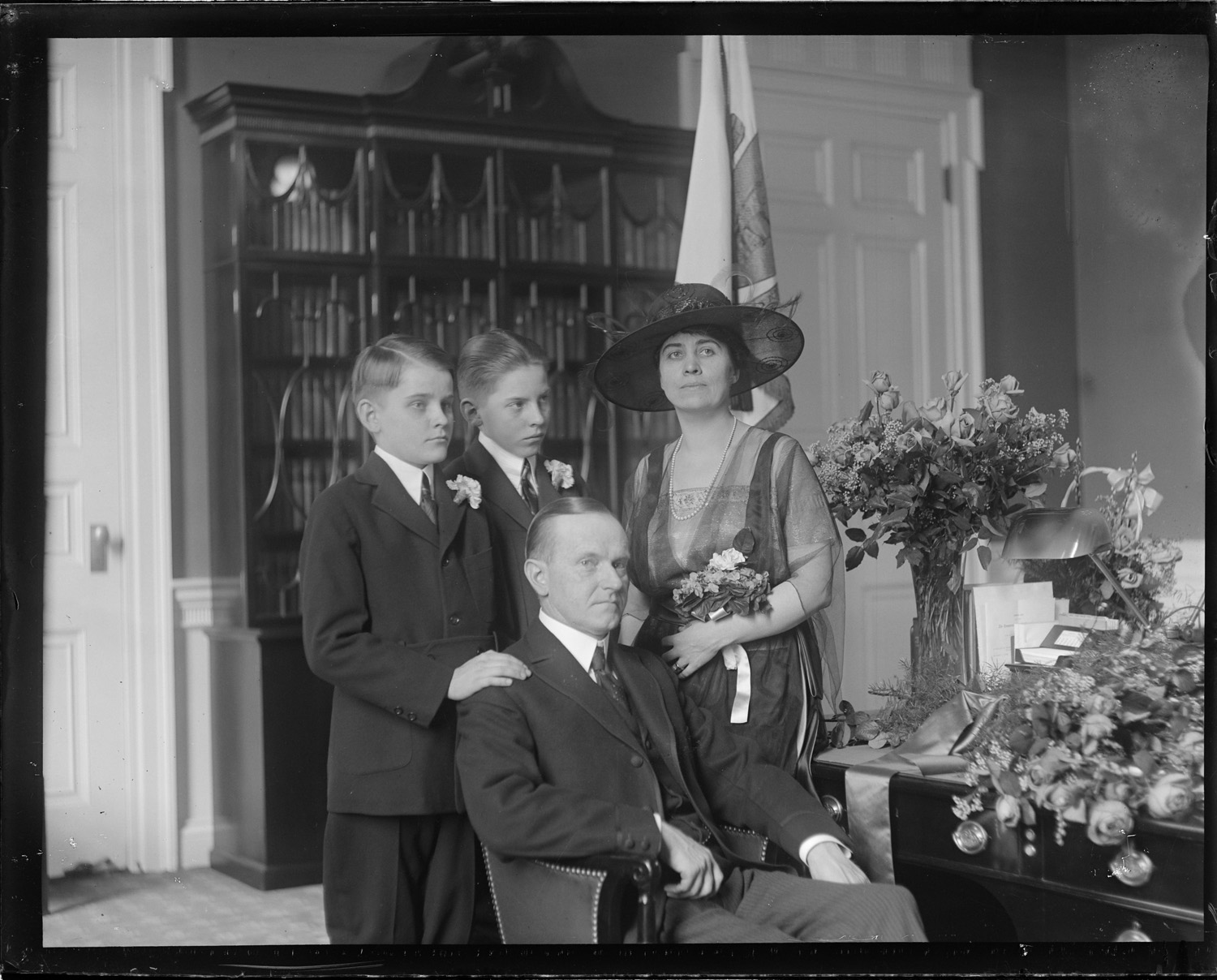
Speaking in Plymouth, Massachusetts, on September 1, 1919, Governor Calvin Coolidge could have been critical of national conditions, its economic disparity and bleak situation coming out of war and into a still very uncertain peace. It remained to be seen how smooth an adjustment into peacetime America could accomplish. There was much unrest throughout the country and the Wilson administration’s Progressive rhetoric combined with the Justice Department’s prosecution of political threats continued to keep Americans on edge, a palpable anxiety which hovered over the Nation like a cloud.
1919 was not only the year of the Boston Police Strike but witnessed steel, coal and general strikes from Seattle to Johnstown, Pennsylvania. The immense power of the strikers to halt operations throughout the country reminded people they were not to be crossed without serious consequences. The incessant claims that ours was an unfair and inequitable system took a special kind of courage to publicly confront. Governor Coolidge, eight days before most of Boston’s law enforcement would vote to walk away from their duty, would address those gathered in Plymouth in full display of just that kind of courage. He would tackle the heart of the issue head-on covering the issues of labor, wages, equality and opportunity.
He began with sincere praise for America’s exceptionalism, “…[F]or it was here that for the first time in history a government was founded on a recognition of the sovereignty of the citizen which has irresistibly led to a realization of the dignity of his occupation….For the first time in five years it comes at a time when the issue of world events makes it no longer doubtful whether the American conception of work as the crowing glory of men free and equal is to prevail over the age-old European conception that work is the badge of the menial and the inferior. The American ideal has prevailed on European battle-fields through the loyalty, devotion, and sacrifice of American labor. The duty of citizenship in this hour is to strive to maintain and extend that ideal at home.”
In Coolidge’s estimation, unceasing discontent and perpetually-stirred criticism rendered no benefit to anyone and solved nothing — in fact, they were drains of energy when the challenges to be faced demanded constructive effort and optimism on the part of everyone. Creating a false perception that forced Americans into fixed classes to be constantly pitted against each other was not only dishonest but destructive if improvement and progress were to be continued. Fostering dissension and enmity between those perceived to be “Haves” and “Have Nots” was a denial of the Founding and a deceitful manipulation of the real property owners America empowers, the people themselves.
Coolidge continued, “We have known that political power was with the people, because they have the votes. We have generally supposed that economic power was not with the people, because they did not own the property. This supposition, probably never true, is growing more and more to be contrary to the facts. The great outstanding fact in the economic life of America is that the wealth of the Nation is owned by the people of the Nation. The stockholders of the great corporations run into the hundreds of thousands, the small tradesmen, the thrifty householders, the tillers of the soil, the depositors in savings banks, and the now owners of government bonds, make a number that includes nearly our entire people.”
Citing the figures of Massachusetts alone proved this assertion and laid bare the simplistic notion that justice could be legislated after “assuming that we can take from one class and give to another class.” The “property class” was already one and the same as the “employed class.” The interdependence of interests made it impossible to separate them and preserve what was good or just for either one. Reflecting on the fact that Massachusetts was an industrial state, he raised a series of questions that illustrated the path America would have to take to grow. It lay not in the direction of jealousies, hatred and class warfare but in expanding opportunity, not regulation, and raising prosperity for everyone through policies that encourage profits and its by-product, employment. He asked, “How can our people be made strong? Only as they draw their strength from our industries. How can they do that? Only by building up our industries and making them strong. This is fundamental. It is the place to begin. These are the instruments of all our achievement. When they fail, all fails. When they prosper, all prosper. Workmen’s compensation, hours and conditions of labor are cold consolations, if there be no employment. And employment can be had only if some one finds it profitable. The greater the profit, the greater the wages.”
In this economic axiom, Coolidge made clear the need, not to demonize profits, but to welcome them as a legitimate part of unchaining America’s economic potential. Coercive legislation was not the answer to higher wages. Clearing away the hampering clutter of controls that made people’s participation in the marketplace unprofitable was the solution. This raised wages. The increase in value of each individual’s labor is not determined by penalizing growth and punishing employment. The increase in value manifests itself in higher wages. The value of the individual’s work is as limitless as that person’s potential. Yet, it grows in proportion to the profitability of the enterprise to which a person’s labor is invested. If profits are suppressed, expansion of opportunity stops and, sooner or later, so does employment itself.
Governments, inept at accurately gauging the value of labor cannot set wage rates without harming growth and continued employment. In short, Governments in the business of setting wages always hurt the most vulnerable Americans, the very people wage laws claim to be helping.
Coolidge reminds us of these obvious and yet repeatedly forgotten truths. If we genuinely want everyone to prosper, we can only accomplish it by building up, not tearing down, America’s engine of growth. We do this not through constant appeals to prejudice and anger but through constructive work, encouraging the opportunities to be found in a marketplace of growing value and expanding opportunity. In such an environment, employment, higher wages, increasing profits and upward mobility are made possible for anyone with the will and determination to achieve his or her highest potential. That potential, the ability to work for yourself and keep the rewards of that labor is an American concept. It is through this recognition of the dignity of work, what Coolidge called the “crowning glory” of a free and equal people, that so extraordinary a success has been enjoyed here in America.
Economic power cannot be repeatedly stifled and thwarted without an accompanying loss to the people’s political power. Both powers are inseparably joined. While the force of Government fails whenever it attempts to harness capitalism for its own, vastly different ends, America still proves that freedom works.
 The Importance of the Obvious