On Remembering Our Shared Fallen

The Confederate Monument today, looking south.

The Confederate Monument today, looking south at Arlington National Cemetery, Washington, D. C.

“If I am correctly informed by history, it is fitting that the Sabbath should be your Memorial Day. This follows from the belief that except for the forces of Oliver Cromwell no army was ever more thoroughly religious than that which followed General Lee. Moreover, these ceremonies necessarily are expressive of a hope and a belief that rise above the things of this life. It was Lincoln who pointed out that both sides prayed to the same God. When that is the case, it is only a matter of time when each will seek a common end. We can now see clearly what that end is. It is the maintenance of our American form of government, of our American institutions, of our American ideals, beneath a common flag, under the blessings of Almighty God.

“It was for this purpose that our Nation was brought forth. Our whole course of history has been proceeding in that direction. Out of a common experience, made more enduring by a common sacrifice, we have reached a common conviction. On this day we pause in memory of those who made their sacrifice in one way. In a few days we shall pause again in memory of those who made their sacrifice in another way. They were all Americans, all contending for what they believed were their rights. On many a battlefield they sleep side by side. Here, in a place set aside for the resting place of those who have performed military duty, both make a final bivouac. But their country lives.

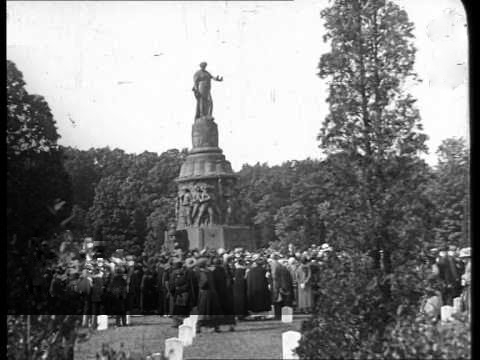
Americans North and South gather with Coolidge to honor all Americans who fought and died for our ideals, but especially those who wore the gray, 1924.

Americans North and South gather with Coolidge to honor all who fought and died for our ideals, but especially those who wore the gray, 1924. Coolidge could have used Presidential rhetoric to withhold recognition, instead he upheld the honor and importance of what they died to preserve. He helped to heal, not inflame, division and to reunite all Americans around our love of country founded on principles we share in common. See a silent film from the gathering here.

“The bitterness of conflict is passed. Time has softened it; discretion has changed it. Your country respects you for cherishing the memory of those who wore the gray. You respect others who cherish the memory of those who wore the blue. In that mutual respect may there be a firmer friendship, a stronger and more glorious Union…

“…A mightier force than ever followed Grant or Lee has leveled both their hosts, raised up an united Nation, and made us all partakers of a new glory. It is not for us to forget the past but to remember it, that we may profit by it. But it is gone; we cannot change it. We must put our emphasis on the present and put into effect the lessons the past has taught us. All about us sleep those of many different beliefs and many divergent actions. But America claims them all…” — President Calvin Coolidge, May 25, 1924

The Confederate Memorial at Arlington in 1922, two years before President Coolidge spoke the words above. In the years to follow, the markers of those who wore the gray would multiply as the great heroes and warriors of the South shed mortality.

The Confederate Memorial at Arlington in 1922, two years before President Coolidge spoke the words above. In the years to follow, the markers of those who wore the gray would multiply as the great warriors of the South shed mortality.

On the Death of American Exceptionalism

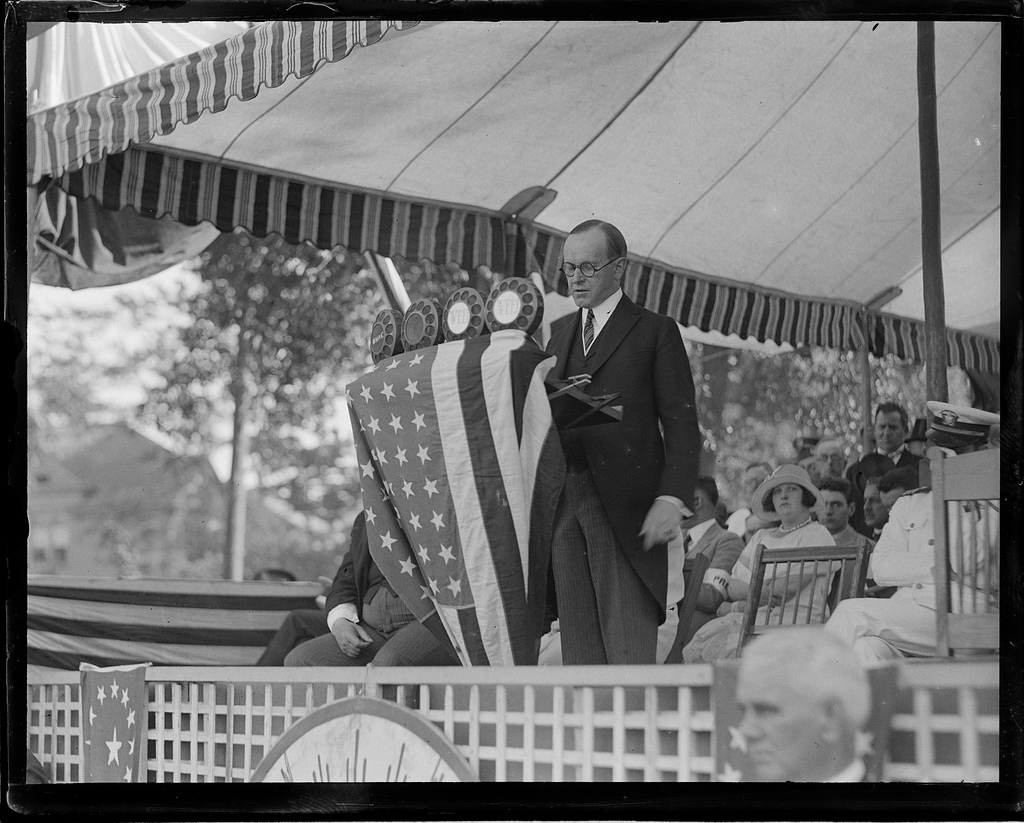
6192836527_39ae0562bc_b CC speaking

The assertion that America has unfairly led the rest of the world is not a new claim. For decades the argument has been pushed forth that it is incumbent on the United States to lower its standards around the globe, share its power, scale back its presence and a fairer, more equitable world would rise. We are led to believe that for civilization to advance it must all be in the direction of less individual freedom and more bureaucratic control. It is unjust, they insist, for America to realize such unprecedented prosperity, success and progress while the rest of the nations live in poverty, decay and oppression. Meanwhile, the denial of individual liberty and government by men instead of laws — notions irreconcilable with America’s ideals — are never recognized as central causes to all the suffering. It is as if the subordination of America’s ideals is something over which to rejoice and hasten. Such attitudes are like condemning the victim for the crime rate.

Why America is different is only impugned and criticized, never understood. After all, they assume, Americans took all this wealth, opportunity and its historic living standards from everyone else. Containing far more envy of America’s power than reality warrants, it is conveniently omitted that America is the exception to the rule because of a voluntarily agreed upon set of principles. These ideas, including government by consent, freedom of conscience, the sanctity of individual life, liberty and one’s pursuit of happiness, do not originate from the tyranny and injustice that have defined normal human existence since the beginning.

The rule of a few on the backs of the many has been tried, weighed and found wanting. It makes no difference whether it be called absolute monarchy, democracy, socialism or liberalism, it is the same prevalent, recurring weed that releases the same toxins upon society every time. America, founded as a refuge from suppression of conscience, denial of political choice and refusal of economic opportunity, applied the years of practical experience gleaned since ancient time to forge a government that served a sovereign people, not the people enslaved to government. Authority would reside not in personalities and social classes but in duly enacted laws through representatives delegated with specific responsibilities from the sovereign people. Endowed with the infusion of freedom, restrained by virtue and directed by sound education, America worked beyond the highest expectations of our visionary and audacious founding men and women. Preserved by the duty and service of each generation to those proven ideals, America demonstrated the exception not only succeeds, it perpetuates a very real good at home and for the rest of the world.

Simply because America is no more perfect than any other nation does not disprove that goodness and righteousness are either unattainable in her future or altogether absent from her past. In less than two and a half centuries, America has empowered millions with unprecedented upward mobility, withstood dictators, toppled regimes wedded to personal power rather than the might of its ideals, ventured into every corner of the globe not to dominate and conquer but to defend the weak, build trade and goodwill with all, share with those in distress and serve those in need. Where there has been need for improvement, our constitutional system affords remedy through amendment and circumspect legislation insofar as it follows reform in the people themselves. America has soberly embraced what Coolidge understood so well: With great blessings come greater responsibilities.

America has done all these things because at one time or another, no one else in the “room” stood up when the occasion demanded. The world has been and will continue to be far better off as long as moral power triumphs over material power. While the few redistribute wealth and call it “fairness,” the only commodity being equalized is misery and its attendant restriction of opportunity for everyone. The only ones who gain from this denial of eternal truths are those who already hold political power, and seek to extort more from the rest of us.

America’s ideals, as the exception to the ancient “might makes right” governance of world affairs, will prevail only if the original sovereigns — we, the people — reclaim our governance. The world will not rise simply by our descent. The vacuum will not be filled by some other equally legitimate set of lofty standards. We will do nothing for the world by relinquishing moral leadership now, expecting that fairness comes by descending to the lowest common denominator. The world will simply be less equal, less just, less free and less morally coherent.

As Calvin Coolidge said, “Some say we cannot go on maintaining a higher standard of living for our people than that enjoyed in other nations. We have done so for generations. That is the fact. The theory that it cannot continue may be no better than the theory that it will last indefinitely. Some nation always has taken the lead. But supposing we shall finally reach the same position as others that is no reason why we should now relinquish our supremacy and descend to their level. It is our business to make our conditions the best as long as we can. We would not be justified in tamely surrendering our treasure now because at some time it may be exhausted. To become equal to others we must go down or they must go up. For us to go down would not in itself raise others. Our example of a free and prosperous people has been the sovereign remedy for world oppression. The truth is our trade regulations are more fair to others than theirs are to us. And what is of chief importance is the great service we render by giving credits and furnishing markets. The higher our standards, the greater our progress, the more we do for the world.”

Coolidge once put it even more concisely, “Do not expect to build up the weak by tearing down the strong.” Those who advocate ultimate liberation on the wings of America’s departure from exceptionalism expect more than reality can give. As with so many observations on government and human nature, however, Coolidge could not be more correct. It is a wisdom that can never be escaped, however much nations or individuals wish to jettison the obligations of righteousness or the constraints of moral standards.

President Calvin Coolidge

On Andrew Jackson and America’s Pioneering Spirit

President Coolidge presenting a wreath at the Jackson Memorial in Lafayette Park, January 1924.

President Coolidge presenting a wreath at another landmark in honor of the General and 7th President, the Jackson Memorial in Lafayette Park, January 1924.

“One of the great sources of the strength of our country has been the pioneering spirit…Our people have ever been going forth into the forest and over the plain to establish themselves in the region of the unknown. They have sought new fields to conquer. They have been pioneers, however, not only in the physical world, but in the realm of ideas. The frontier has long since disappeared…but the ambition to enter uncharted regions of industry, of enterprise, of social relations, and of thought continues with increasing fervor.”

“We would miss much of the significance and meaning of the history of the United States unless we took into account this outstanding quality. Our whole outlook has been greatly influenced by it. It is the complete antithesis of all systems of class and caste…” Instead of finding that their place in life, and the way to think “had been previously ordained for them” America “came into existence” for the very “purpose of escaping from this doctrine…The people who came here were seeking freedom of action and freedom of mind. The great revelation of our country has been that men are not born to servitude and obscurity. They are born to all the possibilities of a glorious station which can be won by their own achieving.” Such is the essential difference between self-governed liberty and security by coercion and conformity. It resides in the confidence that we can be trusted with freedom and are born for great things, not the bureaucratic management of our mediocrity.

America’s history is something of which to we can yet find reason to admire and honor. The pioneers who lived and triumphed “by their own achieving” is not the rare exception, it is “our national epic…It is a record of untiring effort, undaunted courage, and persevering will, all of which have set an inextinguishable mark upon the history of our country.”

“One of the outstanding figures which so well represents this development of our national life is Andrew Jackson, the seventh President of the United States…Thrown on his own resources as he was, he grew up proud and high tempered, oftentimes violent in his disposition, and considerably interested in the sports of the countryside…” From the study of law he went on to serve as Tennessee’s first Representative in the House. General Jackson would go on to defeat the attacking British in New Orleans on January 8, 1815, before word of peace had reached our shores. “New Orleans being under martial law, he was soon engaged in altercations with the civil authorities. He did not hesitate to arrest judges and the United States attorney when they interfered with his orders…When civil authority was resumed he submitted to a fine of $1,000 for contempt of court. ‘I have during the invasion,’ he said, ‘exerted every one of my facilities for the defense and preservation of the Constitution and the laws. Considering obedience to the laws, even when we think them unjustly applied, is the first duty of the citizen. I entreat you to remember the example I have given you of respectful submission to the administration of justice.’ Nearly 30 years later the Congress remitted the fine with interest.”

“This was a most significant statement. It might well have been pondered by those who were undertaking to argue away the Constitution after General Jackson became President. Here was a man who stood ready to fight a duel, if he thought the circumstances required it – of an impetuous nature and impatient of all restraint, yet clearly announcing the supremacy of law. More than that, he was acting upon that principle…He believed that at all times and in all places the duly constituted authority of law should be supreme.”
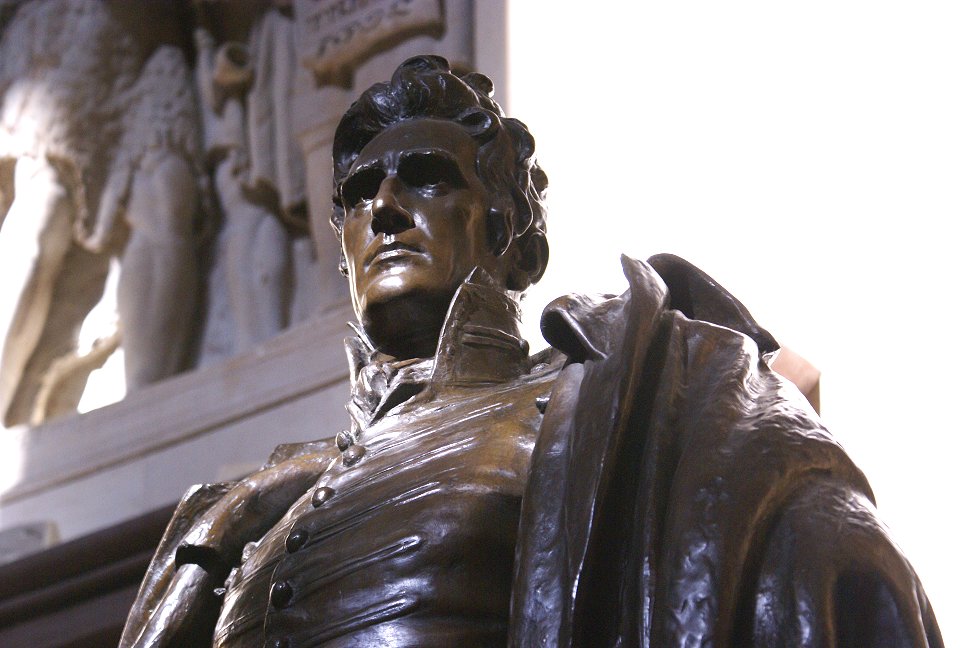
The statute of Andrew Jackson, given by the State of Tennessee and accepted by President Coolidge stands underneath the dome of the Capitol in Washington, where Coolidge, in 1928, delivered the address featured here.

The statute of Andrew Jackson, to which President Coolidge refers, stands underneath the dome of the Capitol in Washington.

Coolidge, finding much to admire about his predecessors, was not above the firm criticism or even the refrain of praise. Yet, when he identified closely with a frailty, he exemplified a remarkable measure of charity and understanding. Such was the case with President Jackson’s temper. Known for his outward calm, Coolidge could give vent to a fiery wrath of his own at times. Whereas some Presidents would look with hypocritical disdain, even withering contempt, for some of those who came before them, Coolidge practiced a humble forbearance, especially when it came to judging history. Being keenly aware of his own flaws, how could he harshly condemn others with all the benefits of hindsight while he shared in that lack of perfection too? He was no partisan hack either, taking cheap shots for their own sake, as his reflections on the Democrat Jackson make plain. In Coolidge, there was no double standard. For Calvin, treating others as we would be treated was not a trite phrase, it was his life. It is not the suppression of passionate conviction, it is sharing (regardless of party) a common fidelity to the supremacy of law and love for our exceptional foundations. It was simply what Americans, imbibing deeply the spirit of the pioneers, do.

As Coolidge surveyed the legacy of President Jackson, he revealed how profound an impact his predecessor had upon him, the Office and the Nation. “He was regarded as a President of the people, and in seeking to remove their burdens and improve their condition he favored economy and payment of the public debt. When this should be done, he favored dividing the surplus revenues among the States. He also criticized the United States Bank,” taking on (like Coolidge many years later) controversial issues which could easily have been deferred to others in the future.

Coolidge reminded his audience that Jackson, while not always consistent, held courageously to both the preservation of the Union and the obligations of the Executive. In the midst of Jackson’s historic battle with Calhoun over nullification in April 1833, he affirmed,

” ‘Our Federal Union – it must be preserved.’ ”

“Without reference to his former views on the tariff or States rights, when this ordinance was passed, President Jackson declared, ‘The duty of the Executive is a plain one. The laws will be executed and the Union preserved by all the constitutional and legal means he is invested with.’ He soon followed this with a proclamation denying the right of secession, refuting the power of a State to set aside an act of Congress, and asserting the supremacy of the Federal Constitution. This proclamation has been regarded as one of the best state papers of any American President…A service of this nature, rather at variance with some of the positions he had formerly taken and some of the policies strongly supported in his own party, could only have been performed by a great man.”

Tennessee Gentleman, portrait of Jackson from 1831. Part of the collection at The Hermitage, Nashville.

Tennessee Gentleman, portrait of Jackson from 1831. Part of the collection at The Hermitage, Nashville.

“His fight on the bank was not yet ended. His next move was an attempt to withdraw the public deposits…Of course, a violent change of this nature affecting the financial policies of the Nation, was bound to have an economic effect throughout the country. Government funds in local banks were used for speculation, which, as usual, brought the reaction of depression.” It is especially noteworthy that President Coolidge includes this concise illustration from history about speculation at a time coinciding with feckless investment in quick money on the market throughout 1928, the year of this speech. It was another occasion where President Coolidge gave sober warning to any who would heed. In this, and many other ways, his attempts to carefully “tap the brakes” (so as not to discourage sound growth) met with little notice at the time. “Opinions have differed,” just as they would over the causes and cures of the recession turned Great Depression of the 1930s, “but no one doubts the great courage of President Jackson in opposing it or the public approbation he received in support of his policy.” Jackson, contrary to Arthur Schlesinger’s wishful claim, was hardly the precursor of FDR, who spent while Jackson paid off the Nation’s entire debt and assumed greater supervision of individual freedoms while Jackson kept faith in the people to govern themselves.

No doubt anticipating his own retirement from public office in just less than eleven more months, President Coolidge turned to Jackson’s departure from Washington. “On the 7th of March, 1837, he set out for his old home, The Hermitage. He had triumphed over opponents who were considered then, and rank now, among the greatest statesmen of his day. Calhoun had gone down on nullification. The great figure of Daniel Webster had stood with the President on that issue, but had opposed his banking policies. Clay had compromised and lost…If at times he was high tempered and overbearing, there is no fairer story of chivalrous devotion and affectionate consideration than that which he lavished upon his wife. In her benign presence he was all submission.”

“History accords him one of the high positions among the great names of our country. He gave to the nationalist spirit through loyalty to the Union a new strength which was decisive for many years. His management of our foreign affairs was such as to secure a wholesome respect for our Government and the rights of its citizens. He left the Treasury without obligations and with a surplus. Coming up from the people, he demonstrated that there is sufficient substance in self-government to solve important public questions and rise superior to a perplexing crisis. Like a true pioneer, he broke through all the restraints and impediments into which he was born, and leaving behind the provincialisms and prejudices of his day pushed out toward a larger freedom and a sounder Government, carrying the country with him.”

“In recognition of the great qualities of her most illustrious son, the State of Tennessee has presented his statue to the National Government. In gratitude for the preeminent service which he rendered, I, as President of the United States, accept it, to stand here in the Hall of Fame so long as this Capitol shall endure.”
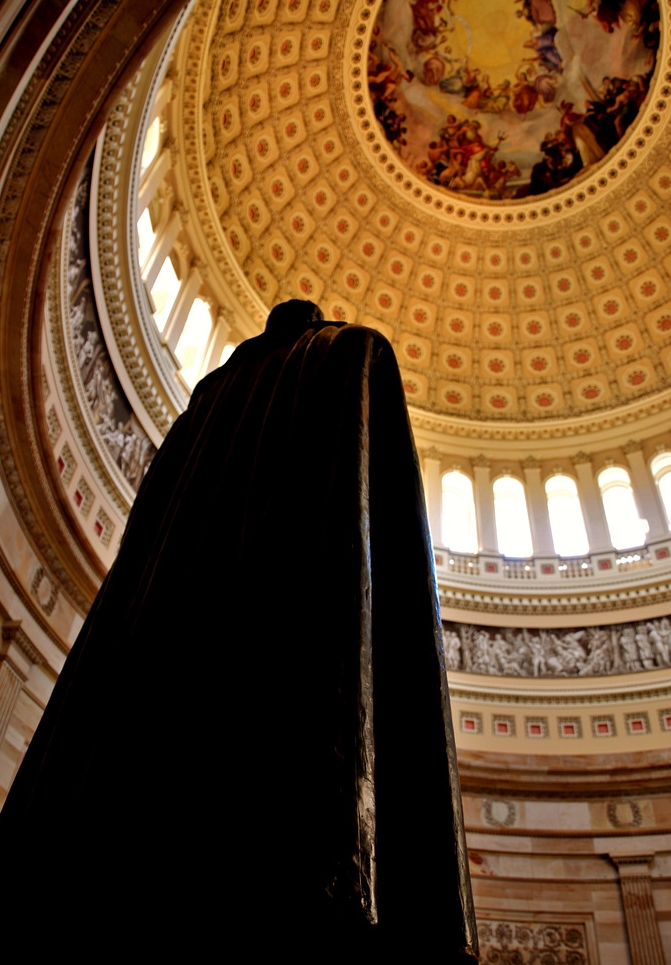
It was underneath this awesome scene that President Coolidge accepted the statute of Andrew Jackson, April 15, 1928.

It was underneath this stunning view that President Coolidge accepted the bronze statute of Andrew Jackson from the State of Tennessee, April 15, 1928.