On Facing Consequences

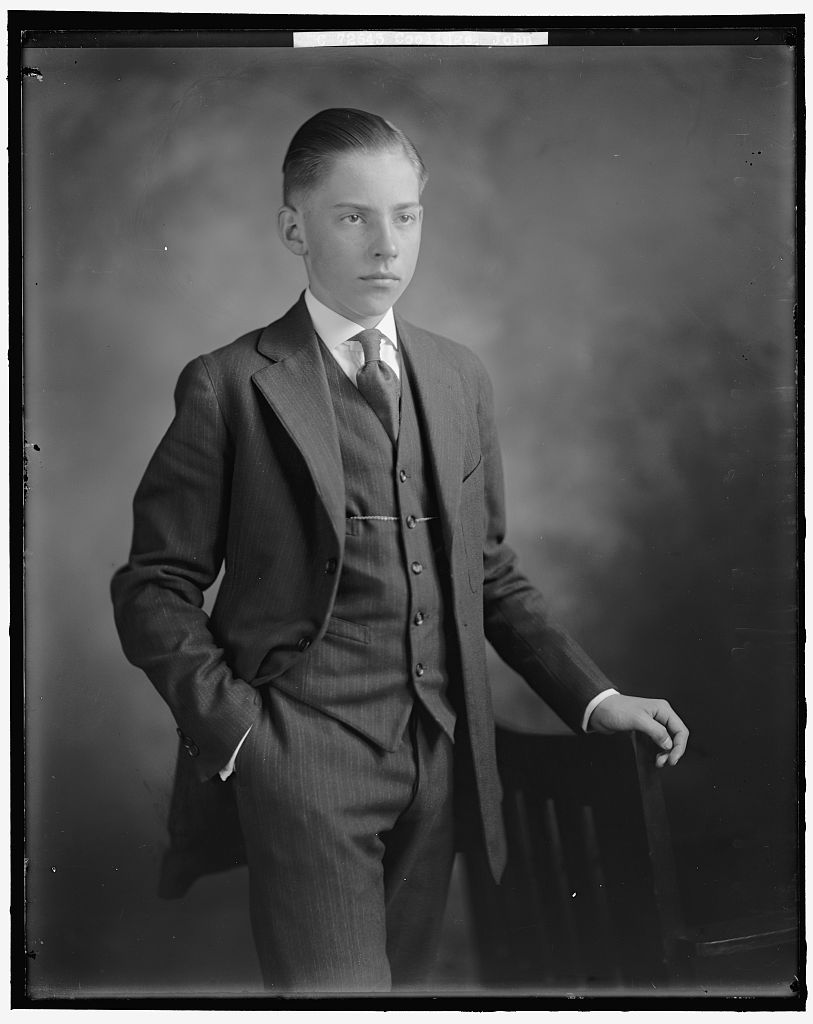
ImageJohn Coolidge, circa 1924

In the April 1935 issue of Good Housekeeping, the President’s son, John, recounted this portion of a father’s wisdom all too absent in political leaders at present. It is best to let John do the telling,

“Mother bought for us one Hallowe’en jack-o’-lanterns made of paper-mache with candles in them. When Father saw these, he warned us to be careful lest they take fire. However, we heedlessly went right ahead, lighted one, and, regardless of drafts, placed it on the window sill in the front room. During the excitement we went off and forgot about it. When we returned, it was in flames. 

“Father had been there all the time, and had seen the jack-o’-lantern going up in smoke and scorching the window sill. But he made not a move to put the fire out. He wanted to impress upon us the danger of what we were doing. He succeeded. The charred window sill served as a lasting reminder.”

Parents and politicians alike might be appalled at such “unfeeling” inaction on the part of Father Coolidge. How could he allow the children to lose their jack-o’-lantern and burn the window sill? Why did he not intervene sooner to spare the loss and destructive consequences of his boys’ actions, despite their neglect? They were just children, who cannot be expected to suffer for their negligent disregard, can they?

The same principle holds as we see millions of Americans, including those who supported Obamacare, who are now feeling the pain of lost insurance coverage, while politicians seek cover for the electoral consequences coming to them next year. The ad campaign launched this week by the Administration to promote government insurance is equally a part of this refusal to instill responsible conduct. Such is equivalent to Father Coolidge helping pour gasoline on the fire in order to put it out before any harm could be done, expecting future self-restraint to prevail. Would the boys have learned the lesson? Or, would John and Calvin Jr. dismissed it as a sign that any future costs of recklessness will be paid for by their parents? Should the government, or anyone else for that matter, not only “bail out” but actively promote reckless behavior in order to “save the day”? Are we not losing sight of what a wise father was trying to teach his children?

An escape from any and all suffering is now perceived humane and compassionate. Coolidge warned his boys what would happen if the fire was not watched but did not immediately take charge, forcing them to comply to his will, when the fire spread. As a father he could have done so. He did not.

Just as members of Congress or the President now strain to spare next year’s voters from the personal and political consequences of past elections, Coolidge could have put out the fire and lectured them later. Instead, he gave them the freedom of their own self-reliance, providing the opportunity to exercise that freedom conscientiously.

Having failed to watch the fire, the boys did not permanently lose the ability to choose nor was any future confidence in them to govern themselves suspended. Father Coolidge kept a vigilant eye on the fire, allowing the boys to experience the proportionate degree of pain for their choice. Obviously, he was not letting the house burn down to illustrate the point. Nor could the point be made without allowing a corresponding measure of suffering for what the boys had failed to do.

The gravity of political choices carries infinitely more weight than a paper-mache jach-o’-lantern. As such, those choices must bear a commensurate cost: defeat at the ballot box for those who voted for it and the pain Obamacare was designed to inflict for millions of Americans. Repeal, instead of prolonging the agony by subsidized reforms, is the responsible course forward.

We do no one any favors by dulling the pain of these consequences with desperate attempts to delay the individual mandate, reform the Health Care Act to “make it work,” spare politicians from the heat of their votes and generally salvage failure so that relatively less suffering occurs in the short-term.

We remember what it felt like to touch that hot burner, despite our parents’ warning, and as such did not repeat it. A child never learns to leave reckless and irresponsible conduct so long as someone is there to insulate him or her from the consequences. It is the genuine exercise of compassion that teaches children to listen, to remember what it felt like to be irresponsible, and not repeat the mistake. It is compassion in the purest sense that prompted Father Coolidge to impress upon his children the lesson they had to experience to remember. Rushing to rescue others from the physical, emotional, and spiritual costs of persisting heedlessly despite the danger is neither caring nor compassionate.

For John and his brother, the consequences were slight because the actions were minor. Heavier consequences inescapably face us now because our choices at the ballot box were far greater in scope. It underscores that voting is indeed no trivial matter. It literally concerns life and death. There is no escape for voting recklessly. Elections have consequences. As Coolidge put it on another occasion,

“Of course it would be folly to argue that the people cannot make political mistakes. They can and do make grave mistakes. They know it, they pay the penalty, but compared with the mistakes which have been made by every kind of autocracy they are unimportant.” Even the People must be allowed to suffer that penalty if the lesson is to be learned. There is no short-cut or magic formula to exempt us from every painful consequence of our actions. It is precisely why Coolidge, knowing the people who comprise the marketplace restore sound conditions if allowed to do so, quoted the precept of Hebrews 12.11, “Now no chastening for the present seems to be joyous, but grievous: nevertheless afterward it yields the peaceable fruit of righteousness…”

Father Coolidge reminds us that suffering has a redemptive value to it as well. It raises mature adults like John, instead of coddling children to remain life-long dependents. By knowing that consequences are certain, an individual will not willfully defy this reality and the responsibility owed to others, oneself, and to God. The future is all the more secure when mature men and women take up each one’s responsibilities. After all, this is simply another word for “self-government,” the system of liberty under law envisioned by the Framers.
Image

On “The Genius of America”

Having spoken the previous day about the power of religion on the making of America, Calvin Coolidge addressed a group of naturalized citizens on this day eighty-nine years ago. He not only told his audience how glad he was to welcome them to the White House but he even made a couple jokes, the first of which went, “if Methuselah (the longest living man, Genesis 5:27) were at this time an American in his period of middle life, and should drop in on our little party, he would regard us all as upstarts.” With his dry wit, Coolidge underscored the youthfulness of our country among the aged nations of the world.

How was it then that America, still so new among civilizations, had “been blessed with an unparalleled capacity for assimilating peoples of varying races and nations”? What other nation could claim so rapid a population growth in so short a time? While, the population trends were predominantly in a western direction, something different was at work than the simple relocation of peoples that had filled Europe over the centuries.

“It was the fate of Europe to be always a battleground.” Animus over the differences between race, religion, politics and social standards made peace the abnormal condition of life. For Europe, as with most of the globe, it has been war disrupted briefly by conciliation that has been the norm. “It is one of the anomalies of the human story that these peoples, who could not be assimilated and unified under the skies of Europe, should on coming to America discover an amazing genius for cooperation, for fusion, and for harmonious effort.” They were the same people who left the shores of the Old World and stepped into the New. What made the difference? What furnished that incredible genius that transformed antagonism into collaboration and perpetual discord into a people united? Coolidge enumerated three factors responsible for shedding the “ancient antagonisms” of race and class.

First, the “broadly tolerant attitude that has been a characteristic of this country” was responsible. Used in its fullest sense, Coolidge meant the wide forbearance Americans show on a daily basis to each other in regard to religious opinions, political differences and social relationships. These differences, as long as they remained law-abiding, did not hinder fellowship as equals. The increased perception of partisanship is due to an intolerance (not native to American ideals) for mitigating racial and class distinctions. While an intolerant few wish to equate so quintessential an American trait with conformity and compliance, Coolidge saw the strength of this country’s success in its ability to look past such irrelevant differences to real equality. This equality was not a suppression of differing opinions or a coerced conformity of outcomes. This equality rested in maximizing opportunity for “every American to become the architect of whatever fortune he deserves.” The opportunity, not the result, afforded by forbearance is what set apart America from the inherited caste systems of Europe. Leaving the security of the crowded cities and old towns of Europe for the open chance to start anew in America, immigrants quickly found forbearance and cooperation were necessary to succeed.

Second, “our Republican system of Government” was responsible. Leaving behind the centralized governments of the Old World, where subjects neither shared in nor held power to make their own decisions, immigrants to America discovered what self-government truly means. Here equals shared in the burdens as well as the privileges of governance. The benefits of being American did not fall exclusively to masters in some distant capital. For the first time an individual could direct his own affairs through institutions which limited central authorities and liberated people.

Third, “our system of universal free education” was responsible. That system was to serve as an ever-watchful sentry against “the revival of old, or the creation of new regional or group hostilities.” No longer would the prejudices and jealousies of the Old World hold sway. Education was not merely for the wealthiest and most connected among us, it was a measure to which all could attain. The American ideal was to open the mind to the possibilities of the individual, not close it through the victimhood of class warfare and the paralysis of predetermined fate. Education was not for a select few to monopolize their peculiar status, it was the shared endowment of all who strove to become Americans.

Looking out over the audience gathered at the White House, President Coolidge expressed his admiration for those most recently arrived in a long line of loyal, patriotic and law-abiding immigrants. They understood, perhaps more keenly than most, the supreme treasure America’s opportunities afford. He knew and his audience understood that it required the best of each individual, hard work to reap the rewards. It was not gifted. It had to be earned. The only entitlement was for an individual to keep the fruits of his own labor.

When land was abundant and large territories still unsettled, conditions lent themselves to receiving large numbers of immigrants. That had changed by 1924. In order to preserve and maximize opportunity, first for those already here and then for those who have yet to become Americans, limits are applied. It has nothing to do with any of the classes or creeds of the Old World. Rather, it considers the good of everyone concerned. If too many came at once, the country would be unable to assimilate them, wages would fall and the means of bettering one’s conditions would be depleted. If America is to preserve robust opportunity to both the newcomer and those already established here, it must set limits on immigration.

Taking this principle one step forward, Coolidge ventured to his final point. If America welcomed the world, it would no longer remain a distinctive and exceptional place of opportunity for everyone. The first responsibility, however, the Nation owed was to its inhabitants, be they native or naturalized. Coolidge shared their sympathies to help the Old World with its “long established hostilities.”

How can America best help the world, though? Coolidge answered, “We want our America to continue an example and a demonstration that peace, harmony, cooperation and a truly national patriotic sentiment may be established and perpetuated on an American scale. We believe our first great service to the Old World will be in proving this.” Our example was to show how peace and strength come to nations by reinforcing liberty and shedding class differences. That example was to be done “on an American scale,” not a global scale. It was not ours to “Americanize” everyone else. It was up to the Old World to determine its own destiny. Yet, it would come by letting go of those long-cherished yet self-destructive habits. By proving this sentiment of peace, cooperation and patriotism, Coolidge continued, “we shall be doing the things that will best equip us, spiritually and materially, to give the most effective help toward relieving the suffering nations of the Old World.”

What was the best way for the individual immigrant to help the struggling nations of the world? It was not to throw money at the symptoms (hunger, poverty, war), while neglecting the causes: an institutionalized denial of forbearance, self-government and education. It was not to import the Old World’s “race prejudices and race hatreds into action here.” Transforming into the likeness of Old Europe would not work in America. “Bringing America down” would benefit no one and rectify nothing.

What was needed most, as Coolidge encouraged, was “devotion to religion.” To best help, an attachment to the faith of one’s fathers was crucial. America, and consequently the rest of the world, would be far weaker if allowed to drift away from the cultivation of religious faith. Coolidge fostered an environment where immigrants remembered their duty to God as well as man.

America sought to help everyone as the need arose. This policy was not offering to aid one and dispensing harm to another. Nor by hurting America would the world’s distress be alleviated. Instead, Coolidge declared, “We can be in a position to help only by unifying the American nation, building it up, making it strong, keeping it independent, using its inclination to help and its disinclination to injure. Those who cast in their lot with this country can be true to the land of their origin only by first being true to America.” It is then that the “genius of America” is at its finest,  reinforcing individual opportunity that thrives in rejection of Old World intolerance, despotism and ignorance.