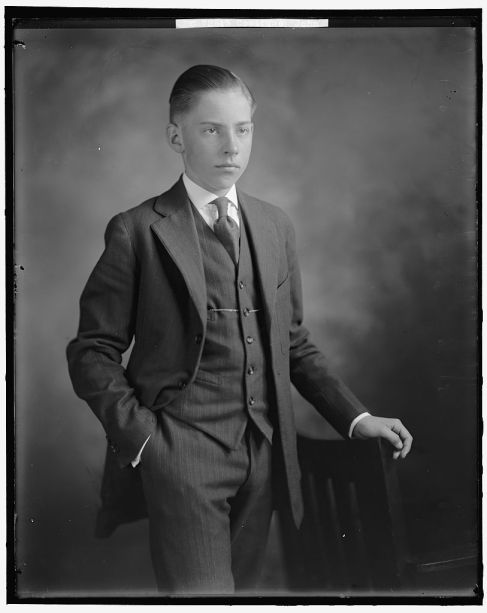
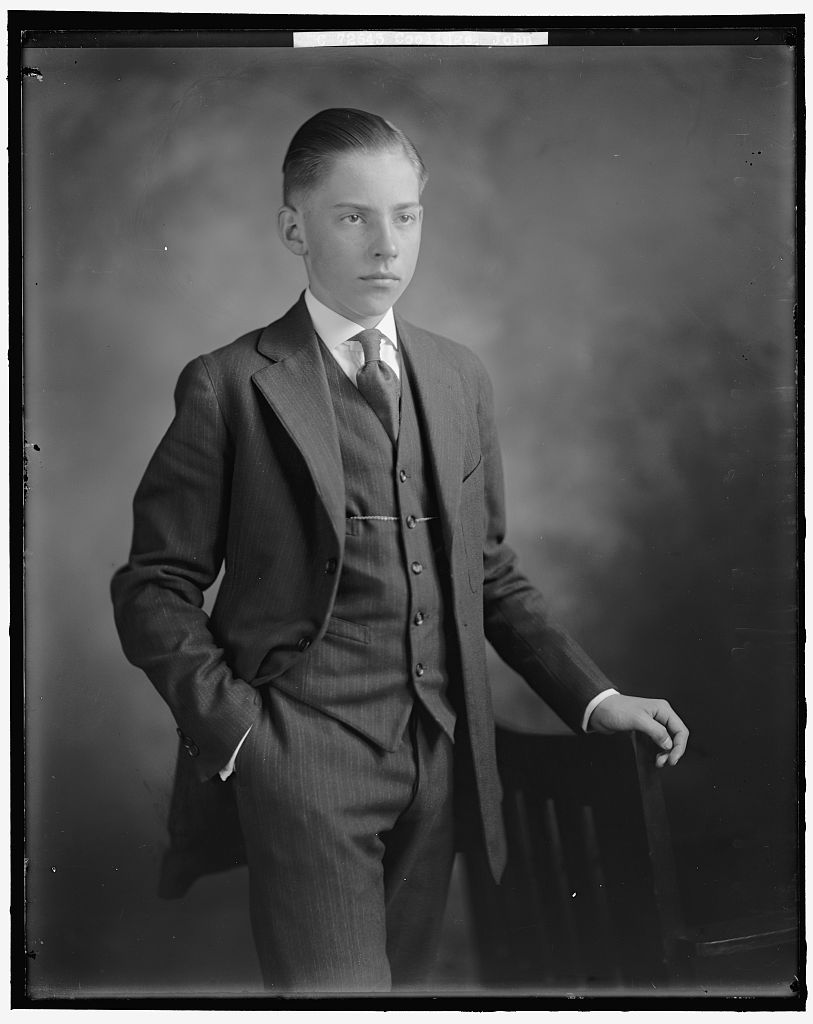
 John Coolidge, circa 1924
In the April 1935 issue of Good Housekeeping, the President’s son, John, recounted this portion of a father’s wisdom all too absent in political leaders at present. It is best to let John do the telling,
“Mother bought for us one Hallowe’en jack-o’-lanterns made of paper-mache with candles in them. When Father saw these, he warned us to be careful lest they take fire. However, we heedlessly went right ahead, lighted one, and, regardless of drafts, placed it on the window sill in the front room. During the excitement we went off and forgot about it. When we returned, it was in flames.
“Father had been there all the time, and had seen the jack-o’-lantern going up in smoke and scorching the window sill. But he made not a move to put the fire out. He wanted to impress upon us the danger of what we were doing. He succeeded. The charred window sill served as a lasting reminder.”
Parents and politicians alike might be appalled at such “unfeeling” inaction on the part of Father Coolidge. How could he allow the children to lose their jack-o’-lantern and burn the window sill? Why did he not intervene sooner to spare the loss and destructive consequences of his boys’ actions, despite their neglect? They were just children, who cannot be expected to suffer for their negligent disregard, can they?
The same principle holds as we see millions of Americans, including those who supported Obamacare, who are now feeling the pain of lost insurance coverage, while politicians seek cover for the electoral consequences coming to them next year. The ad campaign launched this week by the Administration to promote government insurance is equally a part of this refusal to instill responsible conduct. Such is equivalent to Father Coolidge helping pour gasoline on the fire in order to put it out before any harm could be done, expecting future self-restraint to prevail. Would the boys have learned the lesson? Or, would John and Calvin Jr. dismissed it as a sign that any future costs of recklessness will be paid for by their parents? Should the government, or anyone else for that matter, not only “bail out” but actively promote reckless behavior in order to “save the day”? Are we not losing sight of what a wise father was trying to teach his children?
An escape from any and all suffering is now perceived humane and compassionate. Coolidge warned his boys what would happen if the fire was not watched but did not immediately take charge, forcing them to comply to his will, when the fire spread. As a father he could have done so. He did not.
Just as members of Congress or the President now strain to spare next year’s voters from the personal and political consequences of past elections, Coolidge could have put out the fire and lectured them later. Instead, he gave them the freedom of their own self-reliance, providing the opportunity to exercise that freedom conscientiously.
Having failed to watch the fire, the boys did not permanently lose the ability to choose nor was any future confidence in them to govern themselves suspended. Father Coolidge kept a vigilant eye on the fire, allowing the boys to experience the proportionate degree of pain for their choice. Obviously, he was not letting the house burn down to illustrate the point. Nor could the point be made without allowing a corresponding measure of suffering for what the boys had failed to do.
The gravity of political choices carries infinitely more weight than a paper-mache jach-o’-lantern. As such, those choices must bear a commensurate cost: defeat at the ballot box for those who voted for it and the pain Obamacare was designed to inflict for millions of Americans. Repeal, instead of prolonging the agony by subsidized reforms, is the responsible course forward.
We do no one any favors by dulling the pain of these consequences with desperate attempts to delay the individual mandate, reform the Health Care Act to “make it work,” spare politicians from the heat of their votes and generally salvage failure so that relatively less suffering occurs in the short-term.
We remember what it felt like to touch that hot burner, despite our parents’ warning, and as such did not repeat it. A child never learns to leave reckless and irresponsible conduct so long as someone is there to insulate him or her from the consequences. It is the genuine exercise of compassion that teaches children to listen, to remember what it felt like to be irresponsible, and not repeat the mistake. It is compassion in the purest sense that prompted Father Coolidge to impress upon his children the lesson they had to experience to remember. Rushing to rescue others from the physical, emotional, and spiritual costs of persisting heedlessly despite the danger is neither caring nor compassionate.
For John and his brother, the consequences were slight because the actions were minor. Heavier consequences inescapably face us now because our choices at the ballot box were far greater in scope. It underscores that voting is indeed no trivial matter. It literally concerns life and death. There is no escape for voting recklessly. Elections have consequences. As Coolidge put it on another occasion,
“Of course it would be folly to argue that the people cannot make political mistakes. They can and do make grave mistakes. They know it, they pay the penalty, but compared with the mistakes which have been made by every kind of autocracy they are unimportant.” Even the People must be allowed to suffer that penalty if the lesson is to be learned. There is no short-cut or magic formula to exempt us from every painful consequence of our actions. It is precisely why Coolidge, knowing the people who comprise the marketplace restore sound conditions if allowed to do so, quoted the precept of Hebrews 12.11, “Now no chastening for the present seems to be joyous, but grievous: nevertheless afterward it yields the peaceable fruit of righteousness…”
Father Coolidge reminds us that suffering has a redemptive value to it as well. It raises mature adults like John, instead of coddling children to remain life-long dependents. By knowing that consequences are certain, an individual will not willfully defy this reality and the responsibility owed to others, oneself, and to God. The future is all the more secure when mature men and women take up each one’s responsibilities. After all, this is simply another word for “self-government,” the system of liberty under law envisioned by the Framers.
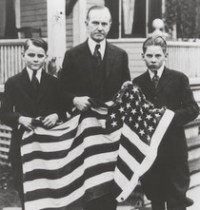
 “Our system of property rights has been devised out of much hard experience for the purpose of confirming the liberty and independence of the people. It cannot be limited or destroyed without limiting or destroying the opportunity of the people…
 The Importance of the Obvious