On Ulysses Grant

Dedication of the Grant Memorial near the foot of the Capitol Building, where Vice President Coolidge delivered these remarks, 1922.

Dedication of the Grant Memorial near the foot of the Capitol Building, where Vice President Coolidge delivered these remarks, 1922.

Ninety-two years ago, 1922, marked the occasion Vice President Coolidge dedicated the Monument to General Ulysses S. Grant in Washington, coinciding with the centennial of President Grant’s birthday, April 27. As with many of his predecessors in the Presidency, Coolidge (though yet to rise to that great office) would have some very thoughtful and profound assessments of the man and his contributions to our institutions, our republican system and to liberty itself.

Grant was, and rightly belongs, among those we honor as a “great American, who was sent into the world endowed with a greatness easy to understand, yet difficult to describe: the highest type of intellectual power–simplicity and directness; the highest type of character–fidelity and honesty. He will forever hold the admiration of a people in whom these qualities abide. By the authority of the law of the land, with the approving loyalty of all his fellow countrymen, in the shadow of the dome of the Capitol which his work proved and glorified fittingly, flanked on either side by a group of soldiers in action, looking out toward the monuments of Washington and Lincoln, this statue rises to the memory of General Ulysses Simpson Grant. It is here because a great people responded to a great man.”

“…He had the ordinary experiences of the son of an average home maintained by a moderately prosperous business. He went to West Point, not so much with the purpose of becoming a soldier as from a desire to secure an education. He liked horses and rode well. He did not appear brilliant, but he had industry. He worked. He made progress. He had that common sense which overcame obstacles. After his graduation he remained in the army for eleven years, rising to the rank of captain” serving through the Mexican War, resigning voluntarily in 1854. “Destiny sent him to private life, where he could better feel the rising tide of freedom. The next few years he spent as a farmer and a business man. He still worked hard, but he did not prosper, scarcely making a living. He had little taste for small things; it required an emergency to call forth his powers.” The “great crisis” of Union found him in Illinois, working his father’s craft, leather. Volunteering himself again, he declared, ‘Whatever may have been my political opinions before, I have but one sentiment now. That is, we have a government and laws, and a flag, and they must all be sustained.’

Appointed by the Governor to lead the 21st Illinois Regiment, he took command with characteristic directness, ” ‘Men, go to your quarters.’ Within four years he was to be recognized as the greatest soldier in the world.” His capture of Fort Henry and Fort Donelson, his struggle at Pittsburgh Landing and finally his success at the surrender of Vicksburg combined to make Grant a major-general in the regular army. However, it was at Lookout Mountain and his maneuvers at Chattanooga that “demonstrated his great military genius, both of plan and execution.” The following March would find him taking command of the Army of the Potomac, unleashing “blow upon blow from the Wilderness to Appomattox…”

general-grant-standing

“…His work finished, though the President had invited him to attend the theatre, he left the city on that fatal evening of April 14. He mourned the loss of Lincoln, but his first allegiance was to his country. His attitude toward Johnson was all that could be required of a general toward his commander-in-chief, until the President, seeking to embroil him in his own political disputes, charged him with bad faith…While Johnson sank in the public estimation, Grant rose, being unanimously nominated and handsomely elected President of the United States.” Coolidge was four months old. As a boy, he would acquire a deepening respect the more he learned of the first President he would recall in youth.

Grant “had little taste for political manuevres. He found his eight years fell on a time of confusion, both of thought and action. He worked as best he could with the contending elements which made up Congress…Although he broke with a well-meaning reform element of his party, which supported Horace Greeley, he was triumphantly re-elected. One of the important contributions which he made to the public service was his veto of the bill which provided for the inflation of the currency by issuing $400,000,000 in greenbacks. At a time when the political ideals of the country were very low, President Grant held to his own high standard of honorable public service…”

“…Through the contested election of Hayes and Tilden, in 1876, he took a course marked by a high spirit of patriotism. ‘No man worthy of the office of President, should be willing to hold it if counted in or placed there by fraud. Either party can afford to be disappointed in the result. The country cannot afford to have the result tainted by the suspicion of illegal or false returns.’ When the man who knew how to command armies took this position for the enforcement of the law, the country stood behind him and peacefully accepted the decision of the electoral commission.”
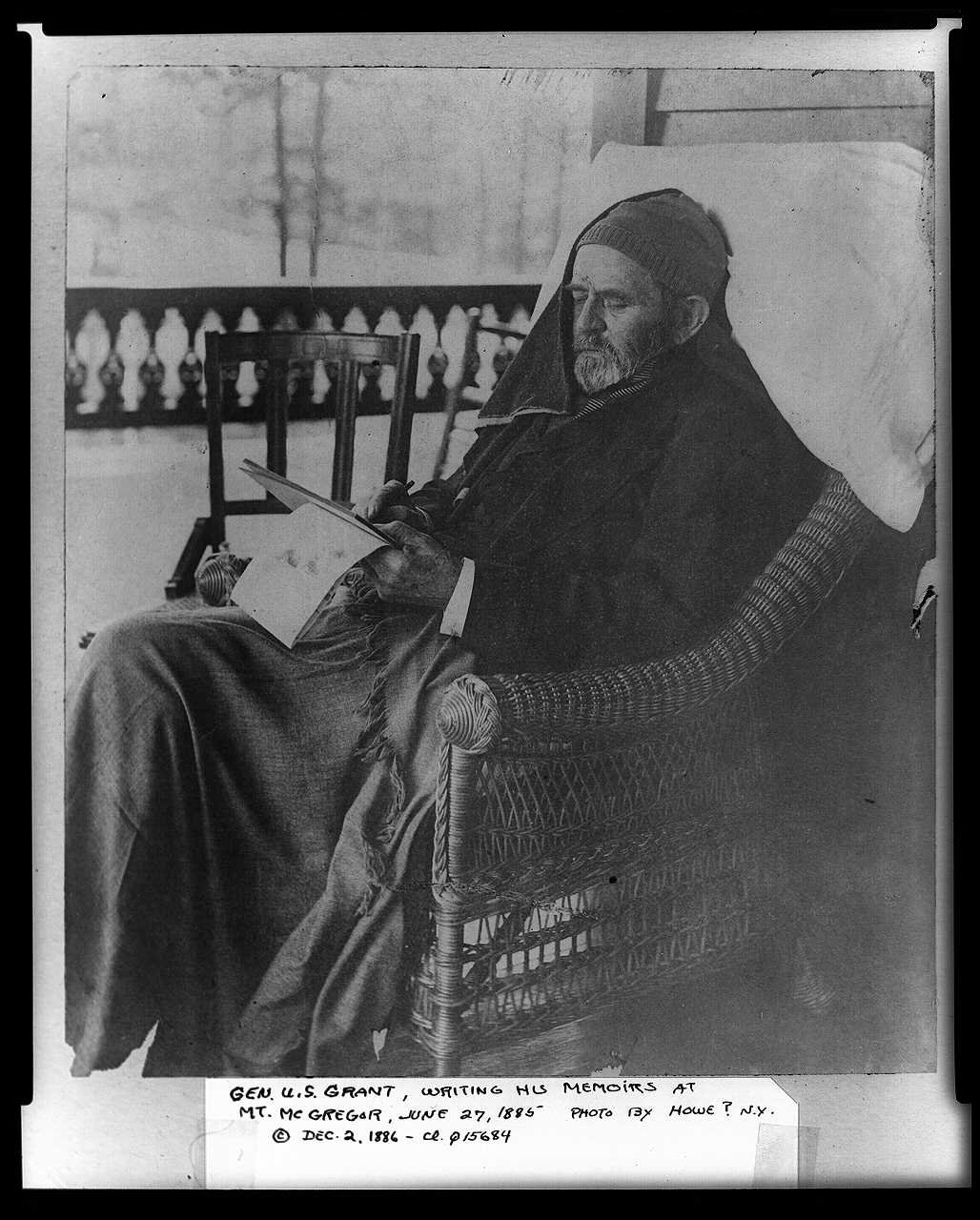
Grant in retirement

“His closing years were marked with great tragedy. Betrayed by one whom he trusted, he saw his property dissipated and large obligations incurred. A lingering and fatal malady added anguish of the body to the anguish of his soul. Never was he greater than in these last days. With high courage, without complaint, on a bed of pain, seeking to retrieve his losses, he was preparing his memoirs…He was still thinking of his country, not as a partisan but as a patriot, not even as the general the armies he had led but as an American.” Being near death, he observed, “I have witnessed since my illness, just what I have wished to see since the end of the war–harmony and good-will between the sections.”

“…Great as he had been, his armies had been greater still…As they supported him in the field, their bronze forms support him here.”

Coolidge would reflect on Grant’s great enemy, General Robert E. Lee, seeing two equally noble champions of integrity, recalling that both reflected what was best about America just when it was most needed.

“Men are made in no small degree by their adversaries. Grant had great adversaries. They fought with a dash and a tenacity, with a gallantry and an enduring purpose which the world has known in Americans, and in Americans alone. At their head rode General Robert E. Lee, marked with a purity of soul and a high sense of personal honor which no true American would ever stoop to question. No force ever quelled their intrepid spirit. They gave their loyalty voluntarily or they did not give it at all.”

“It is not so much the greatness of Grant as a soldier but his greatness as a man, not so much his greatness in war as his greatness in peace, the consideration, the tenderness, the human sympathy which he showed toward them from the day of their submission, refusing the surrender of Lee’s sword, leaving the men of the Southern army in possession of their own horses, which appealed to that sentiment of reconciliation which has long since been complete. It was not a humiliation but an honor to remain under the sovereignty of a flag which was borne by such a commander…”
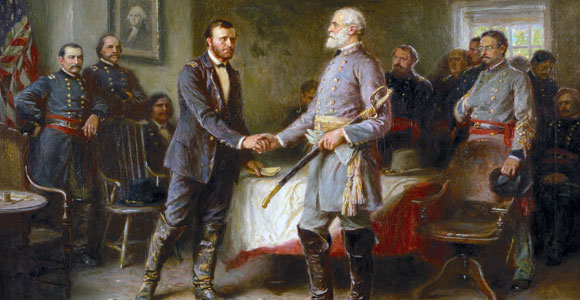
grant-lee

Summing up the significance of this great American and honorable President, never an easy task, seems effortless in the words of Coolidge,

“Our country and the world may well consider the simplicity and directness which marked the greatness of General Grant. In war his object was the destruction of the opposing army. He knew his task was difficult. He knew that the price would be high; yet amid abuse and criticism, amid misunderstanding and jealousy, he did not alter his course. He paid the price. He accomplished the result. He wasted no time in attempting to find some substitute for victory. He held fast to the same principle in time of peace. Around him was the destruction which the war had wrought…He refused to seek refuge in any fictions. He knew that sound money values and a sound economic condition could not be created by law alone but only through the long and toilsome application of human effort put forth under wise law. He knew that his country could not legislate out its destiny but must work out its destiny…His policy was simple and direct, and eternally true. In the important decisions of his life his fidelity and honesty are equally apparent…He never betrayed a trust and he never deserted a friend. He considered that the true test of a friend was to stand by him when he was in need. When financial misfortunes overtook him he discharged his obligations from whatever property he and his family could raise. Here was a man who lived the great realities of life…There was no artifice about him, no pretense, and no sham. Through and through he was genuine. He represented power.”

“A grateful republic has raised this monument not as a symbol of war but as a symbol of peace. Not the false security, which may come from temporizing, from compromise, or from evasion, but that true and enduring tranquility which is the result of a victorious righteousness. The issues of the world must be met and met squarely. The forces of evil do not disdain preparation, they are always prepared and always preparing…The welfare of America, the cause of civilization will forever require the contribution of some part of the life of all our citizens to the natural, the necessary, and the inevitable demand for the defense of the right and the truth. There is no substitute for a militant freedom. The only alternative is submission and slavery.” What Grant gave, “America shall give.”
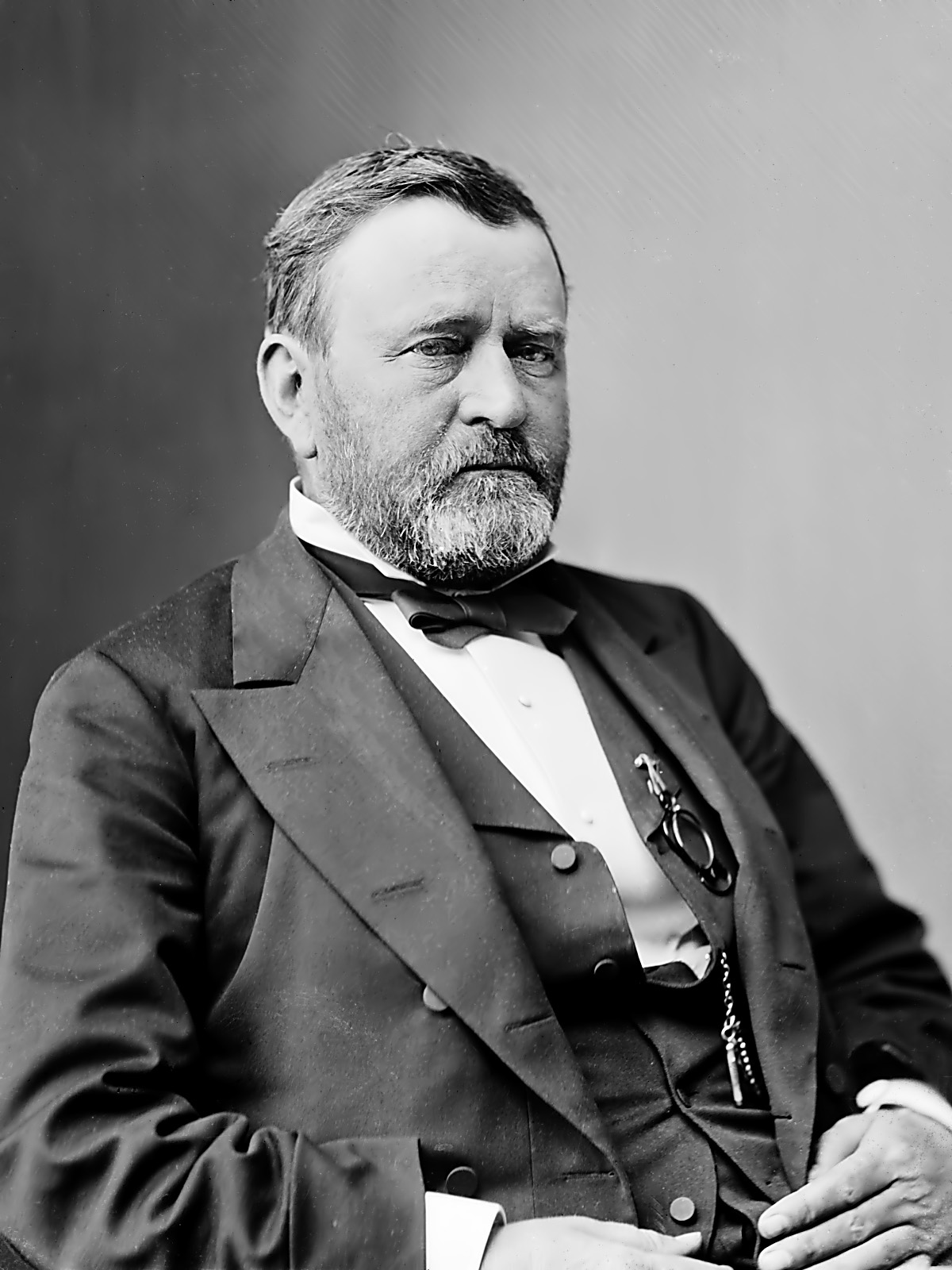
president-ulysses-s-grant

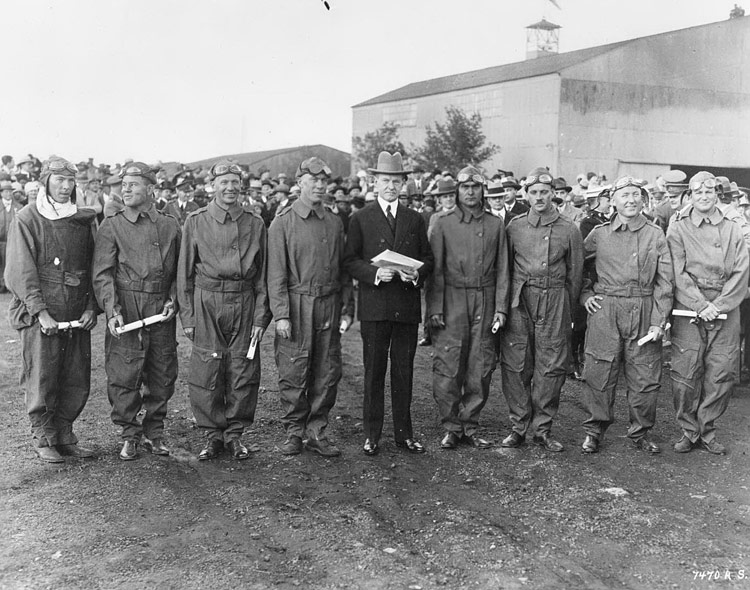
President Coolidge Awards First Distinguished Flying Cross Citations, May 2, 1927

President Coolidge Awards First Distinguished Flying Cross Citations, May 2, 1927

In a decade full of historic achievements in aviation, the crews of the 1926-27 Pan-Am Goodwill flights were the first to receive this award created by President Coolidge. Involving five ships across 22,000 miles in the air, these exceptional Americans delivered messages of good will, aerial collaboration and friendship to our neighbor nations in Central and South America, accomplishing what a few short years before had been decried as impossible. While there are eight aviators in this photo at Bolling Field in Washington, D.C., ten went on this important foreign relations mission. They were:

The New York – Major Herbert Dargue and Lieutenant Ennis Whitehead
The San Antonio – Captain Arthur McDaniel and Lieutenant Charles Robinson
The San Francisco – Captain Ira Eaker and Lieutenant Muir Fairchild
The Detroit – Captain Clinton Woolsey and Lieutenant John Benton
The St. Louis – Lieutenant Bernard Thompson and Lieutenant Leonard Weddington

On Andrew Jackson and America’s Pioneering Spirit

President Coolidge presenting a wreath at the Jackson Memorial in Lafayette Park, January 1924.

President Coolidge presenting a wreath at another landmark in honor of the General and 7th President, the Jackson Memorial in Lafayette Park, January 1924.

“One of the great sources of the strength of our country has been the pioneering spirit…Our people have ever been going forth into the forest and over the plain to establish themselves in the region of the unknown. They have sought new fields to conquer. They have been pioneers, however, not only in the physical world, but in the realm of ideas. The frontier has long since disappeared…but the ambition to enter uncharted regions of industry, of enterprise, of social relations, and of thought continues with increasing fervor.”

“We would miss much of the significance and meaning of the history of the United States unless we took into account this outstanding quality. Our whole outlook has been greatly influenced by it. It is the complete antithesis of all systems of class and caste…” Instead of finding that their place in life, and the way to think “had been previously ordained for them” America “came into existence” for the very “purpose of escaping from this doctrine…The people who came here were seeking freedom of action and freedom of mind. The great revelation of our country has been that men are not born to servitude and obscurity. They are born to all the possibilities of a glorious station which can be won by their own achieving.” Such is the essential difference between self-governed liberty and security by coercion and conformity. It resides in the confidence that we can be trusted with freedom and are born for great things, not the bureaucratic management of our mediocrity.

America’s history is something of which to we can yet find reason to admire and honor. The pioneers who lived and triumphed “by their own achieving” is not the rare exception, it is “our national epic…It is a record of untiring effort, undaunted courage, and persevering will, all of which have set an inextinguishable mark upon the history of our country.”

“One of the outstanding figures which so well represents this development of our national life is Andrew Jackson, the seventh President of the United States…Thrown on his own resources as he was, he grew up proud and high tempered, oftentimes violent in his disposition, and considerably interested in the sports of the countryside…” From the study of law he went on to serve as Tennessee’s first Representative in the House. General Jackson would go on to defeat the attacking British in New Orleans on January 8, 1815, before word of peace had reached our shores. “New Orleans being under martial law, he was soon engaged in altercations with the civil authorities. He did not hesitate to arrest judges and the United States attorney when they interfered with his orders…When civil authority was resumed he submitted to a fine of $1,000 for contempt of court. ‘I have during the invasion,’ he said, ‘exerted every one of my facilities for the defense and preservation of the Constitution and the laws. Considering obedience to the laws, even when we think them unjustly applied, is the first duty of the citizen. I entreat you to remember the example I have given you of respectful submission to the administration of justice.’ Nearly 30 years later the Congress remitted the fine with interest.”

“This was a most significant statement. It might well have been pondered by those who were undertaking to argue away the Constitution after General Jackson became President. Here was a man who stood ready to fight a duel, if he thought the circumstances required it – of an impetuous nature and impatient of all restraint, yet clearly announcing the supremacy of law. More than that, he was acting upon that principle…He believed that at all times and in all places the duly constituted authority of law should be supreme.”

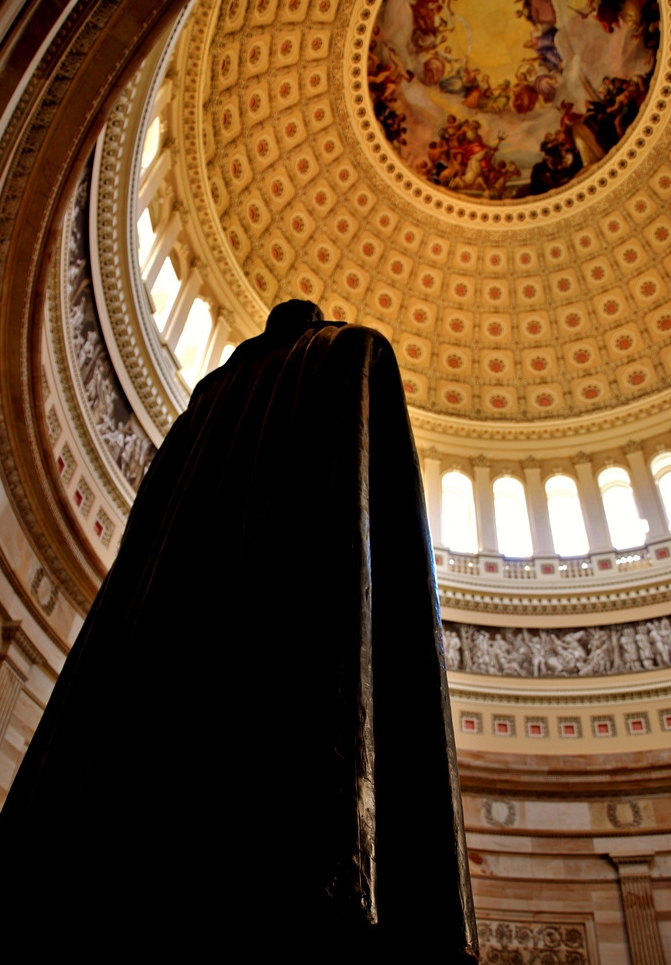
The statute of Andrew Jackson, given by the State of Tennessee and accepted by President Coolidge stands underneath the dome of the Capitol in Washington, where Coolidge, in 1928, delivered the address featured here.

The statute of Andrew Jackson, to which President Coolidge refers, stands underneath the dome of the Capitol in Washington.

Coolidge, finding much to admire about his predecessors, was not above the firm criticism or even the refrain of praise. Yet, when he identified closely with a frailty, he exemplified a remarkable measure of charity and understanding. Such was the case with President Jackson’s temper. Known for his outward calm, Coolidge could give vent to a fiery wrath of his own at times. Whereas some Presidents would look with hypocritical disdain, even withering contempt, for some of those who came before them, Coolidge practiced a humble forbearance, especially when it came to judging history. Being keenly aware of his own flaws, how could he harshly condemn others with all the benefits of hindsight while he shared in that lack of perfection too? He was no partisan hack either, taking cheap shots for their own sake, as his reflections on the Democrat Jackson make plain. In Coolidge, there was no double standard. For Calvin, treating others as we would be treated was not a trite phrase, it was his life. It is not the suppression of passionate conviction, it is sharing (regardless of party) a common fidelity to the supremacy of law and love for our exceptional foundations. It was simply what Americans, imbibing deeply the spirit of the pioneers, do.

As Coolidge surveyed the legacy of President Jackson, he revealed how profound an impact his predecessor had upon him, the Office and the Nation. “He was regarded as a President of the people, and in seeking to remove their burdens and improve their condition he favored economy and payment of the public debt. When this should be done, he favored dividing the surplus revenues among the States. He also criticized the United States Bank,” taking on (like Coolidge many years later) controversial issues which could easily have been deferred to others in the future.

Coolidge reminded his audience that Jackson, while not always consistent, held courageously to both the preservation of the Union and the obligations of the Executive. In the midst of Jackson’s historic battle with Calhoun over nullification in April 1833, he affirmed,

” ‘Our Federal Union – it must be preserved.’ ”

“Without reference to his former views on the tariff or States rights, when this ordinance was passed, President Jackson declared, ‘The duty of the Executive is a plain one. The laws will be executed and the Union preserved by all the constitutional and legal means he is invested with.’ He soon followed this with a proclamation denying the right of secession, refuting the power of a State to set aside an act of Congress, and asserting the supremacy of the Federal Constitution. This proclamation has been regarded as one of the best state papers of any American President…A service of this nature, rather at variance with some of the positions he had formerly taken and some of the policies strongly supported in his own party, could only have been performed by a great man.”

Tennessee Gentleman, portrait of Jackson from 1831. Part of the collection at The Hermitage, Nashville.

Tennessee Gentleman, portrait of Jackson from 1831. Part of the collection at The Hermitage, Nashville.

“His fight on the bank was not yet ended. His next move was an attempt to withdraw the public deposits…Of course, a violent change of this nature affecting the financial policies of the Nation, was bound to have an economic effect throughout the country. Government funds in local banks were used for speculation, which, as usual, brought the reaction of depression.” It is especially noteworthy that President Coolidge includes this concise illustration from history about speculation at a time coinciding with feckless investment in quick money on the market throughout 1928, the year of this speech. It was another occasion where President Coolidge gave sober warning to any who would heed. In this, and many other ways, his attempts to carefully “tap the brakes” (so as not to discourage sound growth) met with little notice at the time. “Opinions have differed,” just as they would over the causes and cures of the recession turned Great Depression of the 1930s, “but no one doubts the great courage of President Jackson in opposing it or the public approbation he received in support of his policy.” Jackson, contrary to Arthur Schlesinger’s wishful claim, was hardly the precursor of FDR, who spent while Jackson paid off the Nation’s entire debt and assumed greater supervision of individual freedoms while Jackson kept faith in the people to govern themselves.

No doubt anticipating his own retirement from public office in just less than eleven more months, President Coolidge turned to Jackson’s departure from Washington. “On the 7th of March, 1837, he set out for his old home, The Hermitage. He had triumphed over opponents who were considered then, and rank now, among the greatest statesmen of his day. Calhoun had gone down on nullification. The great figure of Daniel Webster had stood with the President on that issue, but had opposed his banking policies. Clay had compromised and lost…If at times he was high tempered and overbearing, there is no fairer story of chivalrous devotion and affectionate consideration than that which he lavished upon his wife. In her benign presence he was all submission.”

“History accords him one of the high positions among the great names of our country. He gave to the nationalist spirit through loyalty to the Union a new strength which was decisive for many years. His management of our foreign affairs was such as to secure a wholesome respect for our Government and the rights of its citizens. He left the Treasury without obligations and with a surplus. Coming up from the people, he demonstrated that there is sufficient substance in self-government to solve important public questions and rise superior to a perplexing crisis. Like a true pioneer, he broke through all the restraints and impediments into which he was born, and leaving behind the provincialisms and prejudices of his day pushed out toward a larger freedom and a sounder Government, carrying the country with him.”

“In recognition of the great qualities of her most illustrious son, the State of Tennessee has presented his statue to the National Government. In gratitude for the preeminent service which he rendered, I, as President of the United States, accept it, to stand here in the Hall of Fame so long as this Capitol shall endure.”

It was underneath this awesome scene that President Coolidge accepted the statute of Andrew Jackson, April 15, 1928.

It was underneath this stunning view that President Coolidge accepted the bronze statute of Andrew Jackson from the State of Tennessee, April 15, 1928.