On Open Doors and Isolation

When one approaches the literature that has accumulated over the years about the 1920s, it is found that narrow templates and hostile stereotypes have been allowed to define the decade. This is not honest scholarship, especially when those definitions are passed down as the final word on the matter. Repeating approved doctrines deprive us and future generations of the wealth of insight taught by the Coolidge era. By skipping over Coolidge far too many refuse to acknowledge that a profound and successful political philosophy exists outside the limits and failures of the “New Deal” and all of its legislative offspring. The 1920s are simply not worth studying, it is asserted, because they were an era of greed, hyper-capitalism, “underconsumption,” American isolationism and worship of “big business” (as if none of those conditions ever existed in the administration that swept to office in 1932). Any attempt to return to the primary sources and reappraise the time period is simply “reactionary” or “revisionist,” as if Schlesinger and the long train of “historians” after him were merely reporting the facts without a shred of bias for the policies of F. D. R.

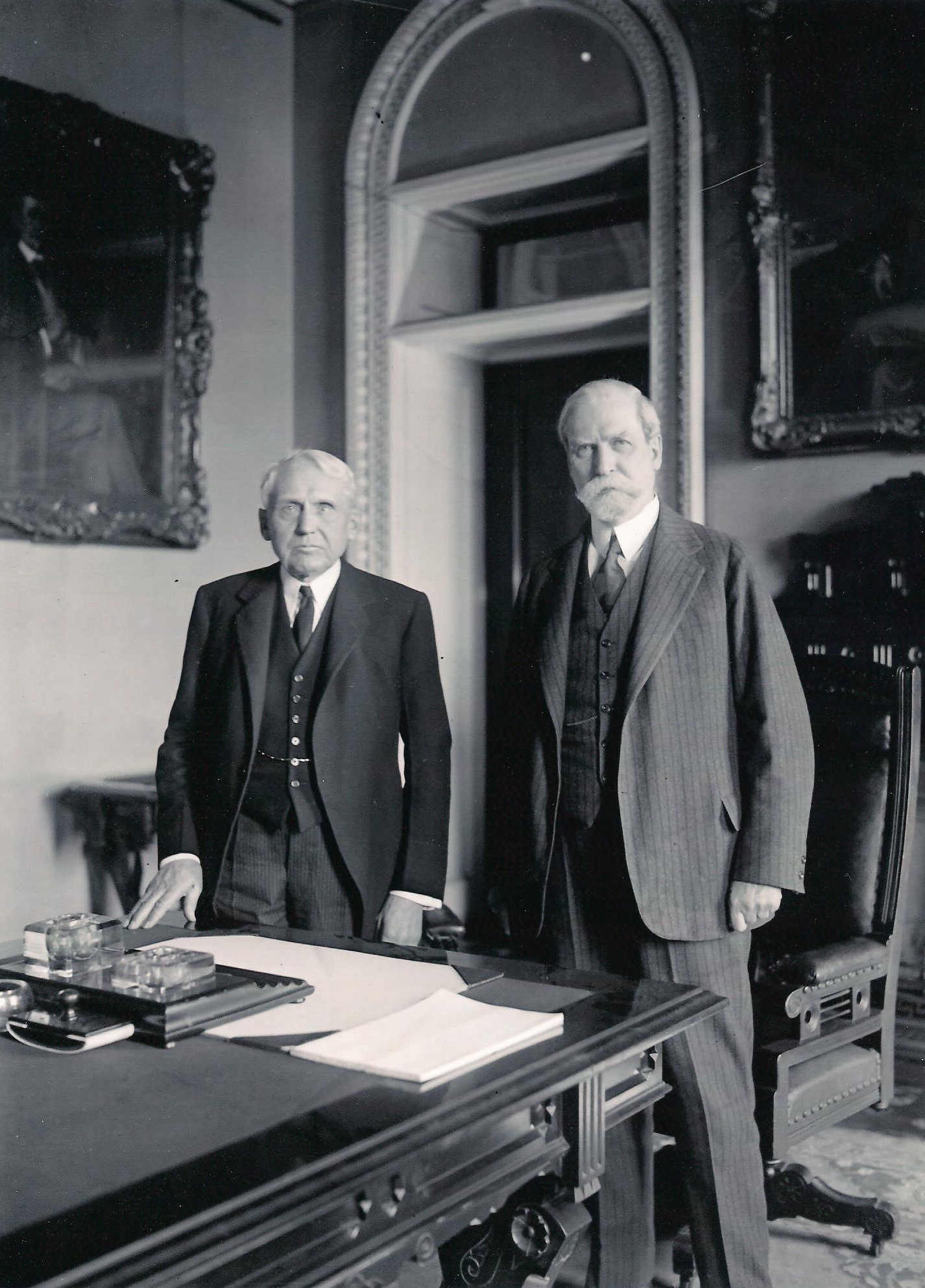
Chief among those accepted templates forced onto the 1920s are: (1) Isolationism and (2) Alliance with “Big Business.” A return to the original sources written by those who developed policy and implemented it during the Harding and Coolidge years, such simplistic frames of reference do not hold. A fascinating letter written to President Coolidge by none other than Secretary of State Charles Evans Hughes, on November 8, 1923, illustrates a far different policy underway at the time. Secretary Hughes is explaining the distinct difference of America’s “Open Door Policy” regarding America businesses abroad. The President’s approach, expressed in giving complete confidence to his Secretary to direct the Department, makes clear that Hughes was acting entirely with Coolidge’s authority.

Secretary Hughes writes, “From time to time there has been some dissatisfaction expressed in business circles because this Department’s attitude toward American business interests in the foreign field differs somewhat from the attitude in similar matters of the British, French and other European governments. The latter are not loath to interfere politically in support of the business interests of their nationals to a degree which is not followed by this Department.” Hughes was articulating an avowed refusal to thrust American businesses on other countries to the chagrin of several of our own businessmen, despite the potential fallout at the polls. He goes on, “Our position is that we are always ready to give appropriate support to our nationals in seeking opportunities for business enterprise abroad, but we do not undertake to make the government a party to the business negotiations or use political pressure for the benefit of private interests in order to obtain particular concessions, or intervene in favor of one American interest as against another. We are persistent in our efforts to maintain the open door policy, or equality of commercial opportunity, but we do not attempt to assume obligations for the government, expressed or implied, which under our system we could not undertake to discharge.” The open door was not for forcing American business on the world, it was for other nations to maximize opportunity for commerce without government favoritism, ours or theirs.

The Turkish government’s patronage of national petroleum companies was closing that open door for opportunity and hindering a free market. Instead of deploying the pressure of politics, however, the Coolidge administration strove to keep that door open to any and all, without negotiating favoritism for American businesses. It was the exact opposite of what Burton Folsom calls “political entrepreneurship.” Under this policy, “big business” had no special advantages to get established overseas. There were no “secret deals” between government and business with Hughes at the helm. Businesses were to approach one another and negotiate as equals with the strength of their own resources and if they failed to persuade foreign investors, the door remained open for someone else to succeed without government there to “strong-arm” a deal.

Disappointing as it was for some in business, Hughes commended the advantages of keeping the door open. “American companies which might prefer a policy of more direct interference on their behalf by the government are inclined, in my opinion, to overlook the fact that American prestige and reputation for fairness has been enhanced, and consequently business opportunities of our nationals have been increased, by the correct policy which this government has followed. I find that in many parts of the world, American business is welcomed largely because foreign countries realize that they can deal with American interests on a business basis without fearing political complications.” The “political intrigues” and “difficulties” that would ensue through closing the door to opportunity, whether by rewarding favored companies or by punishing undesirable industries, vindicates the wisdom of this policy.

The conferences that pervaded the decade on a host of foreign relations problems combined with the direct lines of friendship rebuilt by men like Dwight Morrow in Mexico, Charles Dawes and Frank B. Kellogg in Europe, Henry Stimson in Nicaragua and the Philippines, Sumner Welles and Secretary Hughes toward the Latin American states and many others help to correct the grossly mistaken belief that America retreated from the world under Coolidge. It was as involved as ever. Instead of embracing aggression and propaganda as its weaponry, however, these leaders of the Coolidge era demonstrated what patience, impartiality, service and understanding, with the resolve to protect America’s ideals, can accomplish.

Image

On Foreign Policy

Image

President Coolidge took nearly everyone by surprise when he mounted the podium on the floor of Congress, December 6, 1923, for his first major Presidential address, the first of six annual messages. The “silent” former Vice President enjoyed being underestimated, especially by the “experts,” and when an occasion presented to reveal their erroneous judgment, he took it. This “provincial” man set the tone for where he was going to lead in the future, bravely beginning with foreign policy. He explained the general principles before dealing in specifics,

“Our country has one cardinal principle to maintain in its foreign policy. It is an American principle. It must be an American policy. We attend to our own affairs, conserve our own strength, and protect the interests of our own citizens; but we recognize thoroughly our obligation to help others, reserving to the decision of our own judgment the time, the place, and the method. We realize the common bond of humanity. We know the inescapable law of service.

“Our country has definitely refused to adopt and ratify the covenant of the League of Nations. We have not felt warranted in assuming the responsibilities which its members have assumed. I am not proposing any change in this policy; neither is the Senate. The incident, so far as we are concerned, is closed. The League exists as a foreign agency. We hope it will be helpful. But the United States sees no reason to limit its own freedom and independence of action by joining it. We shall do well to recognize this basic fact in all national affairs and govern ourselves accordingly.”

The vision he explains here, a policy that protects American sovereignty while exercising the readiness to help in times of need, held consistently in each of the many foreign conflicts encountered during his five years and seven months in office. Through the violence erupting in Mexico, the issues of reparation payments in Europe, the involvement in a World Court, the “outlawry of war” movement and the restriction of Japanese immigration, Coolidge and his Secretaries of State, Charles Evans Hughes and Frank B. Kellogg, navigated safely through some very uncertain waters. As we know from more recent experience, “official” peacetime does not eradicate the explosive possibilities ever present in world affairs. Contrary to what many perceive to be an uneventful footnote in history, the peace experienced during the Coolidge administration was not merely accidental. The foreign policy articulated by President Coolidge could easily have succumbed to any one of a series of foreign conflicts during his time. Coolidge did not presume to be a brilliant diplomat. He was simply reaffirming President Washington’s admonition to avoid entangling ourselves by the promises we make to other nations, subjugating American lives and independence to foreign designs. His first loyalty was to America and its protection, in fidelity to his sacred oath. It is a sound policy in any era.

Image

On the Human Race and America’s Source of Exceptionalism

At the NATO Summit in Strasbourg, France, back in 2009, the current assessment of what makes America exceptional was summarized this way, “I believe in American exceptionalism, just as I suspect that the Brits believe in British exceptionalism and the Greeks believe in Greek exceptionalism.” This familiar statement from four years not only misses the point, perhaps even intentionally, but also repudiates the profound distinction.

Outsiders mistake it for arrogance, as if humanity itself does not struggle with hubris, envy or selfish ambition. In purely material terms, America has made possible an unprecedented standard of living, a presence felt globally, and a recurring willingness to aid those in need anywhere in the world. In moral and spiritual terms, the Founders, by studying the ideas of those who came before them, discovered that a system of self-government, protecting the individual by strictly limiting the powers of the State, rather than the reverse, was the basis for a free and fair society. Up to then, the norm had been to empower rulers over individuals, to secure the State. The people revolved around government. Now the balance was returned to recognizing the individual as sovereign while restraining government power. This discovery wrought exceptional results, even with all the obstructions, setbacks and difficulties Americans have encountered in a short two hundred and forty years.

It is in this way, by restoring the ideals of self-government to the foundation of society, that America found they were the exception to the way the rest of the world chose to work. This is American exceptionalism: adopting a set of ideals that all who come here must share if liberty is to remain for everyone. Those ideals must also be infused with hard work to find opportunity and exercise the responsibilities of independence. Those unfamiliar with our optimistic ideals, accept defeat when faced with the slightest resistance of circumstances. Millions around the world languish in real need and emptiness because of this lack of faith in people to govern themselves. Sovereignty resides in the few at the top with privileges doled out and taken back when it suits. Humanity shares this test everywhere. We are no different. It is in America, though, that a deliberate choice has been made to depart from this oppressive and wasteful system of controls, embracing instead the higher ideal of independence with responsibility.

Calvin Coolidge saw this impasse and explained it in 1923 this way,

“There are two broad theories which have held sway in the world. They have developed with the development of the [human] race. One is the system of class and caste, of a claim of divine right of rulers by inheritance — a system where the individual is nothing and the government is all supreme…

     “There is another system with which every American should be familiar, a system of equality and of freedom, not without the claim of divine right, but recognizing that such right reposes in the people; a system where the individual is clothed with inalienable rights, the people are supreme, the government is their agent. Under this conception there is real freedom, real independence, and grave personal responsibility. The rulers look to the people. Their authority is the public will, ascertained in accordance with law. There will be the least possible interference with private affairs. Realizing that it is people who support the government and not the government which supports the people, there will be no resort to paternalism. Under such institutions there may appear to be a lack of machine-like efficiency, but there will be no lack of character. Private initiative will be stimulated. Self-reliance and self-control will be increased. Society will remain a living organism sustaining hope and progress, content to extend its dominion not by conquest but by service. Such is the system of self-government, the orderly rule of the people, carrying within itself a remedy for its own disorders and the power of self-perpetuation. This is the ideal of America.

     “No one would say that existence under these conditions is effortless. Independence is exceedingly exacting, self-control is arduous, self-government is difficult. Always there is the temptation that some element of these should be surrendered in exchange for security and ease [emphasis added]. The appeal to passion and prejudice always lies in this direction. The proposal to despoil others of their possessions is a manifestation of the same spirit. This is reason that to certain of our native-born, and more often to our foreign-born, the American Republic proves a disappointment. They thought that self-government meant the absence of all restraint, that independence meant living without work, and that freedom was the privilege of doing what they wanted to do. It has been a hard lesson for them to learn that self-government is still government, that the rule of the people does not mean absence of authority, that independence means self-support, and that, complete freedom means complete obedience to law. They are disappointed more than ever when they learn, as ever they do, that these are so, not because they have been decreed by some body of men, but that they are so by the very nature of things, and all the governments in the world are powerless to change them.

     “Here again it is perfectly obvious that if the American system is to be cast aside there is only the one other system which can be adopted. The call of the old life of ignorance, of fear, of superstition, of every savage instinct is all toward the old system. The call of the new life of learning, of courage, of enlightened reason, of faith, of religion, is all toward the new system” (quoted from “Calvin Coolidge: His Ideals of Citizenship As Revealed Through His Speeches and Writings” by Edward E. Whiting, Boston: W. A. Wilde, 1924, pp.20-23).

                           Image