“Why America Will Stay On Top”

“Why America Will Stay On Top”

Interviewing the ever-insightful scholar Paul Johnson, Brian M. Carney discusses why ideas matter more than people and how the World’s deepest thinkers have been anti-intellectuals. Johnson, who has explained the substance behind Coolidge’s record in “The Last Arcadia,” chapter 6 of his book Modern Times, keeps an enduring confidence that Americans will find a renewed strength from the power of its founding ideals. This unshakable faith in the people of the country to summon both the will and the work to clean up the mess left by a self-anointed ruling class of intellectuals is right at home with the full assurance Calvin Coolidge held toward Americans as a people. Our thirtieth president, the last to earn a classical education, would firmly agree with Mr. Johnson. In fact, Coolidge would likely find himself quite at home with the most profound philosopher of civilization (a distant second to Christ, of course), the plain, simple-living, anti-intellectual Socrates.
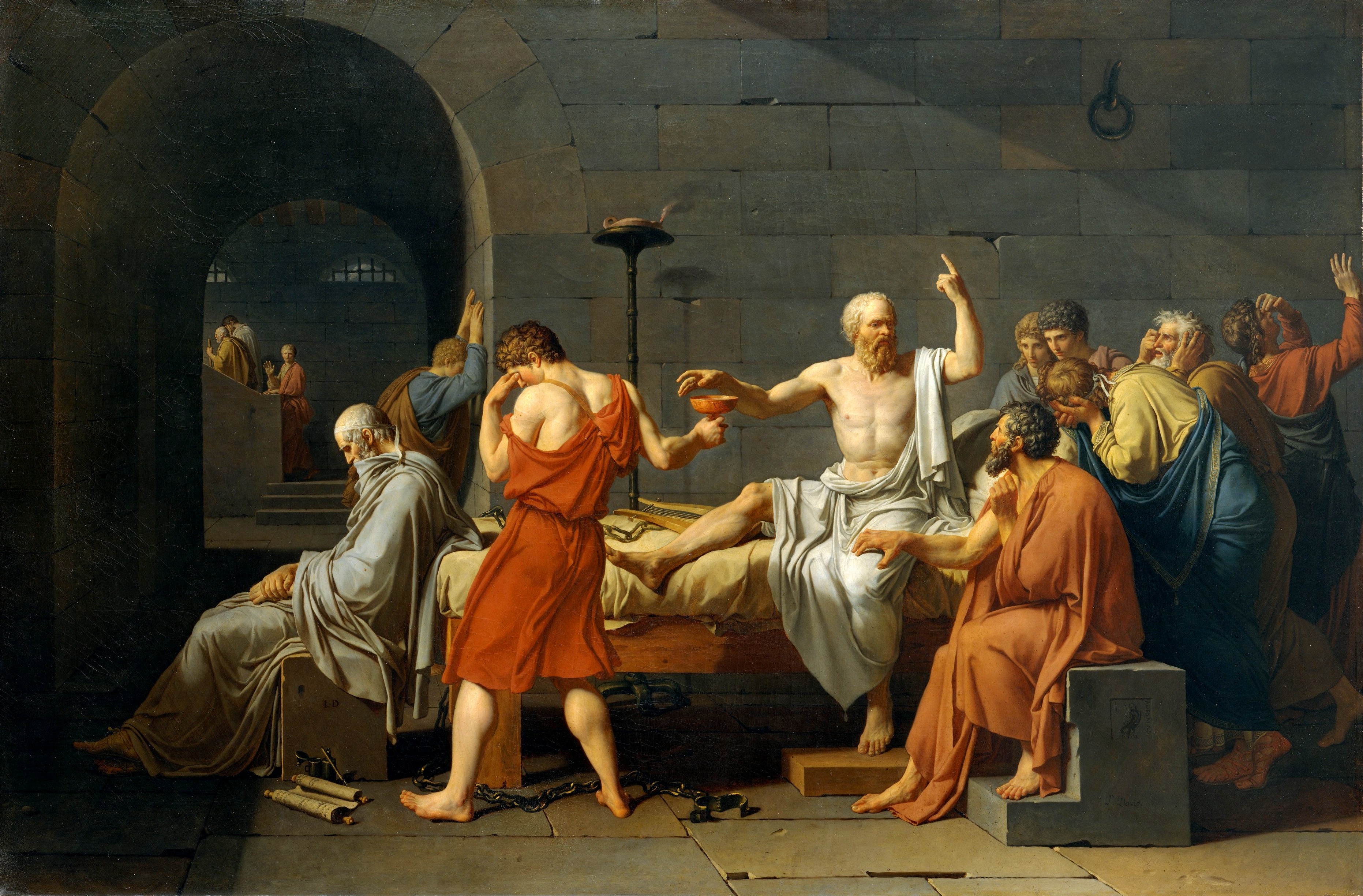
Jacques-Louis David's "Death of Socrates" depicting the ultimatum imposed on the philosopher to recant his ideas or be forced to drink hemlock. He continues to discourse on the truth of the eternal and spiritual. The painting dates from 1787, the year the Framers were thinking through the principles of sound, constitutional government.

Jacques-Louis David’s “Death of Socrates” depicting the ultimatum imposed on the philosopher to recant his ideas or be forced to drink hemlock. He continues to discourse on the truth of the eternal and spiritual. The painting dates from 1787, the year the Framers were thinking through the principles of sound, constitutional government.


“We do not need more of the things that are seen, we need more of the things that are unseen. It is on that side of life that it is desirable to put the emphasis at the present time. If that side be strengthened, the other side will take care of itself. It is that side which is the foundation of all else. If the foundation be firm, the superstructure will stand” — Calvin Coolidge, June 19, 1923, “The Things That Are Unseen,” delivered at Wheaton College, Norton, Massachusetts.

“We live in an age of science and of abounding accumulation of material things. These did not create our Declaration. Our Declaration created them. The things of the spirit come first. Unless we cling to that, all our material prosperity, overwhelming though it appear, will turn to a barren sceptre in our grasp” — July 5, 1926, spoken at the Sesquicentennial Stadium in Philadelphia.
Coolidge-75

On Science and Character

“The National Institute of Social Sciences is met to honor one of the great of the earth, not as the world has always counted greatness in the past, but as it must and will recognize greatness in the future. It is not to a soldier or a statesman who has won the acclaim of multitudes in a contest of peace or war; not to one who has acquired great material possessions, but to one who, passing by all these, with a true humility, by the benefactions she has conferred upon mankind, by her great service to humanity, has forever laid all civilization under tribute. In her gentleness, in her intelligence, in her devotion to the advancement of science, there is mark and warrant of progress of an enlightened society among men…

“But only the most casual observation tells us that something is lacking…We have just had the terrible experience when for more than four years pure science was let loose upon the world…There is something lacking in our science. It is not to be discarded, it is not to be blamed, it is not to be ignored, it is not to be cast aside. All science must be protected and fostered and advanced. But the plain truth is that science alone does not provide the salvation of the world…

“Along with our boasting of science there needs must go a greater humility. We cannot substitute science for character. Least of all can we substitute the superficial for exact scholarship…Unless there be national character, there can be no national progress and no national prosperity…

“This nation cannot pay for what is not earned, it cannot respond to a contribution which has not been made, whether supposed to be of capital invested or work performed. We must take up again the burdens of civilization. We must make of science the handmaiden of character. This appeal has never been made to America without finding an adequate response. It is an appeal not to give up pleasure, but to seek the greatest of all pleasure, the satisfaction that comes from achievement. It is an appeal to turn from pretenses to realities…

“When America is engaged in this struggle, no less hazardous than those crises which she has met in the past through her own efforts and through the sustaining sympathy and assistance of others, it seems almost providential that there should come to us the personification of what American and Americans should seek to be. Other crises have brought us men; there has come to us now a woman…Her presence here tells, as we look back over our history and its accomplishments, that there is no time to forget our friends, that there is no time to take counsel of our animosities, that there is no time to cease to do and to require justice.

“More than this, she comes bearing witness, not to riches she has secured for herself, but to the riches she has bestowed upon mankind, more solicitous to give than to receive. She comes not for glorification, but that there may be bestowed upon her the means by which to continue that service to which she had dedicated her life…

“Recognizing how worthily you represent the principles of the National Institute of Social Sciences…I am directed to bestow upon you this medal, Madame Marie Curie, as the testimony of its approval and satisfaction” — speech presented on behalf of Vice President Calvin Coolidge in honor of Madame Curie’s historic work in radium, May 19, 1921

To which Madame Curie responded with thank-filled brevity, “I am grateful to the National Institute of Social Sciences and I would like you to know how deeply moved I am by the words of Vice-President Coolidge.”

Madame Marie Curie, as portrayed by Susan Marie Frontczak

Madame Marie Curie, as portrayed by Susan Marie Frontczak, http://www.storysmith.org/.

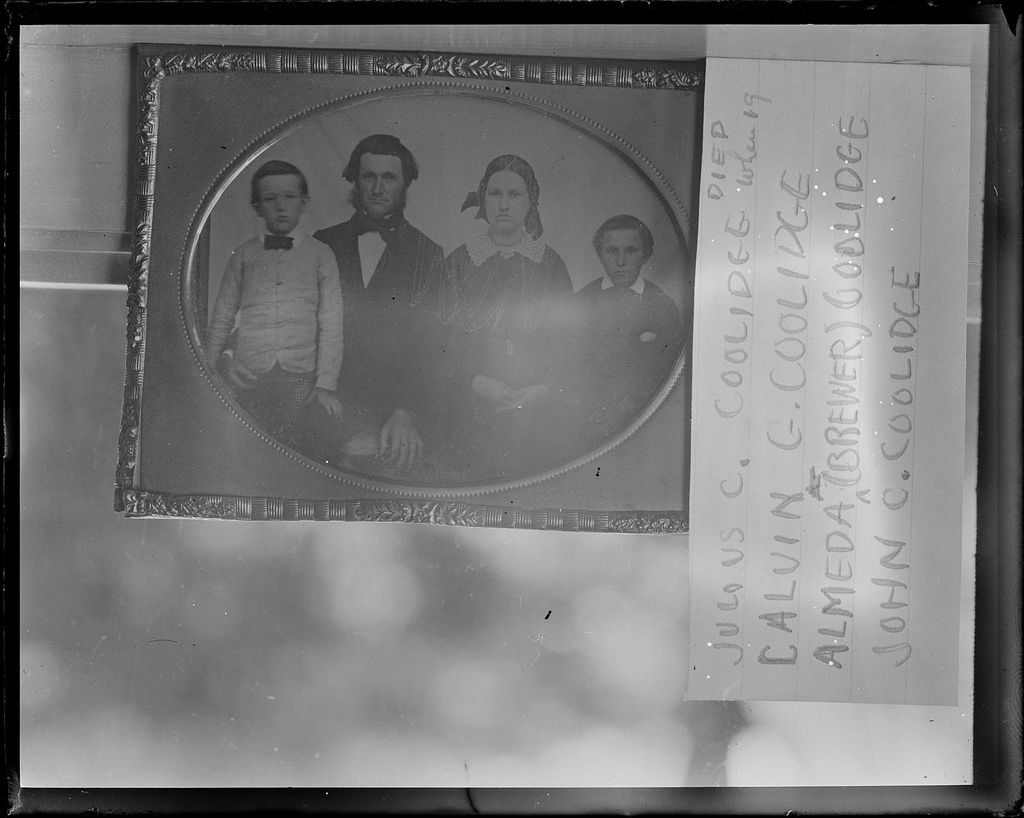
Julius Caesar…Coolidge and Family

Julius Caesar...Coolidge and Family

In observance of the Ides of March, here is an old offering from the Coolidge family album: a photo of Julius Caesar Coolidge (far left) as a boy, the President’s uncle, taken with his family: father, Calvin Galusha; mother, Almeda Brewer; and brother, John Calvin (far right). While Calvin Coolidge never met Julius, who died two years before the future President was born, he experienced much the same mixture of joy and sorrow, play and hard work of which Calvin later summarized from his own experience:

“It would be hard to imagine better surroundings for the development of a boy than those which I had. While a wider breadth of training and knowledge could have been presented to me, there was a daily contact with many new ideas, and the mind was given sufficient opportunity thoroughly to digest all that came to it. Country life does not always have breadth, but it has depth. It is neither artificial nor superficial, but is kept close to the realities” (The Autobiography, p.33).

Like many families of the early nineteenth century, the courageous deeds of heroes from antiquity intermixed with the unshakeable convictions of religious heroes from the Reformation and Great Awakening to be perpetuated in the choice of names for babies born to those early pioneers of Vermont and beyond. What better way to evoke great things for new lives than to name one for the brave conqueror and another for the stalwart reformer?