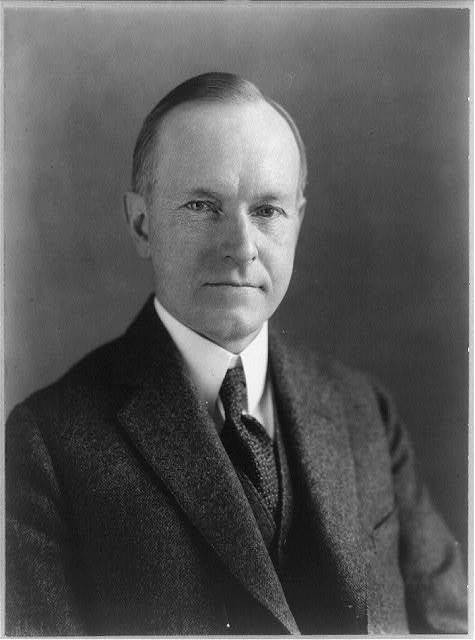
Brought to you by the 1920s

Brought to you by the 1920s

CALVIN COOLIDGE: “Civilization and progress depend upon the genius of the people themselves, but that genius depends to a large extent upon the ability to perceive and accept leadership…”

“As society grows more complicated, as civilization advances, the burden of its support is not less; it is more. It was never so great as now. Society in America is in a healthy state of progress…”

“It is not enough to teach men science; the great thing is to teach them how to use science…”

“Unless the moral power of the world increases in proportion to its scientific power there is a real danger that the new inventions will prove instruments of our own destruction. If moral development keeps step, peace and good will have gained new allies…”

On Presidential Pedigree

45058v caboose of train 1925

“It is customary I suppose for those who are interested in those things to look into the possible inherited background of Presidents. Some one has dug out a tradition that my family, the Coolidges, came from a place in Normandy. The French spelling was Colynge. I have seen on the screen within a short time a picture of a castle in that town–I can’t tell the name of the town. Now I assume that that meant that we had a Norman background, which as I indicated yesterday was a Norse or a Norwegian background. I have got so many backgrounds of one kind or another that I am pretty purely American, having I believe a little tinge of Indian blood in me. I simply speak of the Norman background as of a little interest on account of the Norwegian gathering yesterday. I have got several others that I don’t need to dwell on–Scotch, and, Colonel [Michael] Hennessy says, Irish” — Calvin Coolidge, press conference on June 9, 1925 (The Talkative President, p.42).

Virtually since the beginning, people have been drawn to trace lineage to someone renowned and respected, especially in the last two hundred years when that someone is among our favorite Presidents. While family histories certainly make for fascinating discoveries, at times connecting us closer than first realized to the heroic, human nature seems driven to conclusively confirm that greatness exists through bloodlines instead of through traits of character. Still, it is telling that our nation’s heroes are known for their courage, hard work and service, from George Washington to folk figures like John Henry. They triumph over tragedy through discipline, perseverance, and sincerity. They stand as men and women not as petty, dependent victims. Coolidge, like most Americans, was entirely unashamed of his status as a “mutt” rather than a fancy purebred. Overemphasizing family heritage to bring us closer to what was noble and worthy, especially in America, is missing a very real opportunity. Each one of us can realize the regal inheritance we already possess as Americans under our system of liberty and responsibility. Yet, and even more importantly, partaking of the honor takes genuine effort because it is test in moral virtue not material status. This is why slavery has been the normal condition of human experience. It is easier than true freedom.

While Coolidge could just as readily be looking ahead and looking behind, he summarized America’s kind of nobility this way,

“Although all our Presidents have had back of them a good heritage of blood, very few have been born to the purple. Fortunately, they are not supported at public expense after leaving office, so they are not expected to set an example encouraging to a leisure class. They have only the same title to nobility that belongs to all our citizens, which is the one based on achievement and character, so they need not assume superiority. It is becoming for them to engage in some dignified employment where they can be of service as others are. Our country does not believe in idleness. It honors hard work.” Or, when he said, “There can be no national greatness which does not rest upon the personal integrity of the people.” What makes Americans noble is not found in their ancestry or genetic pedigree, but rests on the self-control, honesty, humility and sense of service each individual cultivates in the heart, the mind and in one’s actions. Coolidge never subscribed to the false premise that greatness is some unattainable birthright or gift from those in authority. Greatness resides in the small things, truth loved above pretense, a job well-done, sacrifice quietly rendered. “We need never fear,” Coolidge once observed, “that we shall not be called on to do great things in the future if we do small things well at present.” As it says somewhere else, “Do you see a man who excels in his work? He will stand before kings” and “He that is greatest among you shall be your servant.”

On “Some of the Teachings of History”

CC in 1924

“History is to be studied and applied not for the purpose of advocating reaction. It is not the accurately informed who continually appeal to the good old times to the disparagement of the present. That is characteristic of those who substitute fable and hazy tradition for fact and reliable record. True history which includes all the records of the past, however obtained and wherever recorded, whether made upon the surface of the earth by the ceaseless shifting of air and water, or transmitted by written signs on tablet and parchment, or through oral repetition handed down from sire to son, or that most indelible of records the accumulated experience of generation after generation moulded into the brain of man, while ever a conservative force, yet holds the only warrant for real progress. It is ignorance of its teachings, which leads men of good intentions to advocate either reaction or revolution, and a knowledge of its forces, which aids men to promote the public welfare. In judging of the strength of a state it is necessary to know what has gone before, what point of development has been reached by the people of that state, and whether their present plan of society is justified by their past experience…

“Liberty is not bestowed, it is an achievement but it comes to no people who have not passed through the successive stages which always precede it. It is very far from a state of nature. It is not light and easy thing to secure or to maintain, but difficult of accomplishment and hard to bear. While there are no conditions under which it is better to be a slave than to be free there are many conditions under which it is infinitely easier to be a slave than to be free and for the sake of their ease there are those who have chosen to relinquish much of liberty rather than bear the responsibilities of the free…

“Coincident with the political development of mankind has gone along the forces of philosophy and of religion, revealing to the race the meaning of nature, of man, of his relation to his creator and to his fellow man. Not enough credit is attributed to these forces in the development of government, society, and civilization. It was by comprehending the natural forces of the universe that man saw he had in them a right of property and set them to be his servants. It was through a realization of the fatherhood of the Almighty that came a knowledge of the brotherhood of man, of his innate nobility, of equality, of his right to be free…

“Human institutions are prone to change but there are certain great principles that do not change. I have hastily sketched the development of the forms of government. That which is based on the rule of the people through a republic in principle is the ultimate. There is no beyond, there is only reaction. To that point we have arrived…

“This is by no means the equivalent of saying that further effort is no longer necessary. Perfection requires not less effort but more. Great privileges means great responsibilities. Truly freedom is not easy but hard for the people to endure. There is always the force of evil without and within. It is difficult to say that any great nation perished by reason of an attack by forces from without. Disintegration begins within…The great question of the preservation of our institutions is a moral question. Shall we use our power for self-aggrandizement or for service? It has been lack of moral fibre which has been the downfall of the peoples of the past. There came a time when they were sunk in indulgence and no longer strove for achievement. But there has been revealed to us the nobility of man, not formerly so well understood, which has taught us to appeal not to his selfishness but to his sense of duty. A nobility which reaches from the highest to the lowest and justifies our firm faith in the abiding convictions of the people…

‘ O Heart be strong!

   Be valiant to do battle for the right,

    Hold high truth’s stainless flag,

                walk in the light,

    And bow not weakly to the rule of wrong.’ ”


Vice President Calvin Coolidge, addressing the Vermont Historical Society, Hall of Representatives in the Capitol, Montpelier, Vermont, January 18, 1921 (emphasis added).