On Factual News Reporting and a Responsible Press, Part 1

The younger, smaller but historically relentless competitor of the Associated Press, United Press Associations, as it was originally known, broke coverage on some of the most pivotal events in history. It was the first to announce Armistice to the world in 1918 from France, the first to cover developments during the Second World War through reports obtained directly from various points in the European theater, the first to disclose the horrific assassination of John F. Kennedy and the first to secure interviews with most of the twentieth century’s foreign leaders, from Emperor Hirohito to Joseph Stalin to Adolf Hitler. Under its President, Roy W. Howard, the United Press achieved a preeminent reputation for world news coverage throughout the Coolidge years, upholding its motto, “Get it First, but First, Get it Right.”

Looking back over its first twenty years, the organization that had begun in 1907 with E. W. Scripps combining three Midwestern papers, had much for which to be proud as part of America’s press. United Press was hardly resting on its laurels, however. It is illustrative that it not only recognized its serious role in international relations but recognized, by inviting President Coolidge to deliver the address at their twentieth anniversary Dinner in New York City, there was much more a responsible press has to do.

President Coolidge, not about to forgo the importance of balancing a consideration of obligations alongside privileges, would keep this a central theme in his speech before those gathered from the United Press. “It is axiomatic,” he would remind his audience, “that a free press can exist only in a free country. One of the first efforts of all kinds of absolutism is to control the press and the schools as the sources of information and education of the people.” The press enjoyed freedom in this country out of both National and State constitutions, but “it has a reciprocal duty of its own to perform toward the administration of the Government, of giving true reports to the people of the actions of public officials.” The press, if it were to retain its First Amendment freedoms, cannot cover for the wrongs of those in power. The press cannot conveniently hide or twist the truth to suit personal political agendas, protect friends in office, manipulate electoral outcomes or otherwise adopt attitudes foreign to America’s history, people, institutions and interests. To do so, Coolidge knew, “would be to establish a petty tyranny of its own.” Retaining an unsinkable faith in the judgment of the American people, he then boldly asserted, “In America the general sources of information are so numerous and on the whole so correct that any publication which constantly misrepresents very soon becomes marked as unreliable and loses its influence both for good and for harm.”

The President continued, “It is natural that the press should represent the character of the government under which it lives and of the people which it serves. I have come to have a profound regard for the American press because it represent America. In the accuracy of its reports, the intelligence of its comments, and the freedom of its actions, I know of no other country where it is surpassed…Because America is what it is, you are what you are.” However, Coolidge’s praise for what constitutes a responsible free press included warnings about the danger of departing from those standards. “Whenever any section of our press turns on America and on American institutions, and assumes a foreign attitude, every informed person knows that it has fallen from the high state which is our common heritage, and becoming no longer worthy of regard is destined to defeat and failure. No American can profit by selling his own country for foreign favor.”

The President surveyed the room full of reporters and editors, seeing many who had covered the happenings at home and abroad since the adventurous days of Roosevelt, out of the turmoil of war under Wilson and finally, through the work of reestablishing peace under Harding and Coolidge. Even before he stood to speak, Coolidge recognized the need to explain the Nation’s foreign policy. He started by outlining basic principles, the role America as a new power plays as well as the crucial part the press holds in world affairs. “The policy that our Nation is trying to promote throughout the world is one of peace and good will based on a better understanding through justice and fair dealing.” This was accomplished by relying on three elements to advance this cause. First, the National Government promotes this better understanding as it “comes into contact through its duly constituted officers with the governments and people of other countries.” America is no belligerent country “desirous of oppression or bent on conquest. Our whole history and tradition, the moderation of our Military Establishment and the general attitude of our people, would altogether disprove any such assumption.”

Second, the connections of trade and commerce promote this better understanding. The advantage, Coolidge reminded his audience, was not a one-sided “exploitation” of the world by Americans. Commercial interaction rendered a very strong and vibrant mutual benefit to those who come here from abroad to engage in business, to those who go overseas to lend their skills to opening undeveloped parts of the world and to all who build, invest and serve. It is the law of service in operation after all, Coolidge observed. As such, there is no justification for utilitarian motives, seizure of property or the “failure to give fair compensation for their labor.” Eeach individual’s labor has worth in the market, not merely those with political strength or social standing. Justice and humanity, accurately defined, has to direct our interaction with other nations “to maintain the respect and friendship of foreign peoples.”

Third, the state of the public mind is the most important means of promoting a better understanding. Nations grounded in an ongoing effort to comprehend one another and exercise a healthy measure of good will do not “find themselves at war” overnight. It is after a “long series of misunderstandings and abuses” that the hostile feelings harbored inside the mind break out into the open with the smallest provocation. By preempting this first step, removing the clutter of animosity and unfamiliarity that accumulates between different people through ignorance, the road to just and equitable dealings with the world is made all the clearer. The press can either accomplish remarkable good or inflict great harm in proportion its commitment: either to inform Americans with honest news reporting or merely exacerbate prejudices and enmities with tainted information. “It is for these reasons that the public press, especially the daily newspapers and weekly periodicals, has such an enormous influence in creating a situation that brings the blessings of peace or is fraught with the perils of war.”

Coolidge elaborated plainly how the press can “endanger our friendly relations,” being under no illusions that America’s media does carry this immense degree of influence around the world. If not directly creating war, the press has the ability to injure the indispensable foundation of trust between nations vital for trade and understanding to exist. Yet, if the press were to engage in “constant criticism and misrepresentation of foreign people” prompted by a “narrow and bigoted nationalism,” it would not only misinform at home but foster an unnecessary bitterness abroad. Furthermore, if the press indulges in “malicious and misleading partisan attacks on the conduct of our own Government in its efforts to defend American rights” an outcome equally as destructive results. The President condemned both extremes. Instead, when our Government is proceeding deliberately to “adjust differences,” defend “the rights of its citizens,” and maintain “national dignity” it is necessary that the press exercise “great care…to give the public the exact facts and avoid the appearance of seeming to support the position of foreign governments.” To take such a side against America “only furnishes ammunition for our adversaries,” attacking “our own forces in the rear.”

Coolidge grasped not only the rewards of freedom of the press, he encouraged some of the best journalists of his day never to forsake that behind those freedoms depend great responsibilities. Coolidge reminds us that the press exists to provide the people with the precise facts and honest reporting to be expected from those who are to represent America’s ideals. The press is to render its support and service to its country because America is worthy of so high a standard of excellence. Consequently, patriotism is not a betrayal of responsible news coverage, it is a manifestation of a free and credible press. It is seen in the daily demand of informed citizens to be armed with the truth and equipped with those facts to better understand the world and America’s righteous role in it. That ideal role endures, not as a force for oppression and exploitation, but as a firm friend of anyone on the side of lawful liberty. That role endures as an advocate of genuine fairness and justice everywhere. But also, that role endures as a peacemaker, laying aside ignorance, martial conquest and nationalist bigotry for a truer understanding and readiness to serve. Love for all that America is is not a narrow nationalism, it is simply a commitment to our eternally right founding principles. Or, as Coolidge ever succinctly put it, “An American press which has all the privileges which it enjoys under our institutions, and which derives its support from the progress and well-being of our people, ought to be first of all thoroughly American.”
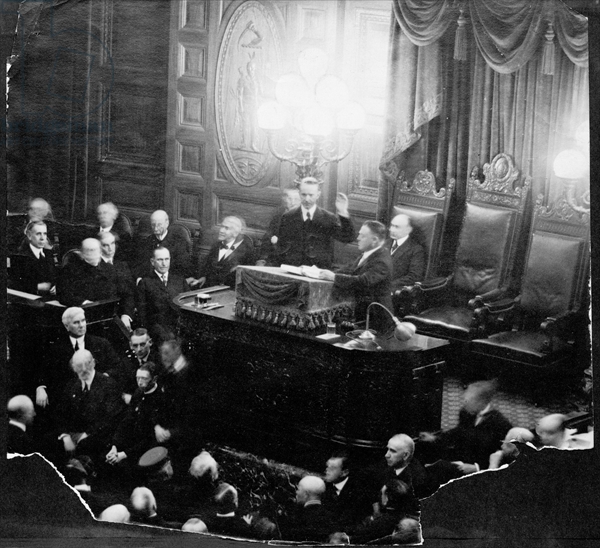
Calvin Coolidge takes the Oath as Governor, January 2, 1919

Calvin Coolidge takes the Oath as Governor, January 2, 1919

Standing in the Massachusetts House chamber, Governor Coolidge faces the joint gathering down the hall from where he had presided as President of the State’s Senate since 1914. Notice the new Governor’s father is conspicuously seated to the right of the podium.


On that occasion, he addressed the General Court,

“Each individual must have the rewards and opportunities worthy of the character of our citizenship, a broader recognition of his worth and a larger liberty, protected by order — and always under the law. In the promotion of human welfare Massachusetts happily may not need much reconstruction, but, like all living organizations, forever needs continuing construction. What are the lessons of the past? How shall they be applied to these days of readjustment? How shall we emerge from the autocratic methods of war to the democratic methods of peace, raising ourselves again to the source of all our strength and all our glory, — sound self-government?”

On Women’s Suffrage, the Revolution and Civic Participation

“In Massachusetts the 19th of April is known as Patriots Day. It is honored and set apart. The whole Nation is coming more and more to observe it. As the time lengthens from the occurrences of 1775, its significance becomes more apparent and its importance more real. It stands out as one of the great days in history, not because it can be said the American Revolution actually began there, but because on that occasion it became apparent that the patriots were determined to defend their rights.”

“The Revolutionary period has always appeared to me to be significant for three definite reasons. The people of that day had ideals for the advancement of human welfare. They kept their ideals within the bounds of what was practical, according to the results of past experience. They did not hesitate to make the necessary sacrifice to establish those ideals in a workable form of political institutions. As I have examined the record of your society, I believe that it is devoted to the same principles of practical idealism enshrined in institutions by sacrifice.”

Grace Coolidge leading by example, completing her absentee ballot on the White House lawn, while both her and Calvin urge all Americans to get out and vote in that year's election, 1924.

Grace Coolidge leading by example, completes her absentee ballot on the White House lawn, while she urges all Americans to get out and vote in that year’s election, 1924.

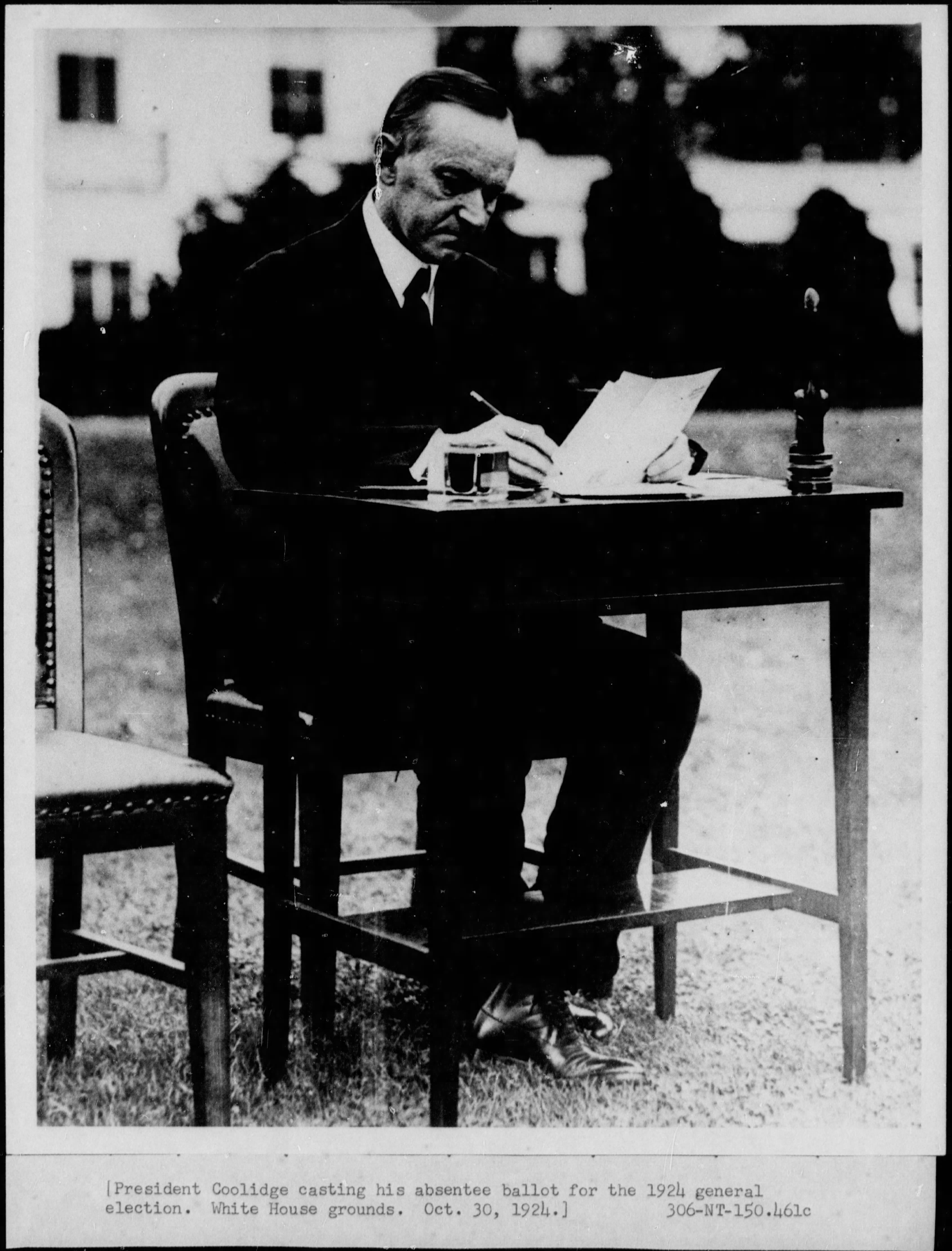
Calvin likewise, filling out his absentee ballot in front of the White House, encourages everyone eligible to exercise their informed choice at the ballot box.

Calvin likewise, filling out his absentee ballot in front of the White House, encourages everyone eligible to exercise an informed choice at the ballot box.

These words, given before the Daughters of the American Revolution on April 19, 1926 by President Calvin Coolidge, underscored that the principles which fueled the fight for independence were neither abstract concepts nor rigged systems of thought to consolidate power in the hands of a few men, at the expense of all individuals, including women. As Coolidge continued,

“This is but the natural inheritance of those who are descended from Revolutionary times. In this day, with our broadened view of the importance of women in working out the destiny of mankind, there will be none to deny that as there were fathers in our Republic so there were mothers.” Cokie Roberts was hardly the first to recognize and praise this all too obvious truth. As Coolidge goes on, “If they did not take part in the formal deliberations, yet by their abiding faith they inspired and encouraged the men; by their sacrifice they performed their part in the struggle out of which came our country. We read of the flaming plea of Hannah Arnett, which she made on a dreary day in December, 1776, when Lord Cornwallis, victorious at Fort Lee, held a strategic position in New Jersey. A group of the Revolutionists, weary and discouraged, were discussing the advisability of giving up the struggle. Casting aside the proprieties which forbade a woman to interfere in the counsels of men, Hannah Arnett proclaimed her faith. In eloquent words, which at once shamed and stung to action, she convinced her husband and his companions that righteousness must win.”

hannah_arnett_large

Hannah was not some isolated instance, though, in a supposedly chauvinistic society, as Coolidge points next to others, some named and many more unnamed who shared in the burdens of freedom. “Who has not heard of Molly Pitcher, whose heroic services at the Battle of Monmouth helped the sorely tried army of George Washington! We have been told of the unselfish devotion of the women who gave their own warm garments to fashion clothing for the suffering Continental Army during the bitter winter of Valley Forge. The burdens of the war were not all borne by the men.”

FlagmakerCanvasLoRes

The President would go on to commend the laudable record and work by the Daughters of the American Revolution for carrying on out of a wisely crafted charter and many acts of service the practical ideals of that Revolutionary generation of men and women. Yet, who could assert that in a Republic the work of one generation is adequate? To continue a free people with republican institutions, the sacrifice of each citizen of every generation is necessary for liberty to last. “Our Republic gives to its citizens greater opportunities, and under it they have achieved greater blessings than ever came to any other people. It is exceedingly wholesome to stop and contemplate that undisputed fact from time to time.” As a corollary to this apparent realization, it becomes necessary that if so many good things are to continue to be enjoyed, it demands “a corresponding service and sacrifice. Citizenship in America is not a private enterprise, but a public function.” None of us can opt out of our duty to vote and still reasonably expect someone else will execute what is ours to exercise. When we refuse to exercise the duties of freedom, we will soon find ourselves severed from the benefits that inseparably accompany them. It short, “disaster will overtake the whole fabric of our institutions.” Participation is the heart of our Republic. “If we are to maintain the principle that governments derive their just powers from the consent of the governed, if we are to have any measure of self-government, if the voice of the people is to rule, if representatives are truly to reflect the popular will, it is altogether necessary that in each election there should be a fairly full participation by all the qualified voters.” Put another way, if we do not participate in the direction of America, that choice will be made for us, usually without our consent and against those principles for which we would vote as informed individuals. As Phyllis Shlafly once put it, our vote is to be a choice, not an echo.

Coolidge did not have much to commend on the participation of voters, even after the victory for woman’s suffrage went into effect just before the 1920 election. “It was hoped,” the President noted, “that giving the vote to women would arouse a more general interest in the obligations of election day. That has not yet proved to be the case.” Calculations from 1920 found that out of some 27 million votes cast, only 37 per cent represented the votes of women. While Coolidge knew that blaming women for failing to exercise so recently recognized a privilege was not entirely fair, yet he understood that it was symptomatic of an even more serious problem when the voter disenfranchises herself or himself by simply not showing up. It remained a “startling fact that in the past two presidential elections [1920 and 1924] barely 50 per cent of those qualified to vote have done so.”

Holding the "Nation's Birthday Book" these Daughters visit President Coolidge in preparation for the Sesquicentennial that year, 1926.

President Coolidge signs the “Nation’s Birthday Book” and the Patriot’s Pledge of Faith, standing with 13 women of the Sesquicentennial and Thomas Jefferson Centennial Commissions seeking to purchase and preserve Monticello, May-June 1926.

Returning to the practical idealism of our Revolutionary generation, Coolidge believed that the solution would be found not in legal disenfranchisement or punitive action but in “all bodies of men and women interested in the welfare of his country to join together under some efficient form of organization to correct this evil which has been coming on us for more than 40 years, but which within the last decade has become most acute.” This is what made the Daughters of the American Revolution so pivotal a contributor to real results in the future of the country. It was not for lack of effort that turnout was declining — as the President made clear in the very next statement — praising the work of numerous volunteer efforts from the National Civic Federation, the National League of Women Voters and many other citizen groups banding together to inform and inspire all Americans to get involved, using the power each citizen already possesses through the ballot box to express one’s will in public decisions. Yet, Coolidge saw the glass not as half empty but as fuller than it would have been had not all of these worthy efforts been made to educate civic responsibilities. Numbers were already revealing that most of the world’s leading nations had far higher voter rates that ours. Even Italy produced more involvement.

Coolidge was not indulging the forces that find fault in America because it has not lived up to some unrealistic definition of perfection, he was urging every man and woman to embrace the duty that goes hand in hand with freedom. What made the indifference toward voting so perilous was its “insidiousness,” the subtle illusion that no harm is inflicted on the future by sitting out the election. In actuality, by abstaining, our interests and choices — the popular will — go unrepresented every time we decline to vote. We need not fear that faith in our foundations is somehow invalidated. The people, even in the gravest emergencies, prove worthy of self-government. “It is only the approach of some silent and unrecognized peril that needs to give us alarm. Such a situation will develop if the Government ceases to represent the people because the public has become inarticulate…But if the people fail to vote, a government will be developed which is not their government.”

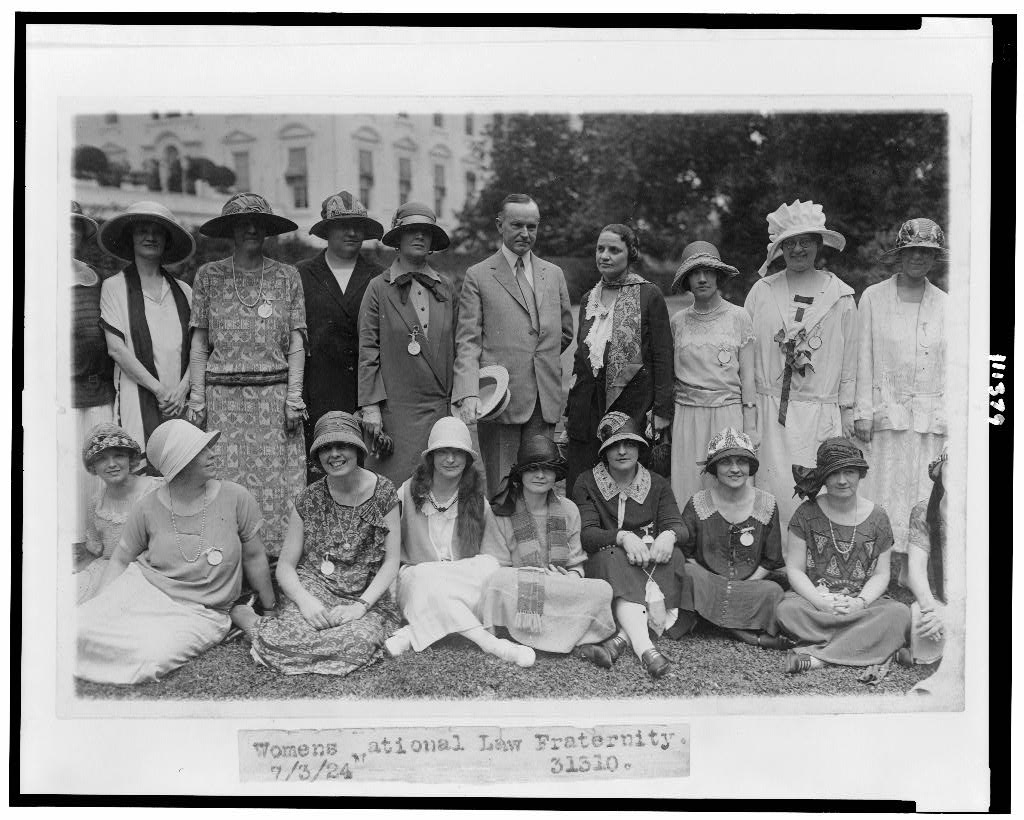
Notice the woman next to President Coolidge's left is his Assistant Attorney General, Mabel Willebrandt

Notice the woman next to President Coolidge’s left is his Assistant Attorney General, Mabel Willebrandt.

As Coolidge summarizes to the Daughters of the American Revolution gathered on this day eighty-eight years ago, “This is not a partisan question, but a patriotic question. Your society, which is organized ‘to cherish, maintain, and extend the institutions of American freedom,’ may well take a leading part in arousing public sentiment to the peril that arises when the average citizen fails to vote…The whole system of American Government rests on the ballot box. Unless citizens perform their duties there, such a system of government is doomed to failure.”

If we stay home this year – 2014 – what is to say America will not pass that point of no return, the failure of which Coolidge warned, a future shut off forever from that “second chance” to assert the power that was always ours but having been abdicated for so long, now rests with others insulated from and unaccountable to our choice, our consent and our control.

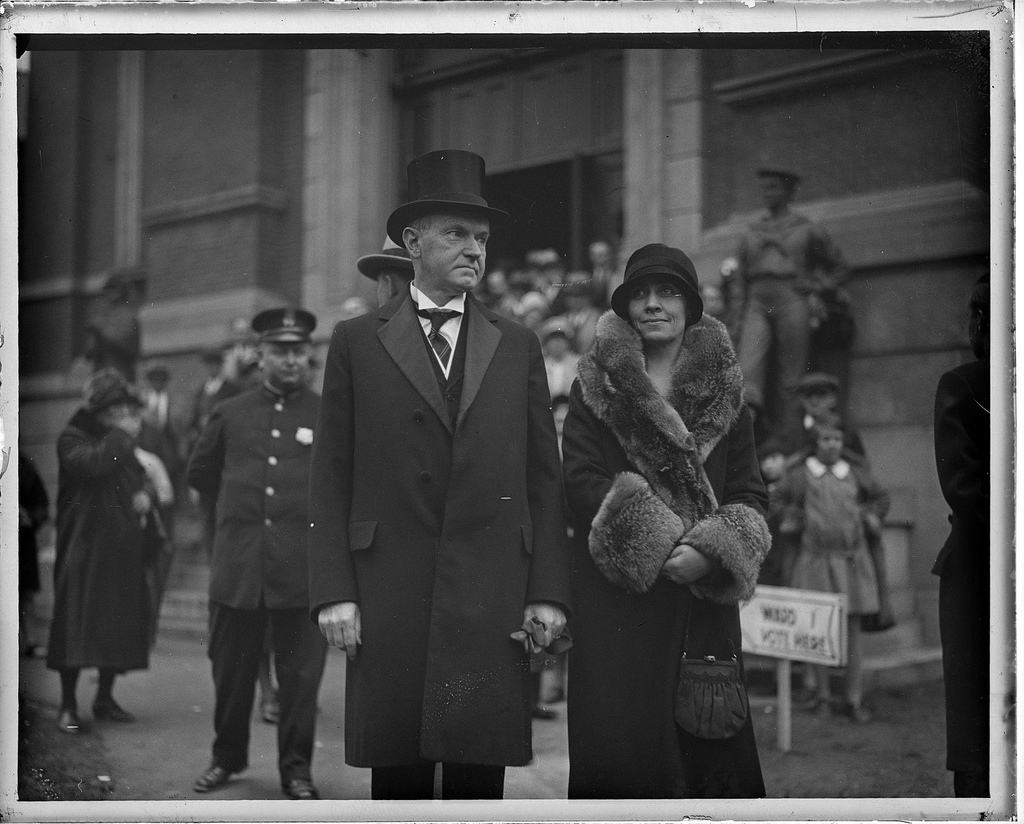
The Coolidges, in retirement, out to vote on election day, 1932. It would be his last in 39 years of civic participation.

The Coolidges, in retirement, out to vote on election day, 1932. It would be his last after 39 years of civic participation.