On Racial Equality and Opportunity

Image

More than twenty years before the Supreme Court mandated desegregated schools and forty years before the Civil Rights Act, blacks and whites were already moving toward a non-segregated existence throughout the country. Moreover, sound economic principles were helping everyone to experience opportunity and the results of upward mobility in America across the entire spectrum. Blacks, finding greater opportunities “voted with their feet,” and began the “Great Migration” to the North. Wages rose in both North and South, home ownership grew 300% percent in the 1920s among blacks. Lynchings plummeted and adjustment of one’s new neighbors, rough at first, adjusted on its own — without the need for government direction of social behavior. It was the incessant social policy of the 1930s and 1940s that retarded, even erased, the progress made in previous decades.

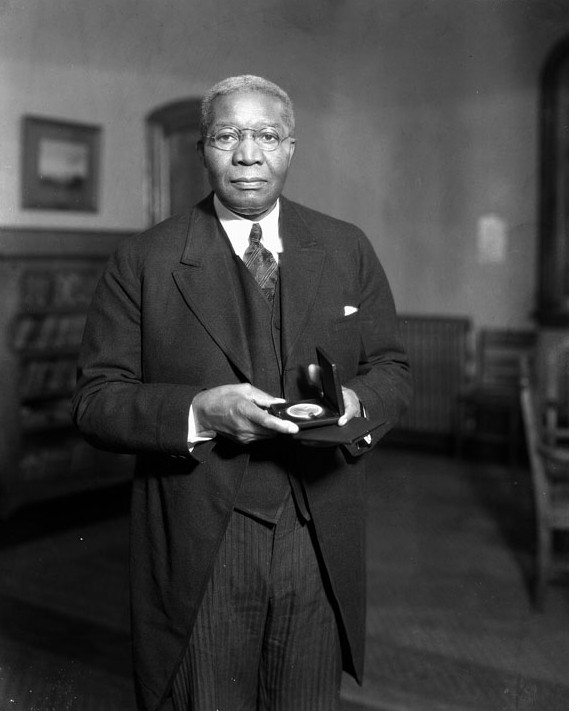
Dr. Moton of Tuskegee Institute studied the progress of his fellow blacks in America for many years, including the Coolidge Era, and he found conditions to be moving steadily toward voluntary desegregation as well as political and economic opportunity. Freedom and equality were marching hand in hand decades before federal involvement. He observed that in sixty years since emancipation, blacks owned 22 million acres of land across the country, 600,000 homeowners (a figure which would rise throughout the remainder of the decade) and ownership of 45,000 church buildings. Blacks owned and operated over 50,000 businesses with a combined capital value of more than $150 million ($2.1 million today), including banks and other “white collar” work. There were over 60,000 in professional fields, 44,000 school teachers and 400 newspaper and media publications operated by blacks. Literacy had dropped twenty percent and would continue to improve with “Coolidge Prosperity.”

Moton would summarize, “Still the Negro race is only in the infancy of its development, so that, if anything in its history could justify the sacrifice that has been made, it is this: that a race that has exhibited such wonderful capacities for advancement should have the restrictions of bondage removed and be given the opportunity in freedom to develop its powers to the utmost, not only for itself, but for the nation and for humanity. Any race that could produce a Frederick Douglass in the midst of slavery, and a Booker Washington in the aftermath of reconstruction has a just claim to the fullest opportunity for developments.”

Writing to Dr. Moton in August 1924, Calvin Coolidge would enthusiastically commend the tangible progress made over so short a timeframe, “My dear Dr. Moton…Only a few weeks ago, I had the pleasure, at the Commencement of Howard University, of reviewing briefly and inadequately the material evidences of the progress of the coloured people…I wish to tell you of the deep impression that was made upon me by my studies of the Negro race’s achievements. In the accumulation of wealth, establishment of material independence, and the assumption of a full and honorable part in the economic life of the nation, it may fairly be said that the coloured people themselves have already substantially solved these phases of their problem. If they will but go forward along the lines of their progress in recent decades, and under such leadership as your own and many others among their excellent organizations are affording, their future will be well cared for.”

We mark the fiftieth anniversary of Dr. King’s speech on steps of the Lincoln Memorial, echoing not only the actions of Dr. Moton, who spoke there in 1922, but the faith in America to hold true to its founding ideals. It was not government to do for us, it was not the solution to give place to either despair or perpetual animosity, it was for us to return to the foundation already laid by the Framers. It is a testament to America’s virtue that Moton and King conclude their speeches with mirroring themes. America is not the problem, its ideals furnish the solution and give a conscience for fairness and justice. By aspiring to those ideals, we renew our pride as American citizens, that “fair and goodly land,” as Moton calls it. As Moton, King and Coolidge looked out over the problems and possibilities of living together a united people, they each saw the answer not in advertising the services of government to fix the human heart, not in fueling class and racial inequities but in appealing to be better than we have been by reclaiming “a dream deeply rooted in the American dream.” A dream that traces back to a shared Creator who sees beyond the externals and non-essentials to the individual’s character and soul. That dream, championed by the Founders and commended by King, Moton and Coolidge point us not to the halls of Washington for answers but to our own love for our neighbor.
Image

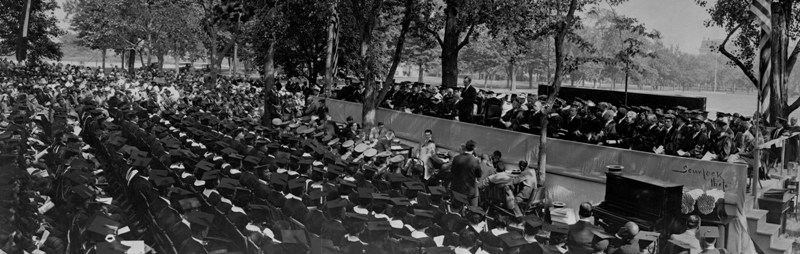
President Coolidge addressing Howard University, June 1924

On Separate Classes

jb_jazz_coolidge_3_e

“There is yet another manifest disposition which has preyed on the weakness of the race from its infancy, denounced alike by the letter and the spirit of the Constitution, and repugnant to all that is American, the attempt to create class distinctions. In its full development this means the caste system, wherein such civilization as exists is rigidly set, and that elasticity so necessary for progress, and that recognition of equality which has been the aim and glory of our institutions, are destroyed and denied. Society to advance must be not a dead form but a living organism, plastic, inviting progress. There are no classes here. There are different occupations and different stations, certainly there can be no class of employer and employed. All true Americans are working for each other, exchanging the results of the efforts of hand and brain wrought through the unconsumed efforts of yesterday, which we call capital, all paying and being paid by each other, serving and being served. To do otherwise is to stand disgraced and alien to our institutions. This means that government must look at the part in light of the whole, that legislation must be directed not for private interest but for public welfare, and that thereby alone will each of our citizens find their greatest accomplishment and success” — Governor Calvin Coolidge, formally accepting Republican nomination as Vice-President, July 27, 1920.

More than ten years later, in the midst of economic downturn, Garet Garrett would echo the same point through his column in the Saturday Evening Post. In articles like, “There Goes Mine,” written in 1932, Garrett attacks the fallacy that economic classes are both fixed and permanent. He refers to the resentment during depressions of car ownership and how confidence in one’s ability to move upward from poverty to prosperity remains entirely within each person’s reach. Coolidge and Garrett both understood that liberty means opportunity, an opportunity that is not coincidental but directly due to our unique political and economic system as founded. Margaret Thatcher, the late British prime minister, grasped the significance of this truth better than have many Americans. She observed that when opportunity is maximized, class distinctions diminish and the disparity between “rich” and “poor” decreases, contrary to every economic “expert.”

As all three realized, however, the opposite holds true every time socialism is allowed to set policy, be it locally or nationally. For the Left, as Thatcher noted, it is better for the poor to stay poor “provided the rich were less rich.” Such a view summarizes modern liberalism. It is the Left’s animus against success and its vested interest in perpetual victim-hood which drive its agenda. It is never about rising to higher aspirations or striving for greater ideals. It is about exchanging our independence for the security they provide, a security of marginal existence.

Coolidge, Garett and Thatcher all knew what the Left denies to this day: policies that maximize individual opportunity remove class distinctions automatically and enable equality on the basis of each person’s determination and potential. Modern liberals would have us all equally poor, feeling guilty of ever rising above the marginal, dependent and miserable and call that “progress.” Incapable of fixing the problems Coolidge’s policies addressed, all that is left for modern liberalism is to keep the class warfare going, to provoke violence, and to project its failures onto those striving to heal and reunite us with the freedom of a truly classless society envisioned by our Framers.

Garet-Garrett margaret-thatcher

On Government Dependence and the Meaning of Freedom

cc_040823_11
“The individual, instead of working out his own salvation and securing his own freedom by establishing his own economic and moral independence by his own industry and his own self-mastery, tends to throw himself on some vague influence which he denominates society and to hold that in some way responsible for the sufficiency of his support and the morality of his actions. The local political units likewise look to the States, the States look to the Nation, and nations are beginning to look to some vague organization, some nebulous concourse of humanity, to pay their bills and tell them what to do. This is not local self-government. It is not American. It is not the method which has made this country what it is. We can not maintain the western standard of civilization on that theory. If it is supported at all, it will have to be supported on the principal of individual responsibility. If that principle be maintained, the result which I believe America wishes to see produced inevitably will follow.

“There is no other foundation on which freedom has ever found a permanent abiding place. We shall have to make our decision whether we wish to maintain our present institutions, or whether we wish to exchange them for something else. If we permit some one to come to support us, we cannot prevent some one coming to govern us. If we are too weak to take charge of our own mortality, we shall not be strong enough to take charge of our own liberty. If we can not govern ourselves, if we cannot observe the law, nothing remains but to have some one else govern us, to have the law enforced against us, and to step down from the honorable abiding place of freedom to the ignominious abode of servitude.

“…If there is to be a continuation of individual and local self-government and of State sovereignty, the individual and locality must govern themselves and the State must assert its sovereignty. Otherwise these rights and privileges will be confiscated under the all-compelling pressure of public necessity for a better maintenance of order and morality. The whole world has reached a stage in which, if we do not set ourselves right, we may be perfectly sure that an authority will be asserted by others for the purpose of setting us right” — President Calvin Coolidge, at Arlington National Cemetery, May 30, 1925.