On “The Farmer and the Nation,” Part 2

As President Coolidge stood before the thousands of lobbyists, farmers, ranchers and agricultural professionals gathered in Chicago, it was becoming increasingly evident that this was not what they wanted to hear. The President was answering their plea to Washington for special help with a firm “no.” Moreover, Coolidge was about to launch into a wealth of statistical data in order to counter the central assumption that government had to act to meet emergency conditions. No emergency existed. Coolidge knew that crises were notoriously disastrous environments to properly and carefully consider drastic legislation, whether it be for farmers, veterans or anyone else. Contrived calamities advance the interests of bureaucrats and lobbyists not the welfare of all the people.

American farmers were experiencing real improvement after the low point of 1921. General trends since 1900 were slowly, but surely, beginning to reach farm prices. Neither the Congress nor his Administration could accelerate that process so that market demand could be supplied to compensate for overproduction. Coolidge was not blindly proclaiming a return of pre-war levels of prosperity either. Such levels were beyond anyone’s reach now. The market furnished the only true value of what farmers had hastily overproduced. No partnership of government and corporate entities could neatly raise the value of one product to keep returns high and costs low, especially when the markets knew otherwise. Advocates of a government rescue seemed to feel that America was still stuck in 1921 and it was the responsibility of government and business to remove the consequences of poor decision-making on the part of farmers. Farming was hard enough, they claimed. It was for no lack of sympathy nor a denial of reality that Coolidge stuck to his guns and refused to succumb to the pressure that “crisis” compelled another unnecessary raid on the Public Treasury.
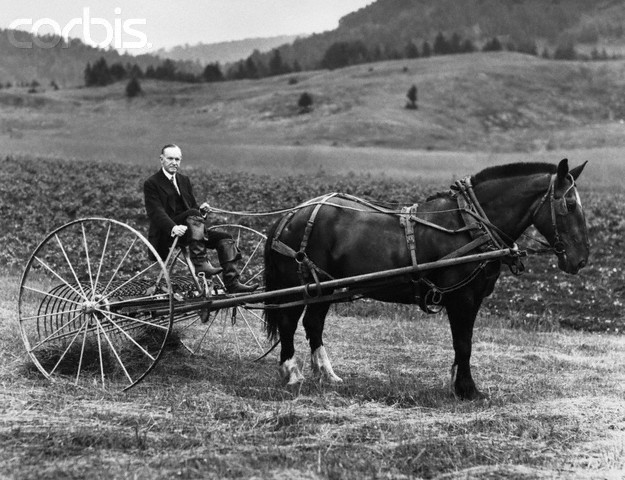
Former President at his Vermont family farm. He and his horse are ready to put the hay baler to work, July 1931.

Former President at his Vermont family farm. He and his horse are ready to put the hay baler to work, July 1931.

The advocates of government relief did not want to be bothered with the facts, though. This did not deter Coolidge from affirming what trends actually revealed: while rural populations were decreasing, production was going up. In fact, production had grown fifteen percent since 1910, a remarkable reality given that the economy had experienced four years of war, an economic depression and witnessed the move from a rural to predominantly urban population. “Fewer people but more production means each person on the farm will receive more.”

Production was but one part of the equation, Coolidge went on to say. Prices were at the heart of the controversy. However, prices were also going back up. No, they were not yet to where they had been before the war. Nothing, for that matter, was at it had been. When compared over a quarter of a century, though, what farmers were making had more than tripled to over $12 billion what sold for $3.5 billion in 1900. Farmers had seen a 350% increase in just two decades! Of course, commodities all across the spectrum had increased in value and the decline of 1921 hit hard, but purchasing power had exceeded even those hits to its worth. Agriculture was not in crisis. Depressed areas could be found, just as debt and taxes continued to burden farmers as well. President Coolidge, who knew directly what it was to struggle on the farm, reminded his audience that these were indicators not of permanent decline but demonstrated that agriculture was improving.
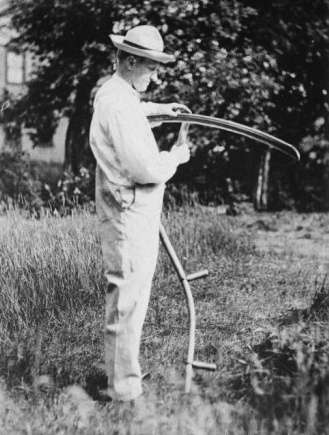
Coolidge sharpening a scythe in order to cut his grass.

Coolidge sharpening a scythe in order to cut his grass.

What medicine to administer depended on the condition of the patient. Farming was neither on a deathbed nor stricken in a sick room. Agriculture was rallying back toward full health. It was not there yet but the treatment, if given by government, would prove worse than the cure, Coolidge maintained. Even were the medicine coated in the garb of corporate partnership with government, experience taught President Coolidge how “dangerous” and destructive it would be to the freedom of the market. “No matter how it is disguised, the moment the Government engages in buying and selling, by that act it is fixing prices. Moreover, it would apparently destroy cooperative associations and all other market machinery, for no one can compete with the Government. Ultimately it would end the independence which the farmers of this country enjoy as a result of centuries of struggle and prevent the exercise of their own judgment and control in cultivating their land and marketing their produce.”

The President knew that however rationalized the government’s “alternative choice” is advertised, the result is always a removal of competition and establishment of one, sole provider — the Federal Government, forcing Americans to pay whatever it decides, however high or artificial a price. The costs are not merely economic ones, either. “Government control can not be divorced from political control.” The project may start innocently enough by insulating producers from low prices and bolstering superficially high values on what is sold. The agricultural policies of other nations, Coolidge pointed out, reveal that price fixing, once entrusted to government, cuts both ways. One of Europe’s great nations had already capped the price of farm labor far below what it was worth. America, were it to set out on that same course, would soon find that a government empowered to give can also take away.

Coolidge also understood that no government has the ability, even with “the best and the brightest,” to surgically adjust one price without seriously influencing all the other costs and components simultaneously operating in the market. The only way to prevent this ripple effect invariably led to the wholesale takeover of the economy by government. American agriculture would no longer be American. Government could not manage one small piece without assuming management of it all to ensure desired results for any length of time. “Unless we fix corresponding prices for other commodities, a high fixed price for agriculture would simply stimulate overproduction that would end in complete collapse.” Farmers realized, Coolidge asserted, “that even the United States Government is not strong enough, either directly or indirectly, to fix prices which would constantly guarantee success. They are opposed to submitting themselves to the control of a great Government bureaucracy. They prefer the sound policy of maintaining their freedom and their initiative as individuals, or to limit them only as they voluntarily form group associations. They do not wish to put the Government into the farming business.”
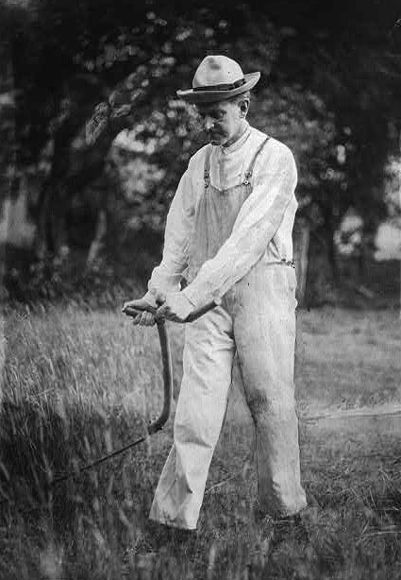
Coolidge working a scythe on one of his fields in Plymouth.

Coolidge working that scythe on one of his fields in Plymouth.

If Government price fixing was not the answer, what other option would address the farmer’s plight? The President turned to a discussion of tariff policy. Coolidge delved not into emotional rhetoric, anecdotal evidence or political pandering to accentuate the unfair deal foisted on the farmer. Instead, he cited the figures and invited everyone to “fact-check” him. If it was discovered that the tariff carried a disproportionate burden on agriculture, it needed to change.

If, however, upon examining the numbers, farmers obtained a high wall of protection from the costs of imported goods, the argument to change fell flat indeed. The facts confirmed that 88 percent of imported goods enter the country free of duty, are luxury items the farmer does not purchase or are paid by industry and commerce on behalf of the farmer. The vast majority, some eighty percent of what is imported free of duty, consists of agricultural goods. This leaves the farmer to pay a maximum of 12 percent for goods he never uses while the other sectors of business pay 36 percent on items “which do not benefit them.” The quantity paid by the farmer decreases even further when the actual expenditures of the average farm household are taken into account. In reality, a mere 1.3 percent of tariff costs falls to the farmer. If anyone is being disproportionately charged under tariff policy, it is anyone but the farmer.

Protection, more than a neutral policy yielded a positive good to agriculture. By exacting costs from foreign products, both the volume of imports and their dilution of American purchasing power was curtailed. It was because of the tariff that the standard of living continued, crop diversification was encouraged and home markets were protected. Because of the tariff employment was kept low and wages remained high. Protection for our own products and labor ensured that foreign competition did not supplant quality with quantity and qualified labor with cheap employment at home. Protection protects the farmer, already struggling as it was, to increase not only the strength of the dollar earned but the ability to employ more here at home, reaping the rewards of market prosperity as a whole. As Coolidge would confirm the service of America’s tariff policy unchanged, he declared, “Protection has contributed in our country to making employment plentiful with the highest wages and highest standards of living in the world, which is of inestimable benefit to both our agricultural and industrial population.” There was no need to redo the law making tariffs any more helpful to farmers than it was already proving to be.

As President Coolidge neared the close of his address, he finally offered what he saw as the soundest answers to the “farming problem.” In Part 3 of our overview, “Silent Cal” gives his take on what can be done in agriculture.
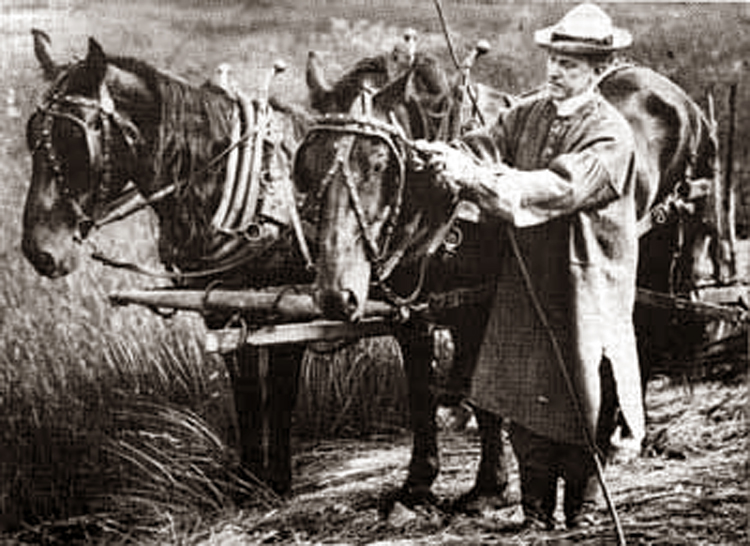
Then-Vice President Coolidge adjusting the gag swivel for one of his horses during work at the Notch, 1920.

Then-Vice President Coolidge adjusting the gag swivel for one of his horses during work at the Notch, 1920.
 

On “The Farmer and the Nation,” Part 1

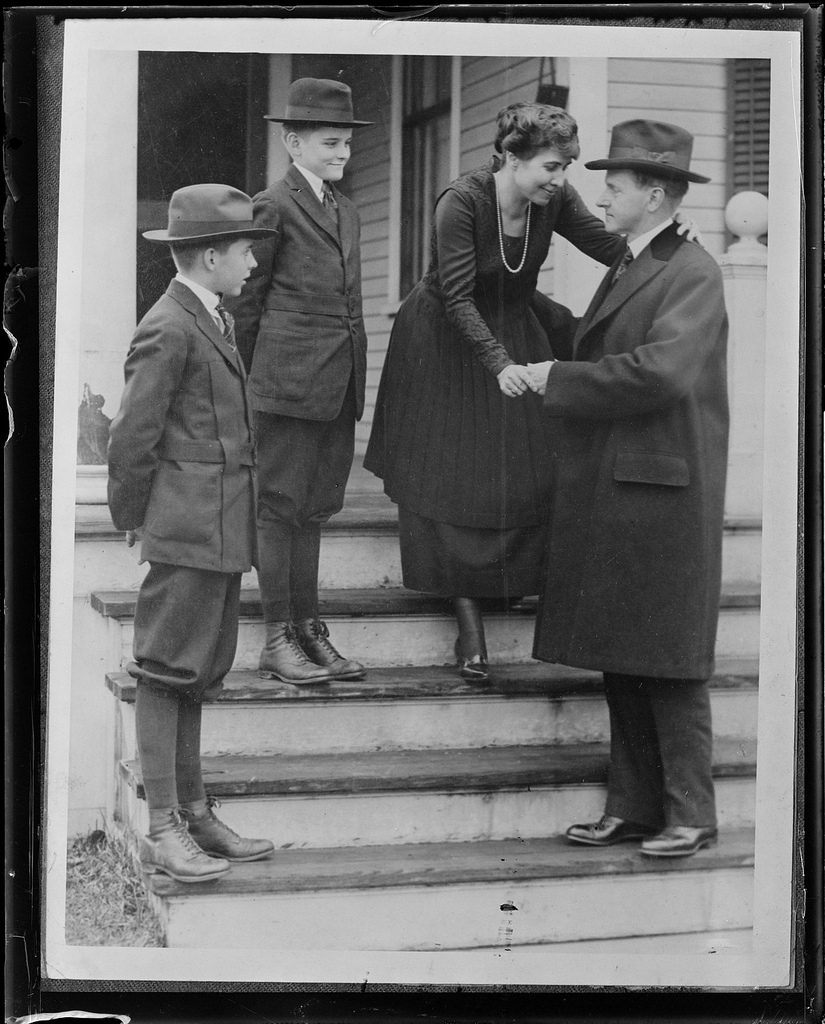
President and Mrs. Coolidge outside the La Salle Hotel during their visit to Chicago, 1925.

President and Mrs. Coolidge outside the La Salle Hotel during their visit to Chicago, 1925.

To say that President Coolidge’s speech before the American Farm Bureau Federation in 1925 was received with skepticism would be an understatement. The 5,000 people assembled in Chicago to hear what the President would say and learn what was ahead for agriculture were neither warm nor receptive. Efforts to empower government control of agriculture had already lost in 1924 despite the energetic support of Agriculture Department Secretary Henry C. Wallace. Unfortunately, Secretary Wallace died suddenly that year and the push for government-subsidized farming was defeated. Congressional support would fall short again in 1926. When the movement gained enough steam to pass, landing on the President’s desk, first in 1927 and again in 1928, Coolidge would veto both attempts for very principled reasons. His vetoes would stand while the policies he articulates here would set the course for American farmers for years to come.

Secretary of Agriculture under Presidents Harding and Coolidge until his sudden death in 1924, Henry C. Wallace is pictured here tending to one of his Jersey cows.

Secretary of Agriculture under Presidents Harding and Coolidge until his sudden death in 1924, Henry C. Wallace is pictured here tending to one of his Jersey cows.

Yet, long before the Congressional battles and Presidential vetoes, Coolidge stood before this gathering of farmers, ranchers, processors, advertisers, the men and women of “agribusiness” to lay out his views on the Nation’s “farming problem.” Coolidge does not receive very high marks from most historians when it comes to agriculture policy. However, the principles he explains here deserve a more honest hearing and respectful appraisal than they have been given today or enjoyed by the audience at the time.

Facing a barely subdued hostility, President Coolidge demonstrated not only his calmness under heat but also the political and personal grit for which he was known all his life. He began with a sweeping reflection on the unique and extraordinary position earned by agriculture in America. He started with praise, not criticism, for the Nation’s incredible success. It had been an incredible transformation in agriculture from what in the Old World had been “uncultured peasants” and “serfs” beholden to work land owned by the Crown. People depended on government to supply their basic subsistence. In contrast, Coolidge reminded his audience, “Agriculture holds a position in this country that it was never before able to secure anywhere else on earth.”

The preceding seventy-five years had brought agriculture to a position unknown in history. “It has become a great industrial enterprise, requiring a broad knowledge in its management, a technical skill in its labor, intricate machinery in its processes, and trained merchandising in its marketings. Agriculture in America has been raised to the rank of a profession.” Coolidge rushes to his point, again reminding his listeners that agriculture “does not draw any artificial support from industry or from Government. It rests squarely on a foundation of its own. It is independent.” Farming in America did not achieve so historic a place by government direction, determining for the individual what he will plant, how much it is worth and where it will be sold. The movement to relinquish the initiative and independent oversight exercised by the farmer would destroy the basis on which agriculture could improve.

As with any great sector of our economy, the “very eminence” of agriculture presented “increasing exactions and difficulties.” The “industry” and “ability” needed to triumph over those obstacles does not come by surrendering the precious independence of the farm to bureaucratic “expertise.” “Whatever other obstacles the American people have had to meet and overcome, of every station in life, they have never permitted themselves to be hampered by a condition of dependence.” President Coolidge, mincing no words, made plain: government controls do hamper, shackle, and restrict people at the worst possible times, when individuals need the freedom to resolve situations quickly and energetically with one’s own judgment, not as Washington slowly allows decisions on its theoretical timetable. “Unencumbered by any special artificial support,” Coolidge admonished, farmers “have stood secure on their own foundation” as opposed to the terms spelled out for them by a central command and control of production and prices. “America is not without a true nobility, but it is not supported by privilege. It rests on worth.”

It is in “our farm life” that a standard of American citizenship displays itself every day. Though diverse, agriculture like America, partakes of the “same high measure of achievement and character.” Coolidge knew firsthand that the farm was not merely in the business of producing food to eat “but as a never-failing source…from which we can always replenish the manhood and womanhood of the Nation.” This was why retaining independence, refusing to resort to government salvation, remained so crucial to Coolidge.

Government dependence exacts a heavy cost upon human life. It robs the individual of her dignity and the person of his humanity. The farm had to continue liberated from the corrosive clutches of bureaucratic stagnation. After all, it was from the same stock that the people fought for and built the country. Americans could not afford to forfeit that spirit of initiative and character. That same spirit manifested itself from Concord bridge with the “shot heard round the world” to the courageous pioneers on the Prairie down to the relentless efforts by those who furnished the supplies needed to turn “the tide for the cause of liberty in the Great War.” America’s independent and rugged farmers had been there through it all. Consequently, America’s gratitude runs deservedly deep for those who farm the land.

Whereas the Old World developed from a centralized power of government to feed and furnish its social classes, reliant on the strength of its crowded cities and affluent metropolises, America was built from its farms. “America,” after all, “never fully came under this blighting influence” of Old World norms. “It was a different type of individual that formed the great bulk of our early settlers.” Gaining results by the cultivation of the soil, the men and women who formed America were not looking to or waiting upon the permission or lordship of sprawling cities or an “industrial population.” The expansive lands, “generous” standards of ownership and technology all collaborated to make possible  “here the first agricultural empire which did not rest upon an oppressed peasantry. This was a stupendous achievement.” It enabled the growth of industry and population to follow, not precede, agriculture.

Poised to become the world’s source of wheat, World War intervened and created a distorted market. Europe’s demand encouraged oversupply and inflated prices. With the end of war, consumption plummeted and prices dropped. The depression of 1920 and 1921 hit farmers — still a solid 25% of the U.S. population — harder than perhaps anyone else. Yet, where many (including much of his audience) saw cause for panic and doubt, Coolidge saw the country incrementally lifting itself out of the valley so that even agriculture was making tangible improvements. It was this review of historical experience that President Coolidge transitioned to the heart of his message: “in order that by a better understanding of the method of its progress and the position it now holds we may better comprehend its needs and better estimate what the future promises for it.”

Coolidge's choice for Secretary of Agriculture fell to William M. Jardine of Kansas. Secretary Jardine would led the counter-charge against government price controls with cooperative marketing and individual initiative.

Coolidge’s choice for Secretary of Agriculture fell to William M. Jardine of Kansas. Secretary Jardine would led the counter-charge against government price controls with cooperative marketing and individual initiative.

Coolidge knew that four years of World War could not be rolled back and prices restored to their former levels. To hope for such a return to what had been abnormal conditions was unrealistic and, ultimately, would help no one. He knew pockets of agricultural endeavors still suffered. He was no Pollyanna, especially when it came to farming because he had come from one of the most remote areas of the country, Plymouth Notch. Yet, surveying the facts and figures of agriculture as a whole, there was no question circumstances were improving since the 1921 depression. Venturing out now on emotional experiments was only going to make the situation worse, not better. Conditions were improving while one timeless truth remained unchanged: life on the farm was always going to be fraught with hardship. No law could exempt anyone from that reality. “Some people would grow poor on a mountain of gold, while others would make a good living on a rock. We can not bend our course to meet the exceptions; we must treat agriculture as a whole. and if, as whole, it can be placed in a prosperous condition the exceptions will tend to eliminate themselves.”As he would argue for in the fight for tax reduction, economic policies needed to be directed at everyone, not a favored few, if the Constitution’s limitation of Federal authority to the “general welfare” of all the people was to honored.

This annoyed his listeners, many of whom, firmly believed that those struggling farmers needed government relief to find a market for what they grew and bolster prices to maintain at least a comparable value to what had been four years prior. Not everyone needed help but those who did, including wheat and cotton farmers, ought to have compensation for the losses suffered. It was unfair that industry had seemingly recovered while agriculture, again seemingly, continued to struggle. Who better qualified to answer those calls for sympathetic help than government, they asserted? The emergency demanded authority to act before agriculture collapsed.

To that baseless forecast of farming’s dire crisis Coolidge next turned. The President had not merely read government reports thrown on his desk but he had traveled the country, met its people and seen its potential. Where some saw failure and catastrophe, the impetus for government intervention, he saw a nation ready to launch into new growth in both farming and industries. It was true that America was already transitioning from a predominantly rural people to an urban population, made possible largely by the mobility of automobile ownership, yet this was “only a part of the story.” To argue for such a drastic takeover of one-fifth of the economy, as agriculture entailed at that time, by government could not be done without fully disclosing all the facts, considering the whole story not merely one side of it. To maintain a sense of doom for agriculture, warranting government step in to save it, was itself a flawed justification, an oversimplification and a gravely short-sighted cornerstone for any public policy.

The President would then explain how, as we shall see in Part 2 of our overview of Coolidge’s address, “The Farmer and the Nation.”

On Wages and Upward Mobility

Image

Speaking in Plymouth, Massachusetts, on September 1, 1919, Governor Calvin Coolidge could have been critical of national conditions, its economic disparity and bleak situation coming out of war and into a still very uncertain peace. It remained to be seen how smooth an adjustment into peacetime America could accomplish. There was much unrest throughout the country and the Wilson administration’s Progressive rhetoric combined with the Justice Department’s prosecution of political threats continued to keep Americans on edge, a palpable anxiety which hovered over the Nation like a cloud.

1919 was not only the year of the Boston Police Strike but witnessed steel, coal and general strikes from Seattle to Johnstown, Pennsylvania. The immense power of the strikers to halt operations throughout the country reminded people they were not to be crossed without serious consequences. The incessant claims that ours was an unfair and inequitable system took a special kind of courage to publicly confront. Governor Coolidge, eight days before most of Boston’s law enforcement would vote to walk away from their duty, would address those gathered in Plymouth in full display of just that kind of courage. He would tackle the heart of the issue head-on covering the issues of labor, wages, equality and opportunity.

He began with sincere praise for America’s exceptionalism, “…[F]or it was here that for the first time in history a government was founded on a recognition of the sovereignty of the citizen which has irresistibly led to a realization of the dignity of his occupation….For the first time in five years it comes at a time when the issue of world events makes it no longer doubtful whether the American conception of work as the crowing glory of men free and equal is to prevail over the age-old European conception that work is the badge of the menial and the inferior. The American ideal has prevailed on European battle-fields through the loyalty, devotion, and sacrifice of American labor. The duty of citizenship in this hour is to strive to maintain and extend that ideal at home.”

In Coolidge’s estimation, unceasing discontent and perpetually-stirred criticism rendered no benefit to anyone and solved nothing — in fact, they were drains of energy when the challenges to be faced demanded constructive effort and optimism on the part of everyone. Creating a false perception that forced Americans into fixed classes to be constantly pitted against each other was not only dishonest but destructive if improvement and progress were to be continued. Fostering dissension and enmity between those perceived to be “Haves” and “Have Nots” was a denial of the Founding and a deceitful manipulation of the real property owners America empowers, the people themselves.

Coolidge continued, “We have known that political power was with the people, because they have the votes. We have generally supposed that economic power was not with the people, because they did not own the property. This supposition, probably never true, is growing more and more to be contrary to the facts. The great outstanding fact in the economic life of America is that the wealth of the Nation is owned by the people of the Nation. The stockholders of the great corporations run into the hundreds of thousands, the small tradesmen, the thrifty householders, the tillers of the soil, the depositors in savings banks, and the now owners of government bonds, make a number that includes nearly our entire people.”

Citing the figures of Massachusetts alone proved this assertion and laid bare the simplistic notion that justice could be legislated after “assuming that we can take from one class and give to another class.” The “property class” was already one and the same as the “employed class.” The interdependence of interests made it impossible to separate them and preserve what was good or just for either one. Reflecting on the fact that Massachusetts was an industrial state, he raised a series of questions that illustrated the path America would have to take to grow. It lay not in the direction of jealousies, hatred and class warfare but in expanding opportunity, not regulation, and raising prosperity for everyone through policies that encourage profits and its by-product, employment. He asked, “How can our people be made strong? Only as they draw their strength from our industries. How can they do that? Only by building up our industries and making them strong. This is fundamental. It is the place to begin. These are the instruments of all our achievement. When they fail, all fails. When they prosper, all prosper. Workmen’s compensation, hours and conditions of labor are cold consolations, if there be no employment. And employment can be had only if some one finds it profitable. The greater the profit, the greater the wages.”

In this economic axiom, Coolidge made clear the need, not to demonize profits, but to welcome them as a legitimate part of unchaining America’s economic potential. Coercive legislation was not the answer to higher wages. Clearing away the hampering clutter of controls that made people’s participation in the marketplace unprofitable was the solution. This raised wages. The increase in value of each individual’s labor is not determined by penalizing growth and punishing employment. The increase in value manifests itself in higher wages. The value of the individual’s work is as limitless as that person’s potential. Yet, it grows in proportion to the profitability of the enterprise to which a person’s labor is invested. If profits are suppressed, expansion of opportunity stops and, sooner or later, so does employment itself.

Governments, inept at accurately gauging the value of labor cannot set wage rates without harming growth and continued employment. In short, Governments in the business of setting wages always hurt the most vulnerable Americans, the very people wage laws claim to be helping.

Coolidge reminds us of these obvious and yet repeatedly forgotten truths. If we genuinely want everyone to prosper, we can only accomplish it by building up, not tearing down, America’s engine of growth. We do this not through constant appeals to prejudice and anger but through constructive work, encouraging the opportunities to be found in a marketplace of growing value and expanding opportunity. In such an environment, employment, higher wages, increasing profits and upward mobility are made possible for anyone with the will and determination to achieve his or her highest potential. That potential, the ability to work for yourself and keep the rewards of that labor is an American concept. It is through this recognition of the dignity of work, what Coolidge called the “crowning glory” of a free and equal people, that so extraordinary a success has been enjoyed here in America.

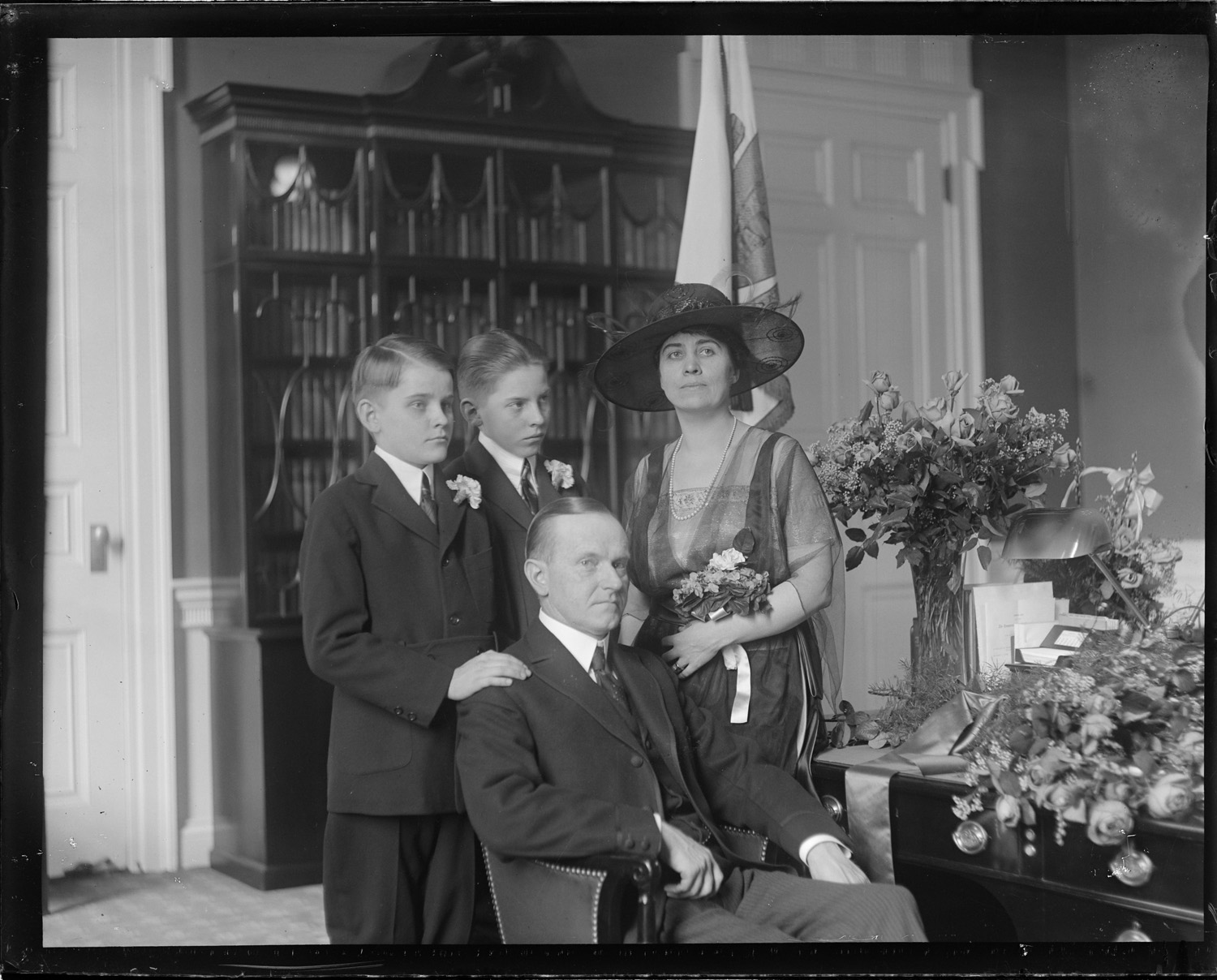
Governor CC at home

Economic power cannot be repeatedly stifled and thwarted without an accompanying loss to the people’s political power. Both powers are inseparably joined. While the force of Government fails whenever it attempts to harness capitalism for its own, vastly different ends, America still proves that freedom works.