CALVIN COOLIDGE: “Civilization and progress depend upon the genius of the people themselves, but that genius depends to a large extent upon the ability to perceive and accept leadership…”
“As society grows more complicated, as civilization advances, the burden of its support is not less; it is more. It was never so great as now. Society in America is in a healthy state of progress…”
“It is not enough to teach men science; the great thing is to teach them how to use science…”
“Unless the moral power of the world increases in proportion to its scientific power there is a real danger that the new inventions will prove instruments of our own destruction. If moral development keeps step, peace and good will have gained new allies…”
Last August the George W. Bush Institute, the Debate Institutes at Dartmouth and the state of Vermont partnered with the Calvin Coolidge Memorial Foundation to launch the first of what we hope are many debates to come over a range of topics. Involving some 100 high school students from 22 states, it brings the young and old together to think anew on economics, grappling with many of the same fundamentals that Calvin Coolidge faced not only in the academic halls of Amherst but in the increasingly globalized market that flourished during his administration. The next one, coming August 1 of this year, is sure to be immensely rewarding for all participants.
Writing to his father on November 13, 1892, he recounted the value of what results from classical education, which included a healthy portion of logical reasoning and debate skills, “President Gates preached to us this morning, his text ‘As a man thinketh, so is he.’ He discussed it from a psychological point of view and urged upon us the importance of keeping our thoughts centered along strong and profitable lines. It was not an exhortation to work harder on our studies but rather to keep before us some great and noble thoughts around which our whole personality might centre not as a narrow specialist but as a broad and liberal cultured man.” Occam’s razor has reduced too many educational institutions down to a restrictive specialization at the expense of inspiring students with the whole picture of existence, an entirely logical worldview grounded in the pursuit of truth.
Calvin described what happened when he took on the best debater at Amherst, in another letter to his father, dated January 14, 1894, “I had a debate yesterday as to whether a Presidential or Parliamentary form of government is the better; I had the Parliamentary side which is not particularly popular in as much as it is really to show England’s government is better than ours, and I spoke against Pratt of Brooklyn who is a very good debater and a general favorite being captain of our football team. But the Parliamentary side won by a large majority when the question was decided.” The encouragement fostered by the debates at Plymouth Notch are contributing mightily to help students and teachers, children and adults alike to apply the mind again to the art and discipline of good debating. Moreover, they are learning to think through the problems Calvin Coolidge encountered and thereby gain a greater appreciation not only for how he approached the problems of his day but also how to apply reasoned solutions for the future.
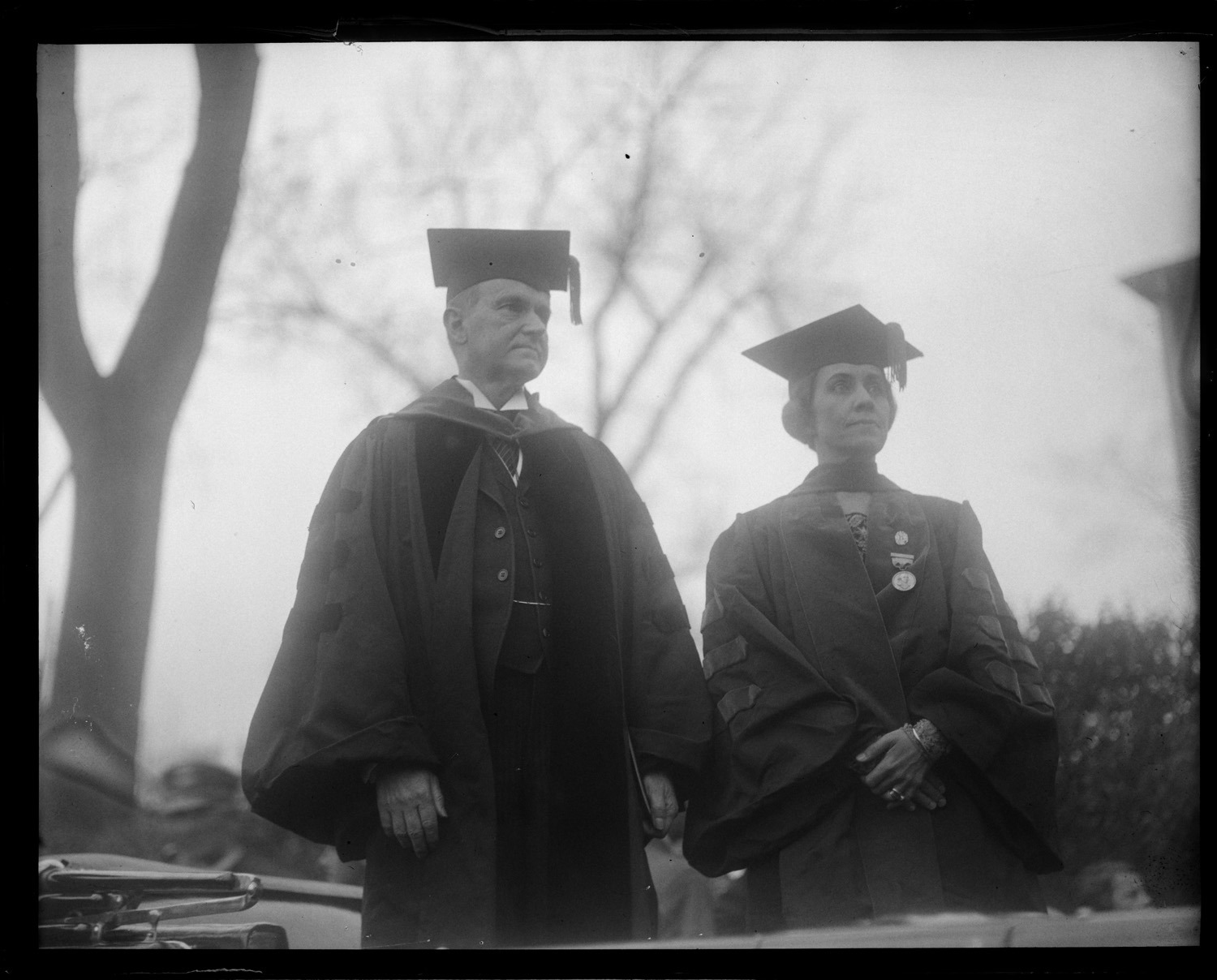
The Coolidges at Andover, May 1928, where Coolidge spoke at commencement before more than 10,000 people, including a class of 650.
Here is an awesome half-hour presentation of the life and landmark accomplishments of Calvin Coolidge by superb scholar Jerry Wallace to the Wichita Pachyderm Club. His irreplaceable volume Calvin Coolidge: Our First Radio President has contributed so much toward shattering the myth that Cal was too inept and silent to make use of the new medium of radio. In fact, Mr. Wallace explains that far from being a failure, Calvin Coolidge bequeaths an historic legacy as not only a masterful communicator but effectual doer and successful President. This is well worth the listen!

 The Importance of the Obvious