On Pan-American Trade

The Coolidges and Ambassador Dwight W. Morrow attend the International Conference of American States, December 1928

The Coolidges and Ambassador Dwight W. Morrow attend the International Conference of American States, December 1928

The Twenties were a decade for Pan-American, or otherwise international, conferences. Coolidge took part in no less than eight during his service in Washington. The issues of international commerce, Pan-American relations, the roll back of “dollar diplomacy” and question of tariff policy revision seemed to attract him to a degree not unlike his commitment to government economy. No one can credibly argue that the Coolidge years were isolationist in outlook or activity. He took every opportunity to personally address those gatherings of private individuals who met to discuss a host of topics from standardization, sanitation, journalism, radio, highways, trade, aviation and many more concerns. As Vice President, Coolidge spoke before the Pan-American Conference of Women sponsored by the League of Women Voters in April 1922. As President he would address the First Pan American Congress of Journalists (April 8, 1926), the Third Pan American Commercial Conference (May 3, 1927), the First International Congress of Soil Science (June 13, 1927), the opening day of the International Radiotelegraph Conference (October 4, 1927), the Sixth Pan-American Conference held in Havana, Cuba (January 16, 1928), the Pan-American Conference on Arbitration and Conciliation (December 10, 1928) and the International Civil Aeronautics Conference (December 12, 1928).

When it concerned America’s connection to the sovereign nations to our south, Coolidge was there at every turn. The Fordney-McCumber Tariff signed by President Harding in 1922, sought to return a higher ad valorem rate to the tariff system, where American-made goods were protected for their value to the markets beyond merely their quantity, size, weight or other factors. The vast majority of goods on the market, no less than sixty percent, were completely free of duties. The Tariff protected American manufacturing while keeping rates low for agricultural products and raw goods. An average 14% increase in rates protected manufacturers from inferior-quality goods flooding the markets and thereby harming both the producer, who has to raise prices to meet higher costs against a cheaper, higher quantity of products, and the consumer, who is left spending more money in the end to replace inferior goods with ones that last. The protective rates, working together with both a large decrease in taxes and reduction in Federal spending, fueled the recovery that brought America out of the 1921 depression and continued (thanks to the Coolidge insistence on economy and tax cuts of 1924, 1926 and 1928) to encourage the spread of prosperity throughout all economic tiers through the rest of the decade. Rather than remaining on course, however, the next administration dismantled the delicate balance of tariff policy up for debate at the worst time. It was the discussion to raise rates even higher in 1929, leading to the passage of a new bill, the Smoot-Hawley Tariff, that unleashed an average 20% increase on dutiable imports, a 60% tax increase on over 3,000 imported products and resulted in a destructive series of retaliatory tariff increases by our trading partners around the world. Despite the firm opposition of more than 1,000 economists to the looming increases, President Hoover signed the bill into law in June 1930. While initial figures seem to indicate it was working at first, trade had collapsed and depression only deepened as a result by the spring of 1932.
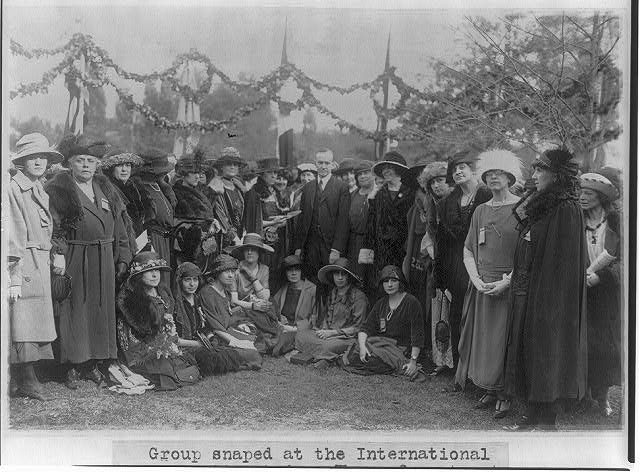
Coolidges at the Pan American Conference of Women, Baltimore, April 28, 1922. Delegates from 21 nations took part in the gathering.

The Coolidges at the Pan American Conference of Women, Baltimore, April 28, 1922. Delegates from 21 nations took part in the gathering.

However, all this was in the future. As Coolidge took the podium to address the entrepreneurs and business men and women of North, Central and South America, imports in raw materials stood on mutually advantageous terms. As Coolidge will point out, this gathering was not a meeting of government bureaucrats and political operatives, it was a voluntary conference between private individuals exchanging ideas, seeking to better understand the needs, problems and market solutions of free peoples, sharing in the “civilizing influence of commerce.” It was not a forum of coercion presenting terms that benefited one at the expense of others with the aid of American money, military might or political deals. It was part of a the grander movement that “rests on the principle of mutual helpfulness,” which is free market capitalism as it naturally exists. Markets, free of state control, are not driven by Bentham’s mechanistic view of people as but utilitarian cogs in a system but rather fellow collaborators, willingly helping supply and be supplied with what each individual needs.

Coolidge commended this gathering of minds and talents from across our Hemisphere for its true merit which lay “in the fact that it represents not government but private industry.” After all, governments do not create, people engaged in commercial relationships do. “Governments do not have commercial relations. They can promote and encourage it, but it is distinctly the business of the people themselves. If this desirable activity is to grow and prosper, if it is to provide the different nations with the means of self-realization, of education, progress, and enlightenment, it must in general be the product of private initiative.” Keenly aware of the political discontent to the south coupled with a clearly harmonious relationship then existing between Pan-American suppliers and U.S. manufacturers, Coolidge continued, “Under free governments trade must be free, and to be of permanent value it ought to be independent. Under our standard we do not expect the Government to support trade; we expect trade to support the Government. An emergency or national defense may require some different treatment, but under normal conditions trade should rely on its own resources, and should therefore belong to the province of private enterprise.”
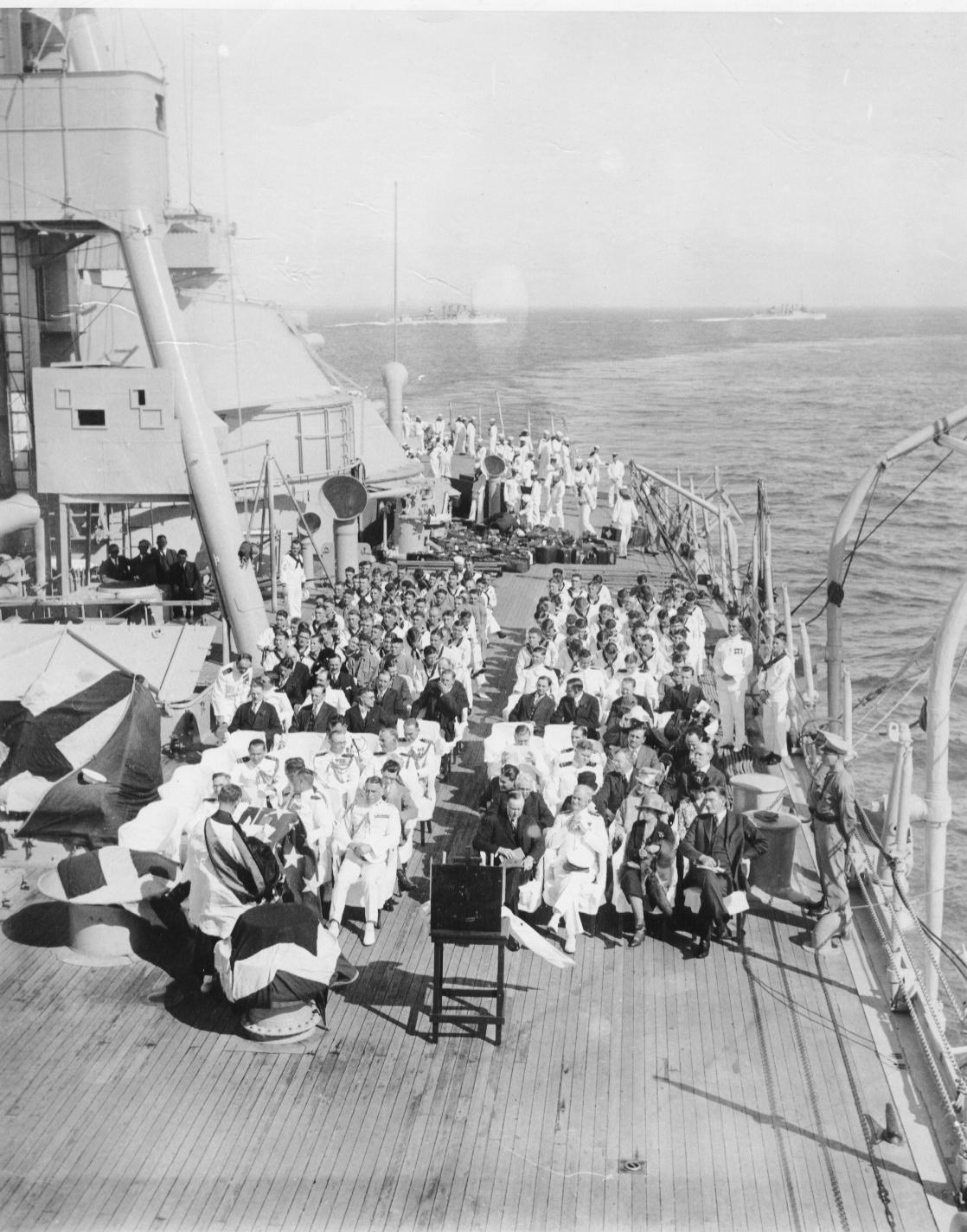
The Coolidges en route to Havana to attend the Sixth Pan American Conference, January 1928. They can be seen seated on the front row to the right on the deck of the USS Texas.

The Coolidges in worship services  en route to Havana to attend the Sixth Pan American Conference, January 1928. They can be seen seated on the front row to the right on the deck of the USS Texas.

That policy, which lifted America out of depression in 1921 and since 1913 had raised it as the foremost market for Central and South American raw goods, from wood and copper to cane sugar, coffee and food stuffs, was yielding benefits overwhelmingly in favor of our neighbors to the south. If there was any dominant partner, it was South and Central America, who held nearly all of our money in unprocessed materials. The dependence on Europe for a market had decisively changed. Now the United States was buying more in the markets of Central and South America than it was selling. The clear beneficiary was the collection of American Republics south of the Rio Grande. This was not an unsettling or harmful development, in Coolidge’s judgment. It was a definitive good and a proof that markets, allowed freedom within marginal tariff rates on a small portion of goods, are mutually advantageous to all participants. “It is our conclusion that while government should encourage international trade and provide agencies for investigating and reporting conditions, those who are actually engaged in the transaction of business must necessarily make their own contacts and establish their own markets. There is scarcely any nation that is sufficient unto itself. The convenience and necessity of one people inevitably are served by the natural resources, climatic conditions, skill, and creative power of other peoples. This is the sound basis of international trade. This diversity of production makes it possible for one country to exchange its commodities for those of another country to the mutual advantage of both. It is this element that gives stability and permanence to foreign commerce. It contributes to satisfying wants and needs, and so becomes help to all who are engaged in it.”

Vice President Coolidge entertains South American delegates to the Chile-Peru conferences then in session at Washington, June 1, 1922.

Vice President Coolidge entertains South American delegates to the Chile-Peru conferences then in session at Washington, June 1, 1922.

Coolidge did not merely praise the broad outlines of growth and commercial collaboration between the Americas, he lauded the specific directions it was taking in the development of transportation, improving the speed the travel by ship, rail, road and air. Coolidge complimented the great network of exchange not only for its material improvement but especially for its conveyance of ideas, its sharing of information, education and communication, embodied in the cable and radio, the Pan American postal agreement, the opening of roads and the clearing of new commercial horizons that resulted. In short, this meant a “more abundant life for all concerned,” not only materially but spiritually.

As he closed his remarks to these market pioneers and creative adventurers from across the Western Hemisphere, Coolidge came back to the intangible importance of what this movement meant. “It is this mutual interdependence which justifies the whole Pan American movement. it is an ardent and sincere desire to do good, one to another. Our associates in the Pan American Union all stand on an absolute equality with us. It is the often declared and established policy of this Government to use its resources not to burden them but to assist them; not control them but to cooperate with them. It is the forces of sound thinking, sound government, and sound economics which hold the only hope of real progress, real freedom, and real prosperity for the masses of the people, that need the constantly combined efforts of all the enlightened forces of society. Our first duty is to secure these results at home, but an almost equal obligation requires us to exert our moral influence to assist all peoples of the Pan American Union to provide similar agencies for themselves. Our Pan American Union is creating a new civilization in these Western Republics, representative of all that is best in the history of the Old World. We must all cooperate in its advancement through mutual helpfulness, mutual confidence, and mutual forbearance.”
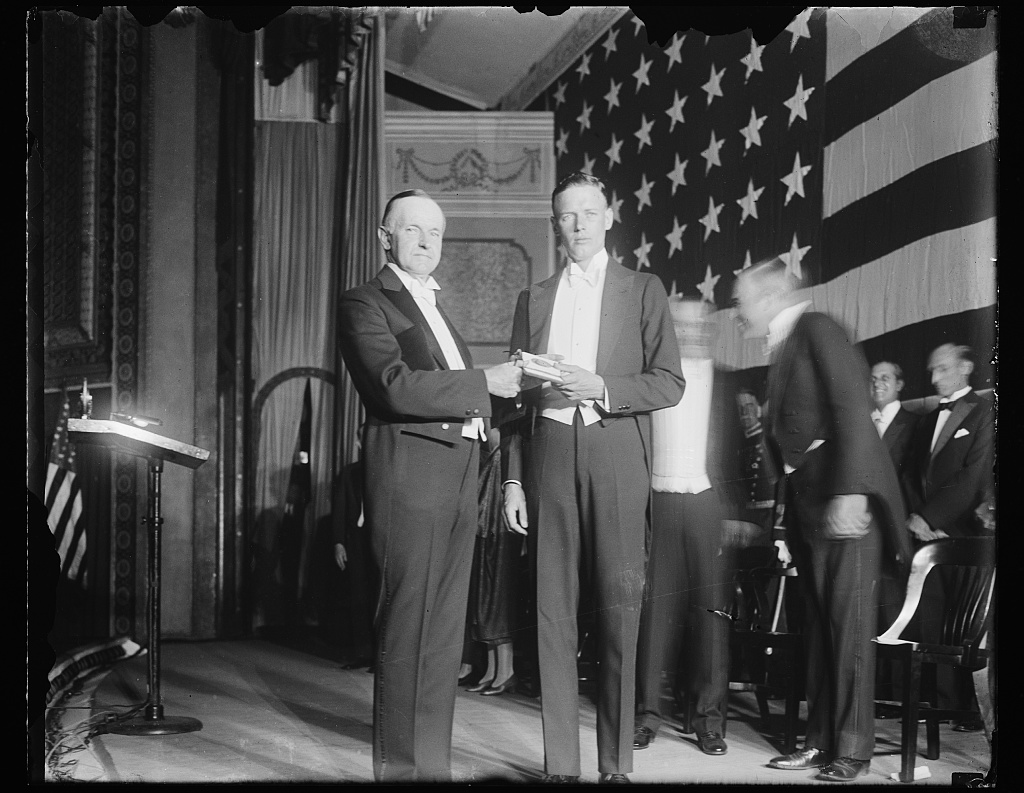
Calvin Coolidge and Charles Lindbergh, November 1927. Lindbergh was virtually conscripted as an ambassador of good will to Latin America, on an even grander scale than the pilots of the Pan-American Goodwill flight of 1926. The diplomatic campaign, on the "wings" of Lindbergh's remarkable solo crossing of the Atlantic that summer, did much to advance Latin American relations. Lindbergh would also meet his future wife, Anne Morrow, as a result of his unwitting venture into diplomacy.

Calvin Coolidge and Charles Lindbergh, November 1927. Lindbergh was virtually conscripted as an ambassador of good will to Latin America, on an even grander scale than the pilots of the Pan-American Goodwill flight of 1926. The diplomatic campaign, on the “wings” of Lindbergh’s remarkable solo crossing of the Atlantic that summer, did much to advance Latin American relations. Lindbergh would also meet his future wife, Anne Morrow, as a result of his unwitting venture into diplomacy by airplane.

“We Must Turn Back Picketty’s Charge” by Burt Folsom

“We Must Turn Back Picketty’s Charge” by Burt Folsom

Dr. Folsom has another excellent analysis of the latest (and still just as devoid of substance) “scholarly” plea for taxing “the rich” so that government “helps the poor.” That “help” never gets to those who actually need it, does it? Folsom’s new article, looking back on the ground laid by Hoover and FDR in the 1930s, reminds us that there is nothing new under the sun and redistribution still fails every time. As Coolidge once said, “No matter what any one may say about making the rich and the corporations pay the taxes, in the end they come out of the people who toil. It is your fellow workers who are ordered to work for the Government every time an appropriation bill is passed.”

On Ulysses Grant

Dedication of the Grant Memorial near the foot of the Capitol Building, where Vice President Coolidge delivered these remarks, 1922.

Dedication of the Grant Memorial near the foot of the Capitol Building, where Vice President Coolidge delivered these remarks, 1922.

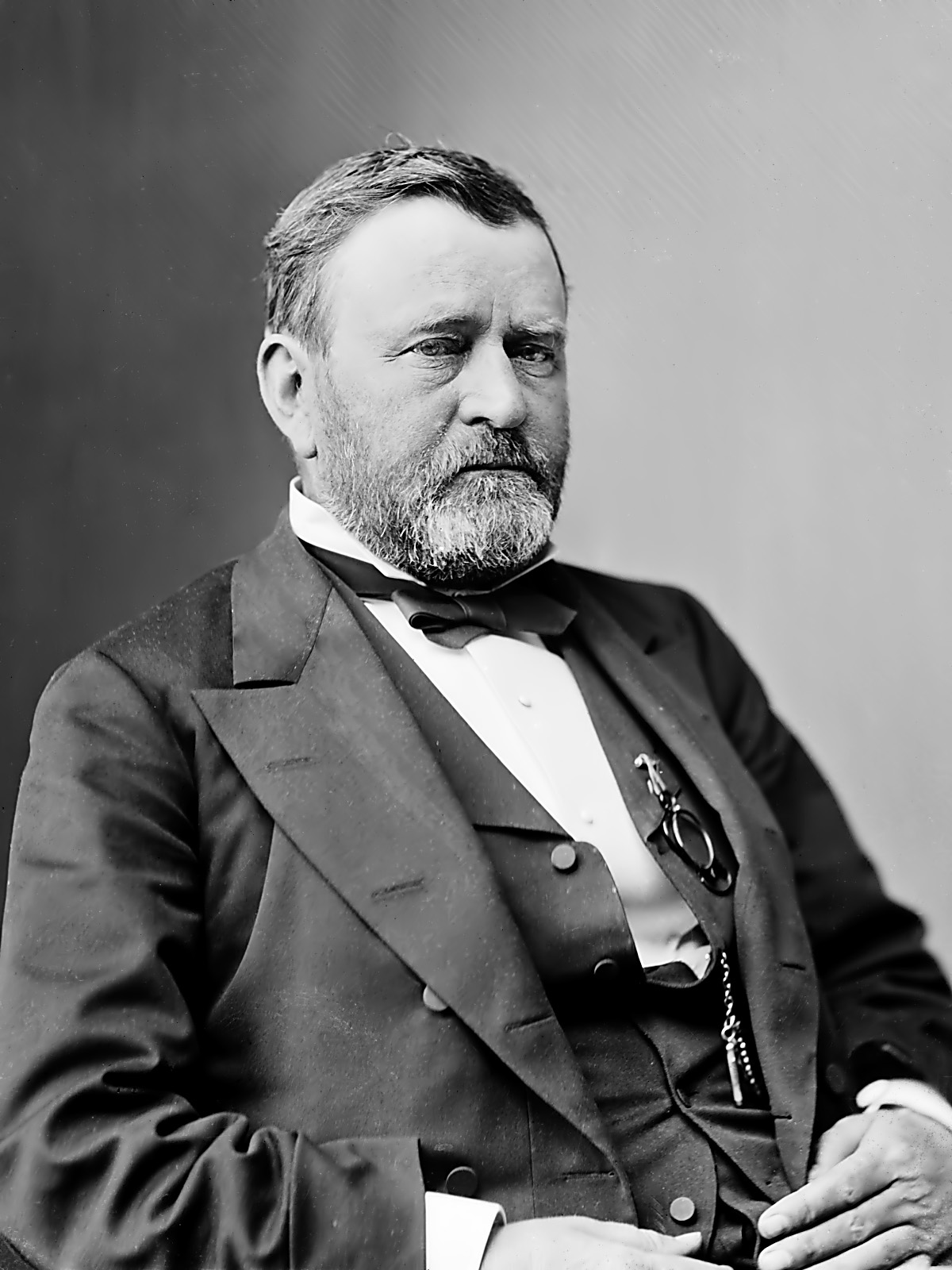
Ninety-two years ago, 1922, marked the occasion Vice President Coolidge dedicated the Monument to General Ulysses S. Grant in Washington, coinciding with the centennial of President Grant’s birthday, April 27. As with many of his predecessors in the Presidency, Coolidge (though yet to rise to that great office) would have some very thoughtful and profound assessments of the man and his contributions to our institutions, our republican system and to liberty itself.

Grant was, and rightly belongs, among those we honor as a “great American, who was sent into the world endowed with a greatness easy to understand, yet difficult to describe: the highest type of intellectual power–simplicity and directness; the highest type of character–fidelity and honesty. He will forever hold the admiration of a people in whom these qualities abide. By the authority of the law of the land, with the approving loyalty of all his fellow countrymen, in the shadow of the dome of the Capitol which his work proved and glorified fittingly, flanked on either side by a group of soldiers in action, looking out toward the monuments of Washington and Lincoln, this statue rises to the memory of General Ulysses Simpson Grant. It is here because a great people responded to a great man.”

“…He had the ordinary experiences of the son of an average home maintained by a moderately prosperous business. He went to West Point, not so much with the purpose of becoming a soldier as from a desire to secure an education. He liked horses and rode well. He did not appear brilliant, but he had industry. He worked. He made progress. He had that common sense which overcame obstacles. After his graduation he remained in the army for eleven years, rising to the rank of captain” serving through the Mexican War, resigning voluntarily in 1854. “Destiny sent him to private life, where he could better feel the rising tide of freedom. The next few years he spent as a farmer and a business man. He still worked hard, but he did not prosper, scarcely making a living. He had little taste for small things; it required an emergency to call forth his powers.” The “great crisis” of Union found him in Illinois, working his father’s craft, leather. Volunteering himself again, he declared, ‘Whatever may have been my political opinions before, I have but one sentiment now. That is, we have a government and laws, and a flag, and they must all be sustained.’

Appointed by the Governor to lead the 21st Illinois Regiment, he took command with characteristic directness, ” ‘Men, go to your quarters.’ Within four years he was to be recognized as the greatest soldier in the world.” His capture of Fort Henry and Fort Donelson, his struggle at Pittsburgh Landing and finally his success at the surrender of Vicksburg combined to make Grant a major-general in the regular army. However, it was at Lookout Mountain and his maneuvers at Chattanooga that “demonstrated his great military genius, both of plan and execution.” The following March would find him taking command of the Army of the Potomac, unleashing “blow upon blow from the Wilderness to Appomattox…”

general-grant-standing

“…His work finished, though the President had invited him to attend the theatre, he left the city on that fatal evening of April 14. He mourned the loss of Lincoln, but his first allegiance was to his country. His attitude toward Johnson was all that could be required of a general toward his commander-in-chief, until the President, seeking to embroil him in his own political disputes, charged him with bad faith…While Johnson sank in the public estimation, Grant rose, being unanimously nominated and handsomely elected President of the United States.” Coolidge was four months old. As a boy, he would acquire a deepening respect the more he learned of the first President he would recall in youth.

Grant “had little taste for political manuevres. He found his eight years fell on a time of confusion, both of thought and action. He worked as best he could with the contending elements which made up Congress…Although he broke with a well-meaning reform element of his party, which supported Horace Greeley, he was triumphantly re-elected. One of the important contributions which he made to the public service was his veto of the bill which provided for the inflation of the currency by issuing $400,000,000 in greenbacks. At a time when the political ideals of the country were very low, President Grant held to his own high standard of honorable public service…”

“…Through the contested election of Hayes and Tilden, in 1876, he took a course marked by a high spirit of patriotism. ‘No man worthy of the office of President, should be willing to hold it if counted in or placed there by fraud. Either party can afford to be disappointed in the result. The country cannot afford to have the result tainted by the suspicion of illegal or false returns.’ When the man who knew how to command armies took this position for the enforcement of the law, the country stood behind him and peacefully accepted the decision of the electoral commission.”

Grant in retirement

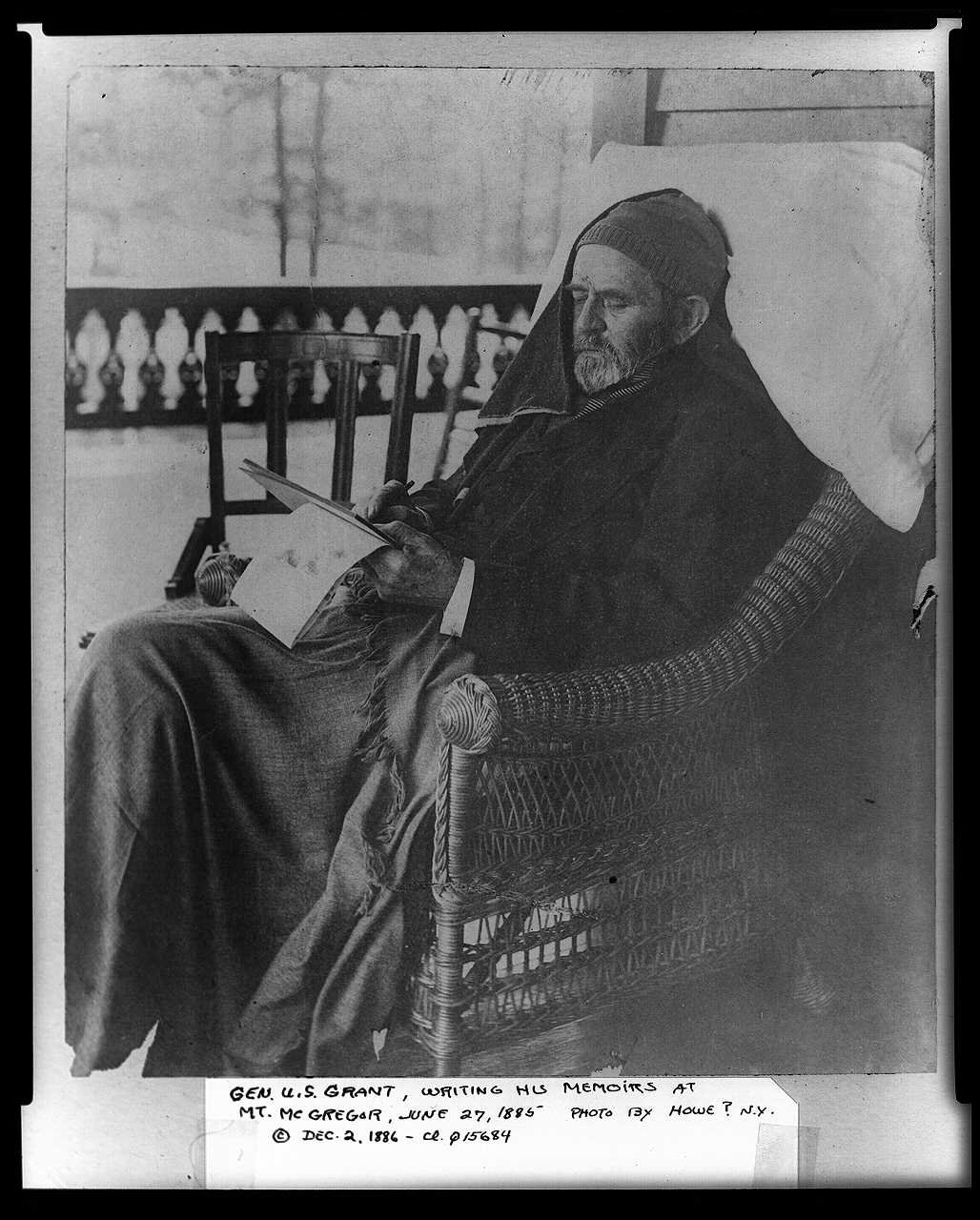
“His closing years were marked with great tragedy. Betrayed by one whom he trusted, he saw his property dissipated and large obligations incurred. A lingering and fatal malady added anguish of the body to the anguish of his soul. Never was he greater than in these last days. With high courage, without complaint, on a bed of pain, seeking to retrieve his losses, he was preparing his memoirs…He was still thinking of his country, not as a partisan but as a patriot, not even as the general the armies he had led but as an American.” Being near death, he observed, “I have witnessed since my illness, just what I have wished to see since the end of the war–harmony and good-will between the sections.”

“…Great as he had been, his armies had been greater still…As they supported him in the field, their bronze forms support him here.”

Coolidge would reflect on Grant’s great enemy, General Robert E. Lee, seeing two equally noble champions of integrity, recalling that both reflected what was best about America just when it was most needed.

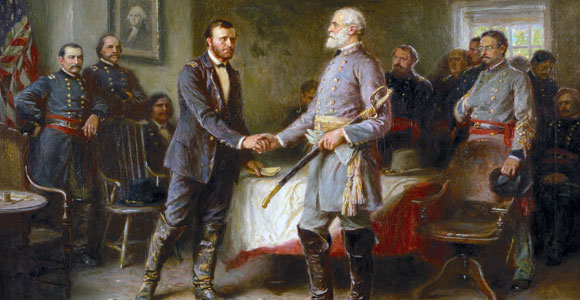
“Men are made in no small degree by their adversaries. Grant had great adversaries. They fought with a dash and a tenacity, with a gallantry and an enduring purpose which the world has known in Americans, and in Americans alone. At their head rode General Robert E. Lee, marked with a purity of soul and a high sense of personal honor which no true American would ever stoop to question. No force ever quelled their intrepid spirit. They gave their loyalty voluntarily or they did not give it at all.”

“It is not so much the greatness of Grant as a soldier but his greatness as a man, not so much his greatness in war as his greatness in peace, the consideration, the tenderness, the human sympathy which he showed toward them from the day of their submission, refusing the surrender of Lee’s sword, leaving the men of the Southern army in possession of their own horses, which appealed to that sentiment of reconciliation which has long since been complete. It was not a humiliation but an honor to remain under the sovereignty of a flag which was borne by such a commander…”

grant-lee

Summing up the significance of this great American and honorable President, never an easy task, seems effortless in the words of Coolidge,

“Our country and the world may well consider the simplicity and directness which marked the greatness of General Grant. In war his object was the destruction of the opposing army. He knew his task was difficult. He knew that the price would be high; yet amid abuse and criticism, amid misunderstanding and jealousy, he did not alter his course. He paid the price. He accomplished the result. He wasted no time in attempting to find some substitute for victory. He held fast to the same principle in time of peace. Around him was the destruction which the war had wrought…He refused to seek refuge in any fictions. He knew that sound money values and a sound economic condition could not be created by law alone but only through the long and toilsome application of human effort put forth under wise law. He knew that his country could not legislate out its destiny but must work out its destiny…His policy was simple and direct, and eternally true. In the important decisions of his life his fidelity and honesty are equally apparent…He never betrayed a trust and he never deserted a friend. He considered that the true test of a friend was to stand by him when he was in need. When financial misfortunes overtook him he discharged his obligations from whatever property he and his family could raise. Here was a man who lived the great realities of life…There was no artifice about him, no pretense, and no sham. Through and through he was genuine. He represented power.”

“A grateful republic has raised this monument not as a symbol of war but as a symbol of peace. Not the false security, which may come from temporizing, from compromise, or from evasion, but that true and enduring tranquility which is the result of a victorious righteousness. The issues of the world must be met and met squarely. The forces of evil do not disdain preparation, they are always prepared and always preparing…The welfare of America, the cause of civilization will forever require the contribution of some part of the life of all our citizens to the natural, the necessary, and the inevitable demand for the defense of the right and the truth. There is no substitute for a militant freedom. The only alternative is submission and slavery.” What Grant gave, “America shall give.”

president-ulysses-s-grant