On Thrift

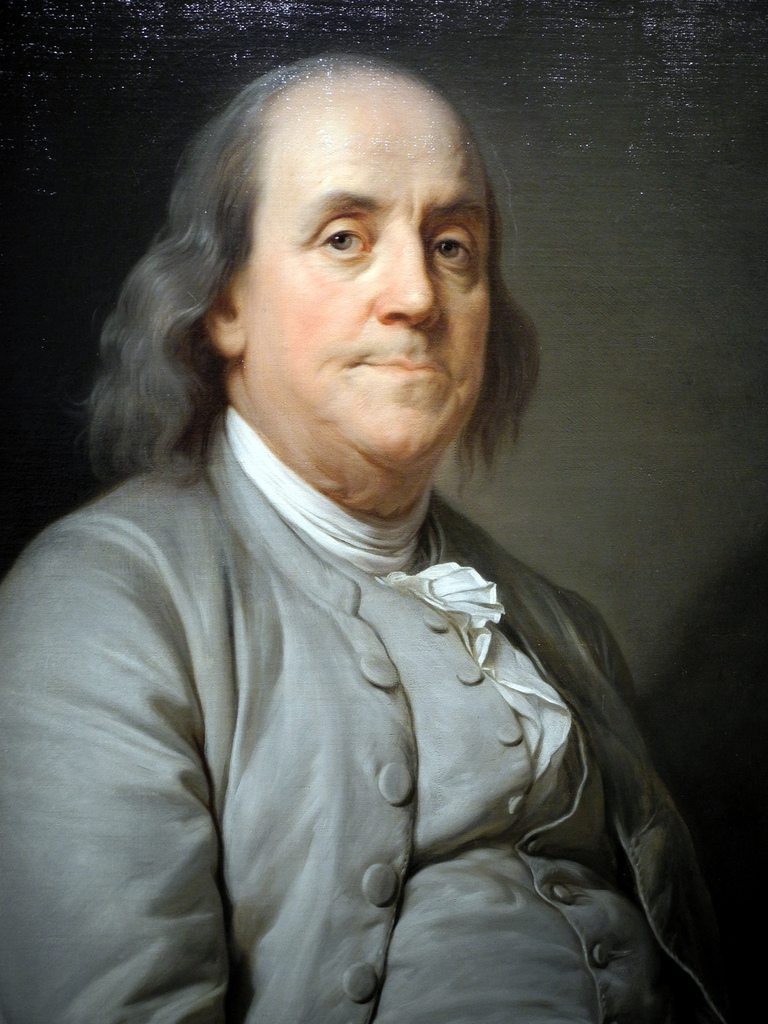
Ben Franklin, painted by Joseph S. Duplessis, 1778.

Ben Franklin, painted by Joseph S. Duplessis, 1778.

“The third week of January has been designated as a time for considering the advantages of thrift, perhaps in part because it follows the birthday of Benjamin Franklin.

“Thrift does not mean parsimony. It is not to be in any way identified with the miser. The thrifty person is one who does the best that is possible to provide for suitable discharge of the future duties of life. In its essence it is self-control. Industry and judgment are required to achieve it. Contentment and economic freedom are its fruits.

“Most frequently we identify the thought of thrift with various institutions that have been provided to make it effective…But the main principle is saving today something that will be useful tomorrow. The whole theory of conservation is included. Money is only an incident.

“Just at present we need to apply the principle to saving and increasing the strength of our governmental and social structure as well as our economic fabric. We must not squander these precious possessions. And, above all, a wise thrift now calls for the expenditure of money to save people” — Calvin Coolidge, January 17, 1931.

The reader is generally right on board with Mr. Coolidge until that very last sentence. How can the economical “Silent Cal” be advocating “expenditures” to meet the worsening depression? Was he inconsistent? Was he succumbing to contradiction with his own record or what he would write throughout his daily columns about the need for a return to greater economy by government?

As Charles Willis Thompson observed in his book, Presidents I’ve Known and Two Near Presidents, Coolidge possessed an exceptional gift for style as one of very few Presidents who were true literary men (pp. 369, 370-1). Yet, there was something peculiar about the way he expressed his thoughts. While he packed more substance into fewer words than the vast majority of public officials have, there was something more than economy of expression. Thompson, in his quest to understand Coolidge, found that “he never said or wrote anything that did not have a certain peculiarity about it. That peculiarity was that there was always at least one sentence which made you say as you read idly through, ‘Hey, what’s that? Let me read that again.’ It hit you between the eyes. When you read it again you stopped for a while to think about it” (p. 361). The closing thought of his piece on thrift is that kind of sentence. It seems to go against everything he just said. That is what compels us to dig further, think deeper and reach beyond a surface appraisal of the man, his mind and what he is saying to us here.

So, what did he mean? On the very next day, he employs our word “expenditure” yet again. His subject, though, is not government acting through the public Treasury but the American Red Cross. Coolidge had confronted in previous articles and would again nine days later the “delusion” that governments spending money to “revive business” never yields the prosperous results promised to everyone. It requires borrowing money we do not have and expecting “salvation” to come out of deeper debt and increasing waste. It only postpones the very prosperity governments claim will finally arrive if we simply spend more.

Coolidge was not talking about public expenditures when he spoke of thrift on January 17. He was referring to the driving force of the marketplace, you and I, not the government. Recovery begins with us. Government needs to save money and strength at the same that “a comparatively small expenditure made now will avert a possible future calamity.” The notion that emergencies, real or contrived, demand expansive plans and exorbitant costs has failed throughout history, whether it is called the “Square Deal” (Teddy Roosevelt), the “New Deal” (Teddy’s cousin Franklin), the “Fair Deal” (Harry Truman) or the “Great Society” (Lyndon Johnson), the result is the same trail of avoidable destruction to real people’s lives. Coolidge meant private charity, local support by the individuals, civic organizations and institutions we sustain with time and monetary resources. These “expenditures” are what “save people,” not the latest extension of unemployment benefits, another stimulus package or postponing budgetary cuts that hurt dependence but need to be done for a sane, self-sustaining and solvent future.

When Coolidge spoke of spending to save, he was not succumbing to a politician’s obfuscation of language, he was reminding us of what he had been saying from his earliest days in public service, “Government cannot relieve from toil…The normal must care for themselves. Self-government means self-support.” It is by spending ourselves and our resources in the service of others locally as free men and women that saves lives, not merely consenting to a government as it confiscates the means of “someone else less deserving” in order to redistribute to those it deems “more deserving.” If we are to remain free, we are called upon to exercise the obligations which accompany that freedom. It is in the practice of thrift, manifested by individuals in both saving and spending, that we and those who most need help receive it without recourse to government expenditures.

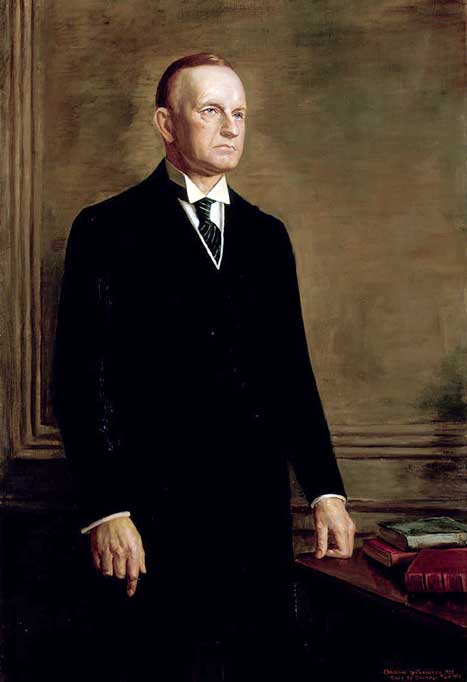
CC by Joseph Burgess 1956 copy of Cartotto

On Accounting for Coolidge Popularity

Image

It may come as a surprise that a coterie of critics, some members of the press and even a Party establishment existed in Coolidge’s day. They were hostile to the notion that one not of their number, lacking in sophistication or elite pedigree, could attain to the Presidency. Taken together they are what Charles Willis Thompson called, “The Intellectuals.” It is no different now for anyone with the courage and common sense to run for elective office independent of and without approval from the self-appointed political and cultural establishment. The Intellectuals had to reckon with Coolidge’s genuine and immense popularity. Henry Cabot Lodge, Republican Senator of Massachusetts, when told that Coolidge was being considered by some to lead the national ticket in 1920, sneered, “Nominate a man who lives in a two-family? Never!”

The fact that Coolidge, from his earliest years in state politics, consistently garnered more votes than any other Republican did. It was no secret that he secured more votes as Lieutenant Governor than his partner, Governor McCall, in the 1916 race. Even as the state went Democrat and Republicans lost their seats, Coolidge kept winning by greater and greater margins. “The Intellectuals,” chagrined at each electoral success, could not believe he was capable of winning the next time. Yet, win he did. In the presidential election of 1924, the man they had dismissed as a lightweight, local fad whom they would easily discard, perhaps along with Harding, went on to surpass challengers, secure a unanimous nomination and win an unprecedented landslide of 15.7 million voters in a three-way campaign, achieving what conventional wisdom said could never be done, especially after the outcome of 1912.

The Party elites had a clear champion in their midst but rather than rally to him, they maintained their skeptical alienation. He was not of them and never would be. Of course, he held an unshakable belief in party loyalty, not to simply secure office for himself or others but to advance principles he knew were right and tested true by human experience. The “secret” to his success lay not in the path of expediency, watering himself down to match what made him “electable” in the eyes of the “experts.” He required no pollster, no consultant, no speech writer to tell him what to believe. Decades before “Reagan Democrats,” the hard-working, patriotic, religious, “blue-collar” family men of manufacturing, service and industry were “Coolidge Democrats.” He earned their trust not through threats, manipulation, calculated promises, misinformation, pandering or even back-door dealing. His recipe for such stunning success, a genuine popularity and political success held all his life, was due to two simple qualities: “Simple words and straightforward acts” comprised Coolidge’s “magic” (Thompson, Presidents I’ve Known and Two Near Presidents, p.354). “The Intellectuals” never understood this. In the end, even as Coolidge walked away from office and continued to enjoy a level of popularity very few former Presidents have, the elites blamed it on the stupidity and simplicity of the American “masses.”

Thompson explained in 1929,

“As for the Mystery of 1924–the mystery of his election by a tremendous majority when so many towering geniuses had demonstrated that he hadn’t a chance–that too, was psychological. He was elected on that day in 1923 when he sent his first message to Congress. The country had heard language for many years. The unceasing, all-embracing sea of it had swollen until it reached high tide under Wilson…The country was apathetically resigned to a permanent government by language.

“Therefore, the first official word it heard from Coolidge was sensational. Not only was there no purple in the message, but there was no ratiocination, no argument, no stock official phrases. He told Congress what he thought would be for the good of the country and told it as briefly as he could. One of the things it wanted was economy. The burning question of that day, the soldier’s bonus, he treated in a single sentence, merely saying he was opposed to it; this at a time when the conventional attitude for politicians on the bonus question was astride the fence.

“The country rubbed its eyes. Here was a President of an entirely new kind. The country waited long enough to see if Coolidge meant what he said. He had just one session of Congress to prove it in. He did. Throughout that session he worked hard to get Congress to carry out the recommendations he had made…The country liked him immensely; it did after he had been President only a year…It liked Coolidge in 1923; it even made up its mind definitely that he was the kind of President it wanted. His first message to Congress fixed his popularity, and it increased until, to the astonishment of the politicians, they had to nominate him in obedience to a popular demand they did not understand and could not account for” (Thompson p.357).

Presidential Election of 1924 by county, showing Coolidge's very impressive support across the country. Securing 54% of the popular and 382 electoral votes to 136 (for Democrat Davis) and 13 (for Progressive La Follette), Coolidge shattered the conventional wisdom that he was both "unelectable" beyond Massachusetts and incapable of prevailing in a three-way race nationally. No one has ever done that before or since without throwing the election into the House (1824) or losing to the Democrat opponent (1912, 1992).

Presidential Election of 1924 by county, showing Coolidge’s very impressive support across the country. Securing 54% of the popular vote (15, 723,789 of 29 million votes cast) and 382 electoral votes (35 of 48 states, 71.9% of 531 electoral votes) to 136 (for Democrat Davis) and 13 (for Progressive La Follette), Coolidge shattered the conventional wisdom that he was both “unelectable” beyond Massachusetts and incapable of prevailing in a three-way race nationally. He even continued, as had begun in 1920, breaking  into the supposedly monolithic counties of the Democrat “Solid South” as well as the supposedly un-winnable Progressive West. No one has ever overwhelmed a Third Party challenge and a Democrat bloc before or since without throwing the election into the House (1824) or losing to the Democrats (1912, 1992).

Just as is the case now, the “talking heads” of media networks, the establishment of Party politics, and many of the gatekeepers of cultural trends revealed their utter insensibility to what Americans understood and felt about the country and its future. This institutionalized tone deafness swept them aside in 1924 and the foundations are already in place to do it again in the Congressional races of 2014. The “silent majority” of American politics led their leaders in 1924, and that same process is poised to happen again. Coolidge saw this as a vindication of the people’s sovereignty over their government. He was not threatened, as some are, by such an event. Coolidge would not even name a Vice President, leaving the delegates to make that decision, saying with a sparkle in his eye, “It did in 1920 and it picked a durned good man.”

Thompson continues,

“Throughout that campaign the Intellectuals were confident that even so stupid an electorate as the American one could not elect such a poor boob as Coolidge, and they never did account for the avalanche which swept him into office. Senator La Follette did emerge from under the avalanche long enough to offer a sort of explanation; he intimated that the sixteen millions who voted for Coolidge were bought up, and self-sacrificingly promised to go on working for the interest of these corrupted ‘masses’; but the Intellectuals didn’t accept that explanation, and finally concluded that it was just another proof of the incorrigible wrong-headedness of the electorate, or, as H. L. Mencken calls it, the ‘booberie’ ” (Thompson p.357).

The same effort by the elites to make sense of the current American groundswell of opposition to the direction its “leaders” are taking the country will follow much the same route, whether the issue be Chris Christie for President or new green cards for the nearly 12 million illegals living in the country. In the end, these elites will not acknowledge their deficiencies of vision or their failures to deserve leadership, they will blame the American voter for being too dumb to understand who and what is good for the country. The challenges we face, and they are supremely daunting, heading into these next two years will require the utmost involvement from the American people to become informed, take up their sovereign duty as participants not merely spectators in politics and perpetuate the republican ideals the Founders presciently secured. They did so not merely for themselves but for us and our children. Staying at home as so many did in 2012 ultimately hurts ourselves and the future of the country. Teaching the establishment a lesson by abstaining from our solemn duty to vote never reaches its intended purpose any more than is surrendering our dual system for a Third Party in 2016.

We simply need to better exercise our power to choose qualified leaders at the primaries, replacing those unfit for public trust. As Coolidge reminds us, our destiny rests in our own hands at the ballot box. If we shirk it there, we have no place to protest the stripping of our freedoms after the election by those we have directly or indirectly sustained in power. That is how serious the vote remains this year, of all years. The ideals the Founders fought to establish, held by subsequent leaders like Calvin Coolidge, are perpetuated not through the choice of an elite few, but through the determined will of an engaged American people.

On Unemployment Benefits

Back when unemployment insurance came with built-in incentives to get off the dole, compensation not to work was something to be overcome rather than expanded and extended indefinitely. Now in its fifth year of “temporary emergency benefits,” the administration is asking us yet again to equate economic growth with more money to those who are not working. Some who know better, like Senator Durbin and President Obama, expect us to believe that job creation does not lead to growth, prosperity and plenty for ourselves, our children and even the poorest among us. Instead, they want us to accept the notion that the engine of economic recovery resides in government redistributing money to whom it wishes. Equating unemployment benefits with economic growth is not only patently absurd but willfully ignorant, understanding neither how prosperity happens nor who works to earn it. It is not government who creates wealth but industrious people who make a profit through the work they do. The more profitable the enterprise, the greater the opportunity to employ more people and improve everyone’s lot. Calvin Coolidge identified the source of real benefits to all when he said, “It is the number at work, not the number out of work, that measures our business prosperity.”

To tell America that recovery occurs by enhancing the number of those not working is dishonest. It is a failure to inform people of the fundamental truths of economics. By obfuscation and distraction the Democrat leadership continues hurting the very people it claims to advocate. The truth could be easily understood but to explain it honestly would liberate those who rely on others, especially Washington, rather than themselves for better lives. “The problem of the wage earner,” as Coolidge explained it, “would be simplified by remembering he works not for money but for goods and services. Wages come out of production. The employer cannot get them permanently out of any other source. Wages are raised or lowered with production.” President Obama hopes we fail to see why taking from the wages of those who work to provide “benefits” to those who do not is never going to create jobs or increase opportunity.

Coolidge knew that a sound system of meeting unemployment is not so easily solved by the Democrat method of throwing money at the problem. “If unemployment insurance were like life and accident insurance the problem would be simple,” he observed. “Each would take what he wanted and pay for it. But it is generally proposed that the employer and the public treasury should pay part of the cost as in workmen’s compensation. If when unemployed he is to receive something he did not pay for, no one can say how that would affect the will of the wage earner to hold his place by doing his best. Evidently, the morale would be lowered.” Coolidge identified local institutions as the ones to assist the individual return to what he, on another occasion, called “normal,” the freedom of self-support. He rejected the falsehood that without National Government “help,” no help would be given to those in true need. “The duty,” at the local level, “to relieve unemployment is plain, but not even the unemployed have a right to what they do not earn. Charity is self-existent. Employer and employee are on a business, not a charitable relationship.” Remaining such enables greater opportunity for everyone, especially in depression.

Coolidge understood that what was ultimately being considered was not actually helping those who needed, it was about “government ownership,” exercising the power to make the decisions and direct the material means of life, death, prosperity and poverty as political considerations dictated. In contrast, the free enterprise makes opportunity for everyone with the industry and perseverance to improve one’s lot, bettering the lives of those around him or her. It is the means to feeding the hungry, clothing the naked, and raising life’s standards. “Healthy and normal employment consists of serving another for his personal satisfaction or profit. As the government is not personal, its proper business would be for those serving for its profit…If it is assumed that payment of wages will go on without work, that is not employment, but relief. Then no one should work. The government has never shown much aptitude for real business…The most free, progressive and satisfactory method ever devised for the equitable distribution of property is to permit the people to care for themselves by conducting their own business. They have more wisdom than any government.”

The eternal truth of that statement remains in force even now. The genuinely unprecedented success of the Coolidge Era was not something for which he ever took credit. He did not boast of contributing to the latest stellar job creation numbers because individual Americans accomplished them. Free individuals build prosperity. He simply “minded his own business,” removing the hindrances to the full and just reward for one’s labor neither resorting to the public treasury — the income of our neighbors — nor funding redistribution schemes rooted, then as now, in vague and destructive conceptions of equality.

Joseph E. Burgess copy of Ercole Cartotto original