On Peace and Presidential Greatness

robertmerry   Politically Incorrect Guide to the Presidents Cover   recarving_rushmore_180x270

                              Felzenberg book   Gerhardt book

A series of books over the last several years have taken a second look at the standards by which we measure our Presidents. The decisive bias toward Chief Executives who expanded the powers of the Office, reaching into the authority left to the Congress, the courts, the states or the people during times of war abroad or civil conflict at home has featured so largely in biographical and historical literature that no countenance is given to those who led in peacetime and prosperity. Some, like Robert Merry in Where They Stand have made an excellent points assessing our leaders based on a faith in the judgment of the electorate. Others, like Stephen Hayward in The Politically Incorrect Guide to the Presidents have reiterated the need to weigh “greatness” from the Oath they take. Still others, like Ivan Eland in Recarving Rushmore, focus on the economic health of the country as the primary gauge for Presidential quality. Alvin Felzenberg in The Leaders We Deserved (And a Few We Didn’t), appeals to a broader treatment of the character traits (or lack thereof) in each man raised from the people to lead for a time. Michael Gerhardt in The Forgotten Presidents ventures into a welcome examination of the constitutional impact and presidential lessons left by twelve of our most overlooked national leaders, from Tyler to Taft and Cleveland to Coolidge, Gerhardt relates some much-needed analysis beyond those lauded superficially as the “strong” Presidents. Each author makes important points in the ongoing conversation on what makes for Presidential greatness. These authors are challenging the preconceived notion that nothing can be learned from those who led in peaceful times. The “good times” no more indicate Presidential inactivity or weakness than do the policies of Hoover equate a “hands-off, laissez-faire” approach to government. Rather than overemphasize the merits of those who led during wartime, could it not be equally as insightful to study those who kept the nation at peace? Is it possible that the very lack of war is due to the abilities exercised by that leader at that time?

Warfare is such a prevalent condition of human nature that when peaceful conditions prevail, especially as long as they did during the eight years of the Harding and Coolidge administrations, it demands that we sit up and take notice. It cannot be merely chalked up to a global exhaustion after the Great War, though people were certainly tired of the destruction and loss. Leadership played an essential part in the restoration of peaceful terms to America, especially. It should, at the very least, warrant an inquiry into the reasons and causes of such a return of calm. The only lessons do not come from those who fail to prevent war but belong equally to those who preserve peace. It certainly takes no less wisdom or skill to navigate an entire nation clear of the rocks and shoals not merely one or two years but eight, six of which belonged to the unflappable, confident approach of Calvin Coolidge.

Any one of a series of complex issues could have ignited another powder keg of hostilities, yet they did not. Simply because they found resolution hardly means that armed conflict was not genuinely close at hand. Readily in the memories of most alive at that time, it did not take much for an entire world war to pit nation against nation again into open fighting, as had happened in 1914 after years of suspicious and inordinate preparation for peace to end, rather than investing in its continuance. During the 1920s, as America stepped into world leadership, peace could have died nearly anywhere: over war indebtedness and disarmament in Europe, over property and commercial rights in Latin America, over the inherited troubles in the Philippines or the defiant disregard for law and national obligations by those given to violent overthrow in Soviet Russia, China or Africa.
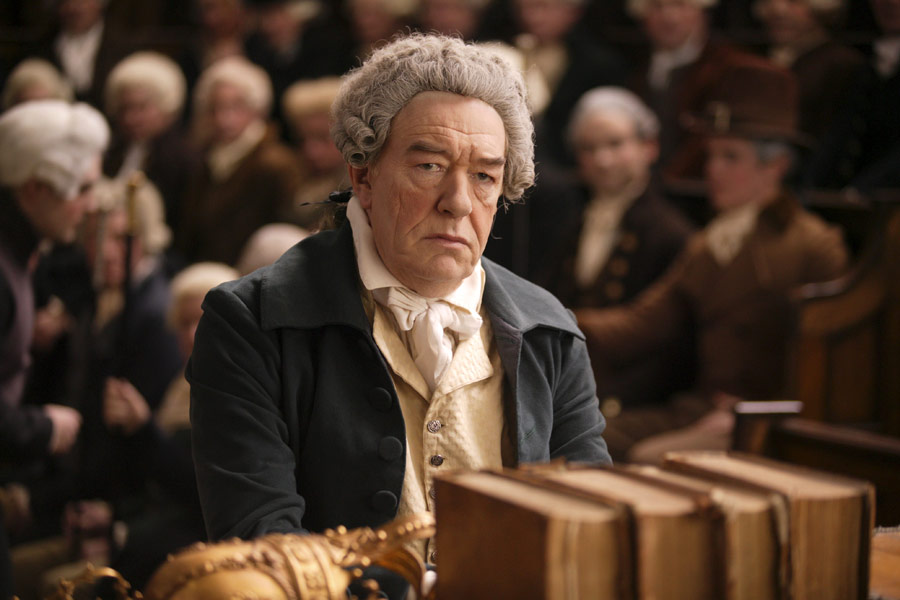
Michael Gambon as Lord Fox

The observation on peacetime leadership by Lord Charles Fox, portrayed in the 2006 film Amazing Grace, is particularly apt here, “When people speak of great men, they think of men like Napoleon – men of violence. Rarely do they think of peaceful men. But contrast the reception they will receive when they return home from their battles. Napoleon will arrive in pomp and in power, a man who’s achieved the very summit of earthly ambition. And yet his dreams will be haunted by the oppressions of war. William Wilberforce, however, will return to his family, lay his head on his pillow and remember: the slave trade is no more.”

Once reflecting on the troubles weighing on the President’s mind, Coolidge noted, “In Washington I went to sleep pretty quickly, but if I had a hard problem on my mind, I would wake up in the middle of the night, and the tougher the problem, the earlier I waked up. Sometimes it was hard to go to sleep again. Of course, everything a President does is subjected to criticism. But I used to remind myself that the criticism probably wouldn’t bulk very large in the pages of history, and then I would reflect that the country seemed to be in pretty sound condition. So I would roll over and go to sleep.” This confident expression cannot be severed from the often serious and heavy burdens of leadership he carried with him. As he also said, “While it is wise for the President to get all the competent advice possible, final judgments are necessarily his own. No one can share with him the responsibility for them. No one can make his decisions for him. He stands at the center of things where no one else can stand.” Study reveals that peace is not an accidental outcome, that it exacts much from even prepared and experienced leaders. Leaders, by what Coolidge would credit Providence, “appear to come forward to perform a certain duty. When it is performed their work is done.” The work begun by Harding and carried to completion by Coolidge was how to “put the country in a position to liquidate the liabilities which had resulted from the war” bringing conditions from a “wartime basis” to that of peacetime.

"Not so bad when you get 'em all strung together, eh?" Cartoon in the Des Moines Register by "Ding" Darling, June 10, 1924.

“Not so bad when you get ’em all strung together, eh?” Cartoon in the Des Moines Register by “Ding” Darling, June 10, 1924.

President Wilson, for all his dreams, had failed to craft terms of peace between the nations involved in the war. He had left America in deeper indebtedness than ever before, had fostered social and economic divisions, and had neglected his obligations here to restore calm after the storm. Blaming America for rejecting the League of Nations, Wilson retreated to obscurity leaving the unsettled problems of world war to others. It would be left for Coolidge and those he would carefully select to reclaim the environment in which Americans could flourish again, working more for themselves than for the national government, bringing calm and regularity after the social upheaval and legal arbitrariness of the war years, and finally, ushering in circumstances that would replace the reliance on great personalities in Washington. Correcting this imbalance would have to start not with material resources but by tapping into the spiritual strength which America possessed. It meant reclaiming the moral power that inspired the Declaration, gave life to the Constitution and repeatedly triumphed over every attempt to replace peace and prosperity with warfare and want.

This success, though, has not come automatically, nor through the initiative and mere force of Presidential charisma. Contrary to conventional thinking, it is to the humble and honest leader who conscientiously meets the day’s duty, goes to sleep at night having ably accomplished what was given him to do, who has done more for the peace and well-being of the country than a dozen well-intentioned Wilsons or braggadocious Roosevelts. Coolidge was one such Presidential success not because he personally furnished the “roar” of the twenties but because he respected the ideals that made it possible, continually encouraging a quiet assurance and competent faith in God and ourselves, the people in each generation who make the country work.

"There is another element, more important than all, without which there can not be the slightest hope of a permanent peace. That element lies in the heart of humanity. Unless the desire for peace be cherished there, unless this fundamental and only natural source of brotherly love be cultivated to its highest degree, all artificial efforts will be in vain. Peace will come when there is realization that only under a reign of law, based on righteousness and supported by the religious conviction of the brotherhood of man, can there be any hope of a complete and satisfying life. Parchment will fail, the sword will fail, it is only the spiritual nature of man that can be triumphant" -- Calvin Coolidge, March 4, 1925.

“There is another element, more important than all, without which there can not be the slightest hope of a permanent peace. That element lies in the heart of humanity. Unless the desire for peace be cherished there, unless this fundamental and only natural source of brotherly love be cultivated to its highest degree, all artificial efforts will be in vain. Peace will come when there is realization that only under a reign of law, based on righteousness and supported by the religious conviction of the brotherhood of man, can there be any hope of a complete and satisfying life. Parchment will fail, the sword will fail, it is only the spiritual nature of man that can be triumphant” — Calvin Coolidge, March 4, 1925.
“Calvin Coolidge” by Jerry Wallace

Here is an awesome half-hour presentation of the life and landmark accomplishments of Calvin Coolidge by superb scholar Jerry Wallace to the Wichita Pachyderm Club. His irreplaceable volume Calvin Coolidge: Our First Radio President has contributed so much toward shattering the myth that Cal was too inept and silent to make use of the new medium of radio. In fact, Mr. Wallace explains that far from being a failure, Calvin Coolidge bequeaths an historic legacy as not only a masterful communicator but effectual doer and successful President. This is well worth the listen!

On Inauguration Day

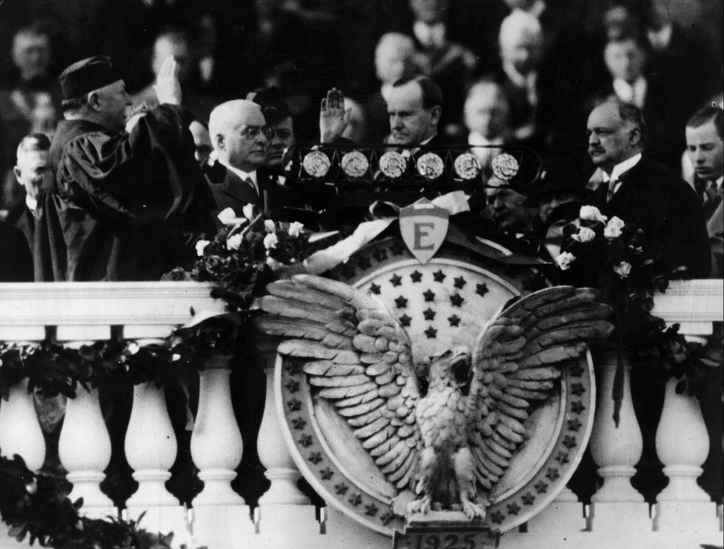
Before the Twentieth Amendment to the Constitution was ratified on January 23, 1933, Inauguration Day fell on March the 4th every four years. It was on this day in 1925 that Calvin Coolidge was sworn in as President on the East Portico of the Capitol by former President, Chief Justice William H. Taft, following his landslide victory in the previous November election. It was an historic occasion for at least four reasons.

This was the first time an Inauguration was broadcast over the radio. It had been a mere four years before that President Harding, using amplifiers, could only be heard by the 100,000 present for the event. Even more remarkable, it had only been four years prior to Harding when President Wilson, solely on the strength of his voice, could not be heard save by those on the platform with him. Now, everything had changed. Arranged on a 22 station national hook-up by the American Telephone and Telegraph Company, it is estimated 22.8 million people tuned in to the President’s Address on this day eighty-nine years ago. Schools around the country made a concerted effort to make the live broadcast available to students and their parents, as the first sound Inauguration reached into people’s homes, businesses and meeting places. Even the children of rural areas were brought to nearby towns where they could hear the broadcast via loudspeaker.

Before then, it was up to the newspapers and conventional media to relay what had already happened and provide the text of the President’s speech on the next day. Now what was happening could be heard in real time. Coolidge took to the new medium readily. He respected the technology, understanding both its strengths and limitations. Keeping a careful distance from the microphone, he spoke in a characteristically measured tempo and calm, clear voice, which carried better over the air than the utterances of many of his contemporaries, including his own Vice President, still used to the old days of dramatic gestures, sweeping oratorical flourishes, and virtually shouting to be heard by the crowds.

Chief Justice Taft administering the oath of office to President Coolidge

Chief Justice Taft administering the oath of office to President Coolidge

Coolidge’s inauguration also marked the first time a former President would administer the oath of office to the current occupant. The Bible open to the first chapter of John, one of Coolidge’s favorite passages, the Chief Justice asked the President,

“Calvin Coolidge, do you solemnly swear that you will faithfully execute the office of president of the United States and will to the best of your ability preserve, protect and defend the Constitution of the United States, so help you God?” To which Coolidge solemnly responded, “I do.”

The clock struck 1 in the afternoon and the President turned, after receiving congratulations, to begin his Address.

In the weeks leading up to the Inaugural, Coolidge helped encourage much speculation over what he was to say and whether he, like Grover Cleveland, would practice economy of length as well as content. When the time came, Coolidge delivered one of the longest Inaugural Addresses in history, at 4,059 words and 41 minutes in duration. While the quality of the broadcast was superb — listeners marveled that they could hear the turn of each page of his manuscript — it was recorded, unfortunately, on one 78rpm disc machine, with the result that only 24 minutes of his speech has been preserved. The remaining 17 minutes in the middle was lost between turning over the record in order to capture the end of a surprisingly long speech. Perhaps AT & T was expecting brevity from the President? Despite this, the 1925 inauguration deserves its place in history as the first to be nationally broadcast, the first to be administered by a former President and one of the few to successfully practice economy, not just preach it.

In addition to the historic recording, AT & T would successfully transmit nine photographs of the Inauguration to San Francisco over long-distance wires. Graciously thanking them for these two historic achievements, President Coolidge later wrote, “This group of photographs…is, of course, one of the products of present day advancement in science and the mechanic arts that are so numerous and continuous that we hardly have time to realize them as they come to our attention.” Coolidge would continue, “I shall preserve these pictures as a memento of peculiar historic and scientific value, and in thanking you for your thoughtfulness in sending them to me, I wish to add appreciation of the wonderful service which was rendered in the nation-wide distribution of the Inaugural Address.”

President Coolidge's letter reproduced in William P. Banning's book, Commercial Broadcasting Pioneer: The WEAF Experiment 1922-1926. Cambridge: Harvard University Press, 1946, between pages 270 and 271.

President Coolidge’s letter reproduced in William P. Banning’s book, Commercial Broadcasting Pioneer: The WEAF Experiment 1922-1926. Cambridge: Harvard University Press, 1946, between pages 270 and 271.

Washington has always sought an excuse to grandly celebrate something. It was no different heading into the inaugural year of 1925. The Committee tasked with overseeing the Day’s events envisioned the intricate, elaborate and expensive. It would be Coolidge, however, who ultimately prevailed on the direction the Inauguration would take. As scholar Jerry Wallace has detailed, March 4, 1925, was hardly what history has recounted as dull and plain. It was a colorful statement of Coolidge economy. He insisted on three particulars: 1) The celebration would not be not be of extravagant taste or cost; 2) The parade would have a military focus, honoring those who served in every branch rather than as a pageant for politicians; 3) There would be no official ball, leaving the evening’s festivities to be done for charity conducted by voluntary hosts.

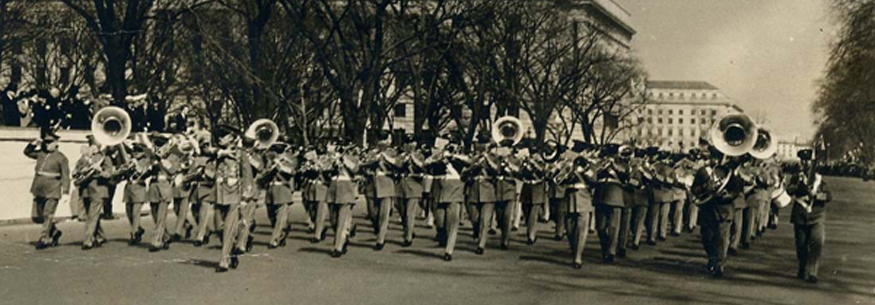
"Pershing's Own," The Army Band marches down Pennsylvania Avenue during the Inaugural Parade, 1925

“Pershing’s Own,” The Army Band, marches down Pennsylvania Avenue during the Inaugural Parade, 1925

The platform used in 1921 would be recycled, the Committee would be restrained from undermining Coolidge’s strict economy and the entire tone of the Inaugural proceedings would retain a simple dignity befitting the Office and the President’s agenda. Coolidge was serious about government economy and he was determined to let everyone know that no exceptions, especially occasions centered around himself, would be made. The nation, experiencing steady prosperity after war and depression, would not be served if he spoke of cutting expenditures while spending exorbitantly on Inaugural ceremonies. The parade, kept to one hour, would recognize the diverse heroes of every branch in the military first, followed by only 19 governors and their state delegations. Saving the people’s money and avoiding wasteful expense were to be practiced by the states as well as the Federal Government. Only local units would be brought in while the pricy transportation of Annapolis and West Point personnel would be discouraged. The 5,000 soldiers, sailors, aviators and Marines walked in full dress formations with the music of military bands playing patriotic tunes accompanied by National Guardsmen, cavalrymen, artillerymen and even tanks. Two prestigious ranks of “colored” cavalry units, including the famous horseman Tom Bass, trotted past the President and First Lady in the vivid array of units represented.

Tom Bass, renowned horseman and participant in the 1925 Inauguration

Tom Bass, renowned horseman and participant in the 1925 Inauguration

View down Pennsylvania Avenue with the Capitol in the background, as a wide variety of America's servicemen march in honor of President Coolidge's inauguration.

View down Pennsylvania Avenue, with the Capitol in the background, as a wide variety of America’s servicemen march in honor of President Coolidge’s inauguration. Upwards of 8,000 men and women took part in the impressively efficient fifty minute parade.

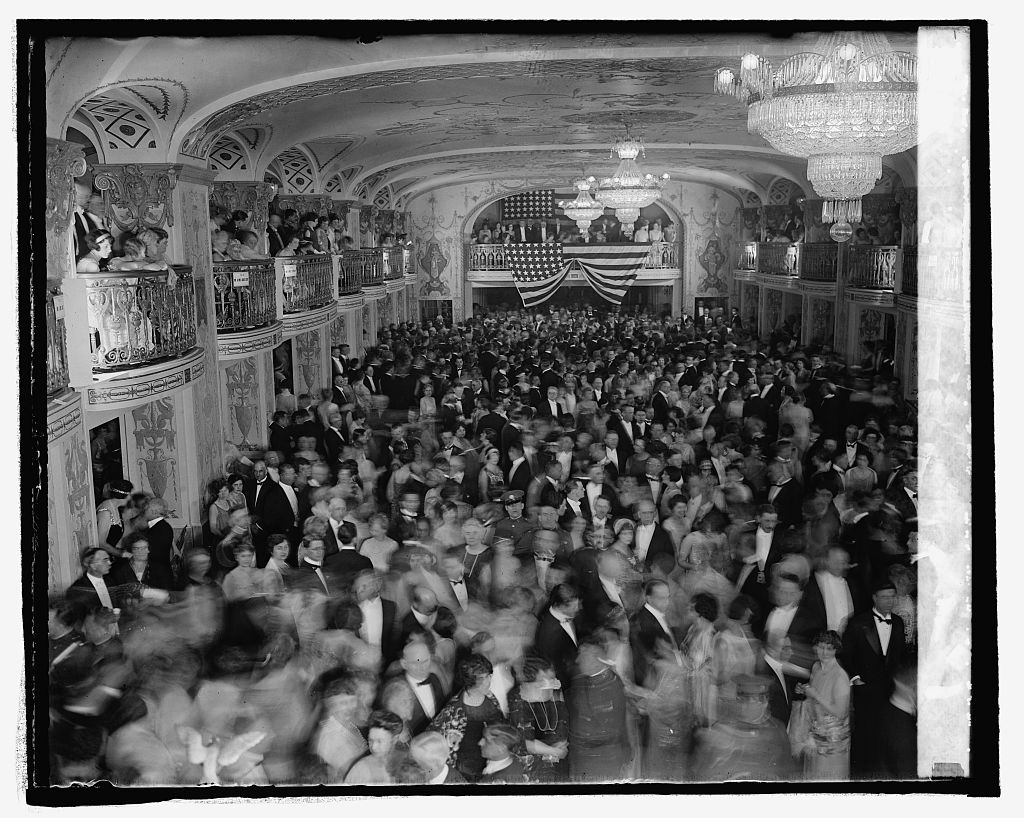
Finally, the ball was a splendid success. Though Washington would not have an official ball that evening, the private initiative of individuals put together one of the most memorable dances the capital city has ever known. While the Coolidges were not present, they served as sponsors for the occasion and at the end of the night some $300,000 had been raised for children’s charities, an accomplishment that later Presidents would envy. The 1928 Inaugural failed to come close to such a figure while future Inaugural Committees would fail, often massively, to keep within budget. Even the 1957 Committee would embarrass President Eisenhower by reporting a $160,000 loss.

Snapshot from the unofficial ball, Inauguration Day, March 4, 1925

Snapshot from the unofficial ball, Inauguration Day, March 4, 1925

Coolidge really accomplished something historic, certainly not by carrying the Day’s events on his own shoulders, but by holding Washington to live within proper means and sensible proportions, he was practicing what he insisted in others. That alone is a remarkable achievement, especially as we see how Washington lives so flagrantly at our expense today. It gave a unique power and credibility to his words, verbiage that was not merely being spoken to make listeners feel good but to actually accomplish desperately needed changes to how government operated. Moreover, he used the potential of radio to reach an unprecedented number of people with his case. He employed a natural aptitude for the medium not to serve himself, but to substantively remove the needless liabilities government exacts from those it is supposed to be serving. Taking his arguments directly to the people, it would be the responsibility of each citizen, ultimately, to keep Washington accountable to them. He, as the President, represented them in a way the Congress did not, but even so, not even he could supplant their obligations of self-governed citizenship. For Coolidge, words were not enough either; they must be coupled with results.

The next day found the President back in the office, not basking in privilege or accolades, but quietly doing the new day’s work. During his five and a half years in office, he would cut income tax rates four times, present surpluses every year and encourage substantial improvements for all Americans in radio, aviation, civil rights, the court system and the economy. What is perhaps most surprising is that he accomplished so much without promising to do any of it. He simply acted while others waffled. His last hours in office, before joining the inaugural ceremonies of his successor, would find him signing legislation, preparing correspondence and handling what remained on his desk before walking away from it all for the last time. Writing to his father on January 1, 1926, Coolidge revealed this self-effacing habit of mind, “I suppose I am the most powerful man in the world but great power does not mean much except great limitations. I cannot have any freedom even to go and come. I am only in the clutch of forces that are greater than I am. Thousands are waiting to shake my hand today.” He was but a servant in temporary residence at their House. Yet, so long as he was there, he would be faithful to the things entrusted to him — including Washington’s penchant for wasteful spending — finishing what remained his to do. As the Lord once said, “to whom much is given, of him shall be much required.” Like Cleveland before him, Calvin Coolidge reminds us on this day what it means to live by our word.