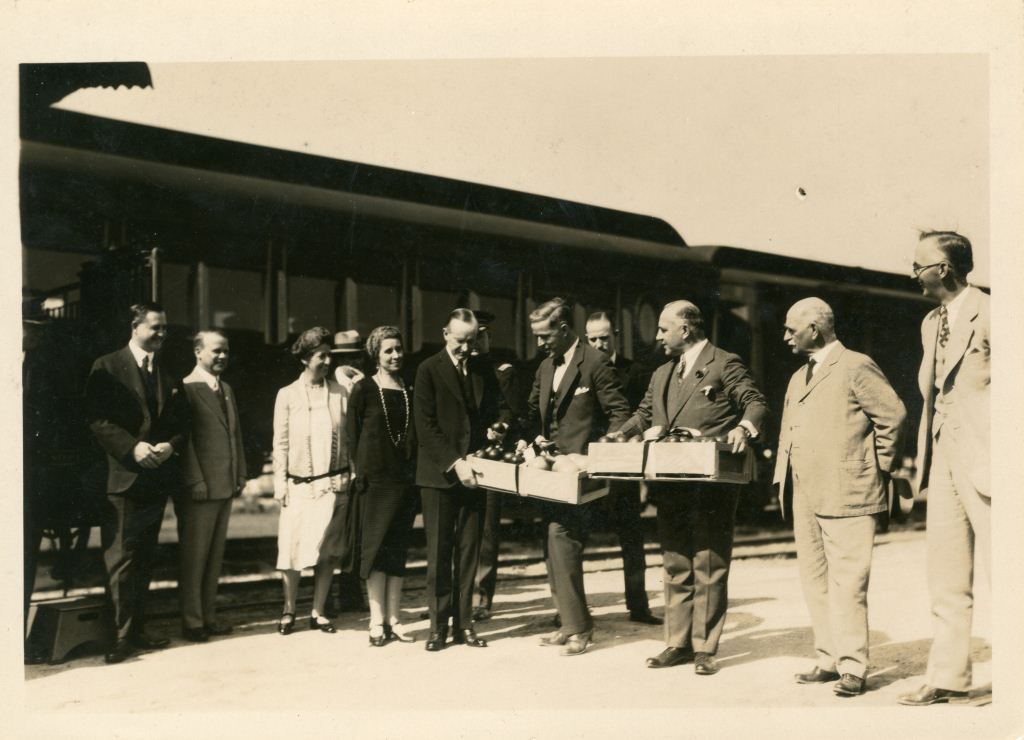
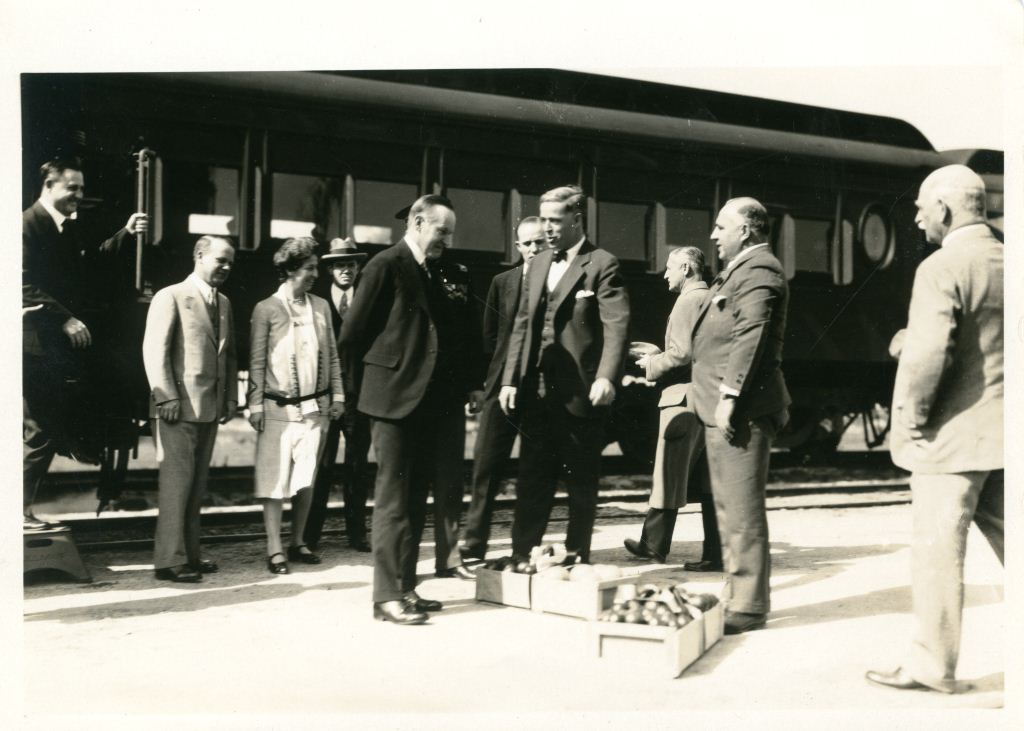
The Coolidges at Sanford being received by the officers of the Florida Citrus Growers Clearing House (Secretary A. W. Hanley; General manager J. Curtis Robinson [holding the crates of grapefruit]), joined by Sydney O. Chase (Chase & Company, citrus growers, storage & insurance), and Mrs. H. H. Williams of Boston, among others. Photo credit: Special and Area Studies Collections, University of Florida.
President Coolidge, an adept communicator and savvy manager of the press a century ago, is back to headlining the news. Roger Simmons over at the Orlando Sentinel has a piece out today on the visits of Presidents to central Florida, especially highlighting the February 1929 and January 1930 trips the Coolidges made to the Sunshine State. Mr. Simmons also contrasts the rivaling accounts between the favorable Morning Sentinel and the hostile Evening Reporter-Star of that first visit on the way to the dedication of Bok Tower in 1929. Even salient Cal still generates his partisan detractors. Political reporting is anything but a phenomenon of recent years.
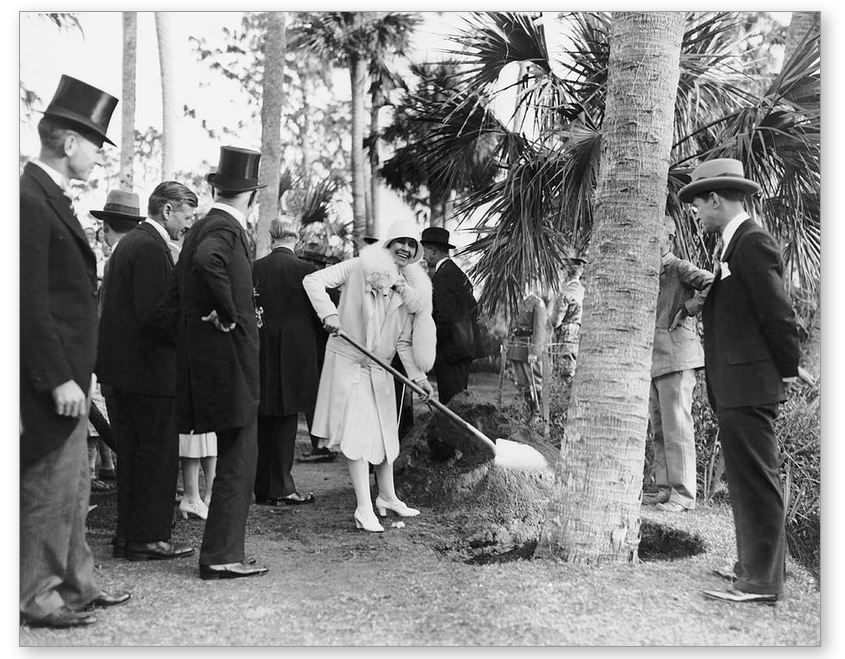
First Lady Grace Coolidge putting in one of the two palms at Bok Tower which the Presidential couple planted that day in February 1929.
Also in the news, a statue loaned to Florida through the efforts of Secretary of State Cord Byrd, chairman of the state’s 250th Commission, is set to be dedicated on Independence Day at Bok Tower in Lake Wales. It is a fitting place to host the dedication, as Bok Tower has long been a firm friend of the Coolidges. It promises to be a momentous year of commemorations, bringing Coolidge’s place in America’s 250 years welcome central stage, highlighting the fact that he not only dedicated Bok’s iconic landmark and gardens but presided over the nation during its Sesquicentennial in 1926.
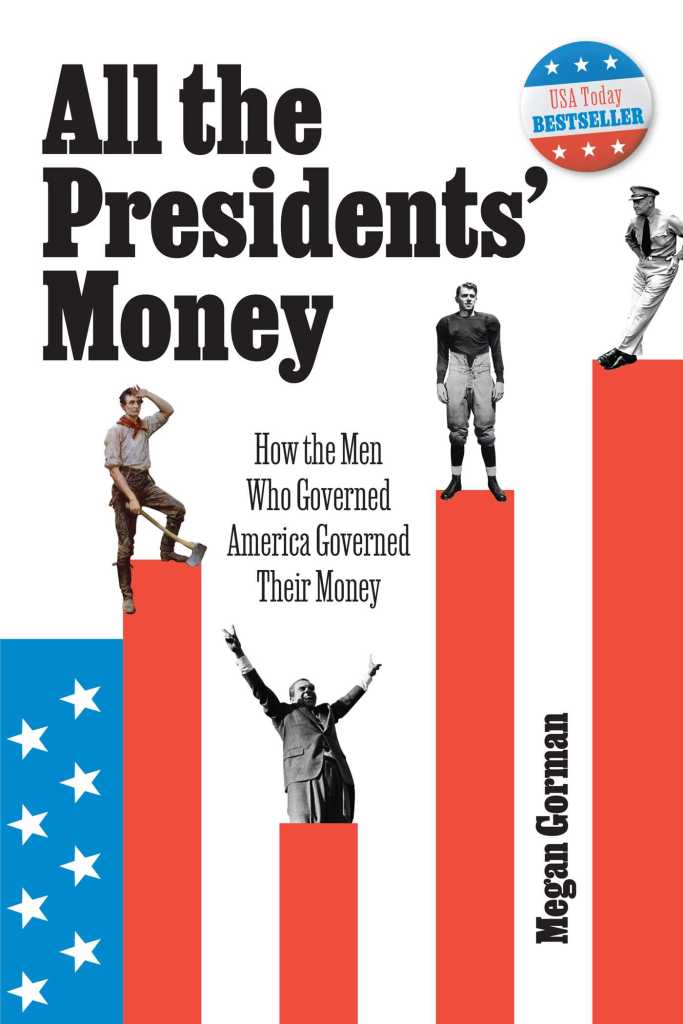
Tax attorney and wealth management professional Megan Gorman, founding partner of Chequers Financial Management, has a wonderfully untapped perspective on the Presidents in her excellent book, All the Presidents Money, with a great section on Coolidge’s legacy handling his own money. Her presentation at the Truman Presidential Library today (2-3pm CST) is well worth attending, if you have secured a seat!
Moreover, another project launched by former President Bush’s More Perfect initiative is underway called In Pursuit, led by Colleen Shogan, assembling a broad range of scholars, authors, and public figures with essays and academic reexamination challenging Americans to take inventory with a purposeful “debrief” of the last two and a half centuries. The forthcoming work is offered for every American to renew commitment to the nation’s continuously developing institutional framework and a rejuvenating civic responsibility to its “enduring principles” heading into the next 250 years. Partnering with 43 Presidential Libraries and institutions, In Pursuit is working through the Semiquincentennial year of America’s experiment in self-government to approach historical study through the lens of the Presidents and First Ladies. Naturally, the Coolidge Presidential Foundation is involved in the effort. Archivist Shogan and Ms. Amity Shlaes of the Presidential Foundation will be working on the studies relating to Grace and Calvin Coolidge.
Happy Presidents’ Day this Semiquincentennial Year, Coolidge Country!
It was clear that the Coolidges kept Christmas in an exceptionally special way. The President described the occasion in his Autobiography, “Christmas was a sacrament observed with the exchange of gifts, when the stockings were hung, and the spruce tree was lighted in the symbol of Christian faith and love.” For the Coolidges, Christmas seemed to kindle an extra sense of the magical power inherent in its omnipotent roots, bringing everyone a little closer to those things of the spirit that no force can destroy, no will crush, no darkness extinguish. As we are underway in the kitchen, wrapping gifts, and remembering that Christmas is, as Cal put it, “more than a season but a state of mind,” here are some of the hallmarks of a Coolidge Christmas:
Carols sung at the Coolidge White House, 1923. Photo credit: Library of Congress.
I. Carols and Hymns: The initiation of musical performances became a staple of Christmas during the Coolidge years. Nor were these programs limited to Sousa’s Marines or small groups of musicians but featured what became an annual — and beloved — custom: the singing, without accompaniment, of carols. The high point of these programs usually consisted of the sixty-member choir of the First Congregational Church under the direction of the talented Mrs. Ruby Smith Stahl. Alongside a full collection of established favorites, the lineup came to include Dr. Jason Noble Pierce’s “The Bells of Christmas,” composed in 1925 and dedicated to Mrs. Coolidge. When the Coolidges opened the grounds to the public and encouraged guests to sing along, they were tapping the power of music to reach souls.
II. Service and Charity: The spirit of service found rightful expression also in the preparations and distribution of food baskets and gift parcels. The President inaugurated the first community Christmas Tree lighting over one century ago in honor of community. Together the Coolidges launched the Christmas Seals campaign each year to support the work of the National Tuberculosis Association. No year went by without the Coolidges inaugurating some public effort to render time and care for children, hurting veterans, and those in need of Christ’s love for all humanity.
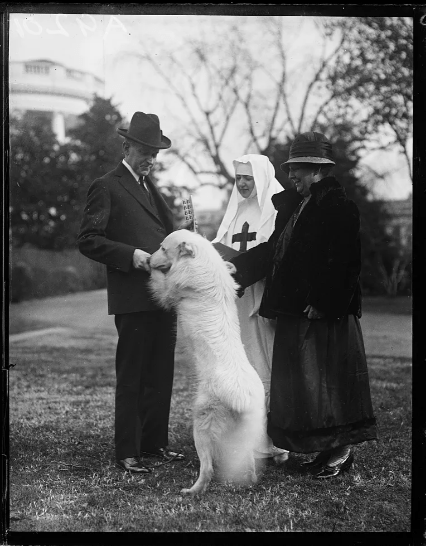
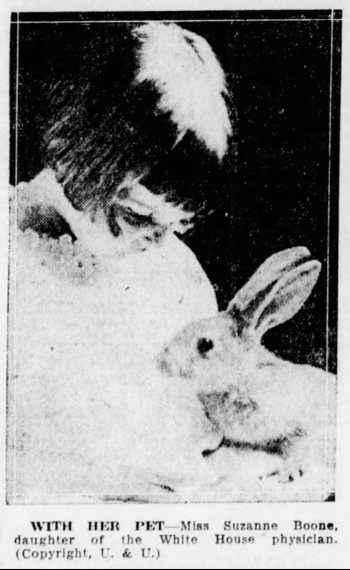
III. The Food that Brings Together: The Coolidges understood not every gift was tangible. Joining their inner official family, which included Mary Randolph and Laura Harlan, the First Lady’s secretaries, Ted and Henrietta Clark, the President’s personal secretary, Colonel Starling, the President’s Secret Service agent, Frank and Emily Stearns, Chef Lee Ping Quan, and Dr. Joel and Helen Boone, assistant White House physician, was the Boones’ six-year-old daughter Suzanne, giving (in a real sense) the Coolidges their own little girl. She became a regular recipient of the Coolidges’ adoration and generosity. When she learned from Dr. Boone that a Washington family had lost a father around Christmas, she gave up her presents to comfort the mourning children. Dr. Boone later remarked, “It gratified me, at her age to have her demonstrate her philanthropic disposition, which she has maintained throughout her life,” and whether acquired or born with that quality, he noted, “She was always most thoughtful of other people.” Without the Boones and the closely knit inner circle of extended Coolidge family, Christmas in the years to come would not have been as rich. We are shaped not only by the families in which we are born but also by the families which form by choice and circumstance. Without, however, that highest debt paid for us and which we owe everyone — selfless love — can Christmas be said to live, truly, in each of us?
Here is one of Cal’s favorites, per Lee Ping: the Custard Pie recipe from 1924
3/4 cup Sugar 2 Eggs. well beaten
2 tablespoons Flour 2 1/2 cups Milk
1/8 teaspoon Salt 1 teaspoon Vanilla
Pour into pie plate with thin layer after mixing ingredients well together. Bake a 450 degrees F for 10 minutes to set the rim. Reduce heat to 325 degrees F, continue baking for 30 minutes or until custard set. Sprinkle a little grated coconut on top when removed from oven.
We find the Coolidges are even nearer to us at this time of the year, especially as we bake the legendary Coolidge Custard. A very Merry Coolidge Christmas to you and yours!
U.S. President Calvin Coolidge, right foreground, delivers his inaugural address after taking the oath of office on the East Portico of the Capitol building in Washington, D.C. on March 4, 1925. Coolidge was sworn in as the 30th president of the United States. Photo credit: Associated Press.
One of the unheralded heroes on Inauguration Day a century ago was legendary radio announcer Graham McNamee. He had already initiated the now familiar tradition of giving historical context and commentary to the news in President Coolidge’s first Annual Message in December 1923. McNamee’s image, wired from the resplendent Public Auditorium in Cleveland the previous summer while covering the Republican National Convention, became one of the first transmitted by the rapidly accelerating powers of the medium. The transmission, just developing at the time, took four minutes. His work for WEAF remained on the cutting edge as he was set to cover the Presidential Inaugural Address in March 1925, the first in history to be carried by radio. It was estimated by correspondents at the time that between 22 to 25 million people heard the Inaugural, including the full recording of Coolidge’s 4,000 plus word Address. Carried across twenty-two stations spanning coast-to-coast, the still novel technology captured the sounds of the pages and the President’s voice so crisply (including more than one of his inspirations!) that he seemed to be on the stage of nearly every school gym and public gathering in the country at the same, shared moment in time. It was America’s first synchronized experience of a vital cultural and political tradition, carrying with implications set to transcend the constraints of the globe itself. Yet, well on his way to earning the Radio Digest Award that year as the “World’s Most Popular Radio Announcer,” McNamee almost missed the entire occasion.
McNamee recalled it this way: “The inauguration proved a meaner job than most, as it was so hard to get information. Washington was full of officials, each apparently knowing all about what was to take place but unwilling to impart much of their knowledge. Everything was confusion, likewise everybody was passing the buck; and it was almost impossible to make our arrangements. For one thing we didn’t know when to go on the air.” It was predicated, McNamee explained, on how long the vice-presidential oath and ceremonies in the Senate Chamber took. It could be twenty minutes or an hour. No telephone wires were permitted in the Senate and so word had to be carried by runner. “Yet,” McNamee continued, “once on the air we had to stay on.” The announcer had to be ready to innovate, crafting the role of political commentator along the way. “So again I wrote reams of stuff, historical stories, and so on, as filler-in-material. Meantime I had stationed messengers in the capitol to hot-foot it to me as soon as the President and Vice-president left the Senate Chamber to come to the capitol steps, where the President himself was to take the oath of office.”
WASHINGTON, D.C. — March 4, 1925, Calvin Coolidge Inauguration. Mr. and Mrs. Coolidge. Photo credit: Baltimore Examiner and Washington Examiner.
Then it happened. “I got lost and the radio sets were almost left flat without an announcer,” McNamee recalled. “My booth was on the pedestal of one of the statues by the steps of the capitol; and all the messengers being busy, I left the booth for a minute, while the officials were still in the Senate Chamber, to get word to one of our staff. To reach him I had to hurdle a temporary fence built to keep the President’s pathway clear of intruders; and, once on the other side, I found I couldn’t get back. A patrolmen yanked me by the shoulder just as I was climbing over on the return journey, and refused to let me go further. I vain I pleaded: ‘Against orders,’ he said. I told him of the microphone lying silent and pictured all the people from coast to coast that would be disappointed. But he was evidently a man of a single-track mind, one of those burly and not very imaginative policemen that will stick like a bulldog to an order, once they get it, and who are inflexible when given a little authority.”
It became desperately close to time. “For ten minutes I argued until at last I saw light–another way of approach through the crowd, which I had not noticed before. I asked him about it; that was all right–it was out of his jurisdiction, but never would he have let me over that fence in spite of the waiting twenty-five million. And that was the total estimated by the newspapers, the audience on this occasion being vastly increased by the children. Almost every school in the land had a loud-speaker installed in its auditorium or its one little room, in the case of the country hamlets.”
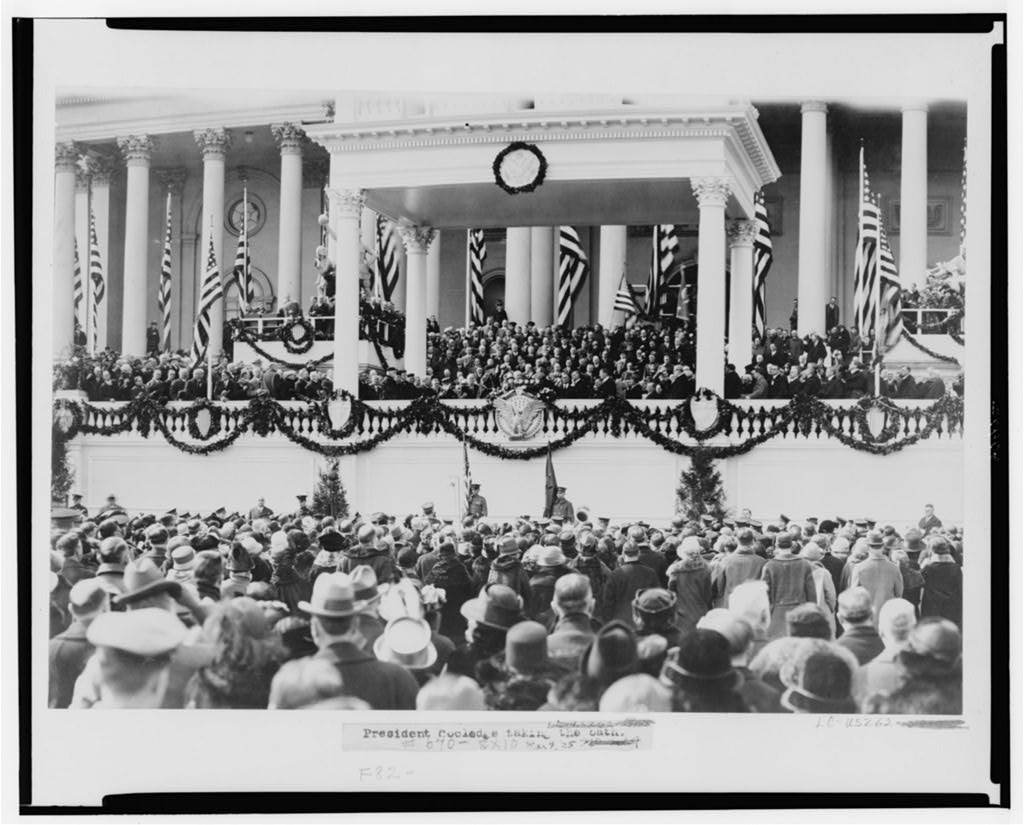
Inauguration Day, March 4, 1925, looking across the thousands gathered to witness the ceremony. Photo credit: Library of Congress.
McNamee got back to his booth just in time. “And at that I was caught, for after I reached the booth, and went on the air, with a little description, then a story, I was halfway through that story when a messenger came racing to me, saying that the procession had started from the Senate Chamber. We were having difficulty enough in timing things, anyway, and General Dawes upset even our tentative calculations. Instead of swearing-in the senators one by one, he had done it in batches. That story was pretty well jumbled, I am afraid, for the President was on its heels. I had to cut off my microphone quickly and signal the control room to put on the President’s microphone, just in time to catch the administration of the oath of office by Chief Justice Taft.”
Chief Justice (and former President) William Howard Taft administering the oath of office to President Coolidge, prior to the Inaugural Address. Photo credit: Library of Congress.
“The President stood there very quietly, looking subdued and careworn, I thought; this was so soon after his boy’s death; and his reply to the oath was so low that none of the people there present, excepting the few immediately around him, and none of the radio audience, heard it. We answered many inquiries by mail, afterwards, telling them that the response was a simple, ‘I do.’ ”
McNamee at the 1924 World Series.
Read more about the legendary Graham McNamee in Salient Cal’s America: Reappraising the Harding & Coolidge Era. Thanks to McNamee and his excellent team’s work, here is an excerpt of President Coolidge’s Inaugural Address (which was recorded in full, at the time), the first of its kind carried via radio a century ago.







 The Importance of the Obvious