On Lafayette and Foreign Affairs

Image

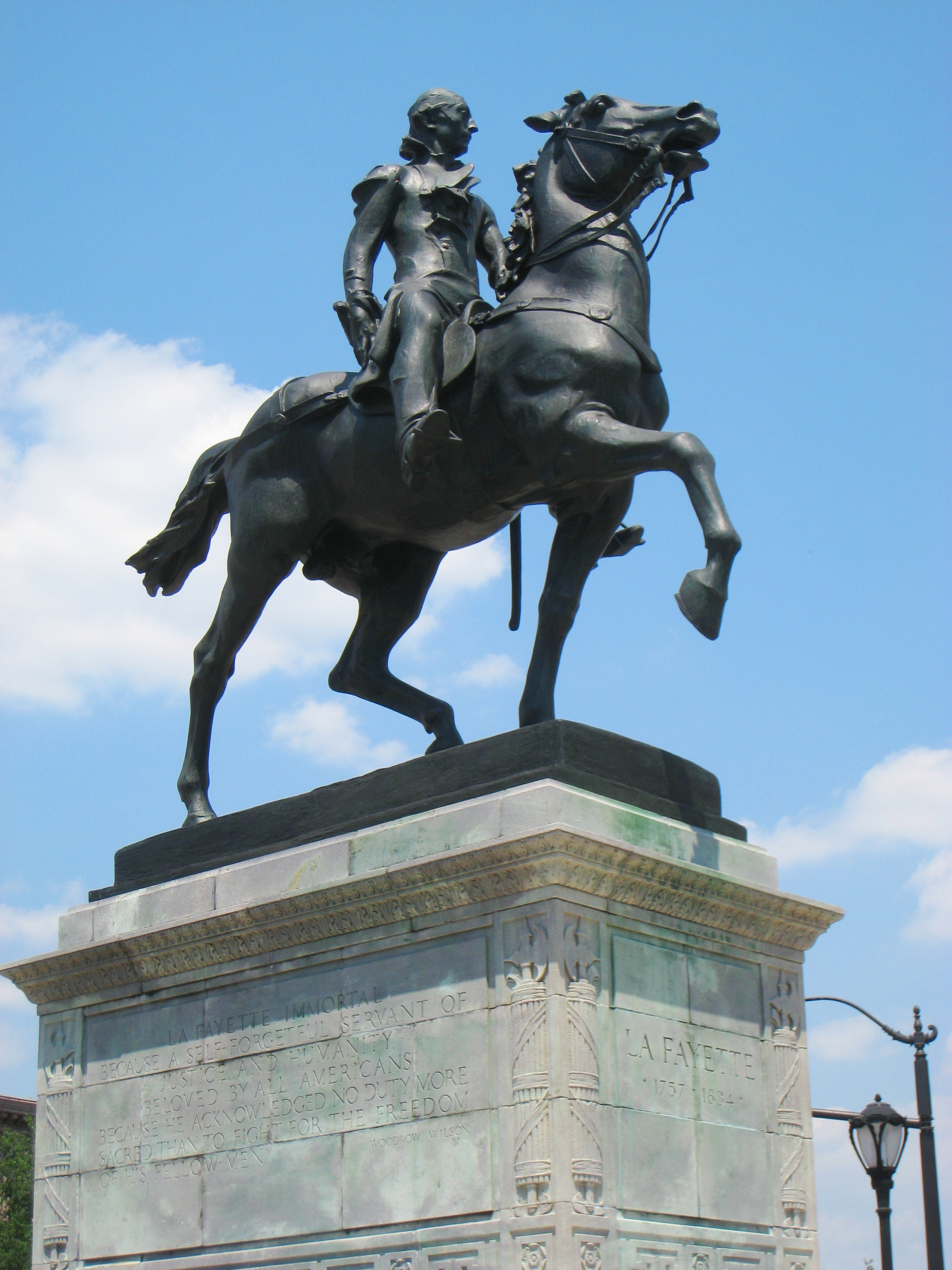
Tomorrow, September 6, marks two important occasions: the birthday of and official farewell to Lafayette by President John Quincy Adams during the French patriot’s last visit to America in 1825. President Coolidge, a century later, upon dedicating the monument to Lafayette placed in Baltimore, Maryland, observed that “[h]is picture to me seems always to have the enthusiasm and freshness of youth, moved with the high-minded and patriotic purpose of maturity. He displayed the same ambition for faithful service, whether he was leading his soldiers in the last charge for American liberty at Yorktown or rebuking the mob at Paris for its proposal to make him king. His part in the French Revolution is well known. He served the cause of ordered liberty in America; he was unwilling to serve any other cause in France…He represents a noble and courageous dedication to the service of freedom. He never sought for personal aggrandizement, but under heavy temptation remained loyal to the great Cause. He possessed a character that will abide with us through the generations. He loved his fellowmen, and believed in the ultimate triumph of self-government.”

As Coolidge continued to reflect upon the freedoms Lafayette fought to preserve in a constitutional republic, he surveys the substance of liberties protected by that document. Coolidge recognized also the deliberate limits placed on the government so that the rights of even the smallest minority — the individual — cannot be deprived of those protections by an ambitious, irresponsible majority.

Coolidge then turns to foreign affairs, hitting upon the true basis for sound foreign policy: guarding independence in our decisions and our interests. Respect, Coolidge shows, comes as a result of that tenaciously guarded independence; not as a product of surrendering it. Being afraid to lead, refusing to use America’s moral power for good, is not the route to successful foreign policy, in other words.

President Coolidge, decried as too provincial for the global burdens of the office, understood the situation far better than the “smartest of the smart” think they do now, as he declared what American foreign policy had been for its first one hundred and fifty years, “We have always guarded it [i.e., independence] with the utmost jealousy. We have sought to strengthen it with the Monroe Doctrine. We have refrained from treaties of offensive and defensive alliance. We have kept clear from political entanglements with other countries. Under this wise and sound policy America has been a country on the whole dedicated to peace, through honorable and disinterested relations with the other peoples of the earth. We have always been desirous not to participate in controversies, but to compose them,” that is, to bring calm back to each situation.

The result? “What a success this has brought to us at home, and what a place of respect and moral power it has gained for us abroad…” No wonder serious statesmen and genuine patriots are astonished at the pathetic equivocations and reckless display of weakness from our current leadership regarding Syria and everywhere else in the world.

Coolidge points to solid ground for future American foreign policy, “To continue to be independent we must continue to be whole-hearted American. We must direct our policies and lay our course with the sole consideration of serving our own people. We cannot become the partisans of one nation, or the opponents of another. Our domestic affairs should be entirely free from foreign interference, whether such attempt be made by those who are without or within our own territory. America is a large country…It has room within its borders for many races and many creeds. But it has no room for those who would place the interests of some other nation above the interests of our own nation.”

“I want to see America set the example to the world both in our domestic and foreign relations of magnanimity. We cannot make over…people…We must help them as they are, if we are to help them at all, I believe that we should help, not at the sacrifice of our independence, not for the support of imperialism, but to restore…a peaceful civilization. In that course lies the best guarantee of freedom. In that course lies the greatest honor which we can bestow upon the memory of Lafayette.”

Image

On Labor

In Robert A. Woods’ fascinating little book entitled, “The Preparation of Calvin Coolidge,” the author recounts the numerous ways Coolidge advanced American labor. Coolidge backed policies that improved conditions for everyone, not merely one interest group over that of another. Through cutting state executive government down from 120 agencies to 19, Coolidge enabled the people of Massachusetts to keep more of their wages every week for themselves instead of sending up increasing quantities in taxes to Boston. He supported the decrease of work hours because it helped those who worked…not simply those who led unions, even though, ironically, it originally had the firm opposition of organized manufacturers. Known for his principled stand for law and order, he not only backed Commissioner Curtis for refusing to reinstate 19 police officers after they led most of the department on strike in September 1919. Having become affiliated with the American Federation of Labor, in violation of long-standing department regulations, their duty to the public became secondary to an ideological allegiance that already brought them in conflict with their sworn obligation.

Any or all of these three instances could have alienated political friends, forced Coolidge out of office or worse, led to a violent series of repercussions around the state, even the country.

1919 was hardly a peaceful year, despite the War’s end. But this was not all he encountered since the Lawrence textile and phone operators strikes could have blown into larger conflicts as well. They did not spiral out of control principally because of sound leadership. It is through good leadership that complex and seemingly insurmountable obstacles are resolved with clear and consistently applied principles. Coolidge, known by everyone for his fairness, gave partiality to none. He adhered to the law, even when it might cost him personally or politically. As such, he gained the support of those who saw past the bias and political agendas of those calling for violence, social upheaval, nationwide strikes and economic change for its own sake.

He continually lauded the glory of work. As Coolidge would observe on Labor Day in 1919, “Workmen’s compensation, hours and conditions of labor are cold consolations, if there be no employment. And employment can be had only if some one finds it profitable. The greater the profit, the greater the wages.” Such a truth needs no clearer illustration than where we stand in September 2013. If only the realization of Coolidge’s day, that “we can take from one class and give to another class” is never going to fix the problem. The problem only aggravates, as it did then, when class warfare rhetoric convinces Americans to expect fairness without freedom for all and benefits without the work to earn them.

Coolidge recognized the right to form unions by mutual agreement. Without consent, both unions and arbitration of disagreements were impossible to reconcile “with the right of individual freedom,” which could never be surrendered to any effort to equalize labor. He saw a clear distinction of responsibility when it came to those performing a service to the public, be it policemen, telephone operators or (in Reagan’s case) air traffic controllers.

This is why Coolidge told labor leaders on September 1, 1924, “Of course employment affecting public safety and public necessity is not private employment, and requires somewhat different treatment.” Those who work in public unions are not simply serving themselves, as Coolidge said on April 21, 1919, “There is another principle involved which has received very little attention, and that is the obligation that exists on those who enter the public service to continue to furnish such service even at some personal inconvenience. This obligation reaches to the highest officer or government official to the humblest employee. The public has rights which cannot be disregarded.” Such is why Coolidge endorsed resolution by peaceful arbitration — not the coercion of strikes, violence and disregard of law and orderly behavior — when disagreements occur. The “us” versus “them” rhetoric only proved increasingly hollow as tax reduction and constructive economy revealed the property owners and the laborer to be one and the same.

The emphasis on what one is entitled, rather than what one owes, misses both the importance and increased opportunity hard work affords to each person. No short cut exists. One cannot demand the fruits of toil without the effort to acquire them. The welfare of all, made clear from the earliest experiments in socialism by Plymouth colony, is never achieved by the many enjoying the rewards earned by a few. Work and the ability to keep its results have proven, through centuries of human experience, to be the means toward progress, the agency of mutual prosperity, and the continuance of civilization.

It is why Coolidge, in his address to the leaders of labor, said this,

“America recognizes no aristocracy save those who work. The badge of service is the sole requirement for admission to the ranks of our nobility. These American policies should be continued. We have outlawed all artificial privilege. We have had our revolution and our reforms. I do not favor a corporation government, a bank government, a farm government or a labor government. I am for a common-sense government by all the people according to the American policy and under the American Constitution. I want all the people to continue to be partakers in self government.”

With Coolidge, his actions matching his words, we can know that he meant it.

Image

On the Oath

Section 1 of Article II of the Constitution prescribes the oath each President is to promise and observe as he carries out the responsibilities of his office, ‘I do solemnly swear (or affirm) that I will faithfully execute the Office of President of the United States, and will to the best of my Ability, preserve, protect and defend the Constitution of the United States.’

When the occasion arose to succeed the President in the early hours of the morning on August 3, 1923, Coolidge did not have to consult a team of legal experts or “brainstorm” with Cabinet members over the telephone about what comes next. He simply consulted the Constitution which sat on his father’s bookshelf and found the oath to be taken by the President, the same he had affirmed over two years before. The answer, to anyone able to read and understand, was accessible simply by looking at the Constitution, our blueprint and road-map.

“Having found this form in the Constitution I had it set up on the typewriter and the oath was administered by my father in his capacity as a notary public, an office he had held for a great many years.”

When it came to the Constitution, Coolidge’s grasp of its power and clarity is no less essential a message for the current President than it has been for the previous forty-three,

…[T]he President exercises his authority in accordance with the Constitution and the law. He is truly the agent of the people, performing such functions as they have entrusted to him. The Constitution specifically vests him with the executive power. Some presidents have seemed to interpret that as an authorization to take any action which the Constitution, or perhaps the law, does not specifically prohibit. Others have considered that their powers extended only to such acts as were specifically authorized by the Constitution and the statutes…This has always seemed to me to be a hypothetical question, which it would be idle to attempt to determine in advance. It would appear to be the better practice to wait to decide each question on its merits as it arises…

Coolidge is not sanctioning an improvisational Presidency employing situational compliance with the Constitution and our laws as it suits the individual. He makes that plain with what he says in the very next paragraph.

For all ordinary occasions the specific powers assigned to the President will be found sufficient to provide for the welfare of the country. That is all he needs. All situations that arise are likely to be simplified, and many of them completely solved, by an application of the Constitution and the law. If what they require to be done, is done, there is no opportunity for criticism, and it would be seldom that anything better could be devised…by simply finding out what the law required (The Autobiography, pp.200-202, emphasis added).

Office holders today, whatever level of importance, would do well to take their oath with the same seriousness of mind and reverence for duty that Coolidge held for it.

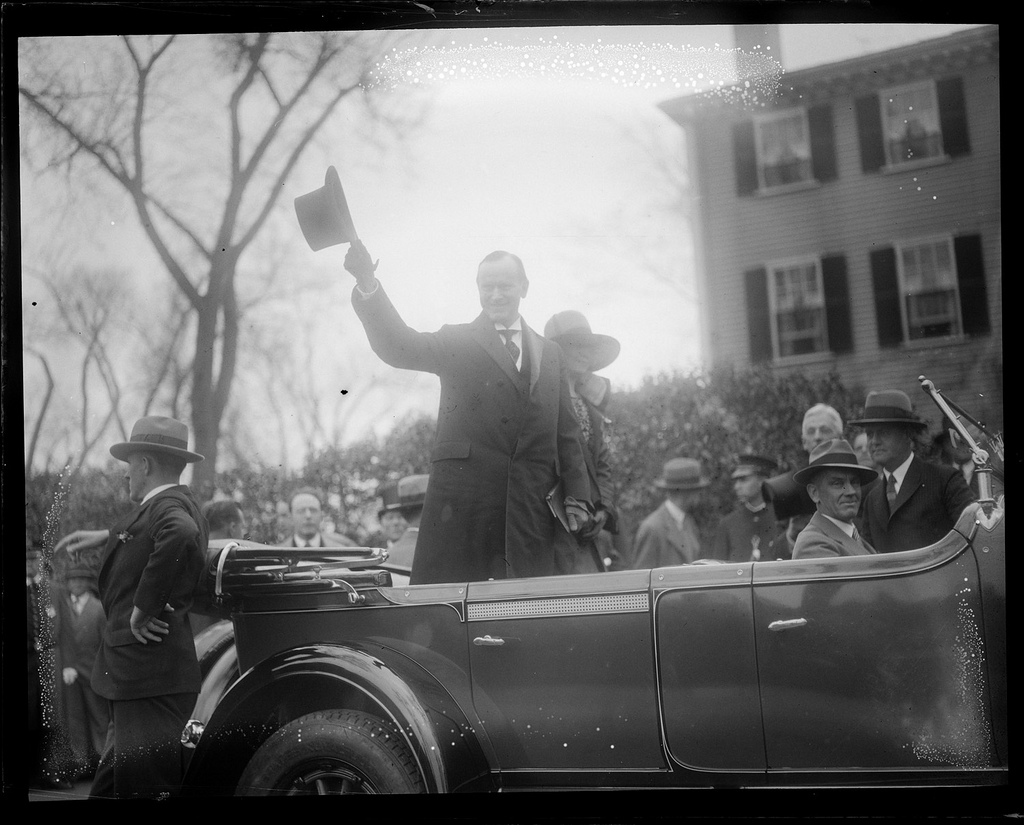
6192828053_50c0a1fa2a_b CC in Andover