On “Negative” Liberties

For Coolidge, when the Constitution said “no” it not only meant what it said, it said so for a good reason. It said “no” in order to preserve good liberties. Much maligned these days is the importance of saying “no,” when it is much easier to say “yes.” While facing the consequences of saying “no” is undeniably unpleasant to the officeholder in the present, it yields good fruit down the road to those who remain unmoved by the intense pressures to relent on behalf of this or that interest.

Much in vogue in recent decades is the academic ridicule of saying “no” when it comes to constitutional governance. It simply is not fashionable to preserve, protect and defend a charter believed to be obsolete and pre-modern. By dubbing them as “negative liberties,” the freedoms articulated by the Bill of Rights (our first ten amendments to the Constitution), it is hoped that a stigma will attach to them without having to explain in what way they somehow lack soundness or credibility.

It is fascinating to consider that a man so widely proclaimed by far too many historians to be an embodiment of presidential shortsightedness was far more prescient and, especially, honest than they. Calvin Coolidge, long before Justice Brennan pined for a “living” Constitution, struck at the heart of this argument. It was not that the Constitution was so old or its provisions so inept at relating to modern Americans, the essence of the complaint went deeper than that. Seeing the essential nature of the matter, Coolidge explained what was really bothering the proponents about a constitution that said “no” rather than “yes.” He first described the grievance, “We often hear people say that our Constitution is antiquated, that it might have been suited to the conditions existing when it was adopted, but we have had so many changes in our mode of life since then that it is not now applicable to our needs.” Some today even go so far as to claim the Constitution “reflects deep flaws in American culture,” remedied not by better application of its principles or through the process of amendments (outlined within the document itself) but by transforming society through unilateral government power.

When specifics are sought, however, the complaint unravels. It unravels because the loudest proponents of replacing the Constitution do not understand the timelessness of human nature. The same reality we face today confronted the Framers two hundred years ago. They grappled with the same issues of individual responsibility versus government power. The Constitution, addresses all of human nature’s weaknesses and strengths to form a framework of principles on which to build now and into the future. Steeped in direct experience with unchecked power, those men and women of two centuries ago preserved a balance of sovereignty decisively with the people not government. Explaining how this framework is “deeply flawed” confuses the imperfections of human nature with the best means ever attained of restraining that human tendency to abuse power and destroy the liberty of others.

For Coolidge, like those men and women of colonial America, “negative” liberties were not a bad thing. They were not to be mocked, maligned or feared. They were safeguards against depriving liberties so precious to all. They kept government in check, limited to specific tasks delegated to it by the states and individuals. Coolidge knew the “beef” with the Constitution went deeper than its supposed flaws. As he would say, “When such people are pressed for particulars, it often develops that they do not want to be limited to raising taxes for public purposes, they despise due process of law, they desire to apply confiscation to other people, impair the obligation of contracts and take property for public use without just compensation.”

The root of the problem, then, was not in the Constitution but in a government hungering to live outside its limits and lawful confines. It is a decidedly positive thing that liberties are denied under such circumstances by our Constitution. When liberties are regarded not as constructive freedoms but as stifling obstructions, it is well that a constitution be zealously supported to say “no.” Granting a power unrestrained by any “no,” to what is, by nature, a hungry Leviathan (as Hobbes coined absolute government) imperils the very real and practical liberties we exercise every day. By performing our liberties dutifully the freedom which government assumes to act for us is correspondingly negated. Coolidge reminds us that such a circumstance is not a negative at all. It restrains those who need restraint and frees those best equipped to exercise liberty. Each of us is infinitely better off as a result.
Image

On Shutting Down Opportunity

“If the Federal Government should go out of existence, the common run of people would not detect the difference in the affairs of their daily life for a considerable length of time” — President Calvin Coolidge, “States Rights and National Unity,” given at the College of William and Mary in Williamsburg, Virginia, May 15, 1926.

As a perverse enthusiasm for the “Government Shutdown” pervades mainstream media coverage, the total mischaracterization of the issue is propagating confusion and fear, not clarity and sound information. The press, having long ago shed the veneer of objective journalism, is no longer upholding its obligation to arm people with accurate and honest information.

The issue is skewed from the outset as a picture of vast human suffering all caused by a callous, unfeeling opposition to the President and his Party’s agenda. Disagreement with that agenda, instead of the agenda itself, is blamed as the problem. In actuality, the problem is never connected to its real cause: the President’s own policies. The cause is never attributed to a Government that has overgrown its very limited and specific Constitutional role. The problem is those lousy Republicans who want Government to shut down and people to die because they want to see “Obamacare,” the law of the land, undone, or so goes the absurd mantra.

Temporarily furloughing those the Government already deems “non-essential” while keeping Congressional and Executive offices open is not a shutdown. Suspending the online stream of the National Zoo’s “Panda Cam” is not a shutdown. Closing the gates of a few parks is not a shutdown. It makes it appear all those indispensably wonderful services Government provides us are going away permanently. It is political manipulation designed to force people yet again to justify a vast, all-encompassing Government in their lives. To believe an apocalypse awaits via Government “shutdown” demands the ultimate credulity. Threatening to withhold military checks while entitlement programs still keep the checks mailing out does not even begin to approach the genuine shutdown this economy is already experiencing directly because of this President’s decisions.

Playing a game of smoke and mirrors, the President and Senate leadership would rather provoke more suffering especially as it helps advance their permanent campaign against Republicans. The focus is never on the 90 million Americans no longer in the work force because of this President’s agenda. The concern is only ever how does the latest Labor statistics make the President look?

The attention is never on the creation of one “unprecedented” crisis after another to force by legislation what would never be passed if calmly and deliberately vetted.  The angst is only ever on how can we survive without Government?

The entire emphasis is turned on its head. The priority is not upon removing the obstacles to ingenuity, opportunity and individual freedom. The priority is ever only on keeping Government alive and growing by “revenue neutral” tax schemes, continuing resolutions, and an endless debt, $17 trillion and counting, which our great grandchildren will still be paying! Add to this “Obamacare” exemptions for Congress ordered by President Obama, the reaffirmation of “quantitative easing” by Chairman Bernanke and now even “shutdowns” are tools to threaten any attempt to restraint this Administration and its agenda for the rest of the country. It is the transfer of authority from a self-governing people to subjects serving an autocratic elite. The focus is all in the wrong direction. The questions should be: How is liberty faring? Are the people being served? How does life look for the people with inflation, massive unemployment and generational indebtedness? Can we survive with Government as it is now, unlimited and absolute?

While Government was significantly smaller in Coolidge’s time, the temptation to encroach on people’s lives was no less alluring. It was leadership that made the difference. Moral character, humble perspective and faith in the institutions and ideals that make America have no substitute when it comes to our leaders. There is nothing that can possibly replace the lack of these qualities in order to lead and lead responsibly. But there is also a fundamental, even natural limitation to any Government which tries to do too much. Opportunity’s door invariably closes whenever and wherever Government gets involved. Consequently, nature itself will rebel against this offense. That is what we are seeing in our time. This is why there remains cause for renewed confidence in our ideals not a lazy and pessimistic resignation to circumstances. The status quo in Washington has already lost. Not living in reality, however, the establishment led by President Obama, does not realize it…yet.

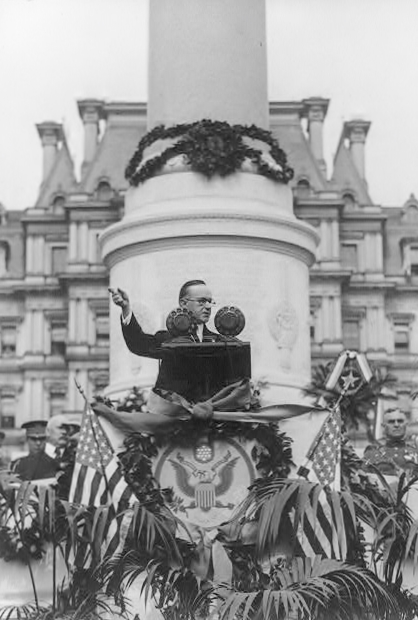
Speaking to those who came to honor their fellow, fallen veterans of the heroic First Division in the American Expeditionary Forces, President Coolidge reflected on the cause for which they fought, saying,

…I cannot let this occasion pass without expressing my most strong and emphatic commendation for the reverence which your words and actions constantly express for the liberty-giving provisions of the fundamental law of our land. You have supported the Constitution and the Flag which is its symbol, not only because it represents to you the homeland, but because you know it is the sole source of American freedom. You want your rights protected by the impartial judicial decisions of the courts where you will have a right to be heard and not be exposed to the irresponsible determination of partisan political action. You want to have your earnings and your property secure. You want a free and fair opportunity to conduct your own business and make your way in the world without danger of being overcome by a Government monopoly.

Such freedom is what we now desire and expect. Government fails when it assumes the life of the individual can best be managed from its halls and corridors. Coolidge went on to explain what happens when Government ventures into the people’s business,

When the Government goes into business it lays a tax on everybody else in that business, and uses the money that it collects from its competitors to establish a monopoly and drive them out of business. No one can compete. When the Government really starts into a line of business that door of opportunity is closed to the people. It has always been an American ideal that the door of opportunity should remain open.

Coolidge saw the road Government takes every time it asserts itself in people’s choices. Opportunity closes. Freedom contracts. It is this road we are now on, with destinations including a single-payer scheme for American healthcare promised by the Government and paid by the rest of us, including generations not yet born. This latest frenzy over “shutting down” the Government is but the latest attempt to distract with fear and obtain by coercion the desired result of greater control and more of the same from an autocratic few. If people will simply stop opposing this Administration then the crisis will evaporate and all our pain will go away, they claim. This President is counting on both ignorance and addiction to the need for Government.

Coolidge reminds us to distinguish between what seems essential from what actually is. When we view it this way, it becomes obvious that the Federal Government needs us, not we it. If Washington ceased to be tomorrow, we would survive. We would even do better than we think. The importance rests with the individual and then his local and state authorities. The Federal Government would not leave a gaping hole which none could fill. The people, exercising their own judgment and creative abilities, would fill that hole. In fact, we would witness the return of choices, opportunity and freedom to our lives impossible when Government tries to “help” us.

Coolidge kept his faith in the ultimate triumph of the people to retain their liberties. The truly intimidating challenges faced by Americans of every time, place and background vindicates his faith. The confidence he had bore no time constraints, it was a faith firmly placed in the strength of ideals we share even now. The assurance of their truth and power for good rests on the conviction not only treasured by Coolidge but by millions of those who build, from nothing, lives of success and quiet excellence without a Washington subsidy. It is the solemn charge of our generation to ensure that door of opportunity remains open.

Image

On Autocracy and Bad Decisions

Image

“Of course it would be folly to argue that the people cannot make political mistakes. They can and do make grave mistakes. They know it, they pay the penalty, but compared with the mistakes which have been made by every kind of autocracy they are unimportant” — Calvin Coolidge, quoted from Adequate Brevity, p.76.

The people do make mistakes in the selection of their leaders. Elections cast the longest shadows, it seems, when bad decisions are made. We are still groping to calculate the costs of the 2008 election, not to mention the two which have occurred since that time. No political persuasion can seriously deny the fact that elections have real and enduring consequences.

It is what Coolidge is saying, in his inimitable way, between the lines that speak volumes. Coolidge would observe on other occasions that if self-seeking, unfit and complacent representation exists in Washington it is because those same vices reside in the voters who put them in office. The voter who never takes the time to learn the substance of the candidate will find the politician never takes the time to responsibly represent that voter.

Still, Coolidge was no cynic, even when it came to politics. He saw the fundamental difference between the conscientious and the careless to come down to one key ingredient: does the officeholder trust the people he represents? Trust is not the blind suspension of one’s judgment. Coolidge would remark on another occasion, “This does not mean that the opinion of constituents is to be ignored. It is to be weighed most carefully, for the representative must represent.” What the people “think determines every question of civilization.” Yet the officeholder has a more sacred obligation to uphold his oath. Constituents can be wrong. They can demand things they should not have. The commitment to keep faithfully to the Constitution and the laws compel him or her with a force outmatching even the most respectable opinion against it. This conscientious struggle to honor their oaths is not the dilemma in Washington. Theirs is a grave listening problem.

Trust is more than a regard or respect for the people one represents. It has nothing to do with personalities. The condescending arrogance of far too many officeholders seem to block out an honest view of problem. It has everything to do with distrust of liberty. It means nothing to convene a town hall meeting without an unwavering faith in what America is. To do otherwise is form without substance, cover truth with an attractive lie. Trust demands loyalty to as well as confidence in the republican design of our system. It is more than carefully-timed expressions of courage to be dispensed with when the time to fight on principle comes.

Coolidge is saying the autocrat does not know he is wrong. He never detects the gravity of his errors because he never experiences the price for them. He is never wrong. Numbed to reality, he is desensitized to the pain of his own actions. He knows better than the governed. His judgment is superior to the wisdom and political sense of the people or their institutions. He continually doubts the ability of the people to govern themselves, exercising their liberties responsibly. He must do it for them. It is too dangerous a world without him or her. They need him to furnish security, stability and surety from the hazards and risks of an unrestrained mob. If his objectives fall short, it is because the people are too stupid to know what is good for them in his or her superior judgment. They failed the autocrat, not he them. Such is the road to serfdom, as Frederick von Hayek coined it. Such is the way to train the people for the yoke.

Coolidge, fully aware that “[a] large part of the history of free institutions is the history of the people struggling to emancipate themselves from unrestricted legislation,” kept an abiding faith in the people to know far better than any autocrat what was best for them. He kept his confidence unshaken that the people are justified with the freedom of making their own choices and will ultimately make the right determination. They would make mistakes, personally and politically, but never learn the surpassing worth of liberty if insulated from not only its risks but also its rewards. Through permanently-affixed training wheels, autocratic authority demands both the eradication of opportunity and the removal of distinctions in order to preserve power. Not even the most foolish mistake by the people could compare with the trail of devastation realized throughout history when a conceited and self-deluded autocracy is at helm.