On Race Relations and Presidential Power, Part 3

The movie hit Boston theaters on April 10, 1915. Adapted from Thomas Dixon’s novel, The Klansman, D. W. Griffith’s “Birth of a Nation” met opposition immediately for its overtly racist slant of history, lionizing the Klan while vilifying the “undesired” elements in American society. It had already been shown and endorsed by President Wilson at the White House. Wilson had praised Griffith’s movie as “writing history with lightning. My only regret is that it’s true.” But it was not true. It was quickly becoming officially validated historical revisionism, neatly packaged pro-Klan propaganda. The fight was on to prevent so bigoted a film from gaining further cultural and official affirmation. William M. Trotter, editor of the Boston Guardian, zealously led much of the effort to petition Governor Walsh and the General Court to strengthen the law for its censorship. As the battle moved into the State House, something curious and unusual happened. Changing the rule for censorship from a simple majority to total unanimity, the House sent the bill to the Senate fully anticipating the upper chamber to go along and effectively kill censorship of the film in its tracks. When the bill came back to the Senate for reconsideration however, they had not considered with whom they were dealing in the person of the Senate President, Calvin Coolidge.

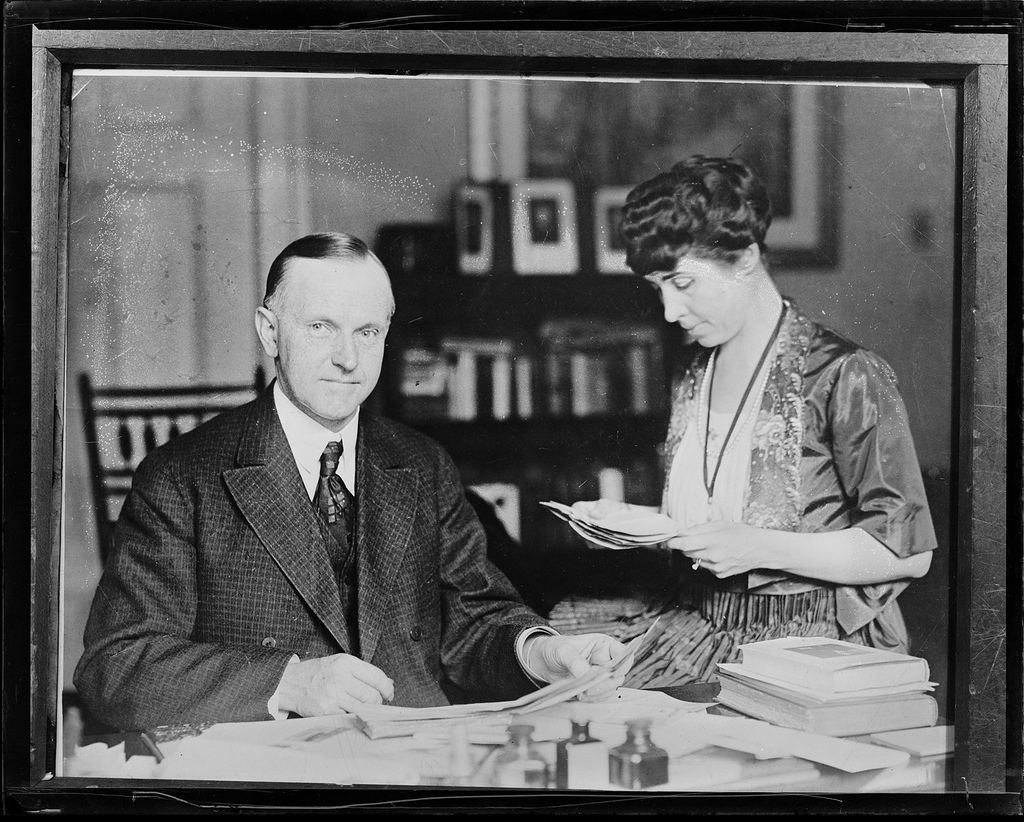
CC signed photo

As the presiding officer of the Senate, no vote is normally exercised in legislative business. A tie means that a bill dies on the floor, thwarting the attempt by the House, on this occasion, from raising a virtually insurmountable threshold in favor of showing the movie. Senator Coolidge could have let this one go by, do nothing and sit silently as the Senate approved the lower chamber’s amended bill, giving a green light to the showing of Griffith’s movie. Instead, as Trotter, Boston papers and “colored” Americans from Massachusetts to Washington noticed, Coolidge intervened. The cumulative effect of removing the movie from local theaters gave an unmistakable rebuke to the Klan and those who had, up to then, failed to stand up to their intolerant agenda, including President Wilson himself. It would not be the only time Coolidge would, by simply doing the day’s work, upstage the sitting President. It was a resounding victory for those who regarded blacks not as second-class imports but as full citizens due the rights and privileges of citizenship under the Constitution and our laws.

Frederick Douglass, 1879

Frederick Douglass, 1879

Hiram R. Revels, c. 1870. Original photo by Matthew Brady.

Hiram R. Revels, U.S. Senator, Mississippi (1870-1), c. 1870. Original photo by Matthew Brady.

Blanche Bruce, U. S. Senator, Mississippi (1875-1881)

Blanche Bruce, U. S. Senator, Mississippi (1875-1881)

Booker T. Washington, founder of Tuskegee Institute

Booker T. Washington, founder of Tuskegee Institute

George Washington Carver, 1906. Photo by Frances Benjamin Johnston.

George Washington Carver, 1906. Photo by Frances Benjamin Johnston.

This insightful controversy, and especially Coolidge’s role in it, is little known and even less appreciated when it comes to the attitude of “Silent Cal” on race relations among “historians.” Both John L. Blair and Macco C. Dailey Jr., in writing on Coolidge and race, glaringly overlook this substantial event and simply accept, unquestioned, James W. Johnson’s impression of Coolidge written years after their White House meeting in February 1924. Furthermore, Dailey even claims there is no evidence that Coolidge had any exposure to black people or the issues concerning them until Mr. Johnson came to see him. For Blair, there is simply no room for interaction or mutual respect between blacks and a Republican Party so long classified as “white, Anglo-Saxon, Protestant.” Blair, writing of the electoral shift in party politics that moved blacks from Republican to Democrat support, discounts the first seventy years of GOP history. The Democrat claim of a “whites-only” Republican Party has to appropriate not only the end of slavery (a Republican achievement), the national influence of Republicans like Frederick Douglass, Hiram R. Revels, Blanche Bruce, Booker T. Washington, George W. Carver, among others, and an enlightened cultural tolerance in place today thanks to Democrat effort. In truth, history shows that Democrats have repeatedly and consistently obstructed the equality of blacks under the law, be it the filibuster of anti-lynching legislation in Coolidge’s day, blocking the famous Civil Rights Act of 1964 or exploiting racial discord for political advantage like those peddling permanent victimhood such as Jesse Jackson and Al Sharpton.

Since there is little institutional support for correcting the record, it is understandable why Blair and Dailey join the echo chamber of “scholars,” rather than question false premises. Still, it is a sad state of affairs when the minds most closed to know the truth are found in modern education. Having been weaned on a sour impression of Coolidge and his actions, or inaction (as they confidently maintain), nothing can exist to challenge that final and unequivocal conclusion, especially not the facts.

Page 2-43

Had that one incident in 1915 been Coolidge’s only interaction with racial issues, the assertion might hold that he “did nothing,” timidly kept “silent” and left the problem for future leaders to finally “fix” injustice. In reality, Coolidge met the problem time and again throughout his five and a half years as President. Yet, like Coolidge understood (perhaps better than we today do), greater government activity does not translate into greater social equality. Has the mountain of legislation and executive activity over the last fifty years “fixed” racial inequality? Intolerance, bigotry and hatred reside in the hearts of people everywhere. Coolidge knew that government action had inescapable limits. Even the best laws and administrations are subject to it. As he once said, “Real reform does not begin with a law, it ends with a law. The attempt to dragoon the body when the need is to convince the soul will end only in revolt.” Such is the eternal nature of us humans. Americans are no more susceptible than anyone else. We were founded on the ideals of Christian forbearance, the Golden Rule and mutual respect but we, like the rest of the world, tend to reject those ennobling, exceptional standards for a base and mean norm, looking to public authorities to compensate for our personal deficiencies at self-government and self-control. There remains a reason why (particularly in our federalist system) law, and the government which enacts it, possesses these inherent limits. Coolidge, applying the principle consistently, saw what happened when individuals and local governments failed to meet their obligations; a higher authority would have to step into the vacuum. This held true whether the issue was flood control in 1927, agriculture in 1928, or enforcement against lynching in 1923. Coolidge, as usual, explains it best in an address at the College of William and Mary in 1926,

“It does not follow that because something ought to be done the National Government ought to do it. But, on the other hand, when the great body of public opinion of the Nation requires action the States ought to understand that unless they are responsive to such sentiment the national authority will be compelled to intervene. The doctrine of State rights is not a privilege to continue in wrong-doing but a privilege to be free from interference in well-doing. This Nation is bent on progress. It has determined on the policy of meting out justice between man and man. It has decided to extend the blessing of an enlightened humanity. Unless the States meet these requirements, the National Government reluctantly will be crowded into the position of enlarging its own authority at their expense. I want to see the policy adopted by the States of discharging their public functions so faithfully that instead of an extension on the part of the Federal Government there can be a contraction.”

That contraction, Coolidge would go on to say, places the burden of citizenship, maintaining the independence of action on local self-government. The better we govern ourselves, the less need there is for greater external authority, be it the State or the Federal Government. The contraction, as Coolidge termed it, of Washington’s involvement in American life was not something dreadful to be held with trepidation as a reversal of progress, it was progress toward our founding ideals. When Coolidge is criticized for not doing enough on race relations, or anything else, what the critic actually dislikes is Cal’s respect for America’s constitutional constraint of power and empowerment of local self-government.

Republican Leonidas C. Dyer, represented Missouri's 12th Congressional District, 1911-1933

Republican Leonidas C. Dyer, represented Missouri’s 12th Congressional District, 1911-1933

Senator William E. Borah, the "Lion of Idaho," held office from 1907-1940

Powerful Senator William E. Borah, the “Lion of Idaho,” held office from 1907-1940

This is powerfully illustrated in the battle over the Dyer bill to make lynching, already a state offense in many localities, also a Federal crime subject to 5 years in prison, a $5,000 fine, or both, to an official who failed to act in his or her jurisdiction. Counties as well as individuals were subject to even harsher penalties if the law was not enforced against lynchers. Congressman Leonidas Dyer had seen the violence in his district of St. Louis back in 1917, the same year several race riots erupted, including one in Houston we will discuss momentarily. When the Tuskegee Institute began collecting a careful record of lynching numbers nationwide in 1882, the decade averaged 150 people, both white and black, annually. The number began coming down slowly in the years that followed but rose again during the Wilson years, peaking in 1915 (69 people) and even higher in 1919 (83 people). Still averaging sixty a year under Harding, the debate over Dyer’s bill reached its zenith in 1922. Introduced in 1918, Dyer had had an uphill fight from the beginning yet the House overwhelming passed the legislation in 1922 with the vote 231-119. Now pending before the Senate, it had to survive the Judiciary Committee and finally the full chamber. First, Senator Borah of Idaho, dependably contrary whatever the issue, gradually came to oppose the bill. Passing despite his resistance, it seemed that the bill would finally reach the President’s desk and become law. It never happened. The Democrats in the Senate commenced a filibuster and threatened to halt every other item of business until Republicans dropped Dyer’s legislation. Senate Republicans did soon thereafter. Not even President Harding, despite his Secretary’s promise to the contrary, would mention the campaign against lynching in his Annual Message that December. Perhaps it would just go away quietly?

Harding died the following August and it remained to be seen what position his successor would take until the first of his six annual messages to Congress, beginning on December 6, 1923, in which he declared,

“Numbered among our population are some 12,000,000 colored people. Under our Constitution their rights are just as sacred as those of any other citizen. It is both a public and private duty to protect those rights. The Congress ought to exercise all its powers of prevention and punishment against the hideous crime of lynching, of which the negroes are by no means the sole sufferers, but for which they furnish a majority of the victims.”

Lawyer Giles B. Jackson and Educator-Author D. Webster Davis photographed together in 1911, both rose from slavery to successful lives of public service

Lawyer Giles B. Jackson and Educator-Author D. Webster Davis photographed together in 1911, both rose from slavery to successful lives of public service

President Coolidge did not stop there, he went on to express his support for other efforts underway, including, of all things, an appropriation for vocational training, another half million for Howard University’s medical program to expand the already successful work of training doctors, and endorsing Giles B. Jackson’s effort to get Congress to create a commission of “mutual understanding” that would work together in the growth and development of economic opportunity between the races. Coolidge would not let it alone either. On December 3, 1924, Coolidge said,

“I firmly believe that it is better for all concerned that they [“colored” people] should be cheerfully accorded their full constitutional rights, that they should be protected from all of those impositions to which, from their position, they naturally fall a prey, especially from the crime of lynching and that they should receive every encouragement to become full partakers in all the blessings of our common American citizenship.”

Signed photo of CC

The country knew he was not only addressing the Dyer bill but also disenfranchisement and segregation. In October of the following year, he would bravely head to Omaha, where the Klan had done their best to stir up prejudice and resentment with their cloaked motto, “America First.” To the cheers of black Americans around the country, President Coolidge before the American Legion convened there, underscored the common heritage all those holding the name “American” rightly possesses. Americans of all backgrounds had served in the recent World War, fighting for the same cause, united toward the same goals and purpose. Now that war was passed, it was no different for everyone to live at peace with his neighbor. The ideal of “America first,” he said, was not inherently wrong, it was how such an aim was being carried out.

Walter Francis White, secretary of the NAACP, was an early correspondent with the Coolidge White House. Americans, white and black, were not looking for a complete overhaul of society by civil rights legislation in the 1920s. White's requests were simple: (1) Turn the Veterans Hospital at Tuskegee entirely over to "colored" administration; and (2) Support the Dyer bill against lynching. Coolidge fulfilled both requests and more.

Walter Francis White, secretary of the NAACP, was an early correspondent with the Coolidge White House. Americans, white and black, were not looking for a complete overhaul of society by civil rights legislation in the 1920s. White’s requests were much simpler and far more practical: (1) Turn the Veterans Hospital at Tuskegee entirely over to “colored” administrators; and (2) Support the Dyer bill against lynching. Coolidge fulfilled both requests and more.

“It can not be done,” Coolidge proclaimed, “by the cultivation of national bigotry, arrogance, or selfishness. Hatreds, jealousies, and suspicions will not be productive of any benefits in this direction. Here again we must apply the rule of toleration. Because there are other peoples whose ways are not our ways, and whose thoughts are not our thoughts, we are not warranted in drawing a conclusion that they are adding nothing to the sum of civilization. We can make little contribution to the welfare of humanity on the theory that we are a superior people and all others are an inferior people. We do not need to be too loud in the assertion of our own righteousness. It is true that we live under most favorable circumstances. But before we come to the final and irrevocable decision that we are better than everybody else we need to consider what we might do if we had their provocations and their difficulties…

“We can only make America first in the true sense which that means by cultivating a spirit of friendship and good will, by the exercise of the virtues of patience and forbearance, by being ‘plenteous in mercy,’ and through progress at home and helpfulness abroad standing as an example of real service to humanity…

“If our country is to have any position of leadership, I trust it may be in that direction, and I believe that the place where it should begin is at home. Let us cast off our hatreds…

“If we are to maintain and perfect our own civilization, if we are to be of any benefit to the rest of mankind, we must turn aside from the thoughts of destruction and cultivate the thoughts of construction. We can not place our main reliance upon material forces. We must reaffirm and reinforce our ancient faith in truth and justice, in charitableness and tolerance. We must make our supreme commitment to the everlasting spiritual forces of life. We must mobilize the conscience of mankind.”

Troops of the 24th Infantry, in a photo taken at Yosemite National Park sometime in the early years of the twentieth century. The 24th Infantry was deployed to resolve more civil conflicts than any other unit. Coolidge authorized the early release of 20 black soldiers originally under sentence of death or life imprisonment for taking part in the race riots in Houston, August 1917.

Troops of the 24th Infantry, in a photo taken at Yosemite National Park sometime in the early years of the twentieth century. The 24th Infantry was deployed to resolve more civil conflicts than any other unit. Coolidge authorized the early release of 20 black soldiers originally under sentence of death or life imprisonment for taking part in the race riots in Houston, August 1917.

Coolidge continued to bring pressure to bear for that mobilization of conscience. In December of that same year, 1925, Coolidge brought the issue before Congress again, reminding them of their unfinished business, the Negro race needed “reassurance that the requirements of the Government and society to deal out to them even-handed justice will be met. They should be protected from all violence and supported in the peaceable enjoyment of the fruits of their labor.” Then Coolidge came to the point, “Those who do violence to them should be punished for their crimes. No other course of action is worthy of the American people…It is fundamental of our institutions that they seek to guarantee to all our inhabitants the right to live their own lives under the protection of the public law. This does not include any license to injure others…But it does mean the full right to liberty and equality before the law without distinction of race or creed.” He would not, however, exceed his duty by using coercion, taking reprisals if certain Senators or Representatives failed to do their job (The Autobiography p.232). They are not his representatives, the people are to hold them accountable as their delegated representation. As Dyer would reintroduce the legislation for the last time in 1926, Coolidge did not consider the matter dead. “The social well-being of our country requires our constant effort for the amelioration of race prejudice and the extension to all elements of equal opportunity and equal protection under the laws which are guaranteed by the Constitution…our duty…requires us to use all our power to protect them from the crime of lynching. Although violence of this kind has very much decreased, while any of it remains we can not justify neglecting to make every effort to eradicate it by law.”

In December 1927, Coolidge continued his annual report to Congress, black Americans “have been the recipients of presidential appointments and their professional ability has arisen to a sufficiently high plane so that they have been intrusted with the entire management and control of the great veterans hospital at Tuskegee, where their conduct has taken high rank. They have shown that they have been worthy of all the encouragement which they have received. Nevertheless, they are too often subjected to thoughtless and inconsiderate treatment, unworthy alike of the white or colored races. They have especially been made the target of the foul crime of lynching. For several years these acts of unlawful violence had been diminishing. In the last year they have shown an increase. Every principle of order and law and liberty is opposed to this crime. The Congress should enact any legislation it can under the Constitution to provide for its elimination.”

Finally, when nearly everyone had given up on Congress doing anything, Coolidge took his incessant thrust at Congress in his final message (contrary to Blair’s claim he abandoned the cause by this time), “For 65 years now our negro population has been under the peculiar care and solicitude of the National Government. The progress which they have made in education and the professions, in wealth and in the arts of civilization, affords one of the most remarkable incidents in this period of world history…Whatever doubt there may have been of their capacity to assume the status granted to them by the Constitution of this Union is being rapidly dissipated. Their cooperation in the life of the Nation is constantly enlarging. Exploiting the Negro problem for political ends is being abandoned and their protection is being increased by those States in which their percentage of population is largest. Every encouragement should be extended for the development of the race” in the just application of State laws against the “crime of lynching” reinforced by “such immediate remedial legislation as the Federal Government can extend under the Constitution.”

Source: The Tuskegee Institute, whose numbers can be found by year at http://law2.umkc.edu/faculty/projects/ftrials/shipp/lynchingyear.html.

Source: The Tuskegee Institute, whose numbers can be found by year at http://law2.umkc.edu/faculty/projects/ftrials/shipp/lynchingyear.html.

Without a single law yet passed, the number had plummeted to 17 that year, from what had for so many years been over a hundred people lynched annually. By 1929 the total for the entire year had fallen to 10 people. How was this possible? Some, like James W. Johnson and Leonidas Dyer, attribute it to the impact of their lynching bill on existing local enforcement. It was federalism functioning as intended. While improved enforcement  certainly had an impact, so did Coolidge for keeping the heat on Congress. This was not the only reason, however, when considered beside the reduction of income taxes spearheaded by Coolidge and Mellon in chopping rates down to 25 per cent by 1928, exempting most Americans from having to pay. Combined with the constructive economy initiative pushed by Coolidge and his Budget Bureau Director, Herbert Lord, all Americans were able to keep more of what they earned for themselves, rather than Washington. Of course, as experience revealed, the States commenced heavy spending practices that placed the Federal Government in the remarkable position of being better placed fiscally than several of the State governments when Coolidge left office.

Cartoon by Charles Berryman, February 12, 1924

Cartoon by Charles Berryman, February 12, 1924

Words are great, very potent instruments for fostering historic advancement but Coolidge did not stop there. He acted. His actions were not always comprehended at the time, whether it was appointing C. Bascom Slemp to serve as Secretary to the President or reappointing Colonel C. O. Sherill over Public Buildings, Grounds and Parks. In time, his selection of Slemp would be hailed as one of many saavy choices to advance the welfare of everyone, not merely one segment of the country. Even his choice to succeed Harlan Stone at the Justice Department, Charles B. Warren, was lauded by blacks for his strong support of equal and impartial application of the law. He would replace Colonel Sherrill with Lieutenant Colonel Grant, who would abruptly end segregation in his bureau and tear down the “white pool” constructed during the Wilson years without simultaneously providing a beach area for blacks. His appointment of first Harlan F. Stone and then John G. Sargent would shut down the institutional prejudice of previous departments. As each year’s departmental reports showed, discrimination was declining, wages of $53 million were increasing, employment practices were returned to a meritorious basis (growing personnel to an historic 51,800 in Federal service), while black Americans were experiencing the blessings of home ownership, self-employment and increased capital, reaching into every field from medicine and law to industry and agriculture (Blair, “A Time for Parting: the Negro during the Coolidge Years,” Journal of American Studies 3.2 [December 1969]: 183; “African Americans and the Consumer Economy,” http://lcweb2.loc.gov:8081/ammem/amrlhtml/inafamer.html). Coolidge would approve the first all-Negro commission dispatched diplomatically to the Virgin Islands in 1924 to investigate the social and commercial conditions of the protected islands and make recommends for future policy. Among the commission’s nine recommendations were: (1) strengthening traditional marriage and the home; (2) building up the ties in educational institutions in America and the Islands; and (3) Upholding clear standards for immigration and citizenship on the Islands.

Colonel Ulysses S. Grant III

Colonel Ulysses S. Grant III

C. Bascom Slemp being sworn in as Secretary to the President, September 4, 1923

C. Bascom Slemp, in white trousers, being sworn in as Secretary to the President, September 4, 1923

A letter dated September 3, 1924 from C. Bascom Slemp to W. D. Johnson of New York, concerning fears about his as well as Coolidge's resolve when it comes to racial conflict. Slemp, loyal to his chief despite having voted against the Dyer bill back in 1922 as a Congressman writes of Coolidge, "he has in one of his messages to Congress referred most sympathetically to this measure, and I have every reason to believe that his attitude will continue friendly and helpful toward it." Indeed, it did. A fascinating chain of correspondence (including this document) can be found at http://lcweb2.loc.gov/cgi-bin/ampage. "Prosperity and Thrift: The Coolidge Era and the Consumer Economy, 1921-1929"

A letter dated September 3, 1924 from C. Bascom Slemp to W. D. Johnson of New York, concerning fears about his as well as Coolidge’s resolve when it comes to racial conflict. Slemp, loyal to his chief despite having voted against the Dyer bill back in 1922 as a Congressman writes of Coolidge, “he has in one of his messages to Congress referred most sympathetically to this measure, and I have every reason to believe that his attitude will continue friendly and helpful toward it.” Indeed, his attitude did. A fascinating chain of correspondence (including this document) can be found at http://lcweb2.loc.gov/cgi-bin/ampage. “Prosperity and Thrift: The Coolidge Era and the Consumer Economy, 1921-1929”

Coolidge stood by those chosen for official responsibility, an impressive list of qualified men and women in an era and by a man who supposedly accomplished nothing for civil rights: renewing the appointments of Charles Anderson as Collector of Internal Revenue and Walter L. Cohen as Louisiana’s Controller of Customs (keeping him as a recess appointment over Senate rejection); selecting Arthur Froe as Recorder of Deeds for the illustrious District of Columbia; giving full control of the Veterans Hospital at Tuskegee to “colored” directors, doctors and support staff; appointing James A. Cobb as a judge of the D.C. Municipal Court; William F. Francis as U.S. Minister to Liberia; and George H. Woodson, Cornelius R. Richardson, Charles E. Mitchell, W. H. C. Brown, and Jefferson S. Coage as the Commission to the Virgin Islands. Among his political team, he collaborated with the talented Emmet Jay Scott, William Matthews and Hallie Q. Brown to promote a campaign that Scott called “constructionalism,” appealing not to black victimhood or affirmative action but initiative, self-reliance and economic opportunity rather than legislative lobbyism.

Charles W. Anderson, reappointed Collector of Internal Revenue for New York's second district. It was a district that included Wall Street.

Charles W. Anderson, reappointed by Coolidge as Collector of Internal Revenue for New York’s second district. It was a district that included Wall Street.

James A. Cobb was appointed by Coolidge in 1925 as a federal judge of the D.C. Municipal Court to succeed the first black man so honored, Robert H. Terrell, nominated by President Taft in 1910. Coolidge sought the most qualified men, finding the notion of special seats for race or religion to be abhorrent and insulting.

James A. Cobb was appointed by Coolidge in 1925 as a federal judge of the D.C. Municipal Court to succeed the first black man so honored, Robert H. Terrell, nominated by President Taft in 1910. Coolidge sought the most qualified men, finding the notion of special seats for race or religion to be abhorrent and insulting.

William T. Francis, appointed by Coolidge to serve as Minister Resident and Consul General to Liberia, July 12, 1927. He was an imminently qualified lawyer, a graduate of St. Paul's William Mitchell College of Law.

William T. Francis, appointed by Coolidge to serve as Minister Resident and Consul General to Liberia, July 12, 1927. He was an imminently qualified lawyer, a graduate of St. Paul’s William Mitchell College of Law.

Charles E. Mitchell of West Virginia, one of five to serve on the Commission approved by President Coolidge whom he tasked with setting policy on the Virgin Islands.

Charles E. Mitchell of West Virginia, one of five to serve on the Commission approved by President Coolidge whom he tasked with setting policy on the Virgin Islands. This was the first time in American history a delegation, completely comprised of blacks, was dispatched in an official capacity by any President. The other four commissioners were well-known and respected leaders in their states: George Henry Woodson of Iowa, Cornelius R. Richardson of Indiana, W. H. C. Brown of Virginia, and Jefferson S. Coage of Delaware. Photo from The New York Age, November 8, 1924.

Emmett Jay Scott of Texas, had served as Dr. Washington's right-hand man at Tuskegee. He documented and published a work on black Americans who served in World War I, had already worked in the War Department during that conflict and while Secretary-Treasurer of Howard University also led the work of "constructionalism" among black Americans during the 1924 campaign to "Keep Coolidge."

Emmett Jay Scott of Texas, had served as Dr. Washington’s right-hand man at Tuskegee. He documented and published a work on black Americans who served in World War I, had already worked in the War Department during that conflict and while Secretary-Treasurer of Howard University also led the advance of “constructionalism” among black Americans during the 1924 campaign to “Keep Coolidge.” 1,308,000 blacks voted to keep Cal that year.

Hallie Quinn Brown of Pennsylvania was a tireless Republican grassroots activist. She helped establish women's clubs in Ohio and directed the effort nationally among black women from 1920-1924. She spoke at the 1924 convention and helped to ensure Coolidge won that November. This is a picture from a book she published in 1926.

Hallie Quinn Brown of Pennsylvania was a tireless Republican grassroots activist. She helped establish women’s clubs in Ohio and directed the effort across the country through the National Association of Colored Women from 1920-1924. She spoke at the 1924 convention and helped to ensure Coolidge won that November. This is a picture from a book she published in 1926.

Coolidge did more, he cut a year and a half from the sentences of members of the 24th Infantry imprisoned for their part in the Houston riots of 1917, he commuted the sentence of Jamaican national, Marcus Garvey, offered the post to W. E. B. DuBois representing America at the inauguration of Liberia’s President, Charles B. D. King and by working closely with Robert Moton of Tuskegee Institute along with Emmett Scott of Howard University, secured annual appropriations for improving academic programs. Furthermore, through his support of Howard University, the first permanent black president, Mordecai Johnson, was inaugurated in 1927. In each instance, when petitioned, he responded honestly and in typical Coolidge fashion, conscientiously following up behind the scenes even when it took years to obtain resolution. When word reached Coolidge that the Commissioner of Pensions had segregated four black Examiners in his bureau, he issued clear orders: “the President directs you to revoke such segregation at once.” Coolidge would not issue blanket commands, however, unrelated to specific violations, insensitive to the host of unintended consequences such a blind exercise of authority would unleash, potentially harming the people he meant to help. He believed in the power of the morally right to ultimately prevail, a power no Congress or President can invent or otherwise administer through legislation or executive order without the individual’s will to choose tolerance over prejudice and service over hatred. As Coolidge potently affirms, “Bigotry is only another name for slavery. It reduces to serfdom not only those against whom it is directed, but also those who seek to apply it. An enlarged freedom can only be secured by the application of the golden rule. No other utterance ever presented such a practical rule of life.” Quite a record for someone dismissed as a “silent, do nothing” President, don’t you agree?

Page 1-21

For further reading:

Hasian Jr., Marouf. “Calvin Coolidge and the Rhetoric of ‘Race’ in the 1920s,” chapter 2 of Civil Rights Rhetoric and the American Presidency. Eds. James Arnt Aune and Enrique D. Rigsby. College Station: Texas A & M University Press, 2005. Hasian does a fair job dispelling the notion that Coolidge was “silent” on the issues of race relations and they even understand the opposition the thirtieth president had and certainly would continue to have for government’s array of social engineering experiments. An interesting walk through Coolidge’s era alongside eugenics, segregation, the Klan and the rest of the “race problem.”

Johnson, Charles C. Why Coolidge Matters: Leadership Lessons from America’s Most Underrated President. New York: Encounter Books, 2013. It is primarily in chapter six, “The Possibilities of the Soul” (pages 164-186), that you will find an excellent exposition of Coolidge’s thoughts on race.

O’Reilly, Kenneth. Nixon’s Piano: Presidents and Racial Politics from Washington to Clinton. New York: Free Press, 1995. O’Reilly angrily asserts that the only two men to accomplish anything constructive for race relations were Abraham Lincoln and Lyndon Johnson. Mr. O’Reilly needs to get out more.

Sherman, Richard B. The Republican Party and Black America From McKinley to Hoover 1896-1933. Charlottesville: University Press of Virginia, 1973. Like the rest, Sherman parrots the same “Coolidge didn’t do enough” line but his explanation of the struggle to advance anti-lynching legislation (chapter 7) is both clear and informative.
On “The Press Under a Free Government”

6208526588_53203fac4d_b Coolidges

Few men have been as singularly characterized by one misquotation as Calvin Coolidge. It is ironic that of all the misrepresented statements which could be made of our thirtieth President, the one incessantly parroted derives from a speech to the American Society of Newspaper Editors. If anyone is supposed to be curious enough to check their facts, research context and accurately report what is found, is it not the press?

Yet, each time, “the business of America is business” is the final word echoed on all that is ever worth knowing about the man and his era, those greedy, materialistic Twenties. Thank you, William Allen White. This “sound-byte” premise sets up a convenient marketing contrast for what came after in the charismatic person of F.D.R. and his “triumph” over economic depression made possible through the “New Deal.” Now just short of ninety years since Coolidge spoke to those members of the press on January 17, 1925, it becomes obvious to anyone who actually reads this speech in full that “Silent Cal” was not claiming business rightly functioned as the end-all of American existence. He was asserting the opposite. The same man who, in actuality, said, “The chief business of the American people is business” also said in the next paragraph, “The chief ideal of the American people is idealism.” He was lauding ideals, the spiritual commodities that accrue to character: peace, honor and charity, and the integrity of the soul, not the absorption in materialism.

If anything, looking at what the media has become, Coolidge was ahead of his time, identifying the very methods the Left has incrementally used to dominate modern education and deploy the “sources of public information” as purveyors of propaganda rather than sound information. These sources have become exactly what Coolidge warned they would be if the press succumbed to autocratic government.

President Coolidge, on the White House grounds, reviews plans for the National Press Building later that same year, September 15, 1925.

President Coolidge, on the White House grounds, reviews plans for the National Press Building later that same year, September 15, 1925.

In his ability to see the danger and explain it, Coolidge’s wisdom is a threat to a news media subservient to those in power. This is why he has been lampooned and caricatured, his statements yanked from context and his credibility discounted by the self-appointed “smartest of the smart.” He refuses to fit neatly into the box built for him all these years by the political and cultural elite, who now rule in alliance with each other. It is this speech, perhaps more cogently than any other, that exposes their motivations and procedures for what they are. He entered into their arena and is it any wonder that Coolidge has been so vilified and maligned for it? To restore Coolidge to his rightful position and his words to their proper perspective would be the beginning of the end for this modern regime. It is, after all, a ruling class of politicians and propagandists who can only retain legitimacy through the perpetuation of ignorance, the maintenance of false standards, and the perverse union between those devoted to power rather than committed to the truth. This elite caste serves the ideological interests of a few rather than the “general interest of the whole people.” Freedom cannot endure without truth.

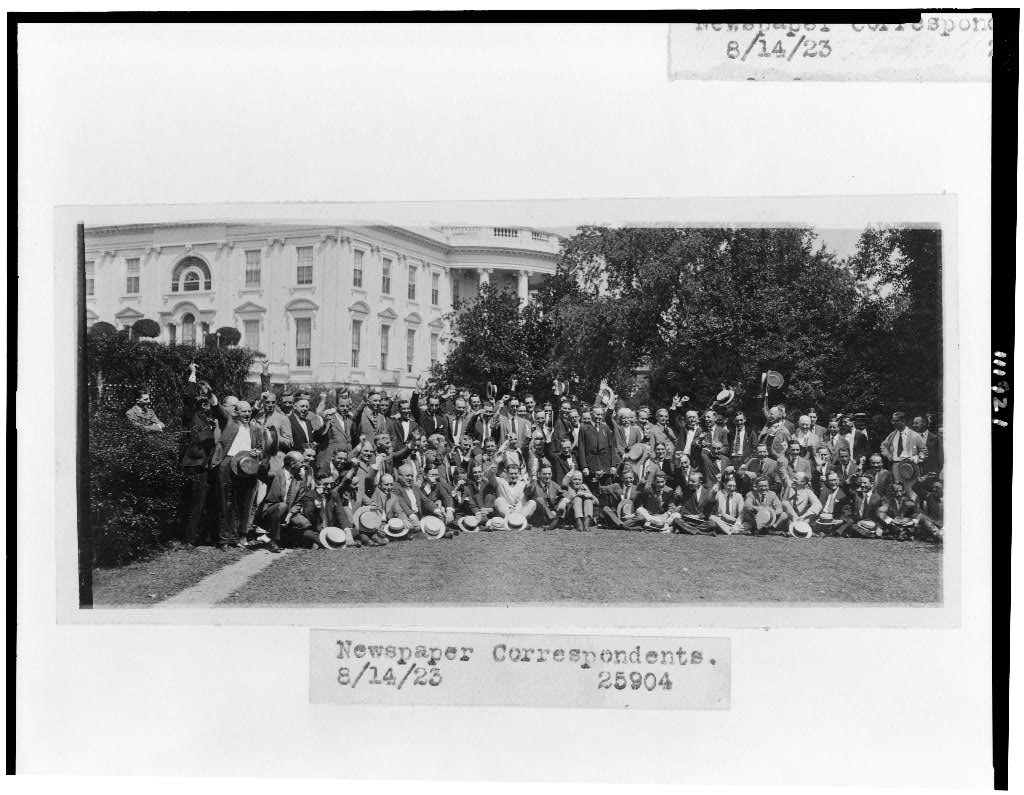
President Coolidge poses with the Washington correspondents corps on the lawn of the White House, August 14, 1923. The press, not without its biases and healthy curiosity even then, remained fair to Coolidge throughout his five years and seven months in office. They had their hostile critics, like correspondent Frank Kent and others, but none walked in the unquestioned conformity they largely do today. Coolidge could honestly assess their coverage in these terms: "You have been, I think, quite successful in interpreting the administration to the country. I have known that I wasn't much of a success in undertaking newspaper work, so I have left the work of reporting the affairs of my administration to the experts of the press. Perhaps that is the reason that the reports have been more successful than they would have been if I had undertaken myself to direct them" (March 1, 1929, The Talkative President, p. 34). Coolidge practiced what he preaches, letting the press do their job, free of forceful directives on what to report from the White House.

President Coolidge poses with the Washington correspondents corps on the lawn of the White House, August 14, 1923. The press, not without its biases and healthy curiosity even then, remained fair to Coolidge throughout his five years and seven months in office. Coolidge had his detractors, like correspondent Frank Kent, Charles Michaels and others, but none walked in the unquestioned conformity they largely do today. Coolidge could honestly assess their coverage in these terms: “You have been, I think, quite successful in interpreting the administration to the country. I have known that I wasn’t much of a success in undertaking newspaper work, so I have left the work of reporting the affairs of my administration to the experts of the press. Perhaps that is the reason that the reports have been more successful than they would have been if I had undertaken myself to direct them” (March 1, 1929, The Talkative President, p. 34). Coolidge practiced what he preached, letting the press do their job, free of fabricated “facts” or political strategy directives on what to report from the White House.

Here it is, President Coolidge’s speech to the American Society of Newspaper Editors in full:

“The relationship between governments and the press has always been recognized as a matter of large importance. Wherever despotism abounds, the sources of public information are the first to be brought under its control. Wherever the cause of liberty is making its way, one of its highest accomplishments is the guarantee of the freedom of the press. It has always been realized, sometimes instinctively, oftentimes expressly, that truth and freedom are inseparable. An absolutism could never rest upon anything save a perverted and distorted view of human relationships and upon false standards set up and maintained by force. It has always found it necessary to attempt to dominate the entire field of education and instruction. It has thrived on ignorance. While it has sought to train the minds of a few, it has been largely with the purpose of attempting to give them a superior facility for misleading the many. Men have been educated under absolutism, not that they might bear witness to the truth, but that they might be the more ingenious advocates and defenders of false standards and hollow pretenses. This has always been the method of privilege, the method of class and caste, the method of master and slave.

“When a community has sufficiently advanced so that its government begins to take on that of the nature of a republic, the processes of education become even more important, but the method is necessarily reversed. It is all the more necessary under a system of free government that the people should be enlightened, that they should be correctly informed, than it is under an absolute government that they should be ignorant. Under a republic the institutions of learning, while bound by the constitution and laws, are in no way subservient to the government. The principles which they enunciate do not depend for their authority upon whether they square with the wish of the ruling dynasty, but whether they square with the everlasting truth. Under these conditions the press, which had before been made an instrument for concealing or perverting the facts, must be made an instrument for their true representation and their sound and logical interpretation. From the position of a mere organ, constantly bound to servitude, public prints rise to a dignity, not only of independence, but of a great educational and enlightening factor. They attain new powers, which it is almost impossible to measure, and become charged with commensurate responsibilities.

“The public press under an autocracy is necessarily a true agency of propaganda. Under a free government it must be the very reverse. Propaganda seeks to present a part of the facts, to distort their relations, and to force conclusions which could not be drawn from a complete and candid survey of all the facts. It has been observed that propaganda seeks to close the mind, while education seeks to open it. This has become one of the dangers of the present day.

Cartoon by C.H. Sykes appearing in Life magazine, October 2, 1924.

Cartoon by C.H. Sykes appearing in Life magazine, October 2, 1924.

“The great difficulty in combating unfair propaganda, or even in recognizing it, arises from the fact that at the present time we confront so many new and technical problems that it is an enormous task to keep ourselves accurately informed concerning them. In this respect, you gentlemen of the press face the same perplexities that are encountered by legislators and government administrators. Whoever deals with current public questions is compelled to rely greatly upon the information and judgments of experts and specialists. Unfortunately, not all experts are to be trusted as entirely disinterested. Not all specialists are completely without guile. In our increasing dependence on specialized authority, we tend to become easier victims for the propagandists, and need to cultivate sedulously the habit of the open mind. No doubt every generation feels that its problems are the most intricate and baffling that have ever been presented for solution. But with all recognition of the disposition to exaggerate in this respect, I think we can fairly say that our times in all their social and economic aspects are more complex than any past period. We need to keep our minds free from prejudice and bias. Of education, and of real information we cannot get too much. But of propaganda, which is tainted or perverted information, we cannot have too little.

“Newspaper men, therefore, endlessly discuss the question of what is news. I judge that they will go on discussing it as long as there are newspapers. It has seemed to me that quite obviously the news-giving function of a newspaper cannot possibly require that it give a photographic presentation of everything that happens in the community. That is an obvious impossibility. It seems fair to say that the proper presentation of the news bears about the same relation to the whole field of happenings that a painting does to a photograph. The photograph might give the more accurate presentation of details, but in doing so it might sacrifice the opportunity the more clearly to delineate character. My college professor was wont to tell us a good many years ago that if a painting of a tree was only the exact representation of the original, so that it looked just like the tree, there would be no reason for making it; we might as well look at the tree itself. But the painting, if it is of the right sort, gives something that neither a photograph nor a view of the tree conveys. It emphasizes something of character, quality, individuality. We are not lost in looking at thorns and defects; we catch a vision of the grandeur and beauty of a king of the forest.

“And so I have conceived that the news, properly presented, should be a sort of cross-section of the character of current human experience. It should delineate character, quality, tendencies and implications. In this way the reporter exercises his genius. Out of the current events he does not make a drab and sordid story, but rather an informing and enlightened epic. His work becomes no longer imitative, but rises to an original art.

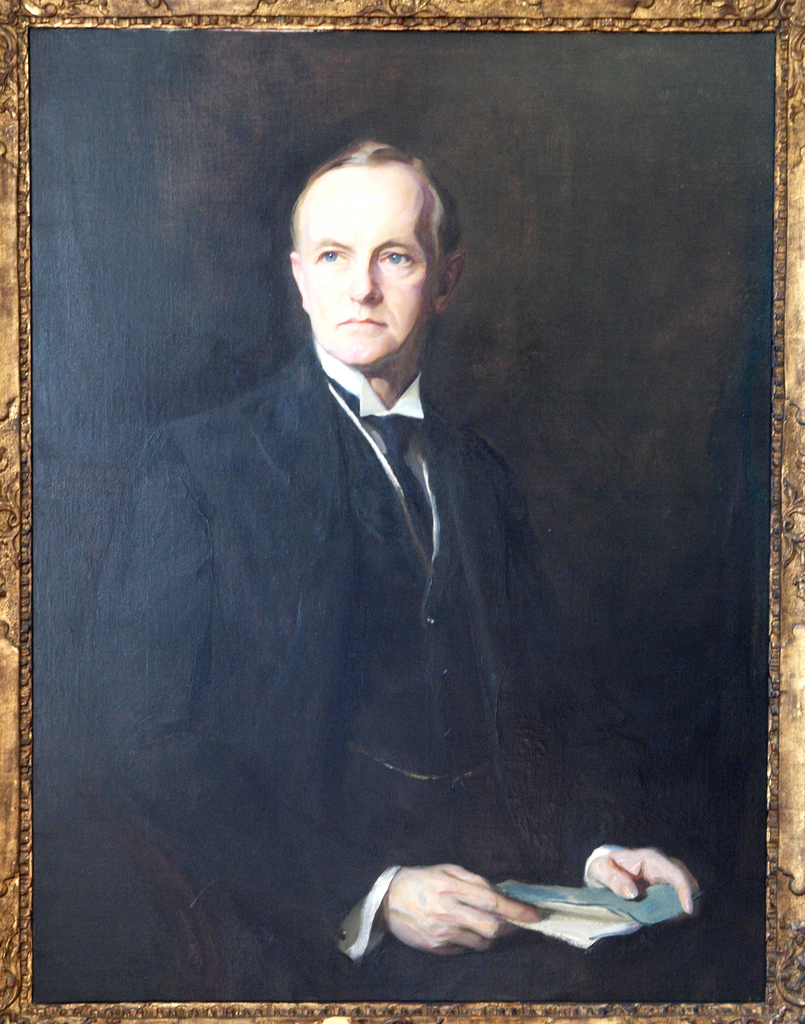
Portrait of Coolidge by Hungarian artist Philip de Laszlo, 1926.

Portrait of Coolidge by Hungarian artist Philip de Laszlo, 1926.

“Our American newspapers serve a double purpose. They bring knowledge and information to their readers, and at the same time they play a most important part in connection with the business interests of the community, both through their news and advertising departments. Probably there is no rule of your profession to which you gentlemen are more devoted than that which prescribes that the editorial and the business policies of the paper are to be conducted by strictly separate departments. Editorial policy and news policy must not be influenced by business consideration; business policies must not be affected by editorial programs. Such a dictum strikes the outsider as involving a good deal of difficulty in the practical adjustments of every-day management. Yet, in fact, I doubt those adjustments are any more difficult than have to be made in every other department of human effort. Life is a long succession of compromises and adjustments, and it may be doubted whether the press is compelled to make them more frequently than others do.

“When I have contemplated these adjustments of business and editorial policy, it has always seemed to me that American newspapers are peculiarly representative of the practical idealism of our country. Quite recently the construction of a revenue statute resulted in giving publicity to some highly interesting facts about incomes. It must have been observed that nearly all the newspapers published these interesting facts in their news columns, while very many of them protested in their editorial columns that such publicity was a bad policy. Yet this was not inconsistent. I am referring to the incident by way of illustrating what I just said about the newspapers representing the practical idealism of America. As practical newsmen they printed the facts. As editorial idealists they protested that there ought to be no such facts available.

“Some people feel concerned about the commercialism of the press. They note that great newspapers are great business enterprises earning large profits and controlled by men of wealth. So they fear that in such control the press may tend to support the private interests of those who own the papers, rather than the general interest of the whole people. It seems to me, however, that the real test is not whether the newspapers are controlled by men of wealth, but whether they are sincerely trying to serve the public interests. There will be little occasion for worry about who owns a newspaper, so long as its attitudes on public questions are such as to promote the general welfare. A press which is actuated by the purpose of genuine usefulness to the public interest can never be too strong financially, so long as its strength is used for the support of popular government.

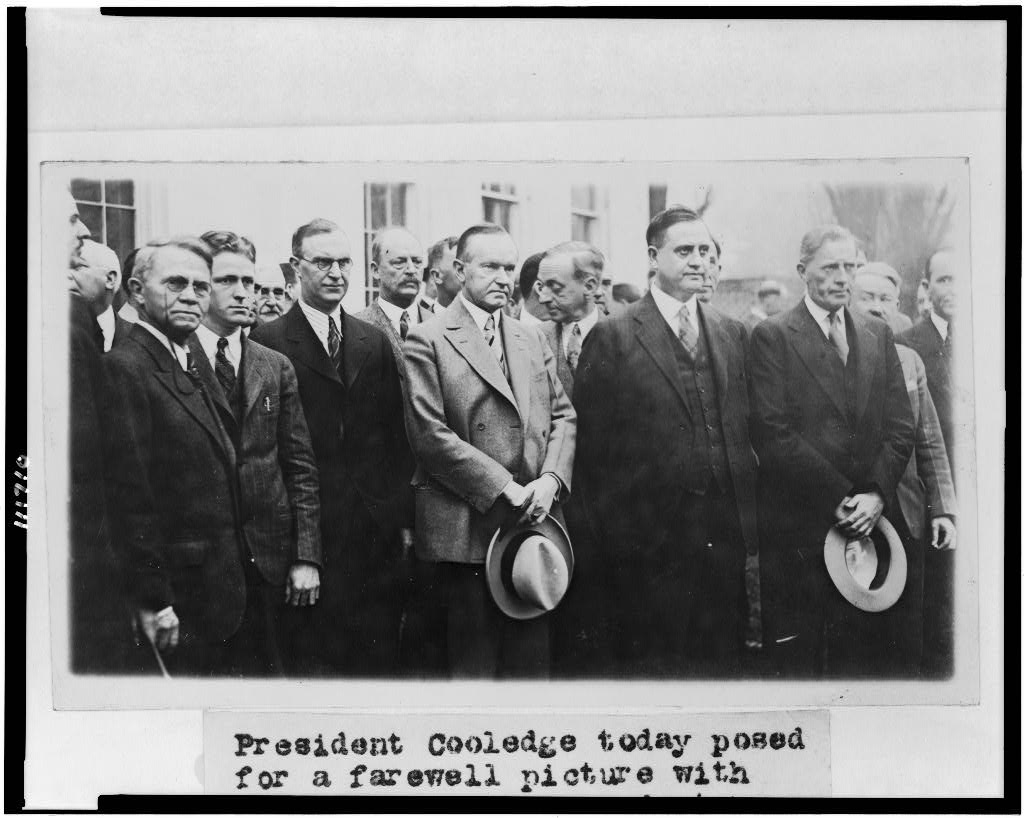
Coolidge standing for the farewell picture with White House correspondents, February 26, 1929.

Coolidge standing for the farewell picture with White House correspondents, February 26, 1929.

“There does not seem to be cause for alarm in the dual relationship of the press to the public, whereby it is one one side a purveyor of information and opinion and on the other side a purely business enterprise. Rather, it is probable that a press which maintains an intimate touch with the business currents of the nation, is likely to be more reliable than it would be if it were a stranger to these influences. After all, the chief business of the American people is business. They are profoundly concerned with producing, buying, selling, investing and prospering in the world. I am strongly of opinion that the great majority of people will always find these are moving impulses of our life. The opposite view was oracularly and poetically set forth in those lines of Goldsmith which everybody repeats, but few really believe:

‘Ill fares the land, to hastening ills a prey,

‘Where wealth accumulates, and men decay.’

“Excellent poetry, but not a good working philosophy. Goldsmith would have been right, if, in fact, the accumulation of wealth meant the decay of men. It is rare indeed that the men who are accumulating wealth decay. It is only when they cease production, when accumulation stops, that an irreparable decay begins. Wealth is the product of industry, ambition, character and untiring effort. In all experience, the accumulation of wealth means the multiplication of schools, the increase of knowledge, the dissemination of intelligence, the encouragement of science, the broadening of outlook, the expansion of liberties, the widening of culture. Of course, the accumulation of wealth cannot be justified as the chief end of existence. But we are compelled to recognize it as a means to well-nigh every desirable achievement. So long as wealth is made the means and not the end, we need not greatly fear it. And there never was a time when wealth was so generally regarded as a means, or so little regarded as an end, as today.

“Just a little time ago we read in your newspapers that two leaders of American business, whose efforts at accumulation had been most astonishingly successful, had given fifty or sixty million dollars as endowments to educational works. That was real news. It was characteristic of our American experience with men of large resources. They use their power to serve, not themselves and their own families, but the public. I feel sure that the coming generations, which will benefit by those endowments, will not be easily convinced that they have suffered greatly because of these particular accumulations of wealth.

President Coolidge with members of the White House Photographers Association, 1923.

President Coolidge with members of the White House Photographers Association, 1923.

“So there is little cause for the fear that our journalism, merely because it is prosperous, is likely to betray us. But it calls for additional effort to avoid even the appearance of the evil of selfishness. In every worthy profession, of course, there will always be a minority who will appeal to the baser instinct. There always have been, and probably always will be some who will feel that their own temporary interest may be furthered by betraying the interest of others. But these are becoming constantly a less numerous and less potential element in the community. Their influence, whatever it may seem at a particular moment, is always ephemeral. They will not long interfere with the progress of the race which is determined to go its own forward and upward way. They may at times somewhat retard and delay its progress, but in the end their opposition will be overcome. They have no permanent effect. They accomplish no permanent result. The race is not traveling in that direction. The power of the spirit always prevails over the power of the flesh. These furnish us no justification for interfering with the freedom of the press, because all freedom, though it may sometime tend toward excesses, bears within it those remedies which will finally effect a cure for its own disorders.

“American newspapers have seemed to me to be particularly representative of this practical idealism of our people. Therefore, I feel secure in saying that they are best newspapers in the world. I believe that they print more real news and more reliable and characteristic news than any other newspaper. I believe their editorial opinions are less colored in influence by mere partisanship or selfish interest, than are those of any other country. Moreover, I believe that our American press is more independent, more reliable and less partisan today than at any other time in its history. I believe this of our press, precisely as I believe it of those who manage our public affairs. Both are cleaner, finer, less influenced by improper considerations, than ever before. Whoever disagrees with this judgment must take the chance of marking himself as ignorant of conditions which notoriously affected our public life, thoughts and methods, even within the memory of many men who are still among us.

“It can safely be assumed that self-interest will always place sufficient emphasis on the business side of newspapers, so that they do not need any outside encouragement for that part of their activities. Important, however, as this factor is, it is not the main element which appeals to the American people. It is only those who do not understand our people, who believe that our national life is entirely absorbed by material motives. We make no concealment of the fact that we want wealth, but there are many other things that we want very much more. We want peace and honor, and that charity which is so strong an element of all civilization. The chief ideal of the American people is idealism. I cannot repeat too often that America is a nation of idealists. That is the only motive to which they ever give any strong and lasting reaction. No newspaper can be a success which fails to appeal to that element of our national life. It is in this direction that the public press can lend its strongest support to our Government. I could not truly criticize the vast importance of the counting, room, but my ultimate faith I would place in the high idealism of the editorial room of the American newspaper.”

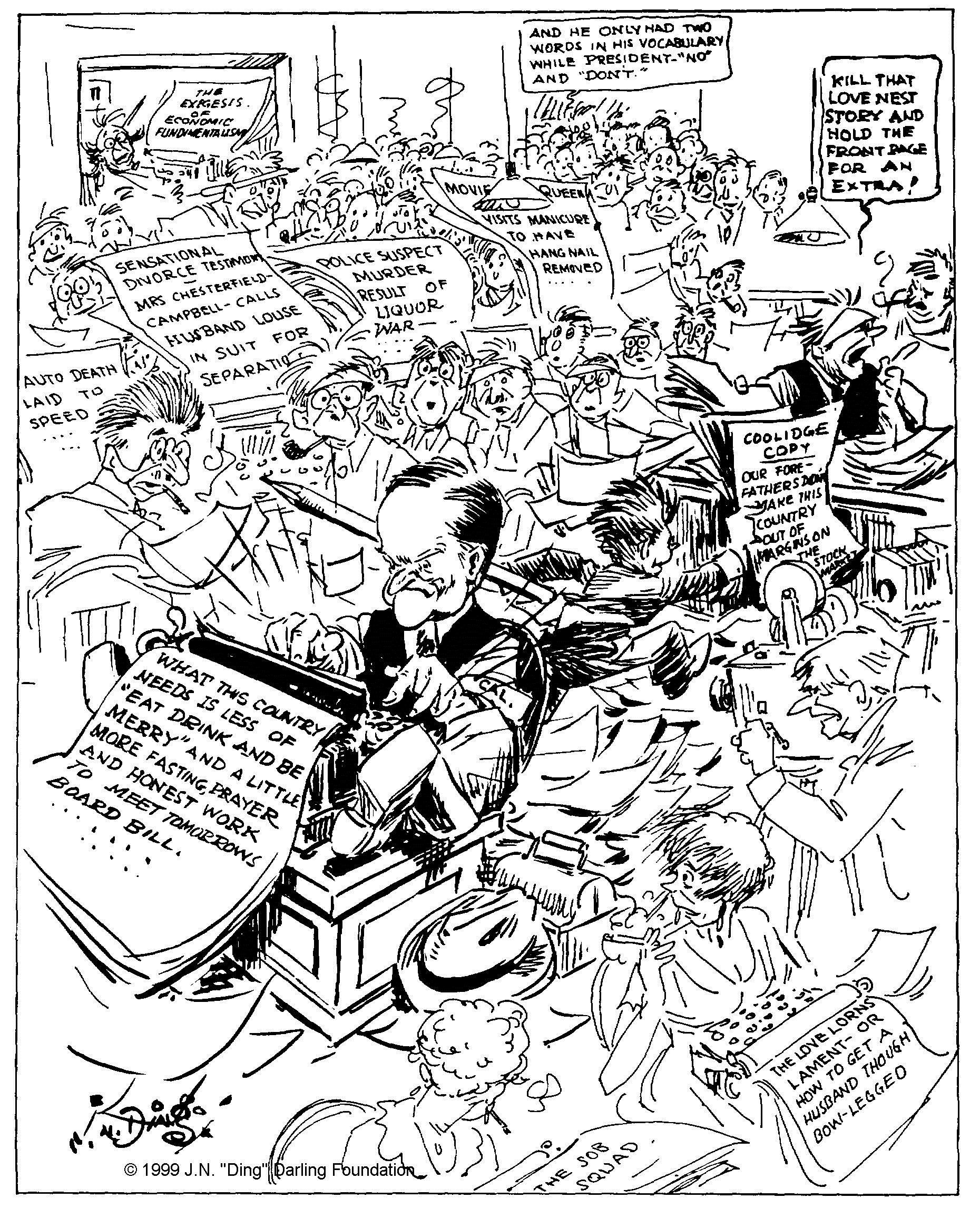
"The New Editor Goes to Work" by Jay "Ding" Darling, as former President Coolidge joined the editorial room as a daily columnist in the summer of 1930.

“The New Editor Goes to Work” by Jay “Ding” Darling, as former President Coolidge joined the editorial room as a daily columnist in the summer of 1930.

It is both illustrative and ironic that the most frequently misquoted statement used to misrepresent Coolidge’s character was prompted by a speech on the danger of institutionalized media bias. Having so successfully relegated Coolidge to the oblivion of a weak, do-nothing President for so long, the modern mainstream of news coverage is content to keep him marginalized indefinitely. As a much older Massachusetts man once said, however, “facts are stubborn things.” A media that, over the course of nine decades, has betrayed their trust as independent and open-minded “sources of public information,” for the benefit of the entire people, is no longer living up to that practical idealism Coolidge knew to be essential for free and popular government. Freedom and truth are inseparable. Either America will remain free and soundly informed or enslaved and ignorant, it cannot be both ways. Our country will not retain political and economic liberty without intellectual and spiritual freedom. Instead, far too many have given themselves over to a slavish adherence to propaganda, closing minds in order to advance the interests of despotic and autocratic politicians.

What some have ridiculed as Coolidge’s “patriotic journalism,” is simply interpreting human experience anchored by a conscientious and careful integrity instead of through the lens of distorted facts, withheld information, suppressed moral standards and a wholesale denial that biases exist everywhere, even among the media and the “experts” on which they rely. The major networks and news sources have donned a cloak of “objectivity” for so long, they are convinced by the self-delusion that journalism requires no obligation to either the American people or their founding ideals. Enslaved by their own closed-minded fidelity to partisan power, many in the press have mentally and morally renounced citizenship as Americans and the duty they once held to all the people, furnishing them a press free and independent of government.

Cartoon by Rollin Kirby in the New York World, February 11, 1926. The "White House spokesman" was a rhetorical device employed by the press corps when referring to a position of the White House. Coolidge never authorized its use and, in fact, detested it, especially as it became an obvious reference to the President himself. It took on a life of its own as portrayed by Kirby in the cartoon above.

By Rollin Kirby in the New York World, February 11, 1926. The “White House spokesman” was a rhetorical device employed by the press corps when referring to a position of the White House. Coolidge never authorized its use and, in fact, detested it, especially as it became an obvious reference to the President himself despite express requests never to quote him directly. Nevertheless, it took on a life of its own as portrayed by Kirby in the cartoon above. See Coolidge’s thoughts on the matter in The Talkative President, p. 30.

Coolidge understood that both the business side and editorial sphere of media serve distinct purposes. This is as it should be. They remain separate for a reason. It is the suicide of a free press when what is newsworthy benefits the image and agenda of authority at the expense of those in “flyover country.” Likewise, when news sources disconnect from the business life of America, cutting themselves off from the practical considerations of regular Americans, the credibility of journalism is lost. Attacking America’s people and heritage, character and accomplishments, constitutional and economic institutions, focusing only on its failures and defects while ignoring its goodness and successes will only squander the opportunity to educate, inform and progress. It does not work here. We expect such cynical misunderstanding of America by international media, not by our own press. The mainstream press, so long insulated from the rest of us as strangers in a place they consider foreign to them, are losing to the new media for this reason.

The success of Rush Limbaugh, Matt Drudge and others like them is not due to some mystical indoctrination method, it is due to simply explaining what we already know to be true, credible and right. They have tapped into an open-minded and highly information-literate American audience finished with the incessant suppression of factual reporting by a correspondent corps subservient to those in office. Americans expect high standards from journalism and we will not condone those who engage in half-truths and unquestioned propaganda on behalf of state-approved authority, moving at purposes without our consent and designs hostile to our free system. The very real good of an independent and honest press comes, just as Coolidge reminded us eighty-nine years ago, from a genuine commitment to the character and ideals Americans work to live up to every day. The truth matters to us and in order to preserve our republican form of government, we return to what Coolidge dubbed “practical idealism,” the rigorous standards of a new press unafraid to meet is obligations, reapplying the practices the mainstream press once did. America’s new media, such as Rush and Breitbart, are justifying Calvin Coolidge’s enduring faith, not in the counting room, but in the editorial rooms of America’s real journalists.

President-Calvin-Coolidge

“[T]he accumulation of wealth cannot be justified as the chief end of existence … So long as wealth is made the means and not the end, we need not greatly fear it…Important, however, as this factor is, it is not the main element which appeals to the American people. It is only those who do not understand our people, who believe that our national life is entirely absorbed by material motives” — Calvin Coolidge, January 17, 1925, emphasis added.

On Accounting for Coolidge Popularity

Image

It may come as a surprise that a coterie of critics, some members of the press and even a Party establishment existed in Coolidge’s day. They were hostile to the notion that one not of their number, lacking in sophistication or elite pedigree, could attain to the Presidency. Taken together they are what Charles Willis Thompson called, “The Intellectuals.” It is no different now for anyone with the courage and common sense to run for elective office independent of and without approval from the self-appointed political and cultural establishment. The Intellectuals had to reckon with Coolidge’s genuine and immense popularity. Henry Cabot Lodge, Republican Senator of Massachusetts, when told that Coolidge was being considered by some to lead the national ticket in 1920, sneered, “Nominate a man who lives in a two-family? Never!”

The fact that Coolidge, from his earliest years in state politics, consistently garnered more votes than any other Republican did. It was no secret that he secured more votes as Lieutenant Governor than his partner, Governor McCall, in the 1916 race. Even as the state went Democrat and Republicans lost their seats, Coolidge kept winning by greater and greater margins. “The Intellectuals,” chagrined at each electoral success, could not believe he was capable of winning the next time. Yet, win he did. In the presidential election of 1924, the man they had dismissed as a lightweight, local fad whom they would easily discard, perhaps along with Harding, went on to surpass challengers, secure a unanimous nomination and win an unprecedented landslide of 15.7 million voters in a three-way campaign, achieving what conventional wisdom said could never be done, especially after the outcome of 1912.

The Party elites had a clear champion in their midst but rather than rally to him, they maintained their skeptical alienation. He was not of them and never would be. Of course, he held an unshakable belief in party loyalty, not to simply secure office for himself or others but to advance principles he knew were right and tested true by human experience. The “secret” to his success lay not in the path of expediency, watering himself down to match what made him “electable” in the eyes of the “experts.” He required no pollster, no consultant, no speech writer to tell him what to believe. Decades before “Reagan Democrats,” the hard-working, patriotic, religious, “blue-collar” family men of manufacturing, service and industry were “Coolidge Democrats.” He earned their trust not through threats, manipulation, calculated promises, misinformation, pandering or even back-door dealing. His recipe for such stunning success, a genuine popularity and political success held all his life, was due to two simple qualities: “Simple words and straightforward acts” comprised Coolidge’s “magic” (Thompson, Presidents I’ve Known and Two Near Presidents, p.354). “The Intellectuals” never understood this. In the end, even as Coolidge walked away from office and continued to enjoy a level of popularity very few former Presidents have, the elites blamed it on the stupidity and simplicity of the American “masses.”

Thompson explained in 1929,

“As for the Mystery of 1924–the mystery of his election by a tremendous majority when so many towering geniuses had demonstrated that he hadn’t a chance–that too, was psychological. He was elected on that day in 1923 when he sent his first message to Congress. The country had heard language for many years. The unceasing, all-embracing sea of it had swollen until it reached high tide under Wilson…The country was apathetically resigned to a permanent government by language.

“Therefore, the first official word it heard from Coolidge was sensational. Not only was there no purple in the message, but there was no ratiocination, no argument, no stock official phrases. He told Congress what he thought would be for the good of the country and told it as briefly as he could. One of the things it wanted was economy. The burning question of that day, the soldier’s bonus, he treated in a single sentence, merely saying he was opposed to it; this at a time when the conventional attitude for politicians on the bonus question was astride the fence.

“The country rubbed its eyes. Here was a President of an entirely new kind. The country waited long enough to see if Coolidge meant what he said. He had just one session of Congress to prove it in. He did. Throughout that session he worked hard to get Congress to carry out the recommendations he had made…The country liked him immensely; it did after he had been President only a year…It liked Coolidge in 1923; it even made up its mind definitely that he was the kind of President it wanted. His first message to Congress fixed his popularity, and it increased until, to the astonishment of the politicians, they had to nominate him in obedience to a popular demand they did not understand and could not account for” (Thompson p.357).

Presidential Election of 1924 by county, showing Coolidge's very impressive support across the country. Securing 54% of the popular and 382 electoral votes to 136 (for Democrat Davis) and 13 (for Progressive La Follette), Coolidge shattered the conventional wisdom that he was both "unelectable" beyond Massachusetts and incapable of prevailing in a three-way race nationally. No one has ever done that before or since without throwing the election into the House (1824) or losing to the Democrat opponent (1912, 1992).

Presidential Election of 1924 by county, showing Coolidge’s very impressive support across the country. Securing 54% of the popular vote (15, 723,789 of 29 million votes cast) and 382 electoral votes (35 of 48 states, 71.9% of 531 electoral votes) to 136 (for Democrat Davis) and 13 (for Progressive La Follette), Coolidge shattered the conventional wisdom that he was both “unelectable” beyond Massachusetts and incapable of prevailing in a three-way race nationally. He even continued, as had begun in 1920, breaking  into the supposedly monolithic counties of the Democrat “Solid South” as well as the supposedly un-winnable Progressive West. No one has ever overwhelmed a Third Party challenge and a Democrat bloc before or since without throwing the election into the House (1824) or losing to the Democrats (1912, 1992).

Just as is the case now, the “talking heads” of media networks, the establishment of Party politics, and many of the gatekeepers of cultural trends revealed their utter insensibility to what Americans understood and felt about the country and its future. This institutionalized tone deafness swept them aside in 1924 and the foundations are already in place to do it again in the Congressional races of 2014. The “silent majority” of American politics led their leaders in 1924, and that same process is poised to happen again. Coolidge saw this as a vindication of the people’s sovereignty over their government. He was not threatened, as some are, by such an event. Coolidge would not even name a Vice President, leaving the delegates to make that decision, saying with a sparkle in his eye, “It did in 1920 and it picked a durned good man.”

Thompson continues,

“Throughout that campaign the Intellectuals were confident that even so stupid an electorate as the American one could not elect such a poor boob as Coolidge, and they never did account for the avalanche which swept him into office. Senator La Follette did emerge from under the avalanche long enough to offer a sort of explanation; he intimated that the sixteen millions who voted for Coolidge were bought up, and self-sacrificingly promised to go on working for the interest of these corrupted ‘masses’; but the Intellectuals didn’t accept that explanation, and finally concluded that it was just another proof of the incorrigible wrong-headedness of the electorate, or, as H. L. Mencken calls it, the ‘booberie’ ” (Thompson p.357).

The same effort by the elites to make sense of the current American groundswell of opposition to the direction its “leaders” are taking the country will follow much the same route, whether the issue be Chris Christie for President or new green cards for the nearly 12 million illegals living in the country. In the end, these elites will not acknowledge their deficiencies of vision or their failures to deserve leadership, they will blame the American voter for being too dumb to understand who and what is good for the country. The challenges we face, and they are supremely daunting, heading into these next two years will require the utmost involvement from the American people to become informed, take up their sovereign duty as participants not merely spectators in politics and perpetuate the republican ideals the Founders presciently secured. They did so not merely for themselves but for us and our children. Staying at home as so many did in 2012 ultimately hurts ourselves and the future of the country. Teaching the establishment a lesson by abstaining from our solemn duty to vote never reaches its intended purpose any more than is surrendering our dual system for a Third Party in 2016.

We simply need to better exercise our power to choose qualified leaders at the primaries, replacing those unfit for public trust. As Coolidge reminds us, our destiny rests in our own hands at the ballot box. If we shirk it there, we have no place to protest the stripping of our freedoms after the election by those we have directly or indirectly sustained in power. That is how serious the vote remains this year, of all years. The ideals the Founders fought to establish, held by subsequent leaders like Calvin Coolidge, are perpetuated not through the choice of an elite few, but through the determined will of an engaged American people.