On Veteran’s Day

Tomorrow will mark not only the Armistice declared at the eleventh hour of the eleventh day of the eleventh month in 1918 (which ended four years of staggering loss and destruction inflicted by the First World War) but it also sets aside a day of honor to all of America’s veterans. President Coolidge, looking back in November 1928 over the first ten years following the return of peace, turned his attention to those who had left the safety of their homes and freedoms years before to risk all on the battlefields of Europe. He spoke, “Our first thought…is to acknowledge the obligation which the Nation owes to those who served in our forces afloat and ashore, which contributed the indispensable factor to the final victory. Although all our people became engaged in this conflict, some in furnishing money, some in producing food and clothing, some in making munitions, some in administering our Government, the place of honor will always be accorded to the men and women who wore the uniform of our country – the living and the dead.”
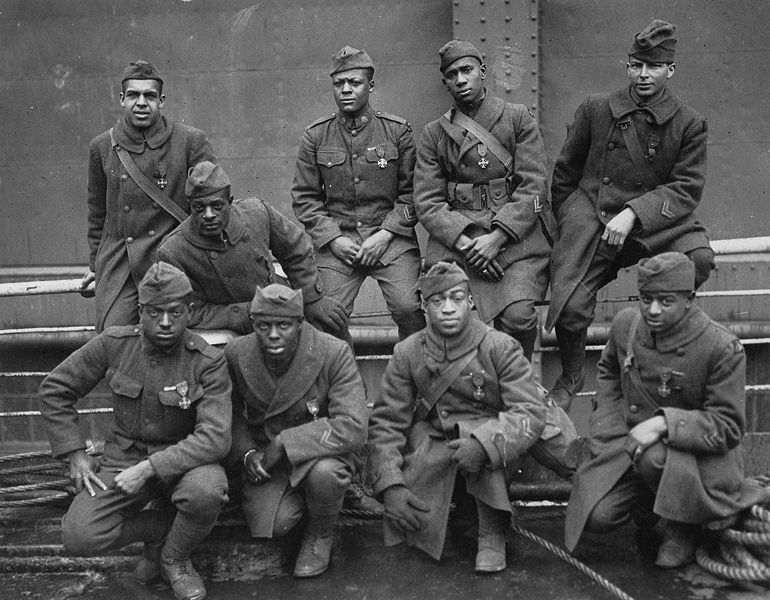
Members of the "Harlem Hellfighters," 369th Infantry, 1919. As Coolidge said on that November day in 1926, "Our armies could not be said to partake of any distinct racial characteristic...but they were all Americans in the defense of our common interests..."

Members of the “Harlem Hellfighters,” 369th Infantry, 1919. As Coolidge said on that November day in 1926, “Our armies could not be said to partake of any distinct racial characteristic…but they were all Americans in the defense of our common interests…”

Members of the 35th Division, marching through the Vosges Forest, France, 1919. They were predominantly comprised by men from Missouri and Kansas, to whom Coolidge offered recognition in dedicating the Liberty Memorial, 1926.

Members of the 35th Division, marching through the Vosges Forest, France, 1919. They were predominantly comprised of men from Missouri and Kansas, to whom Coolidge offered special recognition while dedicating the Liberty Memorial, 1926.

We are remiss if such honor is neglected in our generation but even more so if it is submissively suppressed and quietly denied. Such is not remaining true to our high estate as Americans. It is the epitome of ingratitude and injustice to condone the animosity some in our own land harbor against those who have worn the uniform. It was only natural that the first World War I memorial would be dedicated in November 1921, in the heartland itself, with Calvin Coolidge present. The people of Kansas City, Missouri, can proudly lay claim to this first in a nation of many exceptional firsts.

Image

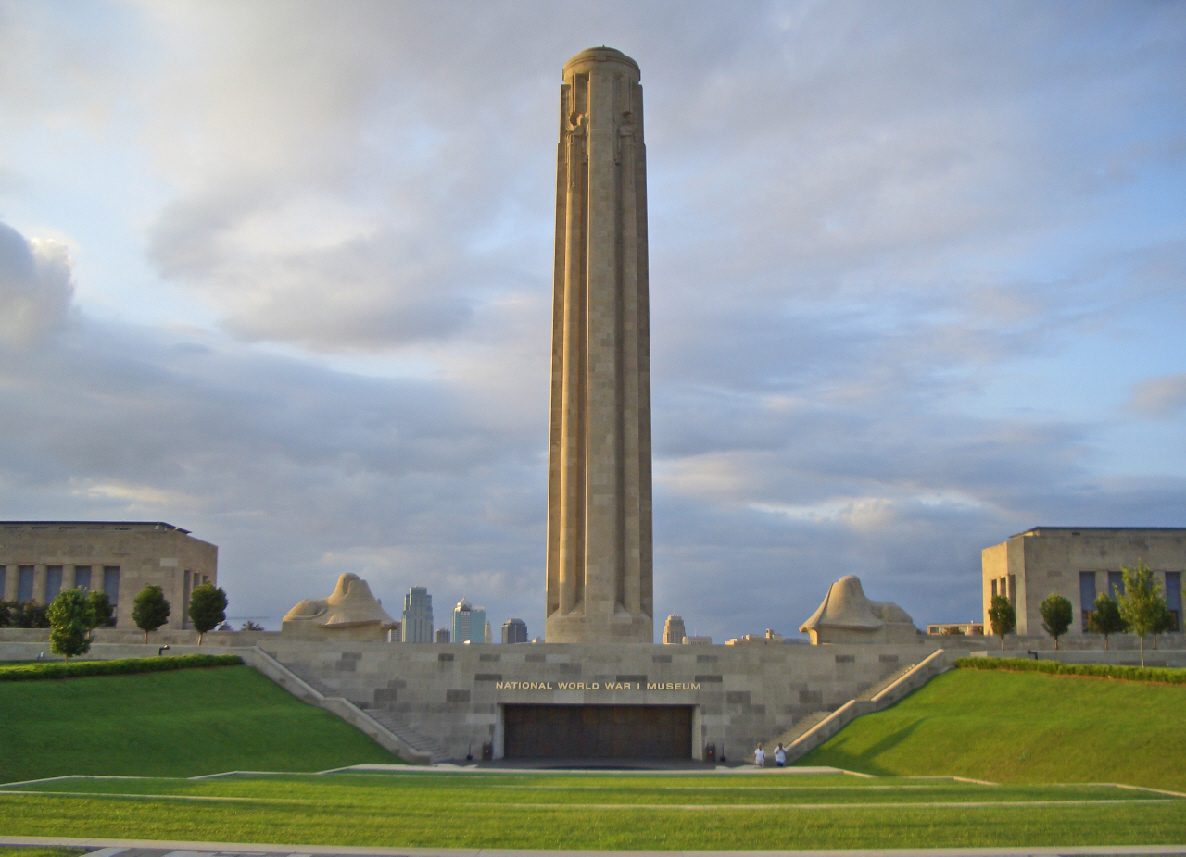
When the Liberty Memorial was completed five years later in 1926, President Coolidge went back to Kansas City to address the 150,000 persons gathered as millions more listened on the radio. Looking up at the 217 foot marker, the sight stirred him to say, “It is with a mingling of sentiments that we come to dedicate this memorial. Erected in memory of those who defended their homes and their freedom in the World War, it stands for service and all that service implies. Reverence for our dead, respect for our living, loyalty to our country, devotion to humanity, consecration to religion, all of these and much more is represented in this towering monument and its massive supports. It has not been raised to commemorate war and victory, but rather the results of war and victory, which are embodied in peace and liberty. In its impressive symbolism it pictures the story of that one increasing purpose declared by the poet [citing Tennyson] to mark all the forces of the past which finally converge in the spirit of America in order that our country as ‘the heir of all the ages, in the foremost files of time,’ may forever hold aloft the glowing hope of progress and peace to all humanity…”
Image

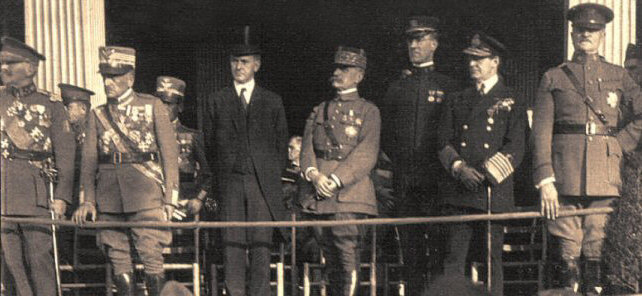
He would recall the august assembly five years before as he stood with General Pershing and those who led the armies of Europe, praising the ideals that prevailed in spite of that conflict’s effort to demolish them. The President continued, “Under no other flag are those who have served their country held in such high appreciation…Our admiration is boundless. It is no mere idle form; it is no shadow without reality, but a solid and substantial effort rising into the dignity of a sacrifice made by all the people that they might in some degree recognize and recompense those who have served in time of national peril. All veterans should know this and appreciate it, and they do. All citizens should know it and be proud of it, and they are.”

Coolidge, scanning not only the massive crowds gathered to observe the dedication on that day, but also looking ahead to what the future would bring, seemed to know such honor and service would not manifest automatically, it would demand renewed effort from later generations. He closed with a question, “If the American spirit fails, what hope has the world? In the hour of our triumph and power we can not escape the need for sober thought and consecrated action. These dead whom we here commemorate have placed their trust in us. Their living comrades have made their sacrifice in the belief that we would not fail. In the consciousness of that trust and that belief this memorial stands as our pledge to their faith, a holy testament that our country will continue to do its duty under the guidance of a Divine Providence.”
Image

“I shall, if they get excited”

ImageA mistaken impression can sometimes be left by historians regarding Coolidge’s attitude on civility. Some seem to think that civility is incompatible with any form of political confrontation, even employing Coolidge as the symbol of a civil discourse and non-controversial comportment. Coolidge possessed very unpopular convictions at times and made controversial stands throughout his life. His refusal to allow Boston strike leaders to return to the police force is one such example. Coolidge’s overhaul of his state’s administrative agencies, reforming 120 into 19 departments was another potential political powder keg he embraced. His adept use of the veto and appointment powers furnish more controversial examples. Instead, the “need for civility” plea, principally coming from the establishments of both parties, being the biggest violators of the rule, tend to use it in order to convince conservatives they need to sit down and quietly consent to whatever happens, for the good of the country and the Party.

It is as if Coolidge never tolerated heated exchanges or passionate debate between opposing sides. In reality, he did more than that, knowing such controversy did not warrant wringing hands over the Republic’s future from the “tone” of partisan bickering. The parties were supposed to be partisan. As he once wrote, someone has to be partisan or else no one can be independent. Partisanship itself was not inherently detrimental because it was through the party system that public policy is discussed and upon which the welfare of everyone is deliberated. Partisanship could be abused, as with anything else, but it was not intrinsically one of the “deadly sins.” Sound conclusions emerge when opposing political principles are free to clash in public discussion. When government becomes too bipartisan, collaborating with unchallenged conformity, the checks and balances of our system are allowed to erode, crowding out both the well-being of all Americans and their freedom to govern themselves.

For Vice President Coolidge, during the summer of 1921, in his first few months as presiding officer of the Senate, an intense back-and-forth between Missouri Democrat James Reed and North Dakota Republican Porter McCumber unfolded before his eyes. As the political exchange turned into blunter rhetoric, accusing the other of being a “liar” and inviting his adversary to “step outside,” the visitors up in the gallery and other Senators chimed in.

Coolidge sat unfazed, calmly and collectedly, as the “coolest” tempered man in the room. Despite the growing din in the hall accompanied by the urgings of a fellow Republican to call everyone to order, Coolidge knew a use of the gavel was unnecessary. It was not detrimental to halt this “teachable moment” on the differences between party principles or to shut down the emotional banter. Both served a purpose in our system. Undiluted civility was strong enough to withstand partisan rhetoric. It could do so as long as an honest press remained free and the people were informed with the truth. It was at this moment that Coolidge gave expression to his legendary dry wit. The Vice President turned to the Republican and remarked, with the straightest of faces, “I shall, if they get excited.”

Image

“A President and a Rug: Hidden History” by Kate E. Bradley

“A President and a Rug: Hidden History” by Kate E. Bradley

Here is a fascinating portion of the back story behind Dr. Deranian’s research that has become the recently published book, “President Calvin Coolidge and the Armenian Orphan Rug.” The suffering and loss endured by over one hundred and thirty-five thousand orphans and more than one million others through Turkish genocide brought the best out of Americans, who contributed millions of dollars, supplies and, for some, even their own lives to rescue as many of the Armenian people as possible. It is a long overlooked detail of President Coolidge’s foreign policy that he encouraged the relief effort, even meeting two of the orphans in 1926 who would eventually call America their home. An enormous rug gifted to President Coolidge in gratitude for America’s actions through the rescue effort headed by Near East Relief, speaks not only to the good will between two peoples but to the timeless reminder that America responds with open hearts and ready service, without a single government mandate, to help defend life and freedom for the most unfortunate anywhere in the world.

Now that the Smithsonian has been inexplicably denied permission by the White House to display the rug, it is shamefully not too far-fetched to conclude that this particular Administration has little concern for the gift’s meaning and even a deliberate interest in suppressing a celebration of the force for good Americans have been not only to Armenians but multitudes of others throughout our history.

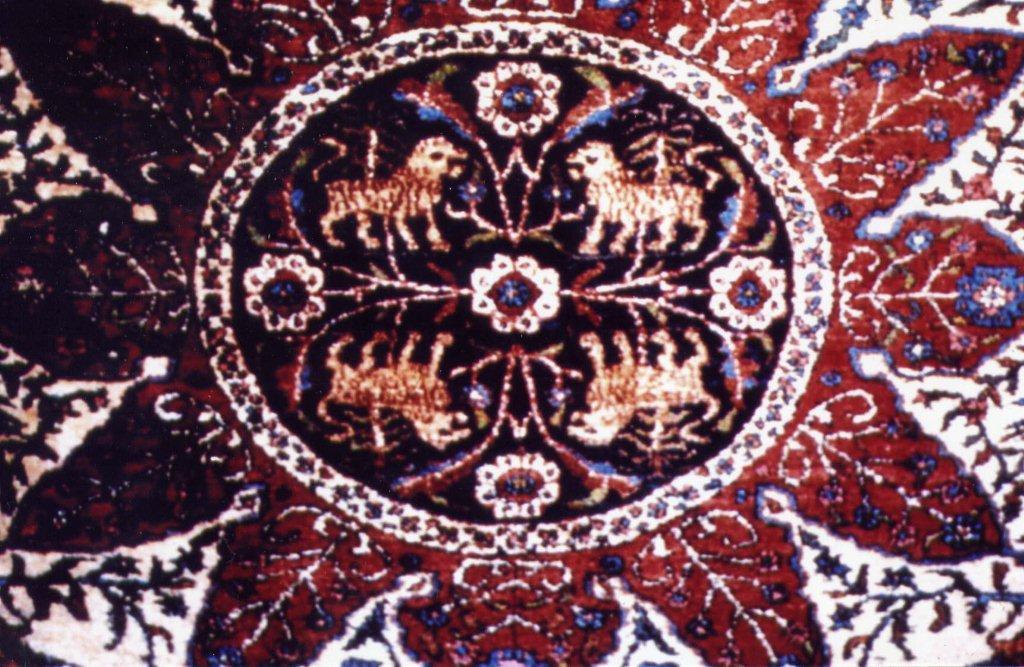
A few of the more than 4.5 million knots lovingly forming this 11' 7" x 18' 5" rug. 400 orphan girls spent 10 months preparing this gift to America.

A few of the more than 4.5 million knots lovingly forming this 11′ 7″ x 18′ 5″ rug. 400 orphan girls spent 10 months preparing this gift to America.