“Born on the Fourth of July” by Sidney M. Milkis

“Born on the Fourth of July” by Sidney M. Milkis

The latest review of both Amity Shlaes’ Coolidge and Charles C. Johnson’s Why Coolidge Matters adds a welcome take to a renewed conversation of Calvin Coolidge. Mr. Milkis, well-known author and professor with the Miller Center of Public Affairs at the University of Virginia, has much to offer when it comes to the Progressive Era, the period generally classified from 1900 to 1929. In his critique of both books, Mr. Milkis presents the Coolidge neither author may envision but one that resembles the man described by David Greenberg, whose Calvin Coolidge, published in 2006, accepted too many of the assumptions handed down by Art Schlesinger and the New Deal gang. Greenberg unfortunately dug himself into a deeper hole with his 2011 piece further ridiculing Coolidge’s “naive faith in the gospel of productivity” as if Big Government has proven once and for all to be a reliable and permanent fixture of American life.

Mr. Milkis contributes a worthy opinion in the ongoing and overdue discussion about our thirtieth president. However, it is equally as important not to reinforce the same, old misrepresentations of what has, for far too long, been the accepted narrative regarding “Silenced Cal.” The fact that Ms. Shlaes and Mr. Johnson are questioning that narrative with meticulous research is not “revisionist” as much as it is a return to the rigorous standards of scholarship restored by Thomas Silver, popularized by Ronald Reagan, and now being revitalized by, among others, the authors Mr. Milkis has reviewed.

Mr. Greenberg and those who preceded him in defense of the New Deal have more to lose by seeing Coolidge’s principles reintroduced and expounded through the heavy lifting done by those he perceives to be on “the Right,” than they do repeating the tired shibboleth of his naivete and failure. Americans all can appreciate Coolidge not because he identified with this or that “political side” but because the principles he embodied were thoroughly and unabashedly true to the foundations of our exceptional system, declared, constituted and reaffirmed by our ancestors. As Coolidge expressed it on another occasion, “Whether one traces his Americanism back three centuries…or three years…is not half so important as whether his Americanism of to-day is real and genuine. No matter by what various crafts we came here, we are all now in the same boat.” His appeal to eternal truths of human nature and political experience should form ground on which we can all Americans can again be a united and prosperous people.
On Thanksgiving

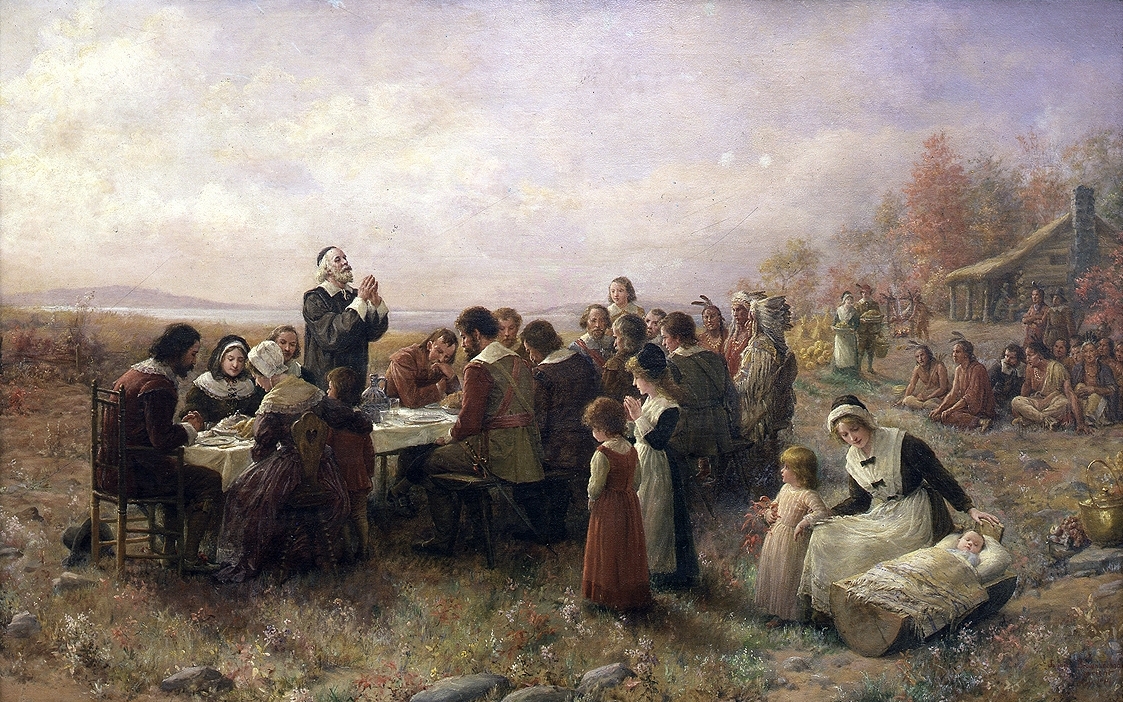
Jennie Bunscombe, "The First Thanksgiving," 1914

Jennie Bunscombe, “The First Thanksgiving,” 1914

“Thanksgiving is not only a holiday, it is a holy day. It is by no means enough to make it an occasion for recreation and feasting. Thanks are not to be returned merely to ourselves or to each other. The day is without significance unless it has a spiritual meaning. For more than three centuries our people have felt the need of celebrating the harvest time as a religious rite by offering thanks to the Creator for all their earthly blessings. There can be no true Thanksgiving without prayer.

“If at any time our rewards have seemed meager, we shall find our justification for Thanksgiving by carefully comparing what we have with what we deserve. The little band of Pilgrims who first established this institution on the shore by Plymouth Rock had no doubts. If their little colony of devoted souls, when exiled to a foreign wilderness by persecution, cut in half by disease, surrounded by hostility and threatened with famine, could give thanks how much more should this great nation, less deserving than the Pilgrims yet abounding in freedom, peace, security and plenty, now have the faith to return thanks to the author of all good and perfect gifts” — Calvin Coolidge, November 26, 1930

The Coolidge family, on Massasoit Street in Northampton, raising the flag, Thanksgiving Day, 1919

The Coolidge family, on Massasoit Street in Northampton, raising the flag, Thanksgiving Day, 1919

Thanksgiving Proclamation, 1923

Continuing the custom instituted by President Washington in 1789, the new President, reflecting over the past year, composed in 1923 the first of six Thanksgiving Proclamations during his service in the White House. It echoes the thanks we owe the Lord not only for His goodness to us this year but also for the exceptional success His favor and providential care have given to America, now in its two hundred and thirty-seventh year since independence:

“The American people, from their earliest days, have observed the wise custom of acknowledging each year the bounty with which divine Providence has favored them. In the beginnings, this acknowledgment was a voluntary return of thanks by the community for the fruitfulness of the harvest. Though our mode of life has greatly changed, this custom has always survived. It has made thanksgiving day not only one of the oldest but one of the most characteristic observances of our country. On that day, in home and church, in family and public gatherings, the whole nation has for generations paid the tribute due from grateful hearts for blessings bestowed.

“To center our thought in this way upon the favor which we have been shown has been altogether wise and desirable. It has given opportunity justly to balance the good and the evil which we have experienced. In that we have never failed to find reasons for being grateful to God for a generous preponderance of the good. Even in the least propitious times, a broad contemplation of our whole position has never failed to disclose overwhelming reasons for thankfulness. Thus viewing our situation, we have found warrant for a more hopeful and confident attitude toward the future.

“In this current year, we now approach the time which has been accepted by custom as most fitting for the calm survey of our estate and the return of thanks. We shall the more keenly realize our good fortune, if we will, in deep sincerity, give to it due thought, and more especially, if we will compare it with that of any other community in the world…

“…We have been blessed with much of material prosperity. We shall be better able to appreciate it if we remember the privations others have suffered, and we shall be the more worthy of it if we use it for their relief. We will do well then to render thanks for the good that has come to us, and show by our actions that we have become stronger, wiser, and truer by the chastenings which have been imposed upon us. We will thus prepare ourselves for the part we must take in a world which forever needs the full measure of service. We have been a most favored people. We ought to be a most generous people. We have been a most blessed people. We ought to be a most thankful people.

“Wherefore, I, Calvin Coolidge, President of the United States, do hereby fix and designate Thursday, the twenty-ninth day of November, as Thanksgiving Day, and recommend its general observance throughout the land. It is urged that the people, gathering in their homes and their usual places of worship, give expression to their gratitude for the benefits and blessings that a gracious Providence has bestowed upon them, and seek the guidance of Almighty God, that they may deserve a continuance of His favor.

“In Witness Whereof, I have hereunto set my hand and caused the seal of the United States to be affixed.

“Done at the City of Washington, this 5th day of November, in the year of our Lord, One Thousand Nine Hundred and Twenty-three, and of the Independence of the United States, the One Hundred and Forty-eighth.”

                                                                 Image