A Conversation on Coolidge with Amity Shlaes
A friend and fellow blogger, Kai, has posted a link to this great interview by Milt Rosenberg with Amity Shlaes on Coolidge. It is too worthwhile not to share.
A Conversation on Coolidge with Amity Shlaes
A friend and fellow blogger, Kai, has posted a link to this great interview by Milt Rosenberg with Amity Shlaes on Coolidge. It is too worthwhile not to share.
It has always been easier to criticize and find fault than to contribute toward and respect the constructive ideal. Optimists, always the creators, have to work not only to realize what previously seemed impossible but they also have to overcome the destructive habits of the pessimists. Those pessimists are the first to surrender in the face of difficulty while they trumpet the message of hopelessness. “Nor is it worth trying,” these closet nihilists aver. Failure to measure up to certain expectations is enough for some to give up entirely on a project and declare defeat for the cause. America is no different. It has always had a healthy share of pessimists and other weak-willed “experts” who knew it would fail in this or that endeavor. The purpose of America, as Coolidge would reiterate, remains valid. It has raised for all the world to see a set of truths that preserve liberty with duty in a way that no set of principles has before, or can surpass. The failure to eradicate all the failings and frailties inherent in human nature is no more proof of failure than evidence of any grander success by empowering government now to accomplish it for us. For these “armchair” critics, it discredits the entire foundation and persuades them that progress means abandoning moral clarity, surrendering confidence in self-government entirely and trusting in our modernity to move past the “old” and “inadequate” concepts of an “ignorant” and “limited” eighteenth century existence. It would be one thing to adopt so foolhardy and naively defeatist outlook for oneself. These self-proclaimed skeptics are imparting this to the next generation, however, through “modern education.” To this issue of education, Coolidge turned in June of 1922, when he said,
“This is the civilization which intelligence has created and which sacrificed has redeemed. We did not make it. It is our duty to serve it. Education ought to assess it at its true worth. It ought not to despise it but reverence it. If there be in education a better estimation of true values, it must be on the side of a great optimism. Under its examination human relationship stands forth as justified and sanctified. There is no place for the cynic or the pessimist. Who is he that can take no part in business because he believes it is selfish? Who is he that can take no part in religion because he believes it is imperfect? These institutions are the instruments by which an eternal purpose is working out the salvation of the world. It is not for us to regard them with disdain; it is for us to work with them, to dedicate ourselves to them, to justify our faith in them…The great service which education must perform is to confirm our faith in the world, establish our settled convictions, and maintain an open mind.”
The annual American Educational Research Association meeting in April made evident that improved testing and eradicating poverty are but symptoms of an education missing its core. As schools all across the country let out for the summer, now is an ideal time to consider the service education is actually rendering for us and our children. Is it consigning our proven ideals to failure, proclaiming a gospel of hopelessness and permanent moral uncertainty? Is it rejecting the worth of Christian standards of behavior because America is forever trapped, they claim, in racism, hypocrisy, chauvinism, bigotry and oppression? Is it championing the control of a few who can finally achieve the perfection which is our right, if only we abandon this failed framework of eighteenth century slaveholders? Such goes the cynic’s mantra. What is not so readily apparent are the rocks waiting on the other side of those words. It has wrecked and will continue to wreck the lives of those who are taught to embrace pessimism, to rely on the force of government to compensate for all of America’s shortcomings. The cynic, ultimately, doubts liberty. America has never worked, he assumes, so why work at it as responsible and informed citizens? Just as Coolidge remarked, though, an open mind can co-exist with settled convictions. Forever holding out undecided on everything is the perfect soil for cynicism. Moral relativity, taught by too many schools in this country, is actually moral surrender in a more subtle form. On the contrary, knowing certain things are right and true broadens the mind to keep learning. It is the pessimist whose mind is closed, failing to accept that the people can be trusted with their liberty far more than government has or ever will. Education serves its purpose when it keeps that flame of optimism in our ideals alive. It is the more difficult task than the ease of cynicism but faith is vindicated in the end.
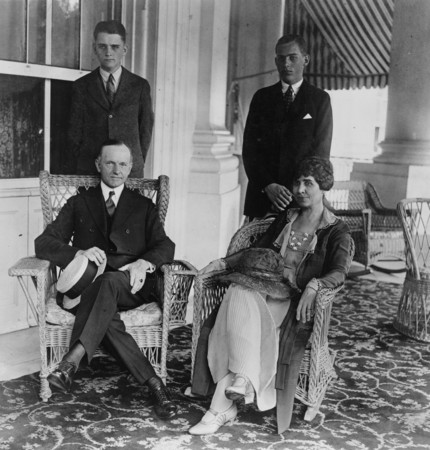
In 1920, even as Calvin Coolidge would become Vice President-elect, few suspected that his voice, as clear and well-suited for radio as it was, would become a frequent part of life in the coming decade. As he would tell Senator James Watson, “I am very fortunate that I came in with the radio” (“As I Knew Them,” p.239). Jerry Wallace, in his superb book, “Calvin Coolidge Our First Radio President,” has found that not only was Coolidge the first to make full use of radio as President but he would become an instantly known and beloved voice of the era. As radio ownership would skyrocket in the 1920s, families would grow up with that distinctive “nasal twang” of President Coolidge on the waves. Of his one hundred and thirty-five Presidential speeches, including the first of his messages to Congress in December 1923, over thirty percent of those were delivered on the radio (some 40 messages, between 1923-1929). In this speech, Coolidge potently encapsulates his philosophy on government and citizenship. The text of this recording, produced by Nation’s Forum during the 1920 campaign to introduce the Harding-Coolidge team, is as follows:
“It is preeminently the province of government to protect the weak. The average citizen does not lead the life of independence that was his in former days under a less complex order of society. When a family tilled the soil and produced its own support it was independent. It may be infinitely better off now, but it is evident it needs a protection which before was not required.
Let Massachusetts continue to regard with the greatest solicitude the well-being of her people. By prescribed law, by authorized publicity, by informed public opinion, let her continue to strive to provide that all conditions under which her citizens live are worthy of the highest faith of man. Healthful housing, wholesome food, sanitary working conditions, reasonable hours, a fair wage for a fair day’s work, opportunity — full and free, justice — speedy and impartial, and at a cost within the reach of all, are among the objects not only to be sought, but made absolutely certain and secure.
Government is not, must not be, a cold, impersonal machine, but a human and more human agency: appealing to the reason, satisfying the heart, full of mercy, assisting the good, resisting the wrong, delivering the weak from any impositions of the powerful. This is not paternalism. It is not a servitude imposed from without, but the freedom of a right to self-direction from within.
Industry must be humanized, not destroyed. It must be the instrument not of selfishness, but of service. Change not the law, but the attitude of the mind. Let our citizens look not to the false prophet but to the pilgrims. Let them fix their eyes on Plymouth Rock as well as Beacon Hill. The supreme choice must be not to things that are seen, but to things that are unseen.
Our government belongs to the people. Our property belongs to the people. It is distributed. They own it. The taxes are paid by the people. They bear the burden. The benefits of government must accrue to the people. Not to one class, but to all classes, to all the people. The functions, the power, the sovereignty of the government, must be kept where they have been placed by the Constitution and laws of the people. Not private will, but that public will, which speaks with a divine sanction, must prevail.
There are strident voices, urging resistance to law in the name of freedom. They are not seeking freedom for themselves, they have it. They are seeking to enslave others. Their works are evil. They know it. They must be resisted. The evil they represent must be overcome by the good others represent. Their ideas, which are wrong, for the most part imported, must be supplanted by ideas which are right. This can be done. The meaning of America is a power which cannot be overcome. Massachusetts must lead in teaching it.
Prosecution of the criminal and education of the ignorant are the remedies. It is fundamental that freedom is not to be secured by disobedience to law. Even the freedom of the slave depended on the supremacy of the Constitution. There is no mystery about this. They who sin are the servants of sin. They who break the laws are the slaves of their own kind. It is not for the advantage of others that the citizen is abjured to obey the laws, but for his own advantage. That what he claims a right to do to others, that must he admit others have a right to do to him. His obedience is his own protection. He is not submitting himself to the dictates of others, but responding to the requirements of his own nature.
Laws are not manufactured. They are not imposed. They are rules of action existing from everlasting to everlasting. He who resists them, resists himself. He commits suicide. The nature of man requires sovereignty. Government must govern. To obey is life. To disobey is death. Organized government is the expression of the life of the commonwealth. Into your hands is entrusted the grave responsibility of its protection and perpetuation.”
 The Importance of the Obvious