On Flag Day

Image

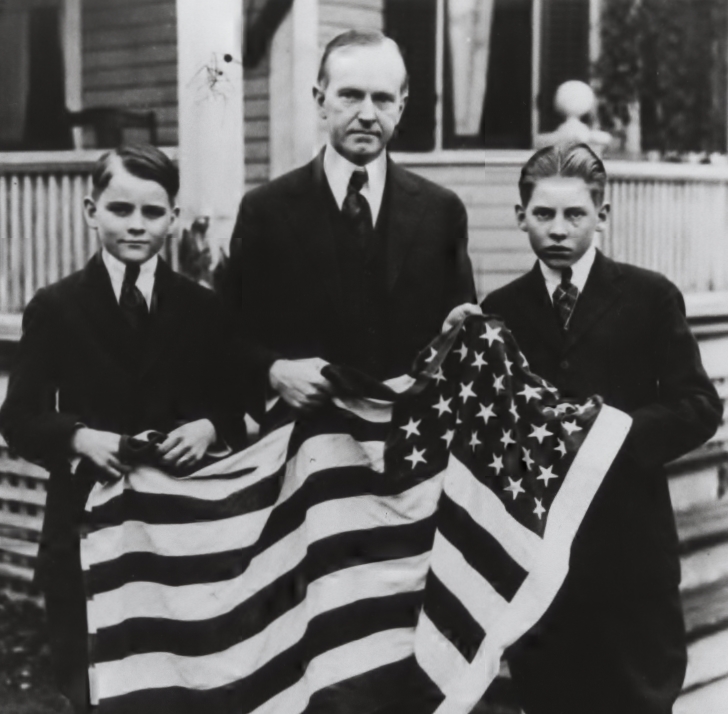
Reflecting on the significance of the flag a couple days in advance, the former President had these stirring thoughts to offer on Friday, June 12, 1931,

“National Flag Day has been observed for some years by official direction on June 14. It is the anniversary of the adoption by the Congress of the flag of the United States. We do honor to the Stars and Stripes as the emblem of our country and the symbol of all that our patriotism means.

     “The stars and the red, white and blue colors have a significance of their own, but when combined and arranged into the flag of our nation they take on a new significance which no other form or color can convey. We identify the flag with almost everything we hold dear on earth. It represents our peace and security, our civil and political liberty, our freedom of religious worship, our family, our friends, our home. We see in it the great multitude of blessings, of rights and privileges, that make up our country.

     “But when we look at our flag and behold it emblazoned with all our rights we must remember that it is equally a symbol of our duties. Every glory that we associate with it is the result of duty alone. A yearly contemplation of the meaning of our flag strengthens and purifies the national conscience.”
                         Image

Image

Governor Coolidge raising the flag with members of the Washington Senators team at Fenway Park, Boston, Massachusetts. General Clarence R. Edwards and others stand with salute. 

On Self-Control and the Future

“It is senseless to boast of our liberty when we find that to so shocking an extent it is merely the liberty to go ill-governed. It is time to take warning that neither the liberties we prize nor the system under which we claim them are safe while such conditions exist.

“We shall not correct admitted and grave defects if we hesitate to recognize them. We must be frank with ourselves. We ought to be our own harshest critics. We can afford to be, for in spite of everything we still have a balance of prosperity, of general welfare, of secure freedom, and of righteous purpose, that gives us assurance of leadership among the nations.

“What America needs is to hold to its ancient and well-charted course.

“Our country was conceived in the theory of local self-government. It has been dedicated by long practice to that wise and beneficent policy. It is the foundation principle of our system of liberty. It makes the largest promise to the freedom and development of the individual. Its preservation is worth all the effort and all the sacrifice that it may cost”
— President Calvin Coolidge, Arlington National Cemetery, May 30, 1925.

On the Individual

It was on Memorial Day in Northampton, 1923, that Vice President Coolidge said,

“…[I]f our republic is to be maintained and improved it will be through the efforts and character of the individual. It will be, first of all, because of the influences which exist in the home, for it is the ideals which prevail in the home life which make up the strength of the nation. The homely virtues must continue to be cultivated. The real dignity, the real nobility of work must be cherished. It is only through industry that there is any hope for individual development. The viciousness of waste and the value of thrift must continue to be learned and understood. Civilization rests on conservation. To these there must be added religion, education, and obedience to law. These are the foundation of all character in the individual and all hope in the nation.”

When Coolidge spoke of conservation here, he was speaking of its broad sense, the preservation of not merely material resources but moral ones. If the Republic is to continue, it will be due to the moral resources of the individual, not the powers of Government. He was no libertarian nor sympathetic to objectivism, both notions that would have struck him as self-defeating and short-sighted. He knew the individual was not liberated from public responsibilities to his or her neighbor. He also knew the government had a clear role to legislate and demand obedience to law. No man was absolutely free in the exercise of one’s rights or duties. Such was a responsibility to each other as we live together in society. His outlook was rooted in a far more resilient foundation, the example of service set by Christ.

It is the individual with the real power to uphold the soundness of our future. It was the deep reservoir of an individual’s moral capital that make civilization possible, the value of whom is bestowed by God, nurtured by the instructions of the home, instilled with virtues like thrift, strengthened by religious faith, and developed with an informed mind that retains reverence for the supremacy of the law upon all people. It was the individual that would keep Benjamin Franklin’s warning from fulfillment. A Republic, with duty-minded individuals such as Coolidge describes (as opposed to the self-centered or hedonistic) would find faithful men and women through whom to entrust its legacy to the next generation. Devoid of such individuals, no civilization is secure.