“A President and a Rug: Hidden History” by Kate E. Bradley

“A President and a Rug: Hidden History” by Kate E. Bradley

Here is a fascinating portion of the back story behind Dr. Deranian’s research that has become the recently published book, “President Calvin Coolidge and the Armenian Orphan Rug.” The suffering and loss endured by over one hundred and thirty-five thousand orphans and more than one million others through Turkish genocide brought the best out of Americans, who contributed millions of dollars, supplies and, for some, even their own lives to rescue as many of the Armenian people as possible. It is a long overlooked detail of President Coolidge’s foreign policy that he encouraged the relief effort, even meeting two of the orphans in 1926 who would eventually call America their home. An enormous rug gifted to President Coolidge in gratitude for America’s actions through the rescue effort headed by Near East Relief, speaks not only to the good will between two peoples but to the timeless reminder that America responds with open hearts and ready service, without a single government mandate, to help defend life and freedom for the most unfortunate anywhere in the world.

Now that the Smithsonian has been inexplicably denied permission by the White House to display the rug, it is shamefully not too far-fetched to conclude that this particular Administration has little concern for the gift’s meaning and even a deliberate interest in suppressing a celebration of the force for good Americans have been not only to Armenians but multitudes of others throughout our history.

A few of the more than 4.5 million knots lovingly forming this 11' 7" x 18' 5" rug. 400 orphan girls spent 10 months preparing this gift to America.

A few of the more than 4.5 million knots lovingly forming this 11′ 7″ x 18′ 5″ rug. 400 orphan girls spent 10 months preparing this gift to America.
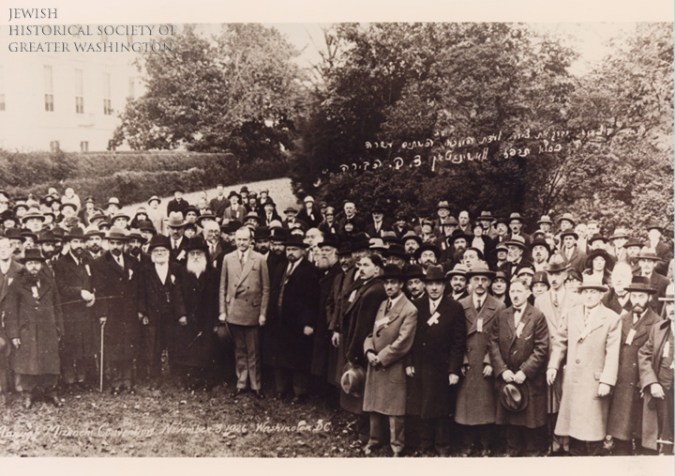
Meeting at the White House, 1926

Meeting at the White House, 1926

“I think — the best thing I can wish to the Jews in Palestine — is that they will get on — as well as they get on — over here” — Calvin Coolidge, 1926.


As a result of a mixture of hostility to Jewish settlement throughout Europe and the activities of the radical “Parushim,” of which Justice Brandeis was a leader, the move to establish homes in British Palestine gained momentum following the First World War. Most Americans, including Jewish Americans, had no interest in carving out a “Promised Land” in Palestine. Here President Coolidge is pictured with Orthodox Zionists. These men and women were working to establish a place where Jews from everywhere would live together as a nation. Rather than observe the principle: be at peace with all men so far as it depends on you, the movement sought to pull up roots and plant anew.  Coolidge’s statement, as the representative of America’s ideals, is a testament to this more excellent way here at home and in our relations abroad. The solution for the peace of the world was not in mandated Statehood but in exercising the obligations of citizenship here and wherever Jews already resided.

Photo part of a collection held by the Jewish Historical Society of Greater Washington.

On the Importance of Budgeting

“To be confidential for a moment, I may confess that an invitation to make a speech is not the rarest experience that comes into a President’s life. But I listened with, I hope, proper politeness, down to the point where your spokesman started explaining that you were to devote an evening to the consideration of a budget. Then I began to take real interest, for the budget idea, I may admit, is a sort of obsession with me. I believe in budgets. I want other people to believe in them. I have had a small one to run my own home; and besides that, I am head of the organization that makes the greatest of all budgets–that of the United States Government. Do you wonder, then,, that at times I dream of balance sheets and sinking funds, and deficits, and tax rates, and all the rest?

     “Yes, I regard a good budget as among the noblest monuments of virtue. It is deserving of all emulation; but there are other topics that afford more obvious inspiration to popular oratory. So when I found that you actually wanted a budget speech, I felt a warming sense of gratitude…

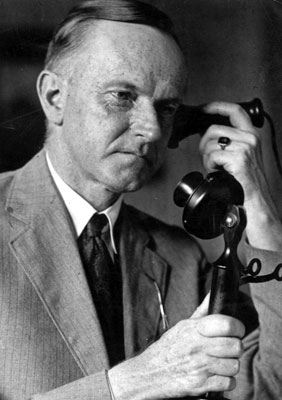
     “Nothing is finer than the open hand and the generous heart that prompt free and unselfish giving. But modern social science knows, also, that ill-directed charity is often directly responsible for encouragement of pauperism and mendicancy. The best service we can do for the needy and the unfortunate is to help them in such manner that their self-respect, their ability to help themselves, shall not be injured but augmented. Nobody is necessarily out merely because he is down. But, being down, nobody gets up again without honest effort of his own. The best help that benevolence and philanthropy can give is that which induces everybody to help himself” — Calvin Coolidge, speaking over the telephone from the White House to the Federation of Jewish Philanthropic Societies of New York City, October 26, 1924, as they listened together from the Hotel Pennsylvania.

317