On Science and Morality

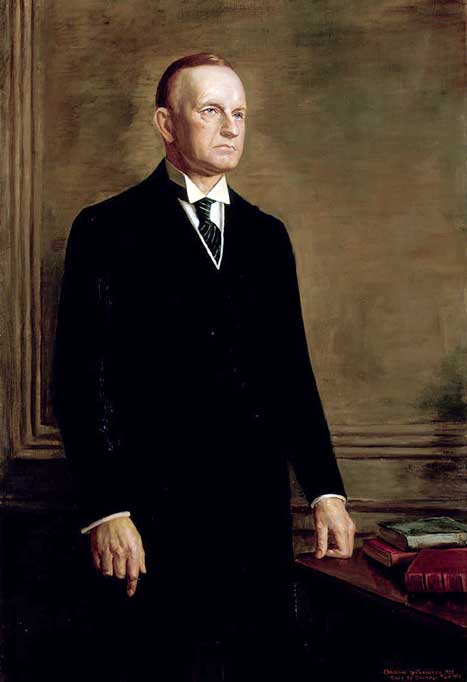
ImageAs the 7th of January marked the well-known “Have Faith in Massachusetts” inaugural speech of Coolidge’s presidency over the Massachusetts Senate beginning in 1914, one hundred years ago, the profound observations of that address find reiteration at the end of his life with equal force and persuasive insight. Coolidge remained philosophically consistent, unchanged even after a long career of public service could have diluted his sense of himself or surrendered convictions in the name of “practicality.” Moral rightness and wrongness were very real to him. Their existence kept him coming back to God for strength to walk humbly and lead righteously. He retained a firm grasp of principled reality that helped navigate through many a political “thicket.” To the end, he kept his commitment to the existence of truth and the inability of man, through his own power, to remove moral responsibility and repeal Divine law.

“For more than a generation we have been worshiping science and glorying in its application to our physical needs. No one should underestimate the value of our advance in knowledge or fail in due appreciation of those who for no reward and little recognition have unselfishly devoted themselves to years of research, which had enormously contributed to the comfort, convenience, health and material power of their fellow men. But all the wonders with which science has surrounded us merely tell us what we can do, they do not reveal what we can be. Of themselves they add nothing to our moral power and are indifferent to the higher aspirations of the soul.

“Science alone furnishes no guarantee of progress. It can be used, as many of us have seen, for evil and destruction. It gives us quantity but we also need quality. If we want to increase our knowledge of liberty and patriotism, of justice and mercy, of self-sacrifice and charity, of salvation and immortality, of any of the ideals which raise men above themselves, we turn to literature.” As Coolidge made clear earlier in this same article, his training for life, from very early on, included “the most important book in the world,” the Bible.

Coolidge continues, “Give a man all knowledge of material forces and with it he may involve himself and all the world in complete ruin, but plant a noble thought and a moral purpose in the human mind, and not only are they incapable of being used for any evil design but they have a contagious power of their own for immeasurable good. Without them there is little which is capable of supporting and advancing civilization” (“Books of My Boyhood,” published in Cosmopolitan, October 1932).

Image

On Unemployment Benefits

Back when unemployment insurance came with built-in incentives to get off the dole, compensation not to work was something to be overcome rather than expanded and extended indefinitely. Now in its fifth year of “temporary emergency benefits,” the administration is asking us yet again to equate economic growth with more money to those who are not working. Some who know better, like Senator Durbin and President Obama, expect us to believe that job creation does not lead to growth, prosperity and plenty for ourselves, our children and even the poorest among us. Instead, they want us to accept the notion that the engine of economic recovery resides in government redistributing money to whom it wishes. Equating unemployment benefits with economic growth is not only patently absurd but willfully ignorant, understanding neither how prosperity happens nor who works to earn it. It is not government who creates wealth but industrious people who make a profit through the work they do. The more profitable the enterprise, the greater the opportunity to employ more people and improve everyone’s lot. Calvin Coolidge identified the source of real benefits to all when he said, “It is the number at work, not the number out of work, that measures our business prosperity.”

To tell America that recovery occurs by enhancing the number of those not working is dishonest. It is a failure to inform people of the fundamental truths of economics. By obfuscation and distraction the Democrat leadership continues hurting the very people it claims to advocate. The truth could be easily understood but to explain it honestly would liberate those who rely on others, especially Washington, rather than themselves for better lives. “The problem of the wage earner,” as Coolidge explained it, “would be simplified by remembering he works not for money but for goods and services. Wages come out of production. The employer cannot get them permanently out of any other source. Wages are raised or lowered with production.” President Obama hopes we fail to see why taking from the wages of those who work to provide “benefits” to those who do not is never going to create jobs or increase opportunity.

Coolidge knew that a sound system of meeting unemployment is not so easily solved by the Democrat method of throwing money at the problem. “If unemployment insurance were like life and accident insurance the problem would be simple,” he observed. “Each would take what he wanted and pay for it. But it is generally proposed that the employer and the public treasury should pay part of the cost as in workmen’s compensation. If when unemployed he is to receive something he did not pay for, no one can say how that would affect the will of the wage earner to hold his place by doing his best. Evidently, the morale would be lowered.” Coolidge identified local institutions as the ones to assist the individual return to what he, on another occasion, called “normal,” the freedom of self-support. He rejected the falsehood that without National Government “help,” no help would be given to those in true need. “The duty,” at the local level, “to relieve unemployment is plain, but not even the unemployed have a right to what they do not earn. Charity is self-existent. Employer and employee are on a business, not a charitable relationship.” Remaining such enables greater opportunity for everyone, especially in depression.

Coolidge understood that what was ultimately being considered was not actually helping those who needed, it was about “government ownership,” exercising the power to make the decisions and direct the material means of life, death, prosperity and poverty as political considerations dictated. In contrast, the free enterprise makes opportunity for everyone with the industry and perseverance to improve one’s lot, bettering the lives of those around him or her. It is the means to feeding the hungry, clothing the naked, and raising life’s standards. “Healthy and normal employment consists of serving another for his personal satisfaction or profit. As the government is not personal, its proper business would be for those serving for its profit…If it is assumed that payment of wages will go on without work, that is not employment, but relief. Then no one should work. The government has never shown much aptitude for real business…The most free, progressive and satisfactory method ever devised for the equitable distribution of property is to permit the people to care for themselves by conducting their own business. They have more wisdom than any government.”

The eternal truth of that statement remains in force even now. The genuinely unprecedented success of the Coolidge Era was not something for which he ever took credit. He did not boast of contributing to the latest stellar job creation numbers because individual Americans accomplished them. Free individuals build prosperity. He simply “minded his own business,” removing the hindrances to the full and just reward for one’s labor neither resorting to the public treasury — the income of our neighbors — nor funding redistribution schemes rooted, then as now, in vague and destructive conceptions of equality.

Joseph E. Burgess copy of Ercole Cartotto original

“A Birthday Tribute to Grace Goodhue Coolidge”

A Birthday Tribute to Grace Goodhue Coolidge

Dr. Fran Becque, leading fan of Mrs. Coolidge and fraternity historian, has offered a fine tribute to one of the most gracious and beloved First Ladies (or the “National Hugger,” as she once laughingly called herself) ever to occupy the White House. Today marks the 134th Anniversary of her birth in Burlington, Vermont, to Andrew and Lemira Goodhue. Even to those of us who know her only from a distance in time and place, we love and miss her greatly. Happy Birthday, Mrs. Coolidge!

Mrs. Coolidge, 1942

Mrs. Grace Coolidge, 1942