On Economy

     Calvin Coolidge cherished the classics. He admired the wisdom of older thinkers and writers for what insights they discovered about human nature. He recognized that the old is not equivalent to the wise just as the younger and newer are not necessarily more enlightened or more modern. He distinguished between rediscovering and reapplying what is timeless from the blind emulation of the past. As Sheldon Stern has noted, he translated Cicero and Dante for relaxation. It was the practice of economy in public service that stood pronounced among the lessons he learned. As he knew, “economy” derived from the Greek compound oikonomos, which literally meant, “house law” (Bauer’s “A Greek-English Lexicon” p.559). To the Greeks, it referred to the management and direction of a household.

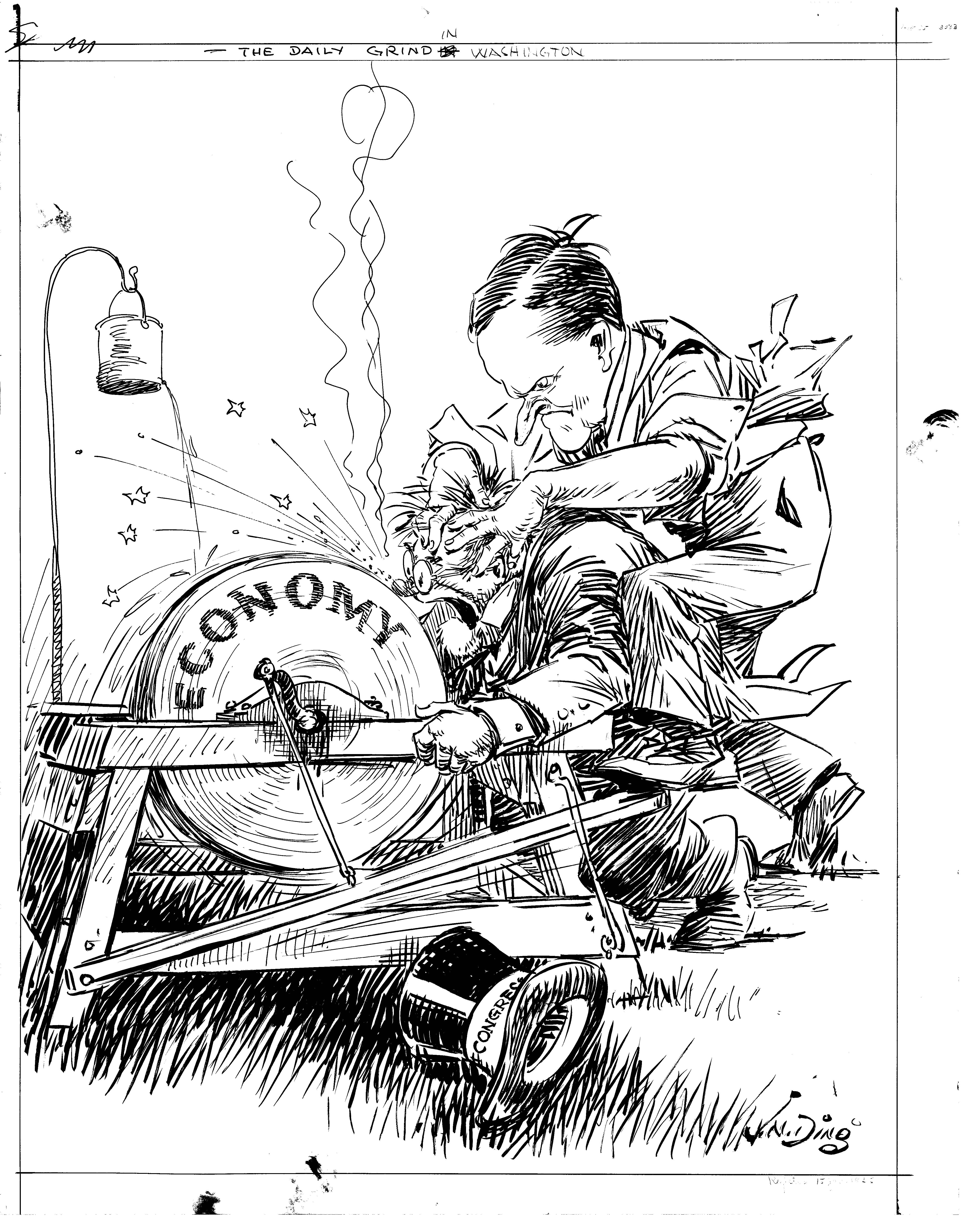
     Together with Coolidge’s profound sense of service, it was a call to lead by example. If he was to preside as the most powerful man in the world, it meant serious responsibilities were upon him. This meant requiring of himself the standards he expected in others. If he was to convince the Congress that government should economize, cutting wasteful expenditures and unnecessary costs, it would forfeit any credibility were he an extravagant spender on the White House staff. It meant the President would have to demonstrate it in his own “house.” This is why he constantly scrutinized the spending of the White House housekeeper, Mrs. Jaffray. It was wasteful to insist on shopping at specialty establishments when the cheaper grocery stores would save money. Why purchase more hams than could be eaten for the occasion? This is why President Coolidge commended his second, and more conscientious, housekeeper, “Ella” Riley for a “very fine improvement” bringing expenses down $2,550.71 in one year, just short of a 22% decrease. This is why President Coolidge prioritized his meetings with Budget Director General Herbert Lord above those with his own Cabinet and Congress. Their exacting work made possible tax refunds of $150 million in 1926 from budget surpluses of $378 million that year and $599 million in 1927. This is why President Coolidge maintained his original $32 a month, two-family residence in Northampton. He was not going to “live large” at the people’s expense. This is why President Coolidge was personally involved when it came to trimming grocery lists, cutting down ostentatious furnishings, and unnecessary costs, though it meant overturning tradition at times. Not even the seemingly inconsequential ribbon and paper used in official correspondence was spared in order to save tens of thousands of dollars each year.

     Coolidge, Lord and Mellon cut and then kept cutting wherever they could. Such was simply the demand of leading by example. The Congress, when faced with each year’s surplus (largely made possible by the trio’s thrift), would look for every possible device on which to spend it. Not so with Coolidge, as the manager of his “household.” The Presidency was not a chance to spend because it was there or waste because he could. That was not an example befitting the President. If he could not live within his “household” budget, he had no ground on which to demand such habits from Congress and thus no credibility as a responsible leader. If he abdicated this duty, the next expansion of government benefits would likely be assured but the cost would not be merely material. A deep moral debt would be created from which no tangible material could deliver. For Coolidge, the morality of saving people by saving money must start at “home.” Without example, words and intentions alone ring hollow.
            Image

On Character

“We must forever realize that material rewards are limited and in a sense they are only incidental, but the development of character is unlimited and is the only essential” — CC, cited in “Adequate Brevity” compiled and edited by Robert J. Thompson (Chicago: M. A. Donohue & Company, 1924), p.18.

“This country was not made on the theory that we should ‘eat, drink, and be merry, for tomorrow we die.’ Its founders were more accustomed to prepare themselves with fasting and prayer that they might meet the serious obligation to live through the morrow. They had their feast days, too, for they found a great happiness in their work. But these were a time of thanksgiving and praise. Instead of falling back and falling down on the claim that the world owed them a living, they moved forward and moved up on the principle that they owed the world the duty of providing for themselves…They put first things first…If this nation is to endure we shall have to continue to walk by their light. We cannot give all our thought to material success” — CC, July 1, 1930, cited from “Calvin Coolidge Says” (Edited by Edward C. Lathem, Plymouth, VT: Calvin Coolidge Memorial Foundation, 1972).

These views are irreconcilable with everything we have been told Coolidge was and what informed his outlook. From the pretentious attempts of William Allen White (who said Coolidge’s faith “rested on the thesis that ‘the rich’ are ‘wise and good’ ” and so dubs Coolidge “the high priest of laissez-faire,” “Puritan in Babylon,” pp.434-5) to the simplistic revisions of Arthur Schlesinger, Jr., who sums up all that need be known about the immoral twenties with a sweeping generalization of the era on nothing more than one snippet of Coolidge’s oft repeated, “The chief business of the American people…is business” (“The Crisis of the Old Order” p.vii). To stop there with no further inquiry about the man, his motivations or, at minimum, confronting the statement in its entirety is not only shabby scholarship but is the product of a dishonest and biased practitioner. This was supposed to be a man who blindly led the nation in the “worship” of business, the pursuit of profits and the exploitation of the poor and minorities. As a result, the Great Depression laid bare all that was wrong with capitalism, limited government and Coolidge’s “inactive” presidency…while the rise of nationalism that would pull the world back into another war came from Coolidge’s “isolationist” foreign policy…or so the story goes. Approaching the man through his writings and speeches to learn who he was, the nature of the problems he faced (in their historical setting) and how he chose to address them are simply inconvenient quests when the misrepresentations are so much easier  to fabricate. If the template doesn’t fit, make your subject conform to it, they assert.

Meanwhile, eighty years have transpired under this fake portrait of one who addressed all sectors of economic endeavor when he declared, “The chief business of the America people is business” but also said in the same address (to journalists no less),

“Of course, the accumulation of wealth can not be justified as the chief end of existence. But we are compelled to recognize it as a means to well nigh every desirable achievement. So long as wealth is made the means and not the end, we need not greatly fear it…It can safely be assumed that self interest will always place sufficient emphasis on the business side of newspapers, so that they do not need any outside encouragement for that part of their activities. Important, however, as this factor is, it is not the main element which appeals to the American people. It is only those who do not understand our people, who believe that our national life is entirely absorbed by material motives. We make no concealment of the fact that we want wealth, but there are many other things that we want very much more. We want peace and honor, and that charity which is so strong an element of all civilization. The chief ideal of the American people is idealism. I cannot repeat too often that America is a nation of idealists. That is the only motive to which they ever give any strong and lasting reaction. No newspaper can be a success which fails to appeal to that element of our national life” (Address to the American Society of Newspaper Editors in Washington, D.C., January 17, 1925, found in “Foundations of the Republic” p.187-8, 190).

It was in the middle of “Coolidge Prosperity” when he observed that “We live in an age of science and of abounding accumulation of material things. These did not create our Declaration. Our Declaration created them. The things of the spirit come first.” Then he warned, “Unless we cling to that, all our material prosperity, overwhelming though it may appear, will turn to a barren sceptre in our grasp” (July 5, 1926, on the one hundred and fiftieth anniversary of the Declaration of Independence, recorded in “Foundations of the Republic,” p.454). So much for the notion that Coolidge was the naive tool of corporate greed and wanton materialism.

Mr. Coolidge understood that the cultivation of character and the upkeep of integrity are constants whether times are prosperous or impoverished. They are immaterial things from which all our technological and societal complexities follow. The advent of the latest iPad or largest Bigscreen do not translate us into mature people. Only spiritual development can do that. To deny it is like equating knowledge with wisdom. We lose all substance when we reject and deprive our spiritual natures. We are not merely masses of tissue or soulless slaves of matter. Not even culture gives us that unique longing for intangible principles. It comes from above. The possibilities afforded when we resolve to be men and women of integrity, who hold to what is right, good and true over the “window dressing” of material well-being, knows no caps, limits or constraints beyond ourselves. That is both a liberating and profoundly challenging thought. Thanks for reminding us of the obvious, Mr. Coolidge.

The Import of What is Obvious

This page is dedicated not merely to the times in which Calvin Coolidge lived but to the “mind of the president” as it addressed problems and articulated solutions through his speeches, radio addresses and writings. To return to the situations he faced over the course of thirty years in public service, one is confronted with the realization that we live in like times. This is because we possess the same human frailties and strengths of his generation.

President Coolidge has been attacked, miscast and marginalized for eighty years as “silent,” “cold,” and a “do-nothing” lackey of “Big Business,” stuck between the greats, Wilson and FDR. His daily articles, written after his presidency, in 1930 through 1931 will be central to this blog’s purpose. When asked about the detractors of those articles in an interview by Bruce Barton, CC smiled, “They criticize me for harping on the obvious. Perhaps some day I’ll write one on The Importance of the Obvious. If all the folks in the United States would do the few simple things they know they ought to do, most of our big problems would take care of themselves” (cited in “Meet Calvin Coolidge: The Man Behind the Myth,” Brattleboro, VT: Stephen Greene Press, 1960, p. 191). He was simply anticipating a truth Bruce Lee would later observe, “Our grand business is not to see what lies dimly at a distance, but to do what lies clearly at hand.”

Despite all of our technological advancements, moral sophistication and governmental complexity, what is too often absent is the import due the obvious. That is why “Silenced Cal,” as Amity Shlaes puts it, has much to say.