On Credibility

Too often promises are made merely to send the inquirer away with hopes of fulfillment rather than informed answers or reliable results. The assurance matters more than the outcome on far too many occasions, it seems. We do not always have the answer but how often do we commit to finding one, only to never actually follow-up on the matter? Besides, who can be so confident (or is it disciplined?) to listen intently, guarantee nothing and then immediately set to work on what has been requested? When someone comes to us seeking information, do we respect him or her enough to keep our answers clear, concise and truthful?

To say what you mean to say and then follow through consistently from both factual certainty and dependable action establishes credibility. It is what sets apart the trustworthy from the unreliable and the faithless. Coolidge was notorious for his keen ability to listen without ever giving his consent or promise of fulfillment. It was not what Coolidge refused to say at the time, it was what he did after each visitor left that mattered. Coolidge would take the time to immediately follow-up on each matter before seeing the next appointment. By his deeds not his words, he accomplished far more with less “fuss,” simply doing what needed to be done. For Coolidge, it was the substance of the outcome not the intentions of the process that meant the most.

In Horace Green’s The Life of Calvin Coolidge, the author sets to work verifying from firsthand sources the facts from the fiction already growing up around the new President. One incident in particular, among those which actually took place, illustrates the seemingly effortless way Coolidge established credibility both personally and professionally. Of course, the perception of effortlessness did not reveal the work it took, the rigorous discipline Coolidge imposed upon himself from a very early age. It was how Mr. Coolidge overcame what so many in society and especially in politics consider even now a serious handicap: his willful taciturnity. By 1924, so many versions existed of young lawyer Coolidge’s “Can Move Body” story that Mr. Green was compelled to correct the record.

The original account, confirmed by Mr. Green’s research, begins with an older gentleman named Orville Prouty, who was currently serving as one of the selectmen of Hadley, Massachusetts. Throughout New England boards of “selectmen” or “aldermen” functioned as city executives whereas the legislative role was exercised directly by the people in town meetings. Hadley was a section of Northampton, the town young Coolidge had settled upon to “read” law. He chose the firm of John C. Hammond and Henry P. Field. Both men had ably and reliably served Northampton, and Massachusetts, for many years.

A man had been shot and killed while rowing on a small lake in the Hadley section of town. It was imperative that the recovery of the body be determined as soon as legally possible. Mr. Prouty needed to know whether he had lawful authority to remove the body himself without violating the law or compromising the collection of evidence for trial. He went to the law office he trusted, the same firm of Hammond and Field. However, neither man was there. There was only a thin young man he had never seen before, intently reading a law book. The young man responded to Selectman Prouty that “everybody was out.” As Mr. Green notes, “Apparently it never occurred to the selectman that the young man was anybody” (p.37). After nervously pacing around the room for a few moments, awaiting the return of either attorney, Mr. Prouty finally presented his question to the quiet youth.

Hearing out Mr. Prouty’s situation, the young man calmly replied, “Can move the body.” Without elaboration or excitement, Coolidge went back to his reading, respecting the selectman’s need for haste. Mr. Prouty could not account for this unruffled certainty. Asking whether Coolidge was completely sure, the young man responded, “Yes, can move the body.”

Astounded, Mr. Prouty met Mr. Hammond on the stairs after he walked out of the office. “Say, who the devil is that young tongue-tied blonde you got upstairs? Doesn’t he ever get excited?” To that Mr. Hammond, smiling, answered, “That young fellow isn’t much when it comes to gab, but he’s a hog for work. If he tells you you can move the body, you can bet your life you can. He’s only been in this office a few months, but I’ve found out that when he says a thing is so, it is.”

Coolidge’s reputation as a credible authority did not come without concerted preparation. He knew the difference between what were essentials and what was trivial. He did not waste time on the latter, whether the time was his or belonged to someone else. His internal focus did not permit the “show” of knowing more or promising much just to pacify the person. On the contrary, he invested himself in actually knowing the law and when he spoke, he would speak only on the firm ground of facts. Anything less would be a betrayal of himself and the trust reposed in him. His sense of economy presided not merely over his debt and budget-cutting policies but it was a consistent rule for his whole life. Just as he would not waste others’ money and time, so he would not waste words, not expecting people to be content with any answer, however correct, or manifold promises, without action. Enacting this resolute program of self-discipline, despite mystifying many while successfully defying the conventional path, made Coolidge a force of credibility that overcame time and again his reticent temperament and anti-social persona.

Dubbed “Coolidge luck” by those who cannot identify it, his diligence readied him unconsciously to be the best wherever conditions placed him, taught him to under-promise and over-deliver and gave him the confidence to lead through quiet action, instead of presumptuous fanfare. Never trumpeting what he intended to do, he dedicated himself to simply doing it, placing the substance of public service on accomplishments not aspirations. Coolidge’s approach had the effect of giving people further confidence in his credibility because they saw what he did, not just spoke of doing.

Judge Field, the other partner in the firm, was exceptionally active in the affairs of Massachusetts. He was not a man to award praise lightly. He assessed the basis for Coolidge’s credibility this way:

“I’ve never known a man who could say what he means more concisely than Coolidge. Moreover, he has an amazing faculty for reducing what he wants to say, to epigrams. No man has ever known Calvin Coolidge to go back on his word. He has lived in this city for more than twenty-three years, and you won’t find a man or woman, Republican or Democrat, but will tell you that this is true. I’ve never known any one who was a better judge of men. I’ve never known any one who doubted his courage. I’ve never known a cleaner man, a more decent citizen, a more loyal friend…Now, I say, that a man who doesn’t know how to advertize better than that is thoroughly lacking in what, from a practical political view, is the essential qualification in the science of self-exploitation.”

As Mr. Green points out, Judge Field said this before Coolidge reached national office. Yet, Coolidge turned that conventional “science of self-exploitation” on its head as he rose to the pinnacle of leadership. It was not by accident just as it was not entirely outside his control. His credibility, built from many years of effort, provides an inspiring reminder that trustworthiness is a quality each of us can attain through a similar dedication as we prepare ourselves, commit to the essentials and cherish substance over appearances. Coolidge remains credible today not because of any soaring pledges, grand intentions, or idealistic crusades but for his quiet competence, humble integrity, and decisive actions.

The Honorable John C. Hammond, President Calvin Coolidge and Judge Henry P. Field, attending a reunion of Amherst alumni.
The Honorable John C. Hammond, President Calvin Coolidge and Judge Henry P. Field, attending a reunion of Amherst alumni.
“Born on the Fourth of July” by Sidney M. Milkis

“Born on the Fourth of July” by Sidney M. Milkis

The latest review of both Amity Shlaes’ Coolidge and Charles C. Johnson’s Why Coolidge Matters adds a welcome take to a renewed conversation of Calvin Coolidge. Mr. Milkis, well-known author and professor with the Miller Center of Public Affairs at the University of Virginia, has much to offer when it comes to the Progressive Era, the period generally classified from 1900 to 1929. In his critique of both books, Mr. Milkis presents the Coolidge neither author may envision but one that resembles the man described by David Greenberg, whose Calvin Coolidge, published in 2006, accepted too many of the assumptions handed down by Art Schlesinger and the New Deal gang. Greenberg unfortunately dug himself into a deeper hole with his 2011 piece further ridiculing Coolidge’s “naive faith in the gospel of productivity” as if Big Government has proven once and for all to be a reliable and permanent fixture of American life.

Mr. Milkis contributes a worthy opinion in the ongoing and overdue discussion about our thirtieth president. However, it is equally as important not to reinforce the same, old misrepresentations of what has, for far too long, been the accepted narrative regarding “Silenced Cal.” The fact that Ms. Shlaes and Mr. Johnson are questioning that narrative with meticulous research is not “revisionist” as much as it is a return to the rigorous standards of scholarship restored by Thomas Silver, popularized by Ronald Reagan, and now being revitalized by, among others, the authors Mr. Milkis has reviewed.

Mr. Greenberg and those who preceded him in defense of the New Deal have more to lose by seeing Coolidge’s principles reintroduced and expounded through the heavy lifting done by those he perceives to be on “the Right,” than they do repeating the tired shibboleth of his naivete and failure. Americans all can appreciate Coolidge not because he identified with this or that “political side” but because the principles he embodied were thoroughly and unabashedly true to the foundations of our exceptional system, declared, constituted and reaffirmed by our ancestors. As Coolidge expressed it on another occasion, “Whether one traces his Americanism back three centuries…or three years…is not half so important as whether his Americanism of to-day is real and genuine. No matter by what various crafts we came here, we are all now in the same boat.” His appeal to eternal truths of human nature and political experience should form ground on which we can all Americans can again be a united and prosperous people.

On Term Limits

ImageOn August 20, we spoke of Calvin Coolidge’s thoughts on the limits of Presidential authority. It would be another twenty years before the passage of the Twenty-Second Amendment which codified President Washington’s self-imposed custom of serving only two terms. Attempted by a handful of previous Presidents, including the most recent third run of Theodore Roosevelt in 1912, it was actually shattered by Franklin Roosevelt in 1940, who would win a fourth term in 1944. After FDR’s death in 1945, Vice President Truman succeeded to the office as a majority of Americans had come to see the wisdom of Washington’s custom and move to protect it with Constitutional provision. Passing the Congress in March 1947, and securing final ratification by two-thirds (thirty-six) of the states on February 27, 1951, Section 1 of the Amendment made clear it would not apply to the current occupant, President Truman, declaring:

“No person shall be elected to the office of the President more than twice, and no person who has held the office of President, or acted as President, for more than two years of a term to which some other person was elected President shall be elected to the office of the President more than once. But this Article shall not apply to any person holding the office of President when this Article was proposed by the Congress, and shall not prevent any person who may be holding the office of President, or acting as President, during the term within which this Article becomes operative from holding the office of President or acting as President during the remainder of such term.”

Truman would be free to run again in 1952, but after losing the New Hampshire primary to Senator Kefauver, he reluctantly bowed out, announcing soon thereafter he would not be a candidate for another term. What one can do is not equivalent to what one should do.

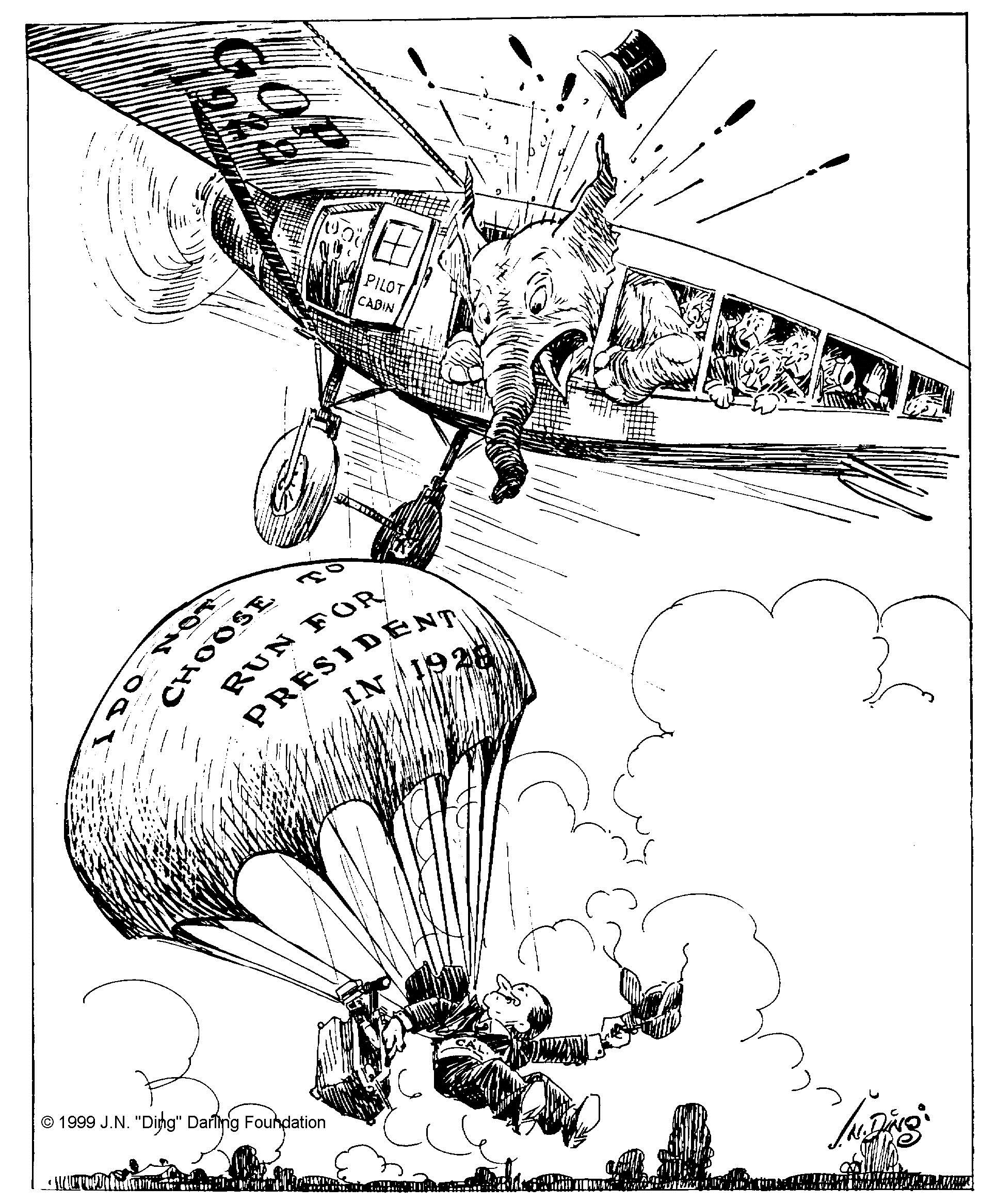
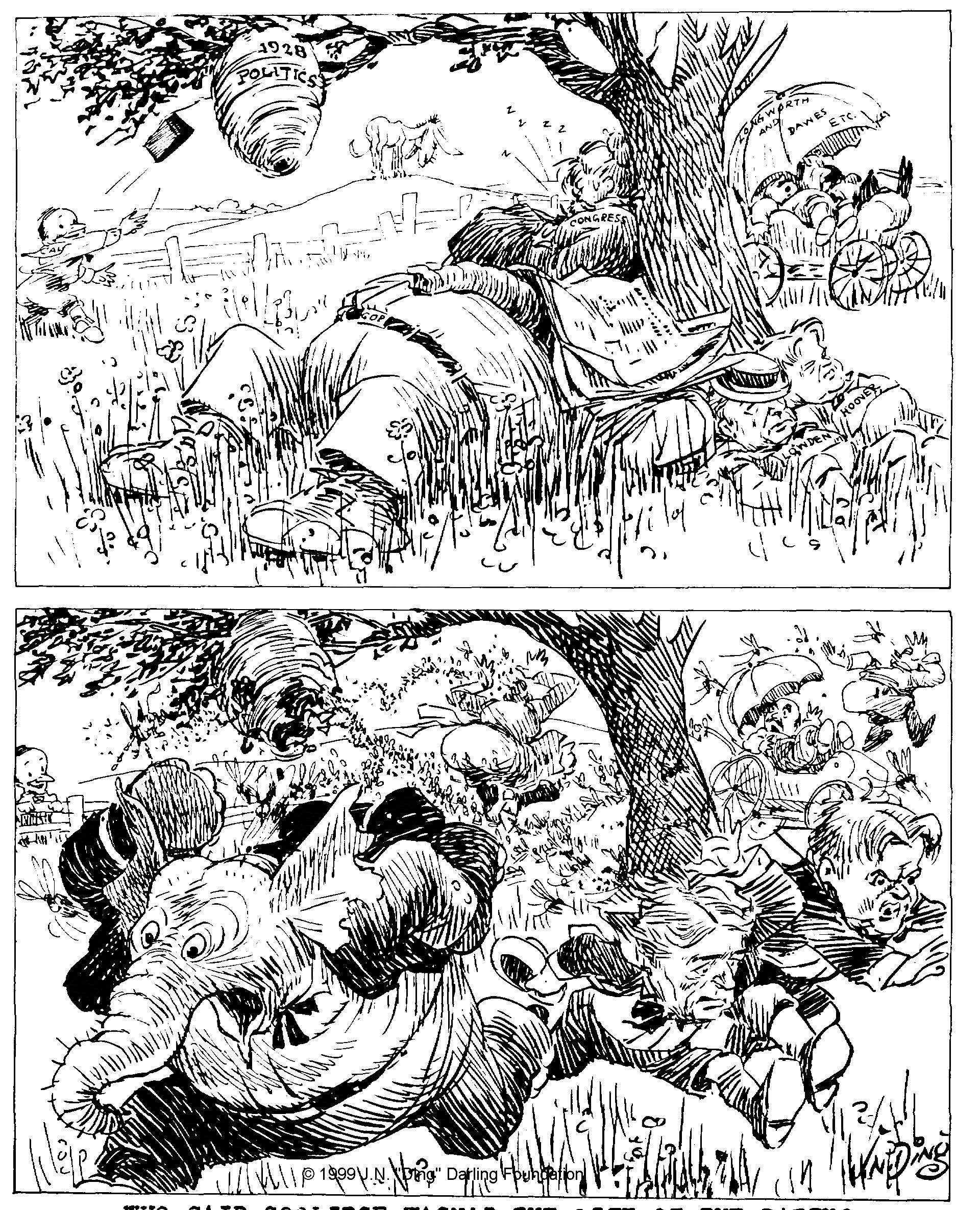
What did Coolidge have to say about the one hundred and thirty year example set by Washington? As already noted, it would be two decades before the passage of the Twenty-Second Amendment. However, it may come as a surprise to us now that talk of formal limits on a third term were gaining steam in the months leading up to Coolidge’s notorious press conference on August 2, 1927. Few Presidential statements caused as much uproar in those years as did his “I do not choose to run for President in nineteen twenty-eight.” Speculation was rampant as to what Coolidge actually meant and what he would do next. If he would not be the nominee, who would?ImageThree interpretations quickly took shape, each explained by scholars Cyril Clemens and Athern Daggett in the June 1945 issue of The New England Quarterly. First, Coolidge neither wanted nor would accept renomination for the Presidency. Second, Coolidge, while not wanting the office, remained open to the prospect if the people renominated him. Third, Coolidge wanted to be President again but played politically coy to gain support.

The final interpretation, generally held by those who perceived him to be a conniving and selfish politician, like any other, attributes motives to the man that simply do not correspond to the facts. There was no question Coolidge would have had renomination unopposed in 1928. He had two, if not three, potential challengers heading into 1924, yet openly pursued the nomination at that time, even after tragically losing his youngest son and any pride he held for the “glory” of the Presidency. He had no reason to calculate for what was readily available to him four years later. But more to the point, his words and actions — in sum, his character — do not conform to this interpretation.

He meant what he said and his respect for the institutions and duties of the Office outweighed his own importance. He never saw himself as so great or indispensable that retaining power meant more to him than preserving the integrity of a very properly limited Presidential authority. He observed the virtue of self-control. It was through this self-imposed denial of executive power that the people were best served in their constitutional system. He had served his purpose, completing the work given for him to accomplish. The time had come for others to lead. It was indeed a wholesome thing to come back to the people from which he was drawn, serving as a private individual and nothing more. He knew that liberty is safeguarded when public servants know, and abide by, naturally imposed limits.

Some would mistakenly attribute a belief that serving four more years would constitute a violation of the “third-term policy” in Coolidge’s estimation. It did not. He had only served one full term and could legitimately stand for another. He made this plain in his Autobiography, “I do not think that the practice [no third term] applies to one who has succeeded to part of a term as Vice President.” If he had, Coolidge would have served ten years, longer than any other President up to that time. He would likely agree that Truman could have pursued a second term in 1952, while concurring that his choice to retire was the right one.

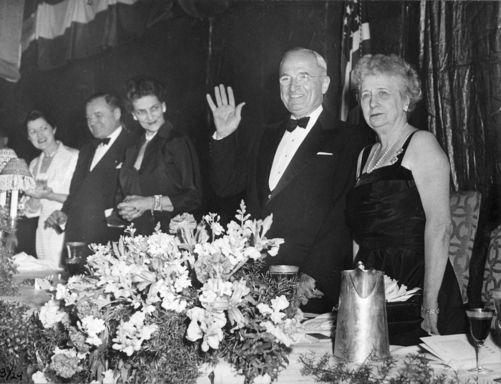
President Truman at the Jefferson-Jackson Dinner, March 29, 1952, at which he announced: "I shall not be a candidate for reelection. I have served my country long, and I think efficiently and honestly. I shall not accept a renomination. I do not feel that it is my duty to spend another 4 years in the White House."

President Truman at the Jefferson-Jackson Dinner, March 29, 1952, at which he announced: “I shall not be a candidate for reelection. I have served my country long, and I think efficiently and honestly. I shall not accept a renomination. I do not feel that it is my duty to spend another 4 years in the White House.”

The strength of our Republic, Coolidge understood, never rested on the coercion of legislation. Not even a Constitutional Amendment could correct human nature, as was evident for all to see during the fourteen years of Prohibition enforcement. It relied on the surpassing might of moral rectitude and religious character in the heart of each individual. It was this which gave force to the legal and constitutional framework of our nation, not the other way around. Our system was a moral agreement. It would fail without virtue in the people and those it chooses to lead. Laws, like people, had natural limits. As Coolidge would say of the Eighteenth Amendment, “[A]ny law which inspires disrespect for the other laws — and good laws — is a bad law.” It would prove destructive if people ignored the wisdom of self-denial by empowering one man with authority for an unlimited time.

Writing as much for the future as for the present, former President Coolidge shared the same suspicions articulated by the Founders whenever people are entrusted with unconstrained power for indefinite periods of time. “A President should not only not be selfish, but he ought to avoid the appearance of selfishness. The people would not have confidence in a man that appeared to be grasping for office. It is difficult for men in high office to avoid the malady of self-delusion. They are always surrounded by worshipers. They are constantly, and for the most part sincerely, assured of their greatness. They live in an artificial atmosphere of adulation and exaltation which sooner or later impairs their judgment. They are in grave danger of becoming careless and arrogant. The chances of having a wise and faithful public service are increased by a change in the presidential office after a moderate length of time.”

As a Washington Post editorial is the latest in a line of calls to repeal the Twenty-Second Amendment, the argument is put forth that democratic choice has been somehow circumvented by term limits. Subjecting Presidents to third or fourth-term rejection by voters would rather supply a greater check upon their abuse of power than reinforcing Washington’s rationale, he asserts. After all the only reason for limits in the first place was political partisanship, the writer incorrectly assumes. We would ask whether this opinion writer at the Post would still maintain this argument if, as the original Amendment provided, it did not apply to the current occupant, who would still be bound to term limits? Party politics was not the reason self-applied term limitations were established over two centuries ago.

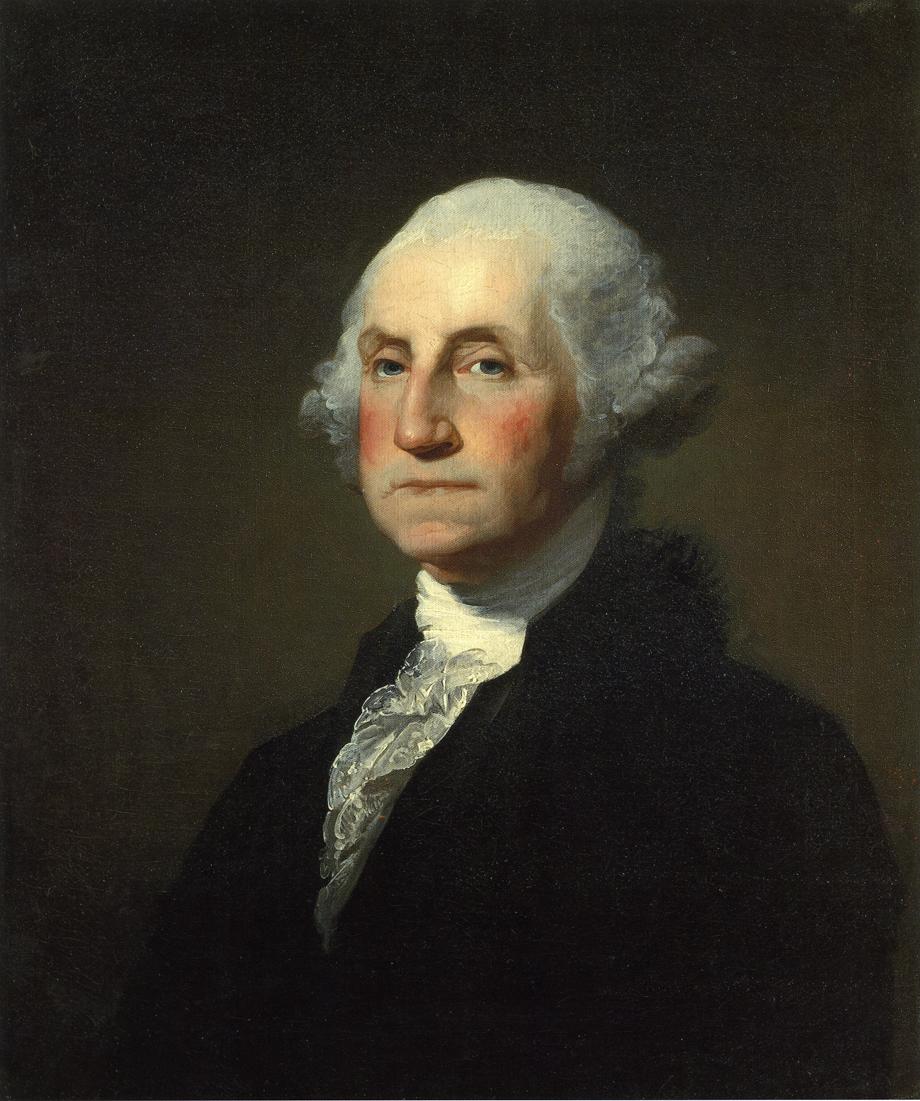
Gilbert_Stuart_Williamstown_Portrait_of_George_Washington

It is conveniently forgotten why Washington established this example, stating on that occasion,

“[I]t appears to me proper, especially as it may conduce to a more distinct expression of the public voice, that I should now apprise you of the resolution I have formed, to decline being considered among the number of those out of whom a choice is to be made…Satisfied that if any circumstances have given peculiar value to my services, they were temporary.”

For Washington, it was gratifying to him that “choice and prudence” invited him to lay down the Presidency. Though patriotic obligation did not forbid it, his wish to retire, wisdom and the people’s ability to choose did preclude it. These words, Coolidge later realized, were not unlike his own that August day in 1927. What one can do is not equivalent to what one should do. What is right for the country demands a subordination of self, these two men understood.

ImageThe power of the people to decide who leads is taken from them, whether a law exists or not, by the presumption that one man can be safely entrusted with additional power for an indeterminate time. “Emergencies” can be contrived and prolonged but experience confirms the soundness of Washington’s example. Even, as Coolidge pointed out, Presidential second terms have only served to confirm Washington’s sagacity. It is echoed in the self-denial of Coolidge, who surrendered the most powerful position in the world not because the law demanded it be done, though that would be reason enough for him. He surrendered its power because he approved of what Washington did, respected the credibility of the Office and subjected himself to the electoral judgment of the people. Free of a sitting President’s influence, however “in demand” he was, people could decide for themselves. They did so and vindicated the checks, even the “unwritten” ones, we impose on our leaders. He walked away gladly, relieved that America still regarded one of the most popular Presidents in history — himself — to be secondary to their commitment to limited government. As Clemens and Daggett ask, “Who can say that he did not choose wisely?”

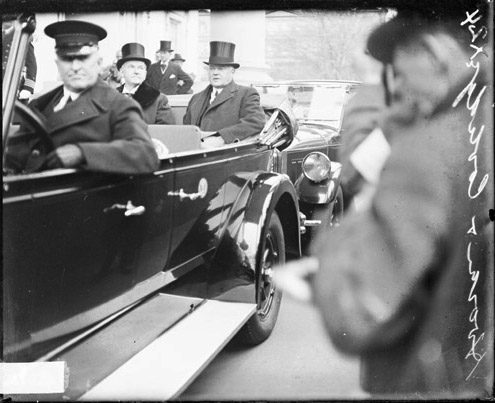
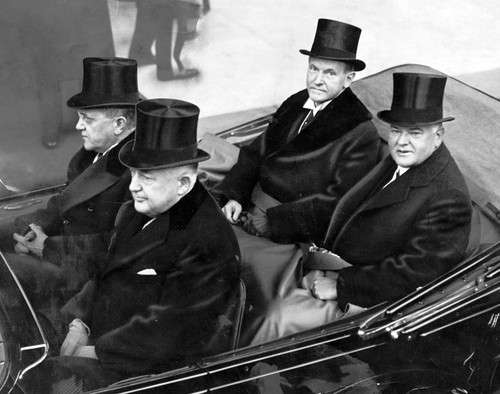
Outgoing President Coolidge looking past the White House to retirement, March 4, 1929

Outgoing President Coolidge, looking past the White House, to retirement, March 4, 1929