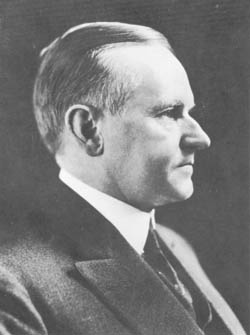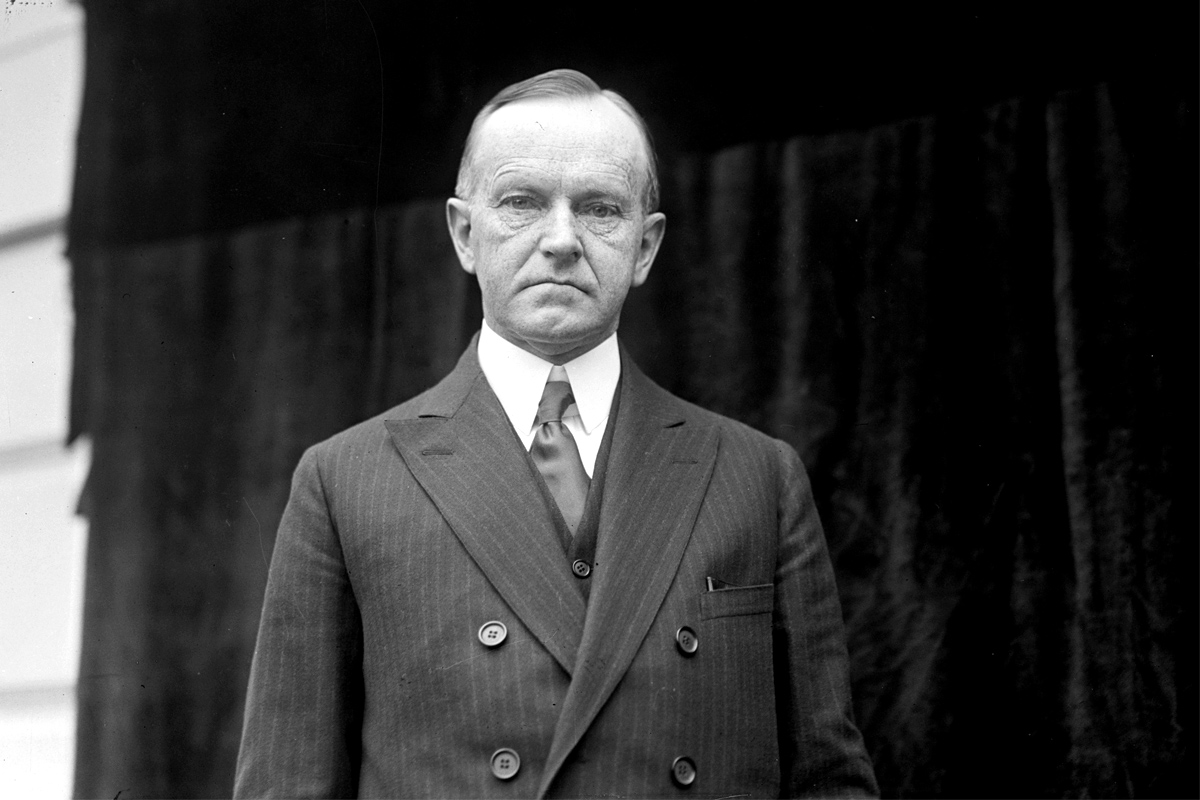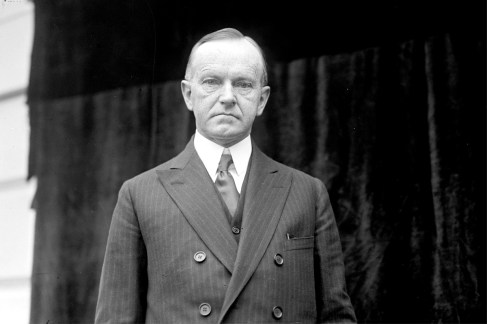
“Every government always has enemies. Our government at this moment is no exception. We have more just now than is usual, and if they are in the pay of the revolutionary authorities of Russia, as I believe to be the case, the danger is somewhat greater than in normal times simply because these enemies to-day are better financed than usual. Even so, I do not regard the menace as genuinely serious…It is right to punish overt acts, but the only way to deal with beliefs is to meet them, to expose their fallacy, to present the facts which prove them wrong. This is the American way” — Governor Calvin Coolidge, 1919.
This is why as a State Senator he would confront with law lines of propaganda that endorsed racial and class preferences. This is why as a Governor he spoke up for Americans’ rights to a law-abiding and due process government. This is why as President he pardoned Wilson’s political prisoners, opposed wiretapping and entrapment procedures and refused all attempts to “play favorites” or target enemies with the enforcement of the law. He knew such measures were an abhorrent dereliction of his duty, an abuse of his office and a perversion of justice.
The current regime in Washington, failing to respect law itself, is not merely suffering from an eroded “trust factor,” as former DOD Secretary Rumsfeld said this week, it has more than proven unworthy of the trust it has left, let alone an ounce of good faith in its honest intentions going into the future. The sanctity of the law, justly applied, demands it. The current regime, living in defiance of America’s respect for law (as it impartially binds all alike), are ideological enemies of that ideal and fail to realize that the law cuts both ways. They will not succeed in flouting that law forever.
capitalism
Frost on Coolidge
While some may think there was little to connect a Grover Cleveland Democrat with a life-long Republican, it would come as a surprise that Coolidge’s life was filled with such connections. He was not a man given to airs or sense of superiority, personally or politically. He would consider Democrats among his closest friends, even allies. He would count numerous Irish immigrants among his supporters. The Democrat presidential candidate of 1928, Al Smith, was a good friend. He married into a Democrat family. These relationships were not due to some lack of commitment to principle, for Coolidge’s consistency and conviction were widely known. It was due to a set of convictions that transcended political posturing. It was an agreement with what America was all about, whether you were Republican or Democrat. It was a respect for people stemming from a mutual reverence for America’s ideals. Character and perspective on both sides made it possible to have principled disagreement but still work toward common aims as Americans. Without integrity, civility has no pillars on which to stand. When the ideals of America are no longer shared and character is demonized, it is no wonder that both a sense of proportion and civility are missing as well.
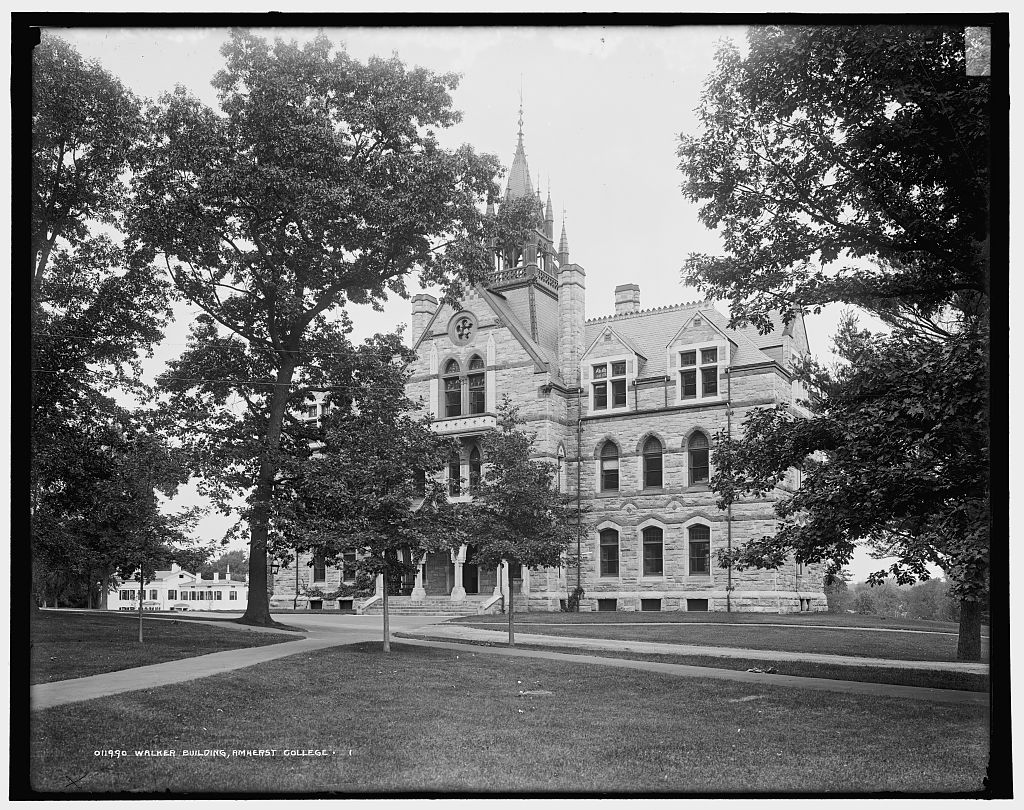
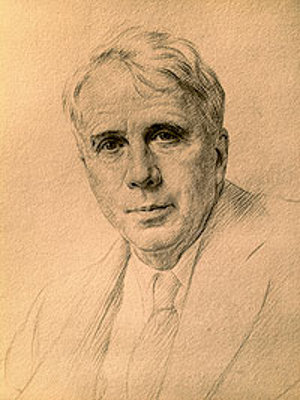
One of the most predictable acquaintances Coolidge encountered, however, was Robert Frost. As Joseph A. Conforti in his book, Imagining New England, examines the identity and mindset of the commonly caricatured “Yankee,” he features both the President and the poet. While, as Coolidge biographer Fuess observed, Coolidge was unique for combining so many — if not all — of the qualities of a “Yankee” in a single person, Frost could not be more different in upbringing and politics. But what did Frost think of Coolidge? There is often an assumed affinity of the two but, again, Frost was a Cleveland Democrat while Coolidge held loyally to the Republican Party all of his life. Frost, widely regarded as a New England rustic, was born and raised in the city, San Francisco to be exact. Coolidge, as we know, came from the rugged hills of Vermont and hailed from rural western Massachusetts, not the sophisticated social circles of Boston. Frost was largely ambivalent when it came to politics; Coolidge joked that his hobby was “running for office.” Frost would never finish college while Coolidge would not only graduate but give the witty “Grove Oration,” for his class. It was Amherst that would enable these lives to cross paths. Frost would come to the College on and off from 1916 through 1938 to teach English. Meanwhile, Coolidge rose in state and national affairs, serving as a trustee of his alma mater through his retirement from public life. They certainly knew each other and among the several interesting observations made by Conforti is this, quoting from Lawrance R. Thompson’s Frost: The Years of Triumph, 1915-1938,
“Frost admired Coolidge; he identified with his political and cultural conservatism, praised his ‘overthemountain nature,’ and respected his kindred descent from ‘a modest, frugal, and unpretentious line of Puritan farmers’…Frost’s political detachment and poetic rejection of social criticism provoked literary enemies who saw him as a product of the same stingy soil that gave birth to Coolidge.” Frost would be defended “against such critics” and his apologists would share the “Coolidge-like Yankee moral vision that emerges from much of his verse.” As Robert Coffin, of Yankee magazine fame, would write, “Frost likes his people in individual, not mass formation. He isn’t blaming their troubles on the capitalists or the environment, but on the way life is built and the way they are built…” Such an outlook would have found Coolidge in agreement.
As Coolidge would preside over the lively and energetic Twenties, Frost would become, in Conforti’s words, a “New England version of Will Rogers” personifying the folk wisdom and authenticity of American character. One reporter summarized the traveling poet this way, Frost’s temperament “was one of inexpressible gentleness, with humor and strength and whimsical sincerity.” It seems Coolidge and Frost were more alike than is apparent at first glance. But then this is America at work, bringing two very different individuals together around transcendent ideals, common principles of character and, tempered by realism, an abiding faith in her purpose.
On Legislative Power
Coolidge knew how to exercise the energy of executive power in calculated doses for maximum effect. Despite the stereotypical impression that he slept through the White House years, a false impression attributed to a later Chief Executive by the name of Ronald Reagan, he understood the use of authority better than most, especially of the executive variety. The independence of Congress, a co-equal in the division of power, was no less imperative to Coolidge.
As a freshman state legislator, Coolidge was not exactly a greenhorn to politics. He had already served as a town councilman, bank legal counsel, city solicitor, clerk of courts and chairman for the Northampton Republican Committee, all by age 34. He had crafted municipal policy before, represented the interests of others both in his practice and in his duties as legal council and city solicitor, learning the law well. Always an active listener and continual thinker, he said little because he truly believed, “He who gives license to his tongue only discloses the content of his own mind. By the excess of words he proclaims his lack of discipline.” Even as he would come to build a record that included direct election of Senators, minimum wage laws, women’s suffrage, transportation regulation, restriction of child labor and other matters, he was not simply running with the “legislative herd” in order to keep pace with a clamor to legislate. While some were running headlong into heavy regulation of rails and Morgan steel, Coolidge refrained. He was not suckered into the movement, quite popular at the time, of breaking up “big business” simply because it was “too big.” He represented the folks back home, to be sure, but was doing so with an informed and conscientious judgment of matters. Even then the full price of what was done would not be understood for years. He knew destroying the mobility of capital and people’s ability to adapt to market conditions, even when it meant unpopular rate increases, hurts not helps everyone, especially the poorest. Legislatures were poor stand-ins for people free to make their own decisions in the marketplace. They may act with good intentions but would leave a trail of havoc that could have been avoided.
Coolidge would later summarize the impact of this period,
The power of legislation has been to a large extent recast, for the old order looked on these increased activities with much concern. This has proceeded on the theory that it would be for the public benefit to have government to a greater degree the direct action of the people. The outcome of this doctrine has been the adoption of the direct primary, the direct election of the United States senators, the curtailment of the power of the speaker of the House, and a constant agitation for breaking down the authority of decisions of the courts. This is not the government which was put into form by Washington and Hamilton, and popularized by Jefferson. Some of the stabilizing safeguards which they had provided have been weakened. The representative element has been diminished and the democratic element has been increased; but it is still constitutional government; it still requires time, due deliberation, and the consent of the States to change or modify the fundamental law of the nation.
It is that slow, deliberate consideration that keeps legislative power independent and people’s liberty preserved. When the Congress abandons that exercise of deliberation and attempt to speed the process without full consideration of the bill, the independence of legislative power is lost. The distinct functions of government are tipped in favor of only one aspect: an energetic executive. Without legislative deliberation, Congress surrenders its central check upon executive abuses. It places decisions that deserve time and thought into the “fast track,” disregarding what harm may come. Coolidge recognized the peril of this transformation to sound lawmaking and people’s freedoms. He differentiated productive collaboration — Congress passing and the President enforcing measures only after thorough consideration –from legislative subservience to executive power.
Speaking in Northampton on Memorial Day, May 30, 1923, Vice President Coolidge articulated the essential distinction this way,
The chief repository of power is in the legislature, chosen directly by the people at frequent elections. Is it this body, which is particularly responsive to the public will, and yet, as in the Congress, is representative of the whole nation. It does not perform an executive function. It is not, therefore, charged with the necessity of expedition. It is a legislative body, and is, therefore, charged with the necessity for deliberation. Sometimes this privilege may be abused, for this great power has been given as the main safeguard of liberty, and wherever power is bestowed it may be used unwisely. But whenever a legislative body ceases to deliberate, then it ceases to act without due consideration. That fact in itself is conclusive that it has ceased to be independent, has become subservient to a single directing influence or a small group, either without or within itself, and is no longer representative of the people. Such a condition would not be a rule of the people, but a rule of some unconstitutional power…An independent legislature never deprived the people of their liberty.
In the haste to “pass the bill to see what is in it” and “prevent deadlock,” the point of properly applied legislative power is being missed on a grand scale. In such an environment, no one can be assured of their freedoms. As Coolidge would say, “A good measure can stand discussion. A bad bill ought to be delayed…Open debate is the only shield against the irretrievable action of a rash majority.”