Jamie K. Wilson has written a profound piece at PJ Media that strikes a resonance with many of Calvin Coolidge’s observations on civilization, including this one from 1921:
Civilization is always on trial, testing out, not the power of material resources, but whether there be, in the heart of the people, that virtue and character which come from charity sufficient to maintain progress. When that charity fails, civilization, though it ‘speak with the tongues of men and of angels,’ is ‘become as sounding brass or a tinkling cymbal.’ Its glory has departed. Its spirit has gone out. Its life is done.
And then, there is this one from 1922:
It is conceived that there can be a horizontal elevation of the standards of the nation, immediate and perceptible, by the simple device of new laws. This has never been the case in human experience. Progress is slow and the result of a long and arduous process of self-discipline. It is not conferred upon the people, it comes from the people. In a republic the law reflects rather than makes the standard of conduct and the state of public opinion. Real reform does not begin with a law, it ends with a law. The attempt to dragoon the body when the need is to convince the soul will end only in revolt.
Perhaps in our current existential dilemma over what anchors we should not have collectively cut and what moorings we can, if at all possible, salvage, we can rediscover that Cal was right all along:
Men do not make laws. They do but discover them. Laws must be justified by something more than the will of the majority. They must rest on the eternal foundation of righteousness.
Perhaps the etiquette we have jettisoned demands a renewed public commitment if we are to survive. If we do not, the American experiment may just deserve the dustbin of history.
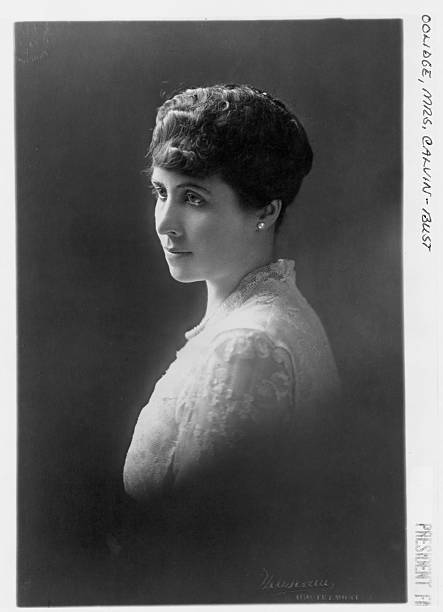
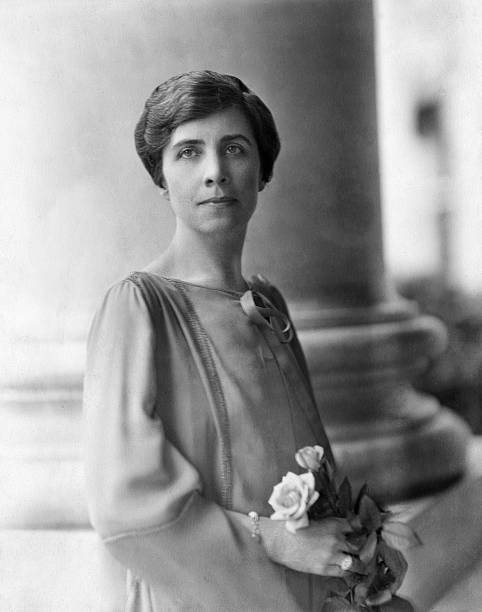
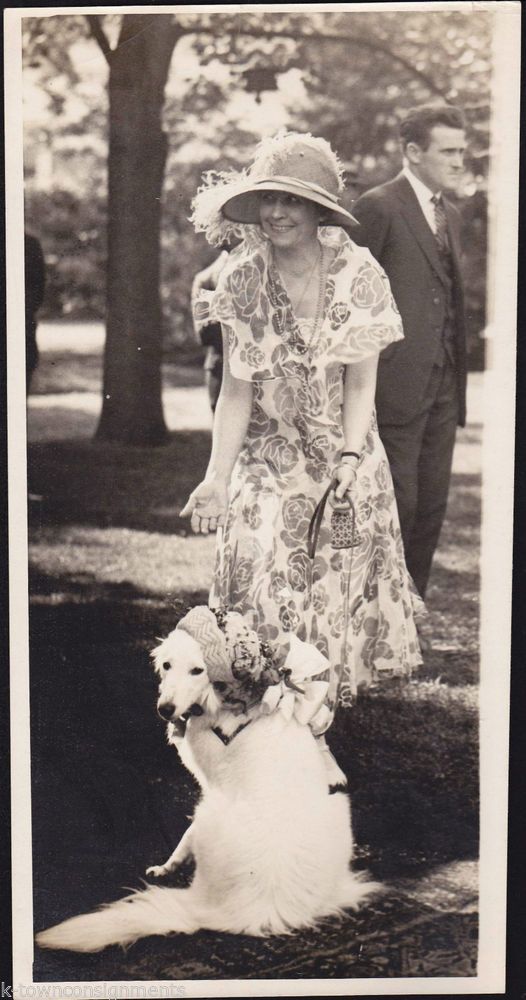
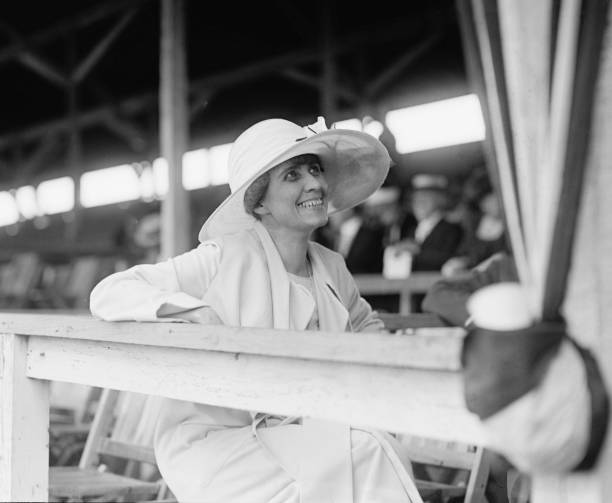
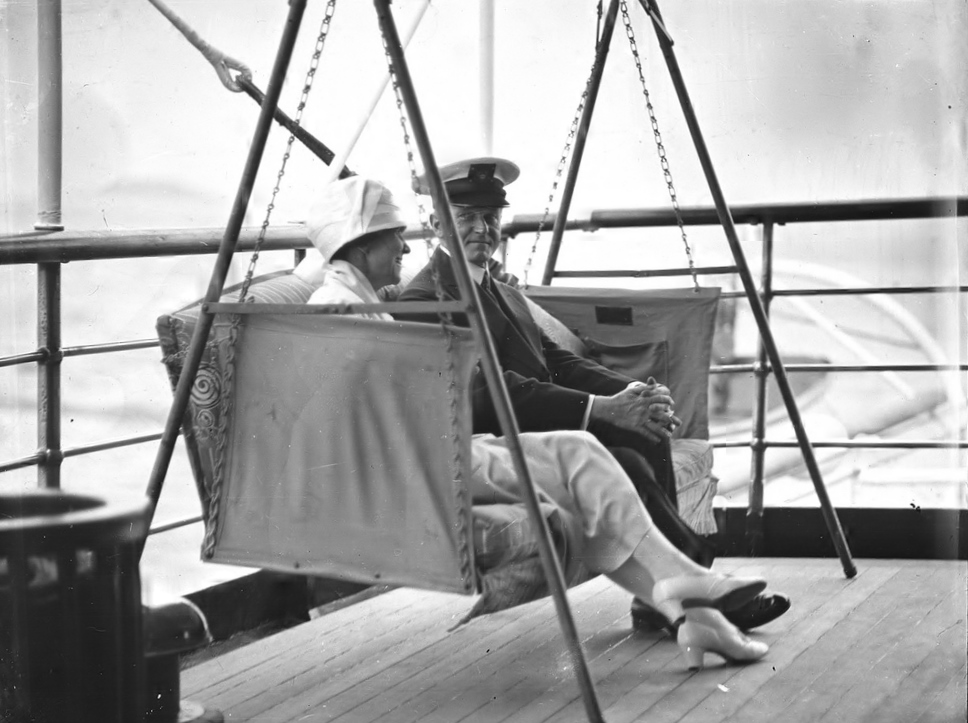
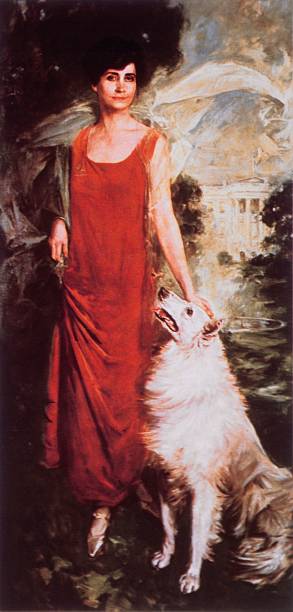
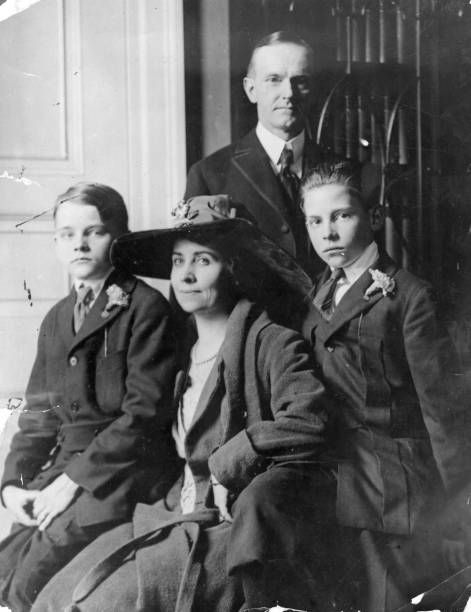
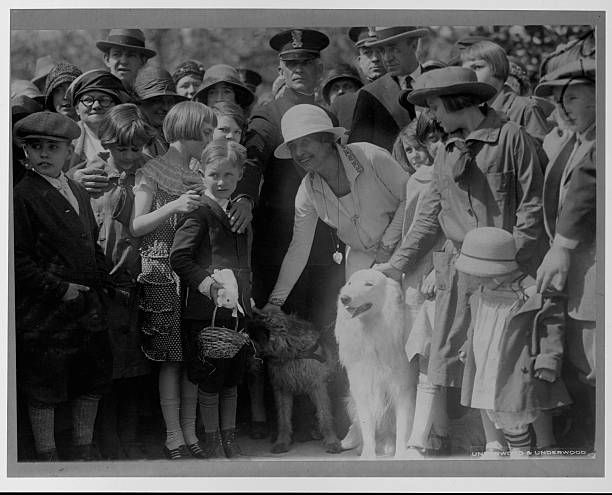
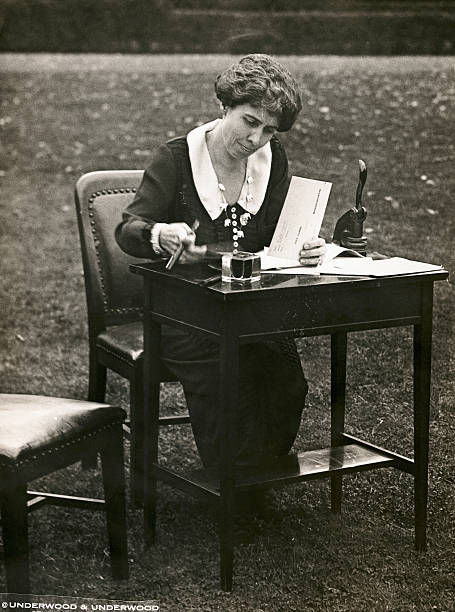
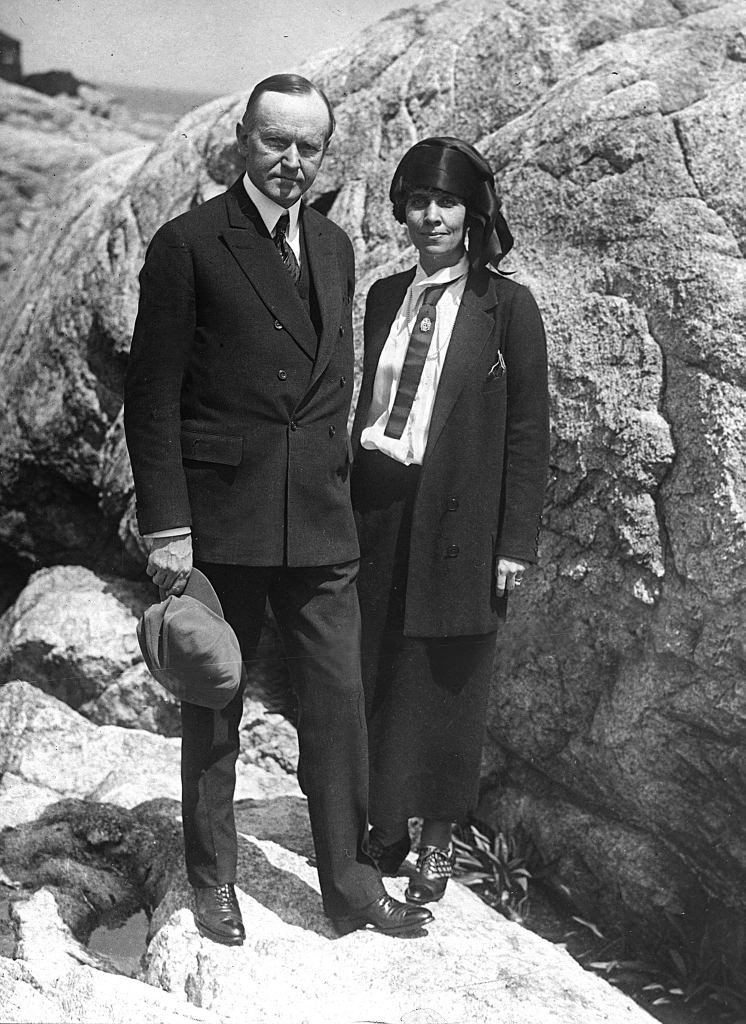
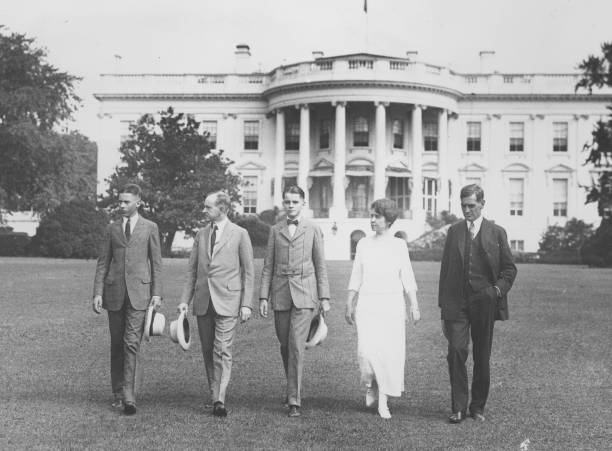
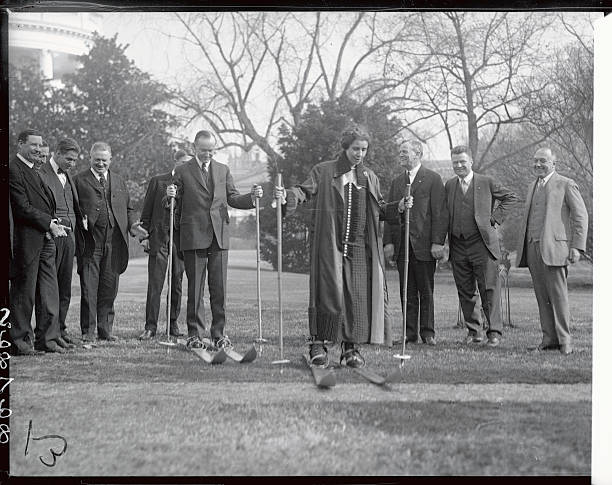
Here are twenty of our favorite Grace Coolidge moments. Which ones are your favorites? Happy Birthday, dear lady!
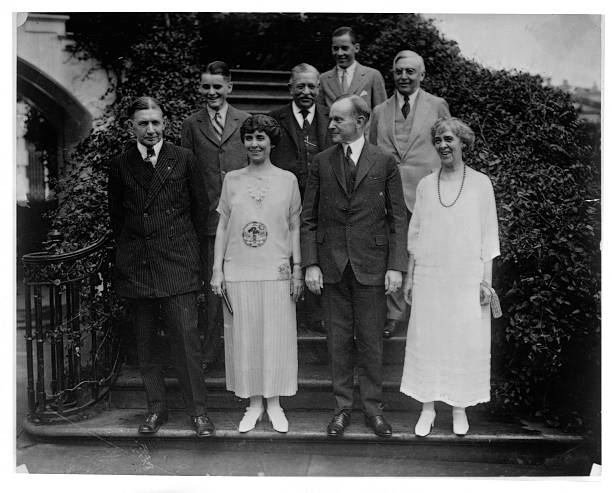
First Lady Grace Goodhue Coolidge (Photo by Library of Congress/Corbis/VCG via Getty Images)(Eingeschränkte Rechte für bestimmte redaktionelle Kunden in Deutschland. Limited rights for specific editorial clients in Germany.) *1879-1957+The portrait of the wife of the 30th President of the United States, Calvin Coolidge Vintage property of ullstein bild (Photo by Nickolas Muray/ullstein bild via Getty Images)Grace and Rebecca on the White House grounds. Photo by: Library of Congress.Grace on the Homestead porch at Plymouth Notch. Photo by: Library of Congress.President Calvin Coolidge, wearing a black armband, and First Lady Grace Goodhue Coolidge. (Photo by Library of Congress/Corbis/VCG via Getty Images)Mrs. Coolidge at one of the famous garden parties with Prudence Prim dressed for the occasion. First Lady Grace Coolidge at Horse Show, Washington DC, USA, National Photo Company, May 1925. (Photo by: Universal History Archive/Universal Images Group via Getty Images)The Coolidges aboard the Mayflower. Grace Coolidge, First Lady and Wife of U.S. President Calvin Coolidge, Official White House Portrait With Her Dog, Rob Roy, by Howard Chandler Christy, 1924. (Photo by: Universal History Archive/Universal Images Group via Getty Images)The Coolidge on the porch at Northampton. Photo by: Library of Congress.circa 1920: Calvin Coolidge (1872 – 1933), the 30th President of the United States of America (1923 – 1929). When Governor of Massachusetts in 1919 he crushed the Boston police strike. Vice President to Warren Harding he succeeded him on his death (2nd August 1923). In 1924, he won the election and America enjoyed a period of economic growth. Seen here with his wife, Grace (1879 – 1957) and his sons John and Calvin Jnr (1908-24) when Governor of Massachusetts. (Photo by New York Times Co./Getty Images)Portrait by Frank O. Salisbury, 1928.First Lady Grace Coolidge and two of her dogs with children gathered on the White House grounds for Easter egg rolling. Washington, D.C. (Photo by H.E. French/Library of Congress/Corbis/VCG via Getty Images)Mrs. Coolidge, an avid enthusiast of the handheld camera, was inducted as an honorary member of the White House Photographers Association.(Original Caption) Mrs. Coolidge, the “First Lady,” sets an example for the millions of women voters of the country, and casts her vote today, to be sent by mail to Massachusetts along with that of her distinguished husband. Note that the “First Lady” intends that her ballot be secret as she carefully shields her vote from view. (Photo by George Rinhart/Corbis via Getty Images)The Coolidges at Mount Rushmore, South Dakota, summer of 1927. John Coolidge (1906-2000), former United States President Calvin Coolidge (1872-1933), Calvin Coolidge, Jr. (1908-1924), former First Lady Grace Coolidge (1879-1957) and George Christian looking over the White House lawns, Washington, D.C., USA, circa 1930. (Photo by FPG/Getty Images)(Original Caption) President and Mrs. Coolidge try out skis presented to them by the National Ski Association.The Coolidge family and the Dawes family (Charles Dawes was Coolidge’s Vice President) on the steps at the White House. (Photo by H.E. French/Library of Congress/Corbis/VCG via Getty Images)Portrait of Mrs. Coolidge by Philip de Laszlo, 1926.
The poppies evocative of Flanders Field inspiring Lieutenant Colonel McCrae’s poem. Photo credit: World War I Centennial Commission.
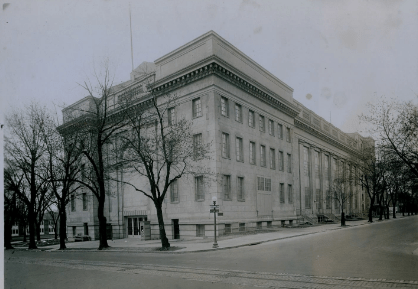
Looking back on the tenth anniversary of the Armistice that ended the Great War on the eleventh hour of the eleventh day in 1918, the occasion that marks this day one hundred seven years later, President Calvin Coolidge, at the Washington Auditorium (now no longer extant) in the nation’s capital, observed:
The Washington Auditorium back in 1926, on 19th street in D. C. Photo credit: Library of Congress.
“While we are placing our faith in more complete understanding which shall harmonize with the universal conscience, we ought not to forget that all the rights we now possess, the peace we now enjoy, have been secured for us by a long series of sacrifices and of conflicts. We are able to participate in this celebration because our country had the resources, the character, and the spirit to raise, equip, and support with adequate supplies an Army and a Navy, which, by placing more than 2,000,000 men on the battle fields of Europe contributed to the making of the armistice on the 11th day of November, 1918. Our first thought, then, is to acknowledge the obligation which the Nation owes to those who served in our forces afloat and ashore, which contributed the indispensable factor to the final victory. Although all our people became engaged in this great conflict, some in furnishing money, some in producing food and clothing, some in making munitions, some in administering our Government, the place of honor will always be accorded to the men and the women who wore the uniform of our country – the living and the dead…
“Every dictate of humanity constantly cries aloud that we do not want any more war. We ought to take every precaution and make every honorable sacrifice, however great, to prevent it. Still, the first law of progress requires the world to face facts, and it is equally plain that reason and conscience are as yet by no means supreme in human affairs. The inherited instinct of selfishness is very far from being eliminated; the forces of evil are exceedingly powerful. The eternal questions before the nations are how to prevent war and how to defend themselves if it comes. There are those who see no answer, except military preparation. But this remedy has never proved sufficient. We do not know of any nation which has ever been able to provide arms enough so as always to be at peace. Fifteen years ago, the most thoroughly equipped people of Europe were Germany and France. We saw what happened. While Rome maintained a general peace for many generations, it was not without a running conflict on the borders which finally engulfed the empire. But there is a wide distinction between absolute prevention and frequent recurrence, and peace is of little value if it is constantly accompanied by the threatened or the actual violation of national rights.
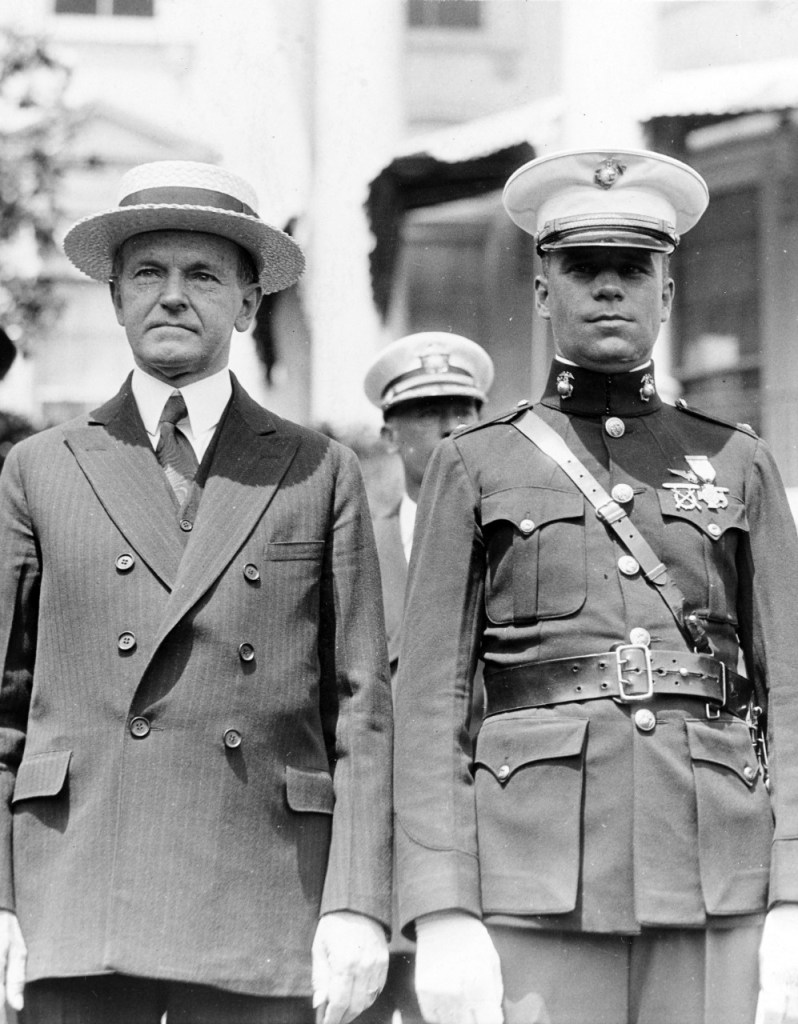
President Coolidge presenting the Medal of Honor to First Lieutenant Christian Schilt, on the White House grounds, c.1928. Photo credit: Library of Congress.
“If the European countries had neglected their defenses, it is probable that war would have come much sooner. All human experience seems to demonstrate that a country which makes reasonable preparation for defense is less likely to be subject to a hostile attack and less likely to suffer a violation of its rights which might lead to war. This is the prevailing attitude of the United States and one which I believe should constantly determine its actions. To be ready for defense is not to be guilty of aggression. We can have military preparation without assuming a military spirit. It is our duty to ourselves and to the cause of civilization, to the preservation of domestic tranquility, to our orderly and lawful relations with foreign people, to maintain an adequate Army and Navy…
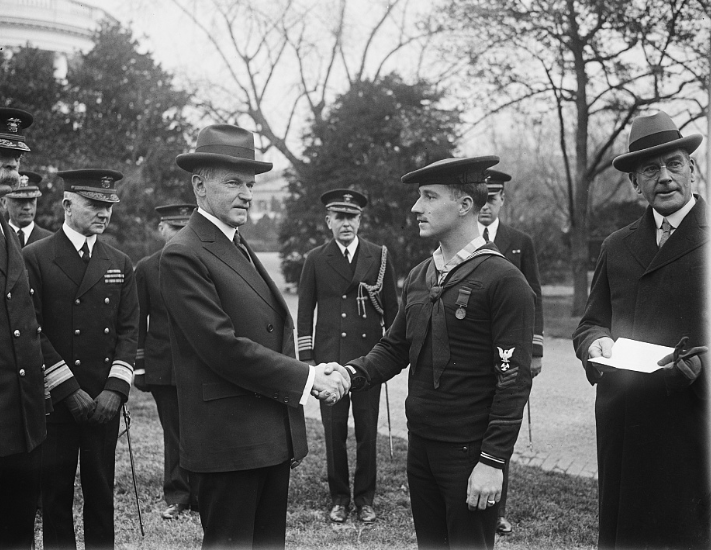
President Coolidge recognizing William R. Huber, Machinist Mate, First Class, U. S. Navy, with a Medal of Honor for his heroic actions aboard the U.S.S. Bruce. Photo credit: Library of Congress.
“So long as promises can be broken and treaties can be violated we can have no positive assurances, yet everyone knows they are additional safeguards. We can only say that this is the best that mortal man can do. It is beside the mark to argue that we should not put faith in it. The whole scheme of human society, the whole progress of civilization, requires that we should have faith in men and in nations. There is no other positive power on which we could rely. All the values that have ever been created, all the progress that has ever been made, declared that our faith is justified…
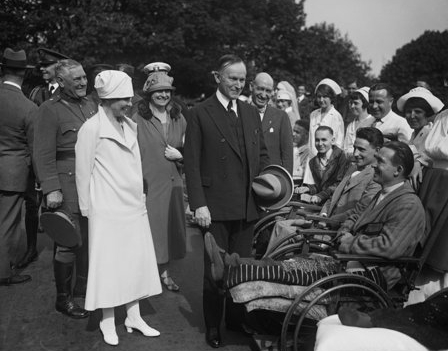
The Coolidges visiting with veterans injured in combat during the Great War.
“We want peace not only for the same reason that every other nation wants it, because we believe it to be right, but because war would interfere with our progress. Our interests all over the earth are such that a conflict anywhere would be enormously to our disadvantage. If we had not been in the World War, in spite of some profit we made in exports, whichever side had won, in the end our losses would have been great. We are against aggression and imperialism not only because we believe in local self-government, but because we do not want more territory inhabited by foreign people. Our exclusion of immigration should make that plain. Our outlying possessions, with the exception of the Panama Canal Zone, are not a help to us, but a hindrance. We hold them, not as a profit, but as a duty. We want limitation of armaments for the welfare of humanity. We are not merely seeking our own advantage in this, as we do not need it, or attempting to avoid expense, as we can bear it better than anyone else. If we could secure a more complete reciprocity in good will, the final liquidation of the balance of our foreign debts, and such further limitation of armaments as would be commensurate with the treaty renouncing war, our confidence in the effectiveness of any additional efforts on our part to assist in further progress of Europe would be greatly increased.
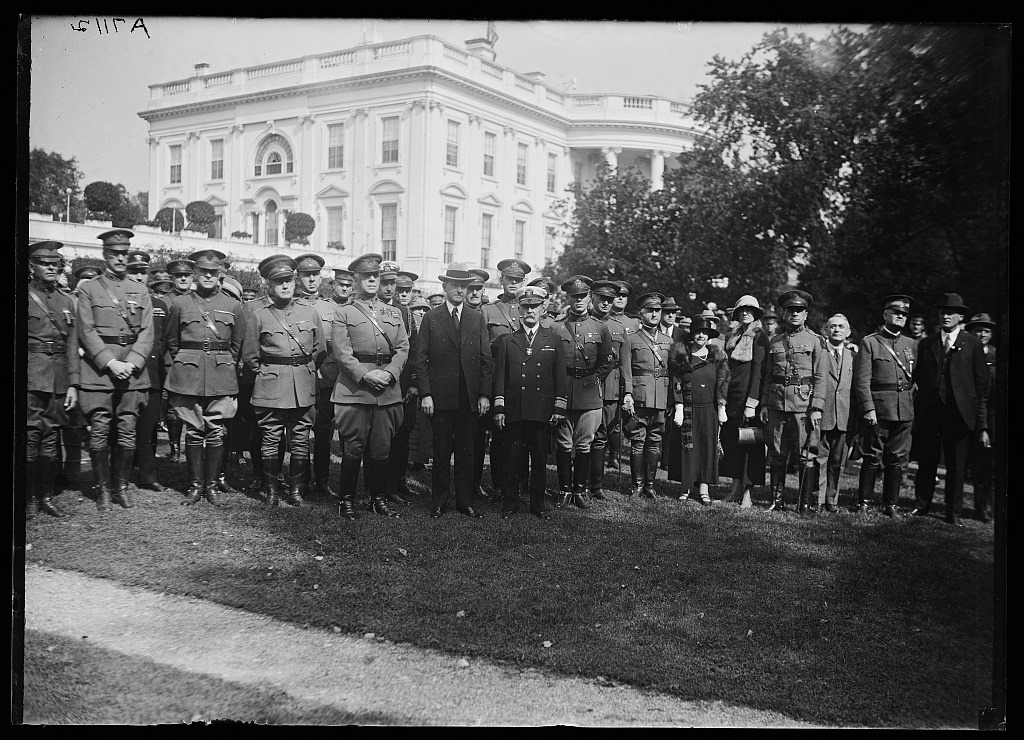
President Coolidge receiving Army and Navy personnel from the Great War on the South Grounds of the White House. Photo credit: Library of Congress.
“As we contemplate the past 10 years, there is every reason to be encouraged. It has been a period in which human freedom has been greatly extended, in which the right of self-government has come to be more widely recognized. Strong foundations have been laid for the support of these principles. We should by no means be discouraged because practice lags behind principle. We make progress slowly and over a course which can tolerate no open spaces. It is a long distance from a world that walks by force to a world that walks by faith. The United States has been so placed that it could advance with little interruption along the road of freedom and faith. It is befitting that we should pursue our course without exultation, with due humility, and with due gratitude for the important contributions of the more ancient nations which have helped to make possible our present progress and our future hope. The gravest responsibilities that can come to a people in this world have come to us. We must not fail to meet them in accordance with the requirements of conscience and righteousness.“
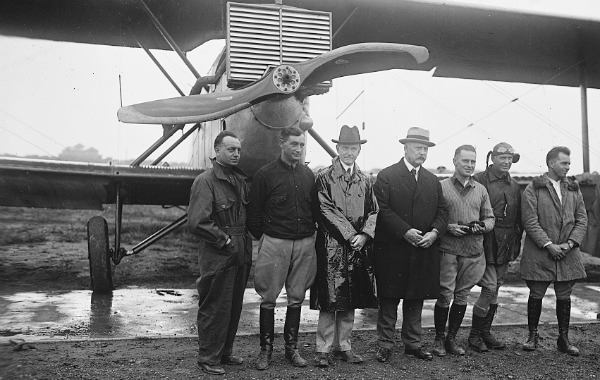
President Coolidge in 1924 beside some of the aviators who gained their first combat experience in the air during the late War. Photo credit: Library of Congress.
A grateful people recognizes, as Cal also once said, that “no person was ever honored for what he received. Honor has been the reward for what he gave.” Thank you to all who serve and have rendered past service in uniform.









 The Importance of the Obvious