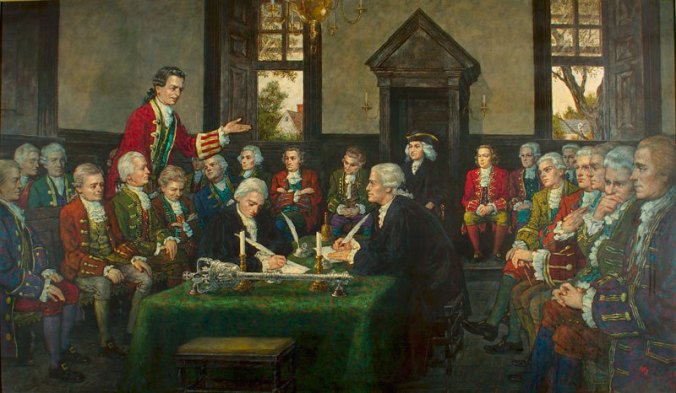
Before securing full independence between all the American colonies through the adoption of the Lee Resolution on July 2, two hundred and forty-two years ago, the states were anything but idle. It was in the villages, towns, and capitals of the states where the foundations and forms of independence would first be studied and then enacted. It was Richard Henry Lee’s (the namesake of the resolution proposed to Congress less than one month later) state of Virginia which mapped the course taken up by Congress by adopting for the state what would become the Lee Resolution on May 15, 1776. While not the first to declare independence (this honor belongs to North Carolina in the Halifax Resolves of April that year) it provided the necessary direction and backing for Congress to formally declare for all the States the condition we celebrate this week. By this time, of course, the colonies had been at war for just over a year’s time. It was on this day, July 3 in 1775, that Washington had taken command of the Continental army. Now, Congress was acting with the ground readied and resolve marshaled by the states to declare independence from Great Britain.
Had the states, like Virginia and North Carolina, not taken those preliminary steps into the dark unknown, it is difficult to see how the Congress could have acted, however willing certain delegations may have been. It was before those gathered to mark the 150th anniversary of Virginia’s Resolutions of Independence at Williamsburg on May 15, 1926, President Calvin Coolidge (himself the only occupant of the White House to share his birth with that of American independence) said this:
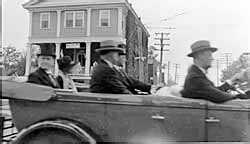
President & Mrs. Coolidge arriving in Williamsburg in 1926 to commemorate the 150th anniversary of the Virginia Resolutions adopted May 15, 1776.
“It has not been the experience of history that political ideals spring into full development all at once. They are the process of the discipline of a long and severe training and constant and continued study.” To cast this arduous process aside casually for failing to avert the problems we now face is not only foolish but a shameful escape of what we ourselves can do to remedy, build up, and serve to make the situation better. It has always been easier to complain than to create and edify. It is not the fault of past generations that we shirk what duties fall to us today. That guilt is our own. We should be seeking how to live worthy of them, the men and women who forged independence despite the danger and darkness poised to swallow everything.
President Coolidge was not done, though, but went on, saying “The principle that those who think alike ought to be able to act alike wherever they happen to live should be supplemented by another rule for the continuation of the contentment and tranquility of our Republic. The general acceptance of our institutions proceeds on the theory that they have been adopted by the action of a majority. It is obvious that if those who hold to the same ideals of government fail to agree the chances very strongly favor a rule by a minority.”
Of course, he meant political minorities of any number or kind. Would it be that bad? He replies, “…[T]here is another element of recent development. Direct primaries and direct elections bring to bear upon the political fortunes of public officials the greatly disproportionate influence of organized minorities. Artificial propaganda, paid agitators, selfish interests, all impinge upon members of legislative bodies to force them to represent special elements rather than the great body of their constituency. When they are successful minority rule is established, and the result is an extravagance on the part of the Government which is ruinous to the people and a multiplicity of regulations and restrictions for the conduct of all kinds of necessary business, which becomes little less than oppressive. Not only is this one country, but we must keep all its different parts in harmony by refusing to adopt legislation which is not for the general welfare.”
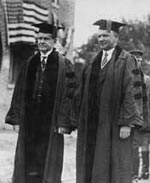
President Coolidge (left) Courtesy of William & Mary College, https://www.wm.edu/about/history/chronology/1926to1950/index.php.
The President, like Virginia adopting its resolutions, did not stop with that ever-timely warning. “They went on to provide that ‘the regulation of the internal concerns of each colony be left to respective colonial legislatures.’ This was a plain declaration of the unassailable fact that the States are the sheet anchors of our institutions. If the Federal Government should go out of existence, the common run of the people would not detect the difference in the affairs of their daily life for a considerable length of time. But if the authority of the States were struck down disorder approaching chaos would be upon us within twenty-four hours.” Coolidge was no stranger to the chaos that can ensue when institutions like law enforcement walk off the job, as happened in the city of Boston during his administration as governor in 1919.
Today, the looming presence of the Federal Government is much more noticeable than it was in 1926 not because Coolidge’s observation is obsolete but because Washington has assumed so much more of the role of the states. At a practical level, when the Beltway overlooks something, our lives and schedules usually proceed apace but we know immediately and feel most keenly when local authorities prove derelict at something.
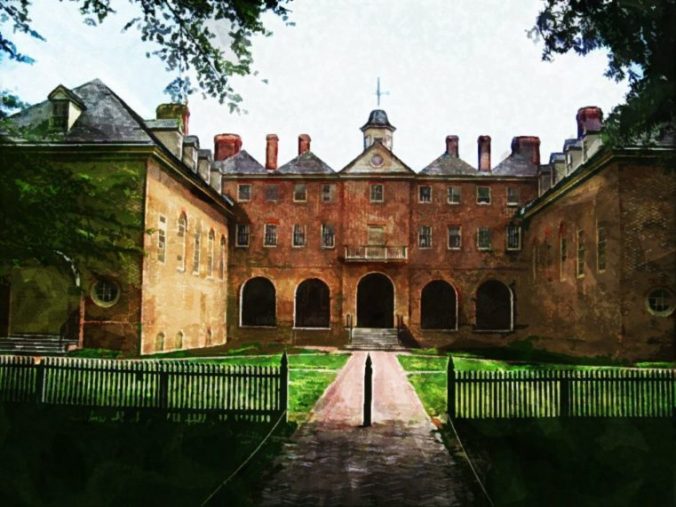
College of William & Mary, where President Coolidge spoke on May 15, 1926. Courtesy of Wikimedia.
Independence would be hollow indeed without state and local jurisdiction limiting what the national government should do. “No method of procedure has ever been devised by which liberty could be divorced from local self-government. No plan of centralization has ever been adopted which did not result in bureaucracy, tyranny, inflexibility, reaction, and decline. Of all forms of government, those administered by bureaus are about the least satisfactory to an enlightened and progressive people. Being irresponsible they become autocratic, and being autocratic they resist all development. Unless bureaucracy is constantly resisted it breaks down representative government and overwhelms democracy. It is the one element in our institutions that sets up the pretense of having authority over everybody and being responsible to nobody.”
What place do the States have then, Mr. Coolidge? Is this a carte-blanche to do whatever they want with impunity?
Coolidge answers, “The States should not be induced by coercion or by favor to surrender the management of their own affairs. The Federal Government ought to resist the tendency to be loaded up with duties which the States should perform. It does not follow that because some thing ought to be done the National Government ought to do it…The doctrine of State rights is not a privilege to continue in wrong-doing but a privilege to be free from interference in well-doing.”
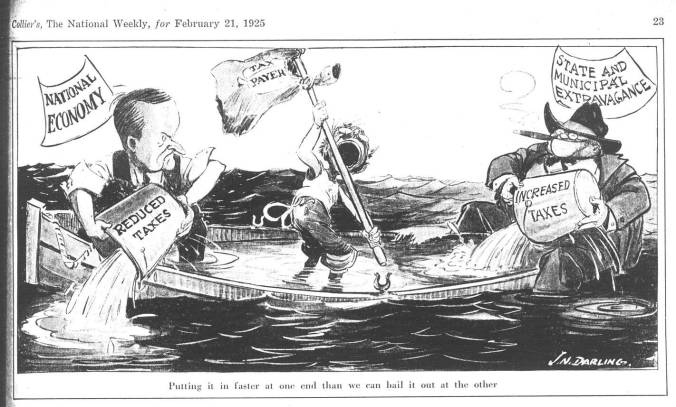
The indulgence of several states in ballooning public expenditures while the National Government under Coolidge actually tightened its belt, paid debt, and reduced taxation for lower earners was a case in point. These states, living on good days, were raiding from future lean years. If this continued, Coolidge points out, it would only undermine local self-government, destroy independence, and invariably involve Washington to the detriment of everyone.
It was beholden to the States, if they would keep the Federal Government limited and independence firm, to faithfully carry out the tasks that rightly respond to the sentiments of their citizens, the public functions delegated by their people, and justice between the same.
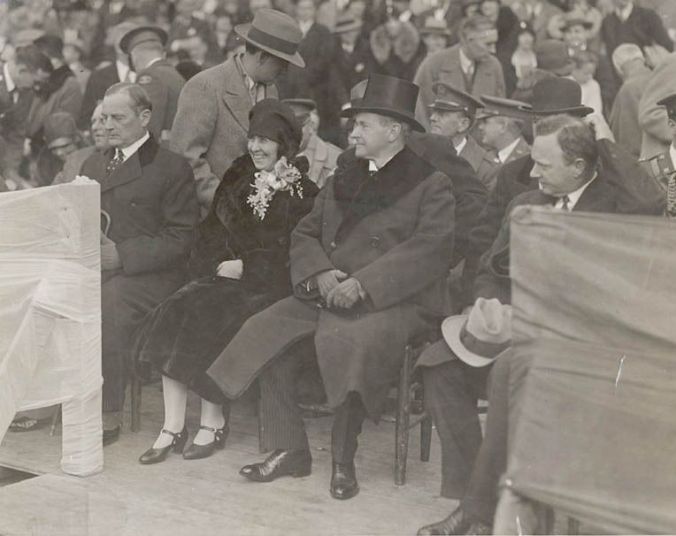
The Coolidges two years after the address at William & Mary College (in 1928), attending the NC vs. VA football game.
The President concludes, when contemplating what preserves our independence, “[w]e may wonder at their need of constant restatement, reiteration, and defense. But the fact is that the principles of government have the same need to be fortified, reinforced, and supported that characterize the principles of religion. After enumerating many of the spiritual ideals, the Scriptures enjoin us to ‘think on these things.’ If we are to maintain the ideals of government, it is likewise necessary that we ‘think on these things’…”
“…Each generation has its problems. The days if the Revolution has theirs, and we have ours…They were mostly bent on seeing what they could put into the Government; we are mostly bent on seeing what we can get out of it…They established institutions guaranteed under a reign of law where liberty and justice and the public welfare would be supreme. Amid all the contentions of the present day nothing is more important to secure the continuation of what they wrought than a constant and vigilant resistance to the domination of selfish and private interests in the affairs of government in order that liberty and justice may still be secure and the public welfare may still be supreme.”
On this anniversary of both American independence and Calvin Coolidge’s birthday, let us take what he has said here and, with renewed respect, think again on these things.
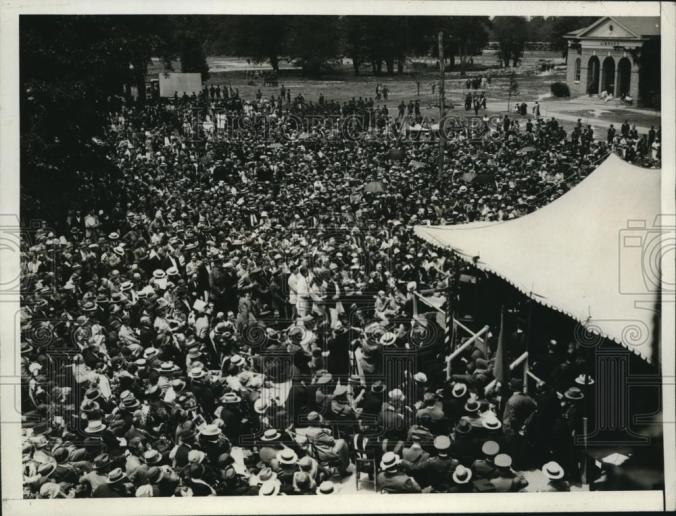
Celebrations in Williamsburg, 1926. Courtesy of Historic Images Outlet.


![Frederick S. Bale introducing Benny Boynton, captain of the Williams College team, to Vice-President-Elect Calvin Coolidge before the Amherst-Williams game, won by Amherst 14-7. [Original in Morrow Papers, Series XIV, box 1, folder 100]](https://i0.wp.com/salientcal.com/wp-content/uploads/2018/06/1895coolidge-with-football-captain-1920b1.jpg?w=200&h=161&ssl=1 "Calvin Coolidge meets Williams football captain, Nov. 20, 1920")


 The Importance of the Obvious