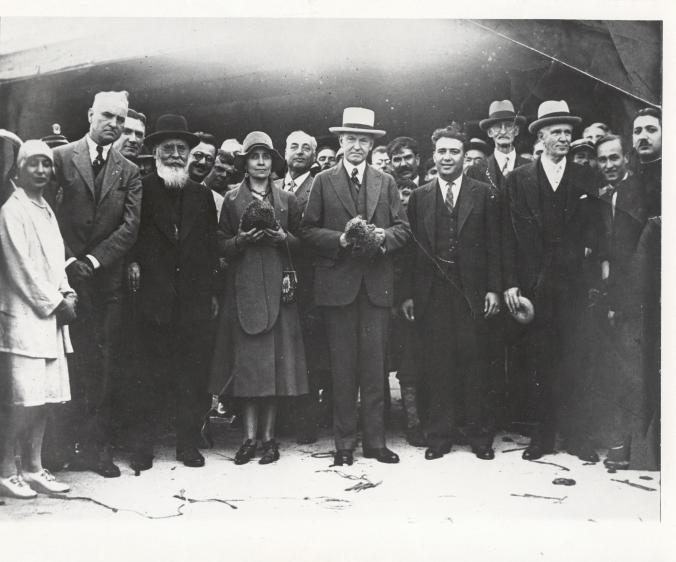
The Coolidges at Tarpon Springs, holding gifted sponges, January 10, 1930. Photo credit: Tarpon Springs Area Historical Society.
The Coolidges had been eager to travel since leaving public life in 1929. It seemed Florida furnished reasons to visit for nearly everyone. Babe Ruth and the Yankees were there for annual spring training at St. Petersburg. Ford returned to honor Edison on his 83rd birthday, commemorated at Rollins College in Winter Park. Al Smith and his family were enjoying Palm Beach. Even President Hoover and Justice Stone were fishing in the Keys.
Invited numerous times to see sunny Florida, this was their first opportunity to visit as private citizens but it came with obligation: the request to deliver a speech. Coolidge spoke on “The Economics of Life Insurance” at Vinoy Park Hotel in St. Petersburg, avoiding politics in the process.[1] He would remind his audience, both present and listening by radio:
“Our country was founded on the…theory which holds that the people are sovereign. While we know that it is vain to look for perfection in human affairs, we are convinced that the best possible government and the best possible economic system are those which the people provide for themselves. We believe that human progress will be greatest where an enlightened people make the law for their own protection and control the business for their own support. We have staked out institutions on the ability and character of the individual. We have recognized that he is endowed with ever power and he must therefore assume every responsibility. That is the essence of popular sovereignty. The people are privileged to follow their own conscience, reach their own decisions, make their own mistakes, and reap their own rewards.”
Even their daughter-in-law’s parents, Governor and Mrs. Trumbull of Connecticut, arrived to enjoy winter there around the same time.[2] Seeking to return to the people from which Presidents are drawn, the Coolidges declined countless invitations to make public appearances or otherwise exert influence on a host of issues. They were supposed to be regular Americans now. Yet, duty kept calling. Their stay in Florida, lasting just over a month (January 8 – February 12, 1930), gave them a chance to recover some of what it was like to be themselves again.
The Coolidges began their visit walking along the St. Petersburg waterfront and motoring to the beaches at Pass-a-Grille in Clement Kennedy’s car. Kennedy was then managing director at Vinoy but known to the Coolidges from hotels around Swampscott, Massachusetts. The Vermont Tourist Society, also staying at the Vinoy, presented flowers, with a gift the Coolidges accepted graciously, sending their thanks via a letter.[3] Billie De Beck, creator of “Barney Google,” and his apprentice, Joe Musial, found the former President in Vinoy’s lobby the next morning. Musial, a future contributor to “Blondie” and “Flash Gordon,” sketched Cal’s likeness.[4] The following day, the Coolidges were welcomed to Tarpon Springs the following day by the Greek community there, sailing into the Gulf aboard the C. Coolidge, renamed in his honor ahead of their arrival, to enjoy an authentic Greek lunch while divers competed for the best two sponges to award the couple.[5] Full of questions for their hosts, the Coolidges posed with their spongy prizes before returning to St. Petersburg.
Brought to Lakeside Inn in Mount Dora by manager and long-time friend, Archie Hurlburt, they spent many happy hours in the main lobby visiting with neighbors they had known from Plymouth and Northampton.[6] The Coolidges attended worship every Sunday for five weeks at Mount Dora’s Congregational Church, walking down the street together as they always had, even while in the White House.
The former President had recently helped settle the estate of Conrad Hubert, inventor of the electric flashlight. Among the approved beneficiaries was Rollins College. The Coolidges were brought to Winter Park by still more friends, the Bachellers, to accept formal thanks from the school.[7] The biggest crowds during their stay, however, came with the dedication of the Lakeside Inn’s Terrace Building two days later. Over ten thousand people from Florida and Georgia, including numerous elected officials, watched as the Coolidges led a procession inaugurating the new structure.[8] As Mrs. Coolidge picked oranges from the hotel’s yard, knitted, played piano in the lobby, attended socials, and shopped in Daytona and Orlando, Mr. Coolidge toured William Howey’s citrus operations, accepted a Lake County fishing license, attended Winter Haven’s Orange Festival, and viewed the blue waters of Silver Springs.[9] Since Mrs. Coolidge had often been asked to plant trees (helping the President plant twin palms for Bok Tower in nearby Lake Wales just the previous February)[10] and Mr. Coolidge had already been tapped for the Terrace dedication, she – not he – was requested to plant a cypress for the new Community Center, which she gladly did.[11]
Together they would help James Kilgallen (father of another legendary journalist, Dorothy Kilgallen) complete his assignment for the International News Service, all without granting a formal interview.[12] Ever adept at handling the press, the Coolidges knew how to diffuse unwanted media attention. When accosted by an enthusiastic female reporter in Daytona with, “You look a great deal like Mrs. Coolidge,” the former First Lady retorted with a smile: “Yes, I’ve been taken for Mrs. Coolidge a number of times,” leaving the reporter to retreat sheepishly before realizing her missed opportunity.[13] In quieter moments, Mrs. Coolidge wrote some of her best-known poems, including “The Quest” while Mr. Coolidge, using Lakeside stationary, wrote out their gratitude for the many kindnesses shown them during their trip.[14] He even went to the local barber shop for a trim, shoe shine, and conversation, another testament to his regard for people as people not classes or colors.[15] At the end of January, the Coolidges drove to the Godfrey home in Orlando, close relatives of Mrs. Coolidge, to enjoy a quiet dinner with Mr. and Mrs. Godfrey and their son.[16] The Coolidges motored back that evening. One can only imagine the two, alone with nature at last, navigating the unfamiliar roads back to Mount Dora as the sun set over the central hills. Reluctantly leaving Florida February 12th, they accidentally forgot Cal’s nightshirt at Lakeside.[17] Florida proved to be the most restorative phase of their adventures in post-Presidential travel. As the ninetieth anniversary of their visit approaches in 2020, perhaps we can enjoy anew the time Florida helped the kind, unpretentious Coolidges rediscover what it was like to be themselves again.


[1] “Coolidge Will Attend Insurance Meeting in Florida,” Arkansas Gazette, January 8, 1930, 4; Board, Prudy Taylor (2008). The Renaissance Vinoy: St. Petersburg’s Crown Jewel. Virginia Beach: Donning, 40-41.
[2] “Florida Crowded With Celebrities For Winter Season,” The Tampa Tribune, February 10, 1930, 2; “Summer Greets Visitors to Beautiful Southland,” Boston Herald, January 5, 1930, 30; “Hotels and Trips Between,” Boston Herald, January 19, 1930, 35.
[3] “Supper Enjoyed by Vermonters,” Tampa Bay Times, January 28, 1930, 7.
[4] “Young Artist Sees Coolidge,” St. Petersburg Times, January 10, 1930, 7.
[5] “Coolidges Sees Tarpon Springs Spongers Work,” The Tampa Tribune, January 11, 1930, 19.
[6] “Mt. Dora Pays Welcome to Coolidges Upon Arrival,” The Orlando Sentinel, January 12, 1930, 1; “Coolidge Attends Mount Dora Church; Will Attend Rollins,” The Tampa Tribune, January 13, 1930, 5; contrast with some of the myths recollected about Coolidge’s visit in later publications like David R. Edgerton’s 1993 Memories of Mount Dora From Then Until Now. Mt. Dora: Link, 92-93.
[7] “Calvin Coolidge Visits Rollins Last Monday,” The Rollins Sandspur, January 17, 1930, 1-2; “Coolidge Greeted by 2,000 on Rollins Visit,” The Orlando Sentinel, January 14, 1930, 1.
[8] “Mt. Dora Filled With Visitors As Coolidge Opens New Hotel,” The Orlando Sentinel, January 16, 1930, 1, 5.
[9] Pendleton, Judy (1998). The Lakeside Inn. Canada: Judy Pendleton, 46-49; “Mrs. Calvin Coolidge and Mrs. Trumbull are Visitors In Orlando,” The Orlando Sentinel, January 28, 1930, 7; “Coolidge Beams Pleasure Over Visit in Howey,” The Howey Tribune, February 1930, 1; “Coolidge Enters Fishing Tourney,” The Orlando Sentinel, January 29, 1930, 2; “Coolidge Sees Citrus Exhibits at Festival,” The Tampa Tribune, January 24, 1930, 4; Riley, Darrell G. (2003, October 25). “1930-1934.” Retrieved from https://www.ocala.com/news/20030101/1930—1934.
[10] “Bok Sanctuary Is Dedicated By President,” The Tampa Tribune, February 2, 1929, 7.
[11] “Mrs. Coolidge at Mt. Dora Plants Big Cypress Tree,” The Tampa Tribune, January 25, 1930, 6; “Mrs. Coolidge Plants Tree,” The Orlando Sentinel, January 25, 1930, 1.
[12] “Hoover and Coolidge Vacationing in Florida,” Detroit Times, February 10, 1930, 3.
[13] “The Coolidges Down South,” Rockford Republic, February 12, 1930, 6.
[14] “Coolidge Likes Sentinel,” The Orlando Sentinel, January 16, 1930, 1.
[15] “Mt. Dorans Like the Coolidges,” Indiana Evening Gazette, February 11, 1930, 2.
[16] “Coolidges are Dinner Guests of Orlandoans,” The Orlando Sentinel, January 31, 1930, 1, 8; “Former President and Mrs. Coolidge Are Guests of Mr. and Mrs. Frederick Godfrey,” Orlando Evening Star, January 31, 1930, 8.
[17] “Good Night! Cal’s Nightshirt Lost,” New York Daily News, February 15, 1930, 3.

 The Importance of the Obvious