“Great men are the ambassadors of Providence sent to reveal to their fellow men their unknown selves. To them is granted the power to call forth the best there is in those who come under their influence. Sometimes they have come as great captains, commanders of men, who have hewed out empires, sometimes as statesmen, ministering to the well-being of their country, sometimes as painters and poets, showing new realms of beauty, sometimes as philosophers and preachers, revealing to the race ‘the way, the truth, and the life,’ but always as inspirers of noble action, translating high ideals into the practical affairs of life. There is something about them better than anything they do or say. If measured at all, they are to be measured in the responsive action of what others do or say. They come and go, in part a mystery, in part the simplest of all experience, the compelling influence of the truth. They leave no successor. The heritage of greatness descends to the people” — Vice President Calvin Coolidge, Women’s Roosevelt Memorial Association, New York City, January 23, 1921
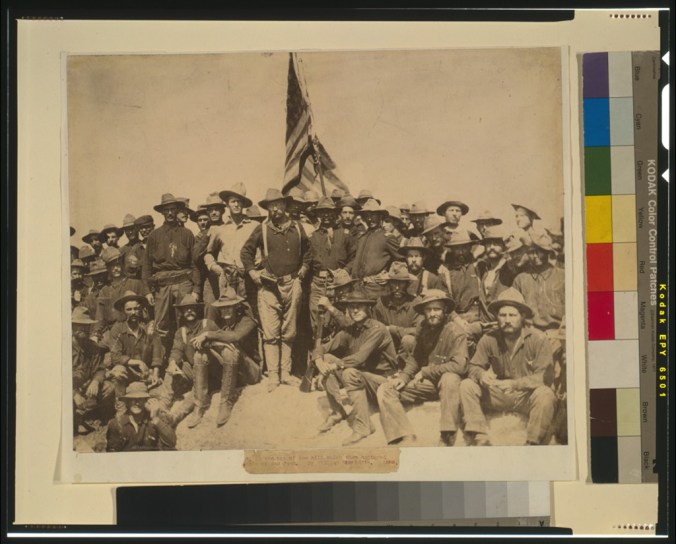
TR with the “Rough Riders” atop San Juan Hill, 1898. Photo credit: Library of Congress.
Theodore Roosevelt enjoyed the fray of battle. Had he lived to see D-Day, it is difficult not to visualize him forcing his way somehow onto the beaches at Normandy, even at eighty-six. It is natural that a man of his irrepressible and epic personality would likewise face equally epic enemies and transmit that passion for the fight to his sons and grandsons. He instilled both his determined sense of public service and selfless courage in his four boys: Ted, Kermit, Archie, and Quentin. Even youngest daughter Ethel would serve as a nurse in World War I. All four would follow their father in wartime service during that same conflict, Ted and Archie on the ground in France with the AEF, Kermit with the British in what is modern Iraq, and Quentin in the Army Air Corps fighting over France until being shot down in 1918, the only Presidential son killed in the war. None of them had to serve but something greater than their security and personal well-being was at stake. Besides, they were Roosevelts. The other three would return with wounds that remained with them into the next World War.
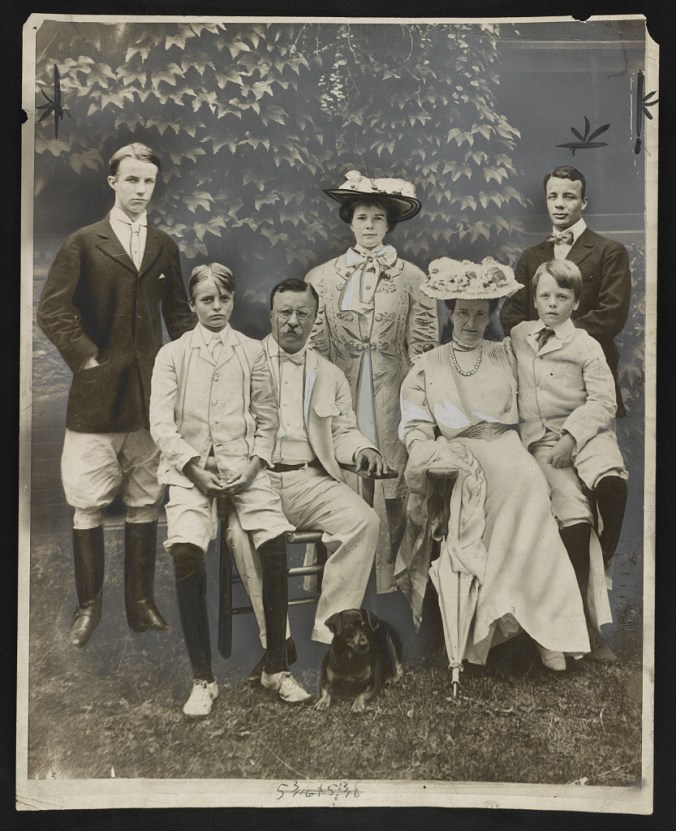
The Roosevelts in 1907: Kermit, Archie, TR, Ethel, mother Edith, Quentin, and Ted. Obviously absent is TR’s oldest, Alice, who had married Nicholas Longworth two years before the picture taken here. Photo credit: Library of Congress.
When asked about placing a monument to his youngest boy near the site of Quentin’s last battle, the former President replied with a grief deeper than his own loss: “And who will build the monument for all the other sons who died?” The death of Quentin rapidly aged his father and by the following year “the old lion” (as Archie referred to him) was gone as well.
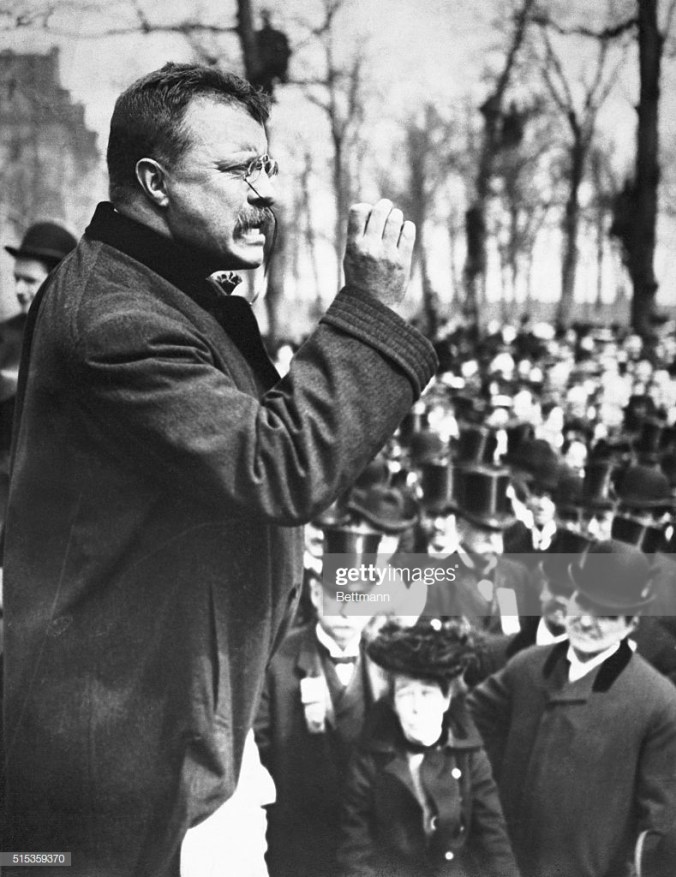
TR hammering a point home on the campaign trail, 1900. Photo credit: Getty Images.
While all TR’s sons continued to build on their father’s legacy, it would be 5′ 8″ Ted who most closely resembled the father in word and deed. Archie would go into the oil business while Kermit went into shipping. It would be Ted, however, who followed in the Roosevelt tradition as Assistant Secretary of the Navy, beginning in the Harding administration in 1921 and ending in September 1924 as the balance of Harding’s term neared conclusion under President Coolidge. Now a Colonel, like his father, Ted would try for Governor of New York but lose to Al Smith. Done with politics for now, Ted’s tireless spirit stepped away from public service and took up exploring the remote wilds of Africa and Asia with his brother Kermit during the rest of the decade. Ted would make his comeback in the Hoover administration, serving first as Governor of Puerto Rico and then Governor-General of the Philippines until July 1933. He would then go into business with American Express and Doubleday Publishing but as war seemed imminent again in 1940, TR’s namesake began preparations for reactivating in the Army.
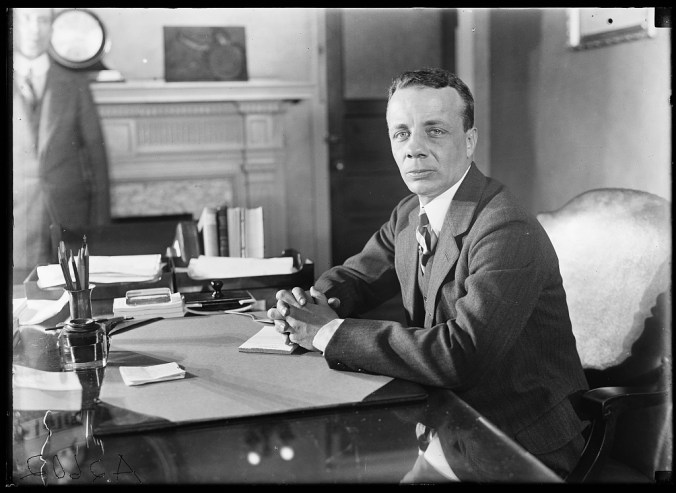
“Ted” Roosevelt, Assistant Secretary of the Navy, 1921. Photo credit: Library of Congress.
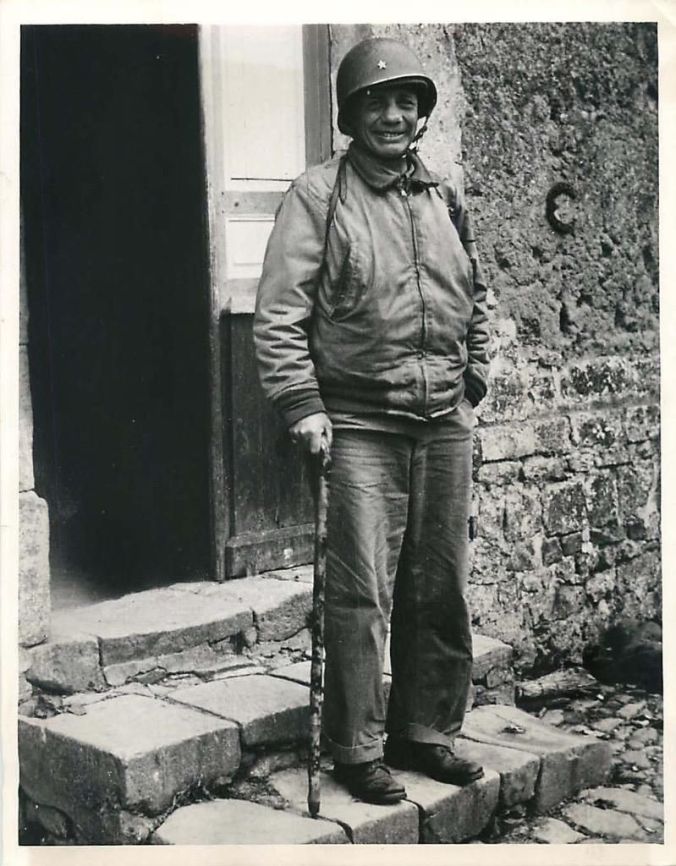
Son Ted would go back to the European Theater while Archie would fight in the Pacific. Peers found little to commend about Ted when it came to military discipline and professional decorum. Yet, his men adored him. His superiors thought even that went a little too far for the needs of discipline in the ranks. But, as they would discover, the future would call for just his kind of style at a necessary moment in history. What he lacked in polish, he made up for in unyielding courage. His old wounds left him arthritic and so, now a Brigadier General, Roosevelt carried a cane. In characteristic fashion, it was Ted who insisted he be assigned among the very first soldiers to make their landings on the beaches of Normandy on this day in 1944. His youngest son, another Quentin, would be among the first to arrive just up the beachhead at Omaha. Ted’s commander thought the old General would never survive. Ted not only survived the landing but proved vital to its success. It was the sight of him calmly traversing Utah beach under fire with nothing but cane and pistol in hand, welcoming troops of the 8th Infantry and 70th Tank as they came in, recounting for them some of his favorite stories of his father’s bravery and encouraging each new wave arriving at this westernmost anchor of five coordinated landings (Utah, Omaha, Gold, Juno, and Sword).
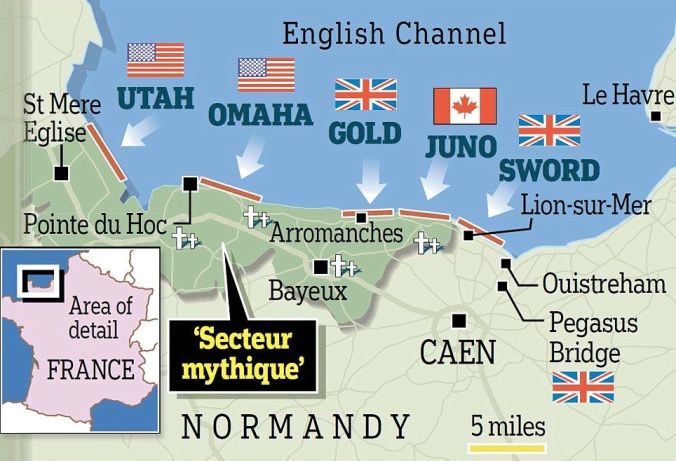
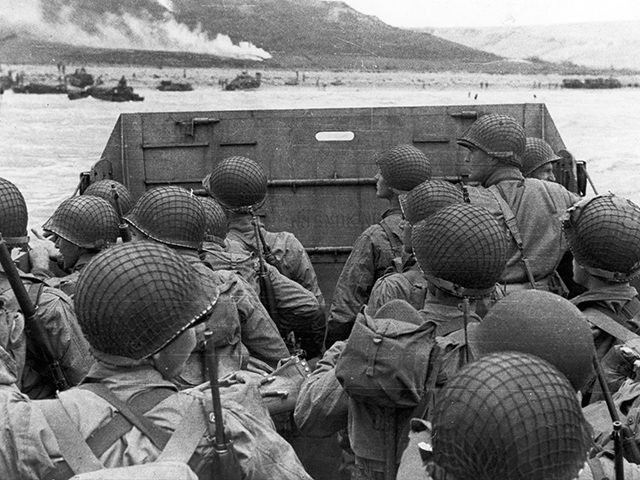
Approaching Utah Beach, June 6, 1944. Photo credit: Getty Images.
The oldest man (age 56) and the only General shoulder-to-shoulder with those coming ashore that day, he originally arrived one mile from the planned location. It made no difference to old Ted. “We’ll start the war from here,” he declared. He would go on to direct landing craft, armored vehicles, and infantry ensuring that each unit went where it needed to be. As the days unfolded, he continued to direct the advance of the 4th Infantry Division with the help of his jeep, “Rough Rider.” Had he not been there to bolster the men and bring the plan into fruition at that critical point in the early morning hours of June 6, however, would we be commemorating a victorious D-Day seventy-five years later?
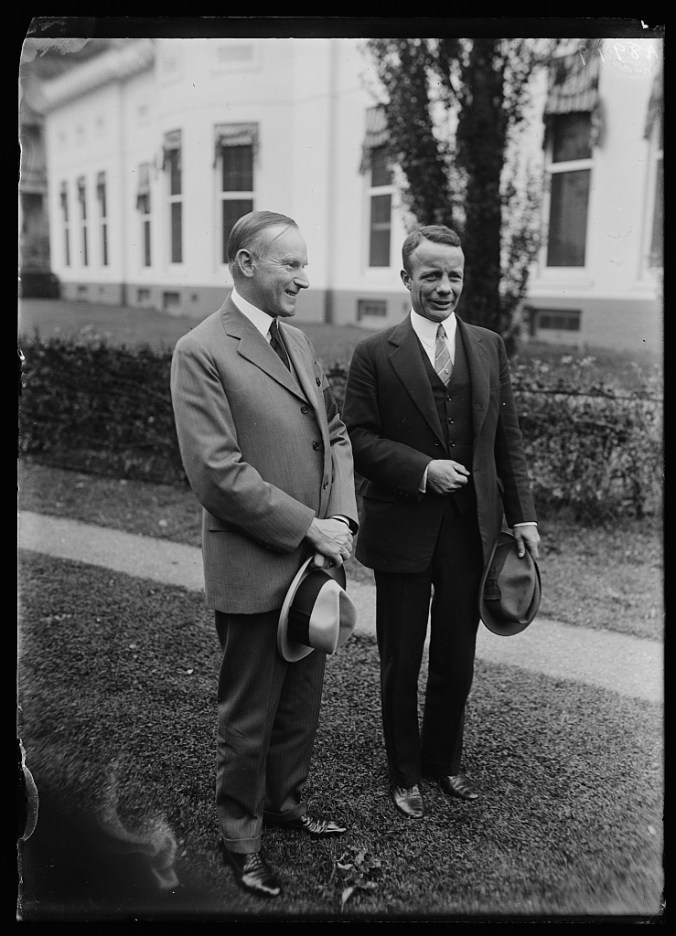
President Coolidge and Roosevelt, September 30, 1924. Photo credit: Library of Congress.
History often turns on the seemingly counter-productive qualities of leaders like Ted Roosevelt. To the surprise of “experts” they turn out to be men fitted for the occasion with just what is needed at the right time and place to inspire and prevail. This is perhaps why the study of leadership never fails to delight and surprise, defying as it often does, a scientific definition or clinical explanation. It is an enduring reminder that we are more than science alone can quantify. Regrettably, Ted would succumb to heart failure five weeks later and be laid to rest among the American dead of D-Day beside his brother Quentin, shot down in the First World War, in Colleville-sur-Mer, France. Coolidge would not live to see the landings on this day in 1944 but he most certainly admired the Roosevelt spirit in both father TR and sons like Ted, a spirit that was again present and very much alive among those fighting their way inland from the beaches of Normandy three quarters of a century ago.


 The Importance of the Obvious