On the 1919 Boston Police Strike Centennial

“We review the past not in order that we may return to it, but that we find in what direction, straight and clear, it points to the future”— Calvin Coolidge, Burlington, Vermont, June 12, 1923
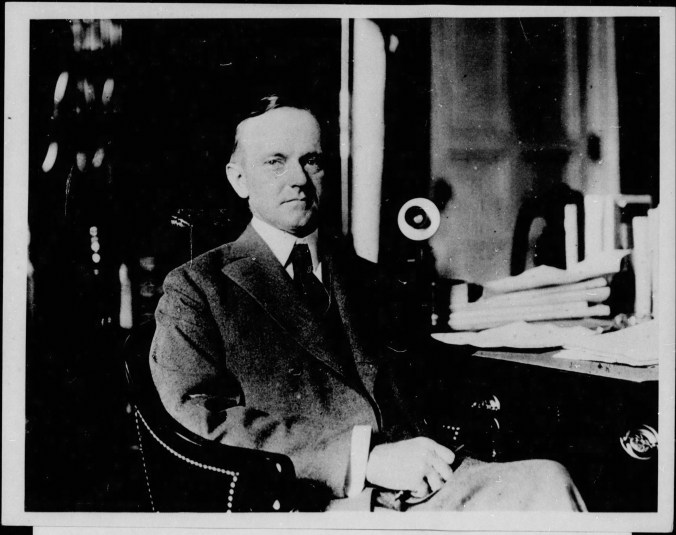
CC Boston Strike

This month marks the centennial of the Boston Police Strike. It came at the height of a very violent and unsettling year, not only for the city of Boston but for folks across the nation. Armed hostilities may have ended in Europe ten months before but the war and its attendant upheaval continued to wreak havoc everywhere. All had been touched by it in some way. Peace had not and would not automatically follow in the wake of the Armistice.

The country was witnessing a palpable and multi-faceted fear that it might actually be tearing itself apart over political, social, cultural and economic differences. Out of the troubling work conditions experienced by Boston’s police departments came a decision to affiliate with the American Federation of Labor in disregard of department rules. The city would then see the commissioner remove the leaders behind that decision only to have the mayor remove the commissioner. Into that crisis stepped Governor Calvin Coolidge who restored the commissioner to his place and steadfastly declined to reinstate the policemen who walked off their jobs, leaving the city open to lawlessness. When urged by Samuel Gompers, the president of the American Federation of Labor, to reinstate the strikers, Coolidge’s declared, “There is no right to strike against the public safety by any body, any time, any where.”

Aid_and_Comfort

A recurring take on the strike in contemporary political cartoons.

Governor Coolidge held to a defense of every law enforcement officer’s sacred duty to uphold law impartially, without favor to any person or organization (labor union or not) but to remain exclusively and directly accountable to none other than the people themselves. Though it would likely end his political career, Coolidge stood by his stand anyway. It had the opposite effect, lifting his name into the national sphere. It did not make him anything, it simply revealed qualities that were already his in abundance but became part of an unforeseeable train of events that would elevate Cal to the Vice Presidency and ultimately, the White House. Long before that, however, he would help the displaced strikers found new employment and address many of the issues that troubled the departments leading up to the decision to strike. It is a reminder that our decisions, wise and unwise, often have far-reaching consequences, long beyond our own lives.

Coolidge put the whole issue this way some ten years later, reflecting: “It was beginning to be clear that if voluntary associations were to be permitted to substitute their will for the authority of public officials the end of our government was at hand. The issue was nothing less than whether the law which the people had made through their duly authorized agencies should be supreme.”

Today, Saturday, September 7, 2019, at 4PM (ET), scheduled at the University of Massachusetts Boston, at University Hall in Dorchester, one side of the issues of the Boston Strike (unfortunately, without a full consideration of all sides, including Calvin Coolidge’s response to it), will be heard marking the pivotal developments which unfolded across the city one hundred years ago this month. It would be no less useful and worthwhile to learn what became of those who stayed on duty through the crisis when their brother officers left the stations. It would likewise be interesting to learn more about each of the National Guardsmen who answered the call, mustering to augment the severely depleted police forces and restore order. Calvin Coolidge, performed by the insightful and talented Tracy Messer, has explored what happened and how it was handled from his vantage point. The presentation of the Strike Project will be streamed live for those unable to attend in person. It will be an incredible opportunity and a very interesting occasion.

We encourage you to check it out here!

The serious issues of the strike aside, once it got going, the conflagration was exploited to politically destroy him. It backfired then and continues to boomerang on the perpetrators who attempt to score off of any narrative that ignores the full story. Coolidge would later observe: “No doubt it was the police strike of Boston that brought me into national prominence. That furnished the occasion and I took advantage of the opportunity. I was ready to meet the emergency. Just what lay behind that event I was never able to learn. Sometimes I have mistrusted that it was a design to injure me politically; if so it was only to recoil upon the perpetrators, for it increased my political power many fold” (Autobiography, 139). A word to the wise about politicizing an issue to discredit an opponent, it often backfires in grand style on those who resort to it.

Perhaps the wise and witty Mr. Coolidge belongs at your next event. If so, contact Mr. Messer here.
John Hendrickson: “The Need for Restraint”

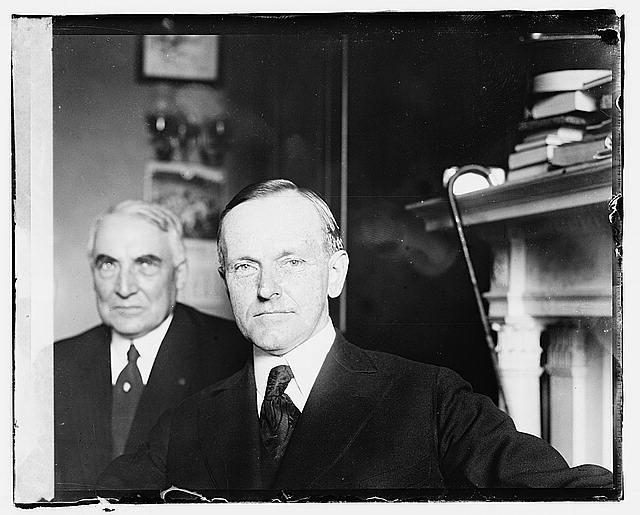
Coolidge-Harding

Mr. Hendrickson of the Tax Education Foundation (Iowa) has some very timely reminders from the steady fiscal restraint demonstrated by Calvin Coolidge in the 1920s. While America’s debt continues to climb, there remains a persistent aversion to dealing with it while at the same time a deeply-seated simplistic and unfounded fear that the 20s either have nothing to teach us or teach us only failure and disaster, encapsulated in the old, cliched catchphrases and campaign trail bogeymen of supposed “income inequality,” fake prosperity, and predestined crash.

While these myths have been addressed on this blog throughout the years, Mr. Hendrickson reminds us of a different lesson gleaned from the fiscal policy of Harding & Coolidge years: It took real work. As it has been easy to deride and caricature, we find the restraint shown by Harding and Coolidge was anything but easy, requiring instead intense focus and persistent effort. We mock that at our own peril. No one is seriously making the case that we can or should return to the 1920s, as if the whole slew of events that brought subsequent depression and suffering are directly attributable to the success of the Harding-Coolidge exercise of restraint. None of it was foregone, whatever “experts” claim.

Our mistake now, a short-sightedness that will reap far more catastrophic results, is in deriding those who had the discipline and perseverance to face squarely the debt problem, who demonstrated the will to oppose wasteful expenditure, and hold back the forces pandering to the “party cruise” mentality as it incessantly beat at the door through both administrations. The example of Harding and Coolidge to show restraint presents a reminder that peace and plenty are always fleeting but the nation is best prepared when it confronts its debt responsibly and redeems the time, when things are good, to set its house in order. The rain clouds will not be held back by our ambivalence. If we fail to learn from the success of their restraint, we cannot blame them for our neglect, we can only blame ourselves and the future will most certainly pay the price.

Truman: The Collector of Coolidge Stories


At first glance, there do not appear to be many similarities between Calvin Coolidge and Harry Truman. Coolidge would never be heard uttering the kind of salty language Truman frequently employed. Coolidge knew how to be crisp and to the point without the colorful metaphors. Both had a strong sense of the Presidential Office’s duty, however, and guarded fiercely his own moral integrity. Aside from the obvious differences of party and regional upbringing, they both came from the country. Even so, 1923 and 1945 (the years they ascended to the White House) were about as different as any separate worlds can be despite being a mere twenty-two years apart. Both men succeeded following the deaths of their predecessors and would win elections in their own right, the 1924 three-way contest remaining the more decisive of the two. They would both lead into a post-war world, facing the challenges and uncertainty of returning to peacetime. War broke out again under Truman while Coolidge kept the peace. They both used the veto and executive power in decisive ways, neither without controversy. For both of them, the “buck stopped at the President’s desk.” They did things differently, to be sure, possessing distinct styles of executive administration, but both could be as immovable as granite when duty required. They would both preside over significant reconstruction projects of the people’s White House, the introduction of a steel-beamed third floor in 1927 and the 1949-1952 renovation, which remains the most substantial work done since the mansion’s burning in 1814. Both were efforts to correct the unfortunate installation in 1902 of a second floor truss and its subsequent strain on the overall structure.


Though Coolidge and Truman apparently never met, they were being prepared for national leadership in different ways at the same time. Truman served as an artilleryman during the Great War and then ventured into haberdashery (his shop being hit by the 1921 depression) and then served as county judge before reaching the U.S. Senate while Coolidge was war-time governor of Massachusetts and then Vice President. Truman would enjoy a much longer post-presidency and yet both returned to the people from whom they came, quiet ‘Main Street’ America. While Coolidge left office adored by the people, it has been intellectuals who join in a chorus of hostility toward Cal while reserving accolades for Harry. Both were more alike than such academics usually countenance. Though, on the campaign trail, Truman helped echo this critical chord as a partisan candidate, I think even Harry learned to walk with greater perspective and a higher regard for his predecessors once he had also been there. They both knew the country could do just fine after their season of leadership had passed to others. They did not see themselves in any sense as indispensable forces. They were above all, thoroughly and authentically human. In one of those frequent points in history when only two former Presidents lived contemporaneously, the years 1924-1930 and 1945-1961 resemble each other. Truman would have the benefit of Hoover’s experience just as Coolidge had had from Taft before them. I think Harry now would find this animus against Coolidge has been unfair to #30 and be rightly repulsed by it. If nothing more, his sense of justice would find it intolerable. Not only this but, as his daughter once noted, Truman was an avid collector of Coolidge stories. He loved them. They were hilarious. They taught while they made you laugh.

Harry’s favorite was the old story about one of those mystifying pancake breakfasts Coolidge often held for legislators. The legislators never quite caught on to the rationale behind these breakfasts, failing to detect that Cal was taking his measure of them, sizing them up and seeing how they reacted, what made them tick, how they thought, how they worked and how they handled situations. Harry relished hearing and recounting the old instance when one of those legislators, Texas Senator Morris Sheppard, sat at table with a piece of bacon still lingering on his plate while Rob Roy, the ever-observant white collie, stared eagerly up at him. “He wants your bacon,” Cal cracked to Sheppard. The unsuspecting Sheppard gave it away and no new slice was forthcoming for the cajoled, but now baconless, Senator from Texas. In Aesop-like fashion: He gave too freely under pressure and illustrated that cautionary tale of legislators snookered by the lobbyist, even when it turns out that lobbyist is a dog.