Truman: The Collector of Coolidge Stories


At first glance, there do not appear to be many similarities between Calvin Coolidge and Harry Truman. Coolidge would never be heard uttering the kind of salty language Truman frequently employed. Coolidge knew how to be crisp and to the point without the colorful metaphors. Both had a strong sense of the Presidential Office’s duty, however, and guarded fiercely his own moral integrity. Aside from the obvious differences of party and regional upbringing, they both came from the country. Even so, 1923 and 1945 (the years they ascended to the White House) were about as different as any separate worlds can be despite being a mere twenty-two years apart. Both men succeeded following the deaths of their predecessors and would win elections in their own right, the 1924 three-way contest remaining the more decisive of the two. They would both lead into a post-war world, facing the challenges and uncertainty of returning to peacetime. War broke out again under Truman while Coolidge kept the peace. They both used the veto and executive power in decisive ways, neither without controversy. For both of them, the “buck stopped at the President’s desk.” They did things differently, to be sure, possessing distinct styles of executive administration, but both could be as immovable as granite when duty required. They would both preside over significant reconstruction projects of the people’s White House, the introduction of a steel-beamed third floor in 1927 and the 1949-1952 renovation, which remains the most substantial work done since the mansion’s burning in 1814. Both were efforts to correct the unfortunate installation in 1902 of a second floor truss and its subsequent strain on the overall structure.


Though Coolidge and Truman apparently never met, they were being prepared for national leadership in different ways at the same time. Truman served as an artilleryman during the Great War and then ventured into haberdashery (his shop being hit by the 1921 depression) and then served as county judge before reaching the U.S. Senate while Coolidge was war-time governor of Massachusetts and then Vice President. Truman would enjoy a much longer post-presidency and yet both returned to the people from whom they came, quiet ‘Main Street’ America. While Coolidge left office adored by the people, it has been intellectuals who join in a chorus of hostility toward Cal while reserving accolades for Harry. Both were more alike than such academics usually countenance. Though, on the campaign trail, Truman helped echo this critical chord as a partisan candidate, I think even Harry learned to walk with greater perspective and a higher regard for his predecessors once he had also been there. They both knew the country could do just fine after their season of leadership had passed to others. They did not see themselves in any sense as indispensable forces. They were above all, thoroughly and authentically human. In one of those frequent points in history when only two former Presidents lived contemporaneously, the years 1924-1930 and 1945-1961 resemble each other. Truman would have the benefit of Hoover’s experience just as Coolidge had had from Taft before them. I think Harry now would find this animus against Coolidge has been unfair to #30 and be rightly repulsed by it. If nothing more, his sense of justice would find it intolerable. Not only this but, as his daughter once noted, Truman was an avid collector of Coolidge stories. He loved them. They were hilarious. They taught while they made you laugh.

Harry’s favorite was the old story about one of those mystifying pancake breakfasts Coolidge often held for legislators. The legislators never quite caught on to the rationale behind these breakfasts, failing to detect that Cal was taking his measure of them, sizing them up and seeing how they reacted, what made them tick, how they thought, how they worked and how they handled situations. Harry relished hearing and recounting the old instance when one of those legislators, Texas Senator Morris Sheppard, sat at table with a piece of bacon still lingering on his plate while Rob Roy, the ever-observant white collie, stared eagerly up at him. “He wants your bacon,” Cal cracked to Sheppard. The unsuspecting Sheppard gave it away and no new slice was forthcoming for the cajoled, but now baconless, Senator from Texas. In Aesop-like fashion: He gave too freely under pressure and illustrated that cautionary tale of legislators snookered by the lobbyist, even when it turns out that lobbyist is a dog.


On Boxing

Bellows_George_Dempsey_and_Firpo_1924

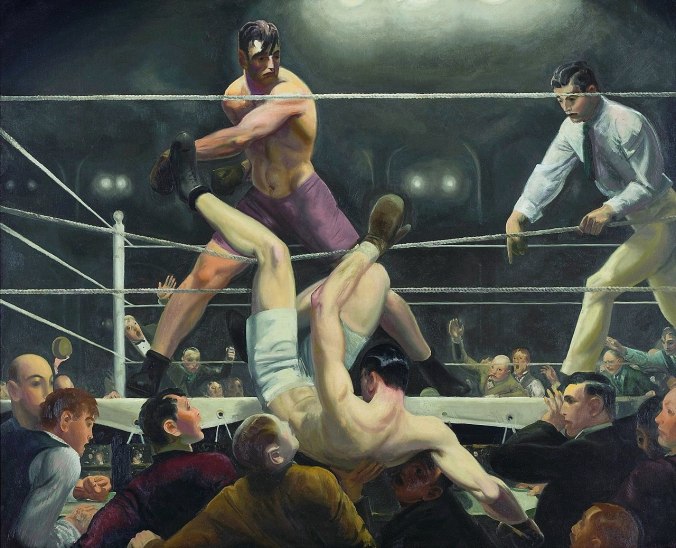
Dempsey and Firpo (1924) by George Bellows

The Twenties remains one of the most vibrant eras of peacetime innovation, cultural achievement, and the leadership to embody it all in iconic personalities which now seemed larger and more glorious than the country — or the decade itself — could contain. The Twenties beheld legendary figures bestriding the world as they would cross a stage, humble but confident, reverent but restless with an energy to accomplish greater things than had ever before existed. Young heroes seemed to develop in abundance on several fronts. A shared cultural bond was emerging in pursuits that defied sectional isolation and narrow outlook ushered in through radio, the automobile, the telephone, the airplane and the camera.

It was a decade of transitions, as almost all decades are, but it was more than that. It was a decade of youthful exuberance and matured experience too but that simplifies the time. Few decades are so replete with pursuits that captured the imagination and encouraged a soar to the stars in the same breath. Lindbergh inspired the conquest of the air, looking forward to a day when we would cross continents in mere hours. Ford accelerated the conquest of the road, presaging a day when seeing the world would be opened to us by the automobile. AT&T was connecting the globe together around the telephone conversation. “Red” Grange was packing in stadiums to watch the new-found thrills of college football. Harold Lloyd was unleashing a subtle revolution in comedy and film itself. Radio was furnishing a cultural language too, programs anyone could access and enjoy. Newscasting had Graham McNamee.

America in the 1920s turned to sports with an enthusiasm that arguably rivals any other era. It sought out these athletic pursuits with a zeal that seemed long-bottled, hungering to do the incredible not with weapons of war but through the prowess of peaceful competition. It pitted wits and athletic abilities against each other to discover the best, confirming that triumph belonged to the winner not merely the participant. Everyone had his loyal fans. It was no less spirited and had its own violent collisions but it gave place and esteem to the victors of the ball field and champions of court and ring. Baseball had its Ruth. Football its Rockne. Golf its Bobby Jones. Tennis its Bill Tilden.

When it came to boxing, it was Jack Dempsey. His successor and rival for the title, Gene Tunney, would likewise receive wide accolades, including a visit to the White House to meet President Coolidge. That would all come later. First, however, it was Jack Dempsey, who would hold the heavyweight title for seven years. Long before Rocky Marciano, it was Dempsey who would earn glory through some 75 fights, losing only 6 of them. Defeating Jess Willard in 1919 for the title, Dempsey would go on to successfully defend it five more times, most notably against French Georges Carpentier in 1921 and Argentine Luis Firpo in 1924.

jack-dempsey-and-his-manager-at-the-wh-ie-white-house-1024

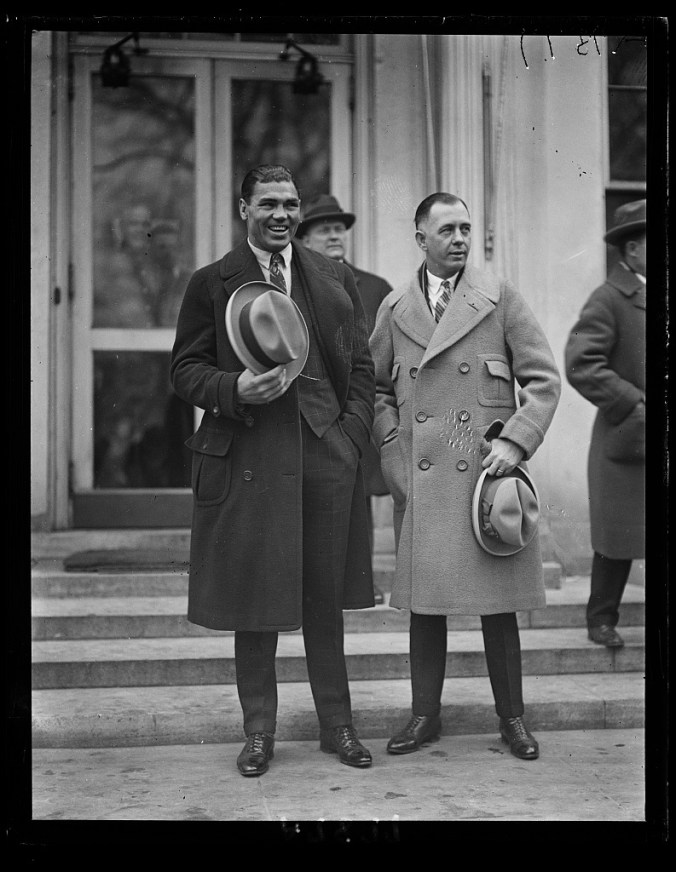
Jack Dempsey and manager “Doc” Kearns posing for photographers at the White House, 1924. Photo credit: Library of Congress.

In 1924, he would meet his third President, Calvin Coolidge. He had already met Woodrow Wilson and Warren Harding. Here is Dempsey’s honest account of that memorable meeting with Cal. It illustrates the maxim that the first impression rarely captures the whole picture:

“I saw a lot of pictures of Coolidge in the newspapers before I met him. He ought to sue every photographer in the United States. The first time I saw his picture, I thought: ‘There’s a man I wouldn’t trade horses with, for he’d trim me.’ I don’t mean he’d cheat me, but I’d get the worst of it. He looked, in the pictures, like a man who was sly and foxy and sour.

“He reminded me, in his pictures, of sitting around a stove in a grocery store in the country in the winter time, and swapping talk and chewing tobacco, and in comes the shrewdest, smartest farmer in the county, and everybody respects him, but you can’t like him much, for even when he smiles his face is too shrewd and foxy.

“Well, when I met the President it was a kind of shock, for he’s different. He’s kind of like his pictures, yet he’s not like them at all. That smile that looks so sour in the photographs has got something good and straight about it that seems to come from his eyes, if you know what I mean.

“After I saw him and talked with him, I wouldn’t have been afraid to take him on in a horse trade unless I had it up my sleeve to trim him, and then I’d been afraid of it. He’d be honest, but you couldn’t fool him, and when he’d get mean he’d awful mean. I guess maybe that’s a pretty good sort of man to have running the country.

“We didn’t really say much to each other. Kearns and I went to the White House, and the President’s secretary, Mr. Slemp, introduced us, and I guess I felt a little awkward, and Mr. Coolidge smiled — believe me, it’s a different smile than you expect from his pictures — and shook hands with me, and said:

‘Well, Mr. Dempsey, you’re a creditable champion, and you’re a more popular man than I am.’

“I said, ‘Well, sir, I don’t see how a man could be more popular than to be President of the United States.’

“Then we talked for a few minutes about boxing. Slemp told him I could knock out a man with a two-inch punch — that’s what they said when I went to a scientific laboratory and punched a machine that registered on a dial, but I doubt if it would be true in the ring — and Mr. Coolidge grinned and said, ‘Well, that’s two inches more of a punch that I’d like to get from you.’ And we talked a little more and shook hands and said goodbye.”

It is noteworthy that the 1920s claims so many heroes of culture. It was an era when winning honestly was given due praise, dishonesty due shame, and the development of culture over and above that of politics mattered much more to regular people. That healthy balance was just how Cal would have wanted it.

Coolidges Chicago 1924

On President Harding’s Legacy

president-warren-g-harding--c-1920-international-images

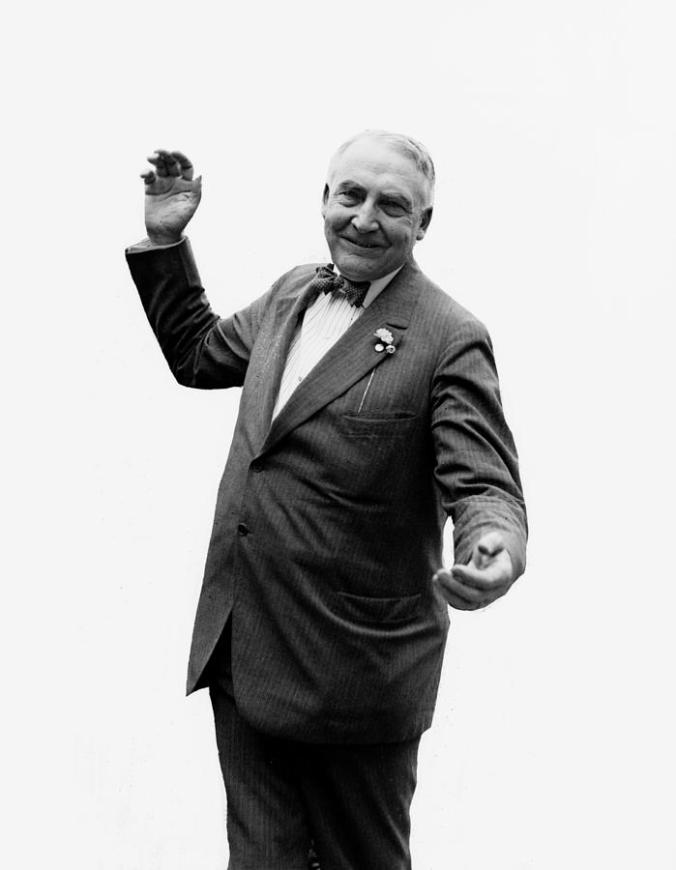
“It often has been remarked that when a particular crisis in human affairs has required a certain type of ability to meet it the right man has appeared. Whether this is because there are latent powers in all of us which give those who become charged with responsibility the ability to respond by rising above themselves, it is impossible to decide. Perhaps it is enough to know that when the world has a work to do some one appears who is able to do it.

“It seems as though President Harding was preeminently fitted to serve the country in the disturbed and distraught period following the war. He had experience and ability, courage and patience, combined with a generous toleration and cheerful optimism that inspired confidence. He had a natural gift of expression which he had developed into an art. He understood the people and the people understood him. In composing a situation, in pacifying men, he was a master.

“Those qualities which were so much needed in our country and in the world he brought to the presidential office. When he began his term our domestic situation was chaotic. Credit was over extended. Commodity prices had experienced a perpendicular decline. Unemployment was extensive. Agriculture was prostrate. The national debt was enormous. War taxes prevailed. Government expenses were heavy. All kinds of business were in distress.

“Our foreign relations were precarious. We had rejected the treaty of Versailles but we had not made peace. We were engaged in building the greatest navy in the world. The islands in the Pacific ocean were a source of friction. Europe looked on us with suspicion.

Harding Cabinet (2)

Photo credit: Fineart America

“To deal with these problems President Harding summoned the Congress and kept it in session for nearly two years. The credit stringency was relieved by reviving the War Finance Corporation. Our markets were protected by enacting emergency tariff law. Labor was protected by restricting immigration. A Budget Bureau was established and a system of rigid economy was adopted. To discharge our obligations to ex-service men the Veterans’ Bureau was organized. A new internal revenue law reduced taxes hundreds of millions of dollars annually. A permanent tariff bull gave protection to our markets in harmony with the new conditions of world trade. Surplus war materials and treasury assets were converted into cash to pay expenses and reduce debts. Several billions of short term governmental obligations were paid or refunded. The shipping business and the railroad administration were put in the way of liquidation.

“While these measures were being adopted for our domestic benefit settlements of even greater magnitude were being made in the foreign field. Peace treaties were negotiated with those with whom we had been at war. A long standing difference with Colombia was generously composed. Diplomatic relations were resumed with Mexico. A commission was appointed under authority of the Congress to negotiate a settlement of our foreign debts under which an agreement was speedily made with Great Britain.

“In spite of a universally genuine desire for peace the world was engaging in a competitive race in armaments which was a source of expense and suspicion. To relieve humanity from this increasing menace President Harding called the historic Washington conference on the limitation of armaments. A preliminary treaty was drafted for the present and future settlement of differences among the many international interests in the Pacific Ocean. The British and Japanese alliance was terminated. The five great maritime powers then entered into a solemn covenant limiting most of the different types of warships in respect to number, tonnage, and armaments. When that treaty was signed it marked an epoch in history.

“Such in barest outline are some of the policies adopted under the leadership of President Harding for the restoration of the United States and the pacification of the world. Under this benign influence trade revived and a better international understanding prevailed. He would be the last to claim all the credit for these accomplishments. He had the loyal and patriotic cooperation of public men within and without his own party. All he could do through governmental agencies was to proceed in harmony with sound economic laws which would strengthen and support the recuperative power of the people in working out their own business revival. He had the advantages, too, of the deeply interested and watchful care of a wife who was ever devoted to his welfare and shared with him his burdens. No record of his work would satisfy him which failed to recognize the helpful influence of Mrs. Harding who sleeps here by his side.

42362762075_36d2490244_k

The Harding Tombs inside the Memorial dedicated in 1931. Photo credit: Christopher Riley/Flickr

“Frequently he asserted that he desired his administration to be an era of good understanding. Conflicts between the government and business he believed should be removed. Differences between capital and labor he wished to see adjusted. There was no room in his broad sympathy for any taint of sectionalism. But chiefly he was determined to use his great office to the full extent of the powers to prevent future wars. He was for good understanding among nations. His vision was broad. His statesmanship was inclusive. It would be difficult to find any peace time period of little over two years when so much that was beneficial was accomplished as during his administration” — former President Calvin Coolidge, accepting the monument to President Harding at Marion, Ohio, June 16, 1931.