Missing Cal?

LeeCoGOP-office2019

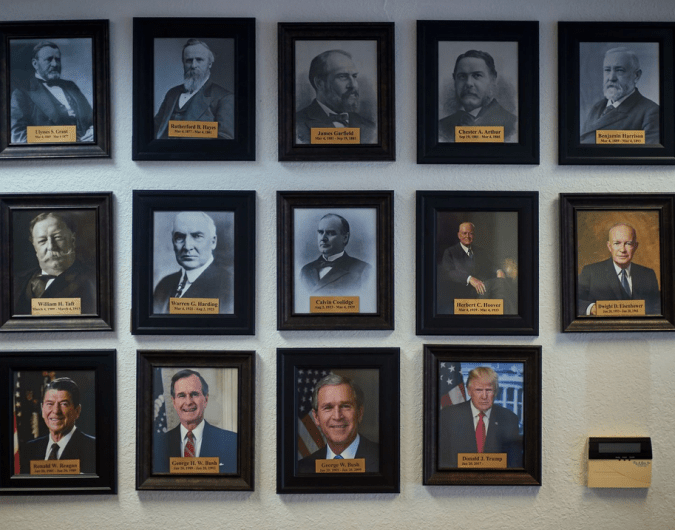
What is wrong with this picture? Photo credit: Zack Wittman/Washington Post.

     Perhaps without meaning to do so photojournalist Zack Wittman of the Washington Post (in an October 31 article by Griff Witte) has captured this snapshot from the Lee County Republican Headquarters in Florida. It looks like the good folks over there are a bit confused as to who this Calvin Coolidge person is. Seems they might have bigger problems than Mr. Rooney. They might benefit immensely from knowing a little more than they appear to about Cal.

     First off, McKinley did not succeed on the death of President Harding in 1923. McKinley was not the 30th POTUS, he was #25, between Democrat Grover Cleveland and Republican Theodore Roosevelt. McKinley was not from Vermont, nor was Coolidge from Ohio. McKinley was not President in the wake of World War I, between 1923-1929. McKinley was not the one who reduced the national debt by one-third in less than six years. McKinley did not preside over six years of unparalleled peacetime. McKinley was not the last President to achieve six consecutive budget surpluses, it was Cal, who was President the last time the United States experienced that many surpluses in a row. McKinley did not sign the Indian Citizenship Act of 1924 or endorse the first serious study to be done in more than 100 years (the Meriam Report, 1928) openly questioning the government’s paternalistic policy toward natives on the reservations. McKinley was not known as the first avid communicator by radio nor did he participate in over 520 bi-weekly press conferences. McKinley did not issue more than 1,250 executive orders, grant more than 1,690 acts of clemency, and deliver 50 vetoes in a short 67 months in office. And McKinley did not say “I do not choose to run for President in 1928,” leaving the powers of office behind when he could have won again with ease.

While the case could be made that both Presidents shared some resemblance in their younger days, a basic image search would have removed all doubt. I am sure the good folks in Lee County’s Republican Party have their hearts in the right place. Now if they could just be clear on who Calvin Coolidge is, they might find fewer distractions and a greater appreciation for the importance of the obvious.


Thanks go to Mr. David Harville for catching this one!

On Your Parents’ Friends

“Do not forsake your friend and your father’s friend…” — Proverbs 27.10a

A spirited discussion around the Morrow family dinner table in the early “teens” (the 1910s, that is) found some resolute skeptics toward the contention of their host (Dwight Morrow) that Calvin Coolidge was going to be President some day. The guests seriously doubted anything of the kind, given how quiet and reserved Coolidge was. It was a marvel he was in public service at all, they countered. Mr. Morrow knew there was much more to Cal than could be seen on the outside. But the guests insisted it would never happen. Coolidge had been underestimated before, Morrow knew, and he would be again. Even Mrs. Morrow was dubious about her husband’s claim. She granted that Grace Coolidge, Coolidge’s wife, was more likely to reach national notoriety, not Calvin.

Just when it seemed that Mr. Morrow’s case would fail to convince, little Anne Morrow chimed in: “I like Mr. Coolidge,” she bravely declared. “He was the only one who asked about my sore finger.” And with that, her father rested his case. Time would prove father and daughter prescient.

Little Anne would grow up to marry Charles Lindbergh, and see Calvin Coolidge become President of the United States. The Lindberghs, Morrows, and Coolidges would retain a close connection as the years unfolded. In a letter written to her mother, March 4, 1930, Anne Morrow Lindbergh would share this story of their visit to the Coolidges. She had not forgotten her parents’ friends.

“…We called on them just to pay our respects, for about ten minutes. She [Grace] came up to me so very graciously and sweetly and said she really thought of me as nothing but “Anne.” And she asked about all of you, and Dwight and Constance [Anne’s siblings]. He was so nice too and not at all hard to talk to or clamlike as the cartoons have made him. In fact Coolidge was very amusing in that inimitable dry fashion all the time we were there. He said to C[harles], ‘You look just as well as your pictures said you were,’ then, with a look at me, ‘You look better than your pictures said.’ Talking of flying, with C[harles], he said, ‘We had a Republican senator from our section for years. He went flying in Washington. Now we have a Democrat.’ “

Guess that flying is potent stuff!

The Lindberghs would go on to meet Will Rogers a few nights later, whose humor and story-telling would always be a delight to Anne. Rogers, who shared and fully appreciated Coolidge’s keen sense of humor, kept the highest regard for both families, the Morrows and the Coolidges. To him, they were some of the finest people America had ever had, genuinely relatable folks who gave all for others and embodied the real meaning of selfless public service. Rogers, looking back on the Coolidge years as it neared its end, would write in his column on March 1, 1929,

“Mr. Coolidge, you are leaving us, and this is only a comedian’s eulogy. But I will never forget what your bosom friend, Dwight Morrow, told me that you said to him on being suddenly sworn in an office that wasn’t yours. ‘Dwight, I am not going to try and be a great President.’ That’s all you said. That will stand in my memory as the greatest remark any office-holder ever made. For no man is great if he thinks he is.

“You should be leaving without a single regret. I have told many jokes about you, and this don’t mean I am going to quite, for we love jokes about those we like…”

We still do.

My Dear Father, November 1, 1920

IMG_2286

The post office box at the General Store, Plymouth Notch, which housed the letters for Colonel Coolidge, like the one below from his son written in 1920.

One of Dr. Edward Connery Lathem’s many invaluable services to scholarship on Coolidge and his Era includes the wonderful collection of letters written by Calvin Coolidge to his father, Colonel John Coolidge, spanning the years 1887 to 1926, when the older man died.

It was an awaited highlight for the proud father when he could walk across the street from the family’s Homestead to the General Store, where the post office box belonging to the Colonel often held letters not only from the President, his son, but also from senders all over the large, growing country.

Here is the letter son wrote to father on November 1, 1920, just as the political campaign of that year was coming to a close. It would sweep in Republican majorities across the states and vote Coolidge, with Harding, into national office.


My Dear Father:–The campaign is over. Some mistakes were made, always are I suppose, but the ones this year were so foolish I do not see how they could have been made by men really trying to elect the ticket.

     I am at home today. Came home yesterday. Boys are well. Your dog is growing well. She has bitten the ice man, the milkman, and the grocerman. It is good to have some way to get even with them for the high prices they charge for everything.

     In the morning Mr. Stearns will try to find out how to telephone returns to you. I shall be passing the evening at my headquarters in the Touraine.

     Tell Aurora I hope she is well.

Your Son  Calvin Coolidge


20180804_150802_Film4

Some of the Coolidge family pictures, Homestead, Plymouth Notch, Vermont. Cal’s sister Abbie (top), Coolidge boys with their mother, Grace (right), Calvin Jr. (bottom), and both brothers, Calvin Jr. & John (left).

The Salient Cal Project is looking for letters (and photos) YOU, dear readers, may be willing to share with us from the 1920s. We would like to publish selections from that decade, perhaps there is a letter from your family that might end up within our book? Reach out to us, we’d love to hear from you!

old-letters-1082299_1920