A Look at Presidential Ages

Interest has been generated of late, with still a dominance of septuagenarians among Presidential candidates, in the history of age and the Office. We offer the following statistical walk back through not only Presidential ages but a glimpse into the often full fields of candidates through the years. A closer look never fails to give us perspective.

Of the 39 instances in which a “seasoned” candidate (either Presidential or Vice Presidential) has campaigned for office, it is fair to conclude that Ronald Reagan’s success made it “cool,” one of The Gipper’s unintended influences on politics and the Presidency.

_Old_ Candidates Club (67+)

Of the first 12 instances (candidates between 1808-1948), seven were Vice Presidential candidates or incumbents. One third party candidate for President, 85-year old Peter Cooper (of the Greenback Party), became the first “grand old man” to run for President, teamed with 62-year old Samuel Fenton Cary in 1876. Van Buren, at still a youthful 65, had been the first ex-President to run again, heading the Free Soil Party in 1848. Fillmore would be the second former President, not counted here because he remained a baby. comparatively, at 56. 71-year old William Eustis, was voted for in the fractured election of 1824, being given a courteous nod on the ballot but otherwise was not a serious contender in a race that had four younger possibilities (J. Q. Adams, Andrew Jackson, William Crawford, and Henry Clay, all in their fifties save the last who was forty-seven). The remaining two were, like Pete Cooper, Presidential candidates. The elections of 1840 and 1844, well after the collapse of the Federalist Party (which ran formally for the last time in 1816), were the first to see a major party run Presidential candidates older than Washington had been when he retired (age 65): William H. Harrison, who would go on to win in 1840 over the younger Van Buren, and Henry Clay, who would go on to lose in 1844 to the even younger Polk, both Harrison and Clay age 67.

_Old_ Candidates, 1980-present

Jackson had retired in 1837 just short of age 70, surpassing Monroe as the oldest to retire from the Presidency up to that point. Buchanan would be next, retiring at 69, followed by Truman at 67. Eisenhower, leaving office in 1961 at age 70, would mark the first occasion of a Presidential septuagenarian. Only Reagan would surpass that mark at 77, and no President after Bush Sr. has yet left younger than he, at 68 years.

Age Range at Retirement

Unless a Vice Presidential candidate (from George Clinton, who died in office in 1812 at age 73, 74-year old Allen G. Turman in 1888 or 80-year old Henry G. Davis, who failed to win election with 52- year old Alton Parker against 46-year old TR and 52-year old Charles Fairbanks in 1904), no one after 69-year old “Fighting Bob” LaFollette’s disparaging effort in 1924 attempted to run for President until Reagan at age 69 tried and won in 1980, an office that typically went to candidates in their fifties. Even there, one of the oldest tickets was in 1944, with 62-year old FDR and 60-year old Truman topped in 1948 with 64-year old Truman and 70-year Alben Barkley. One of the widest contrasts in both tickets may be 2008, when 71-year old John McCain and 44-year old Sarah Palin ran against 47-year old Barack Obama and 65-year old Joe Biden. Biden would join septuagenarian Vice Presidents with reelection in 2012. He is now the favored septuagenarian to carry the Democrat Party banner in 2020. Candidate Biden is on his way to surpassing his duration as a Senator with the time he has spent as part of a Presidential ticket. He has virtually surpassed Bob Dole in that regard. At the same time, the track record for older Vice Presidents is an established one, usually done to strengthen support behind the ticket or attract notoriety for a younger, relatively less known, less experienced name at the top. As sometimes becomes apparent, it can even reach counterproductive proportions if a certain candidate lacks the stamina to campaign energetically or some other quality. Poor Vice Presidents, they seem, at times strongly bound by the same force that operates between brides and bridesmaids. It is not exactly true that “Once a Vice President, never a President,” as eight separate occasions prove it can be done and, in the case of some, handled very well. But, back to the campaign trail. Naturally, reelection campaigns have far less trouble there and greater ease in coalescing around the incumbent, with only a few notable exceptions (the Adamses, Benjamin Harrison, Ford, Carter, and Bush Sr., to name a few). Those were due to other reasons devolving on the Presidents directly, not so much the Vice Presidential candidates who ran with them.

Candidate Age Disparities, 1796-2016

Note: The Democrats in 1840 marked the one time a national party declined to nominate a Vice Presidential candidate to run with incumbent Martin Van Buren. His ticket of one is thus not counted in the numbers above. He would go on to lose to the Whig ticket, “Tippecanoe and Tyler too.” It is interesting to note that while the win-lose ratio is virtually even, the difference for those campaigns which ran a younger Presidential candidate and their subsequent win or loss is pronounced.

It also sometimes reveals, like in the Gilded Age, what can happen when one major party’s leadership languishes outside the Presidency for long enough, its foremost names are all old men by the time opportunity appears. After Lincoln, no Democrat attained the White House until 1884, a drought of twenty-four years. After the failure of 37-year old George McClellan and 39-year old George Pendleton to overcome Lincoln in 1864, subsequent results seemed only to confirm the Democrats’ hopeless situation: the loss of 58-year old Horatio Seymour to 46-year old Grant in 1868, 61-year old Horace Greeley to 50-year old Grant in 1872, and 62-year old Sam Tilden to 54-year old Hayes in the dubious 1876 election. The record for the youngest Chief Executive has had its ups and downs too (and is not a “race” at all), with the current trend not likely to break TR’s all-time record of 42, unchallenged since 1901. JFK came closest in 1961 but the odds are against the lone Presidential candidate under seventy in 2020.

The Race to the Youngest

The passing of the old men of the Democrat party found 47-year old Cleveland gave them the winning combination they had long sought. Of course, Cleveland slightly messes with the statistics here since he had to go and win a second term non-consecutively, giving us actually an even count overall between Presidents above the average age and below it. There has been no uninterrupted trend to out-youth the “other side” between the major parties but there have been periods of ebb and flow when the trend went toward older, hopefully wiser, leadership and away from the youngsters then back again. Candidates are very often attempts to mirror each other and thus tap into a winning combination. The effort to contrast is no less pervasive but for all the work to look different, similarities abound. As the Jeffersonians annihilated the Federalists, paving the way for the 1824 realignment and the Jacksonians, Whigs sought to capitalize on what the Democrats were doing and vice versa. The Republicans and Democrats, at times, do the same. Jackson’s presence (in his own way following in Washington’s appeal) would keep kindled the lure for an old soldier to lead and thus the Whigs sought out Harrison, Taylor and Scott as the Republicans later would with Grant to Eisenhower. It would manifest in the aftermath of the War that, though ended in 1865, doesn’t show any signs of concluding, as Republicans sought to capitalize on Grant’s appeal, with that series of Union soldiers: Hayes, Garfield, Arthur, Harrison, and McKinley. The Democrats would fare less successfully with their own poorly timed and badly executed renditions: George McClellan and Winfield Scott Hancock. Still later, conscientious attorney John W. Davis would be nominated to out-Coolidge Coolidge, Wendell Willkie would be chosen to out-FDR FDR, and Adlai Stevenson II to out-Ike Ike. When does that ever work, when the real deal is on the ballot?

Question of the Ages_ Presidential Age Stats-1

Since 1980, only one presidential election cycle (2004) lacked a candidate (either President or Vice President) who was older than 67 years of age. The remaining nine, including 2020, now see a growing company of septuagenarians or those who will soon join them. Eighty-nine year old Mike Gravel has now entered the Harold Stassen League of “Never Quit Trying.” If God grants him four more years, we are confident Mr. Gravel will be back to break candidacy records into the 90s. Reagan broke his own record, of course, in 1984 and until 2016, no other septuagenarian proved successful at winning the White House. A candidate at 57 in 1968 and again in 1976, at age 65, Reagan seemed to find everything come together at age 69. We remember his joke in 1984 about Mondale’s youth and inexperience, all the more comical given that the Democrat opponent that year was, at age 56, on the upper range of the conventional spectrum for successful candidates. Reagan, once again, shattered that record. Moreover, given that average lifespans have lengthened since the beginning of the twentieth century, we could argue that the sixty-year olds of yesteryear were the septuagenarians of the current time.

All this simply adds up to what we already know instinctively, that no age range is, of itself, suspect. We have had plenty of reasons to doubt the boy Presidents as we have the grandfathers. Both, at times, have not been any more a safeguard to the errors of judgment, lack of character, or basic competence needed to lead well. Reagan demonstrated the septuagenarian could do just fine but he, like the youngsters among our Presidents, did not do everything he set out to do. Neither did FDR, who essentially grew up with the Presidency, nor Eisenhower who, like Truman, came to it as a grandfather. Likewise, the young men were not all perfect either. TR’s ego was often his own worst enemy and had he listened more than carried that big stick, he might not have blundered in the Brownsville Affair (not to mention the 1912 election). We will always rally to the defense of our favorite Presidents but perhaps this election cycle is a reminder of one who came in as one of those younger Chief Executives, one who was elected to national office one hundred years ago at the age of 48. He would defeat FDR that year for the Vice Presidency and orchestrate his remarkable political triumph in 1924 at age 51, winning later that year what usually is an impossible scenario: a three-way race for Vice Presidential successors. Only TR had done it and it would be TR who would join the ranks of unsuccessful attempts to make a comeback to the Presidency, following Van Buren, Fillmore, Hoover, Carter, and Bush Sr. TR never could stand being out of any gathering. Yet, it was the quietly industrious Coolidge who would succeed in ways his contemporaries in the Office did not. But, perhaps, most importantly, he encourages us continually to exercise care with the vote we possess. We are never, as his fan President Reagan put it, more than one generation away from freedom’s extinction. That is why studying Cal provides ample reward. He never fails to give us a lasting insight into what is the right or wise thing to do. After all, it was Coolidge who said, “Nothing is more dangerous to good government than great power in improper hands.” That remains, whatever the candidate’s age, credentials, or political affiliation, true for all times and all places.

CC-confident

Calvin Coolidge, 30th President of the United States (1923-1929)
 

On Washington’s Birthday


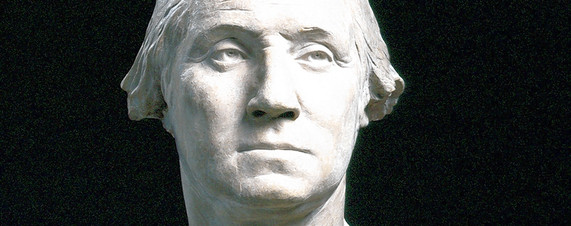
GWbust-Houdon

The Houdon bust of George Washington, based on precise measurements from life, recognized at the time as the best rendering of him as he was. The finished statue would be lauded by Washington’s close friend, Lafayette, with the words, “This is the man himself.”

The bicentennial of George Washington’s birth was long anticipated through the 1920s, as 1932 neared. President Coolidge had given acclaimed expression to the significance of the date as it approached, speaking before joint session of Congress on February 22, 1927. But the President, by that time in retirement, took occasion on the bicentennial itself to offer his reflections on the man who really was, as Coolidge put it, the first American. We must ask, what of anything resembling America’s best qualities would there be today without George Washington? There would have been no practical application of any of those ideals.

Published originally by newspapers of national circulation on February 21, Representative Bertrand Snell read Coolidge’s thoughts into the Congressional Record, where it can still be accessed today. What Coolidge wrote eighty-eight years ago speaks with timely clarity:


     The careful study of the life of George Washington has an intensely practical purpose. We want to know what he thought and what he did in order that we may be the better able to determine what we ought to think and do now at this difficult time. We shall find it providential that the course of our Nation was largely directed in our formative period by a man who was so human, so devoted in establishing a government of the people, and so experienced in private business that he was able to apply sound business sense to the promotion of the public welfare. 

     The celebration of the bicentennial of the birth of the first America which occurs on the 22nd of February of the present year, should, of course, include a proper estimate of him as a great statesman and a great soldier. It is in that character that we have come to think of him. He was both, and as such is entitled to all the praise that can be lavished upon him by the most eloquent. But that is not enough. It does not tell us of the real man nor give us any insight into how he became great. We shall fail in the most desirable comprehension of him unless we turn to the more practical examination of his growth and development and try to learn how to do things by finding out how he did them. 

     There are two kinds of biography which fall short of giving their readers the help which should be secured from an acquaintance with great men. Some of them endow their subjects with all virtue and all wisdom. Such characters appear removed from the reach of common people. They may admire and worship, but they do not feel any kinship. They gain only the impression of a superior being dwelling apart from his fellow men. It would seem almost sacrilege to attempt to imitate him or hope to be like him. Others, proceeding in an opposite direction, represent great men as devoid of most good qualities who have reached the positions they hold by being crafty and successful imposters. They are made to appear unworthy of credit or admiration and left to the inference that all greatness is a sham and a pretense. The logical conclusion is meant to be that there are no heroes and nothing is holy. Neither one of such portrayals is in accord with human nature or the truth. 

GW-JeanFerris1920

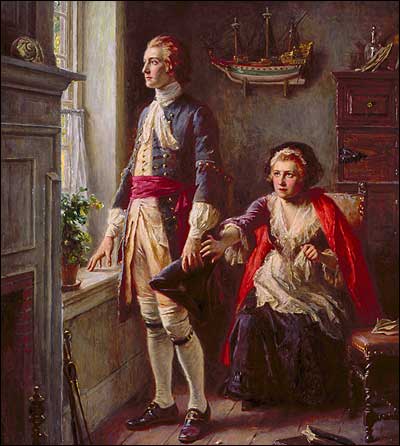
Call of the Sea, 1747, Jean Ferris’ 1920 rendering of fourteen or fifteen year old George Washington feeling the tug of a career on the ocean. His mother persuades him to stay. Photo credit: Vermont Historical Society.

     George Washington was well born. His father was a mature man nearing the forties and his mother was a young woman in the twenties. Neither of his parents had any place by reason of artificial rank or title, but they belonged to that great and strong aristocracy which ennobles itself by the power of its own achievements. They were both people of the world. Tradition has it that they first met in London, where the father was accustomed to go on his business as a successful Virginia planter. 

     It was a serious household into which this boy came. The young mother read the Bible and Matthew Hale’s Contemplations and Meditations. At a very early age her son appears to have been provided with a book of sermons. Of course, membership in the church and regular religious worship were the practice of the family. Faith was a reality in the Washington home. The Bible, the church, the sermons of pious men were all a source of inspiration for the practical affairs of everyday life. 

     While we do not know much of the details of the early education of Washington, we know enough to inform us on the development of his mind and character. In common with the times, his spelling was indifferent and his grammar insufficient. But he was proficient in writing and in figures. Form and numbers came naturally to him. In every sense he was a normal and fun-loving boy, but the loss of his father when he was but eleven perhaps increased his seriousness of mind. It was the practical application of what he was learning even in his early youth that stamped him as remarkable. The forms of business transactions, the precepts of correct deportment, as well as his arithmetic, which he pored over at school, were all instructions to him for the conduct of his daily life. In all things he became methodical and was always making plans for future action, whether it was the cultivation of his plantations or the freedom and government of his country. He educated himself to know how to plan and how to do — to be an executive. 

GW-copybook-excerpt

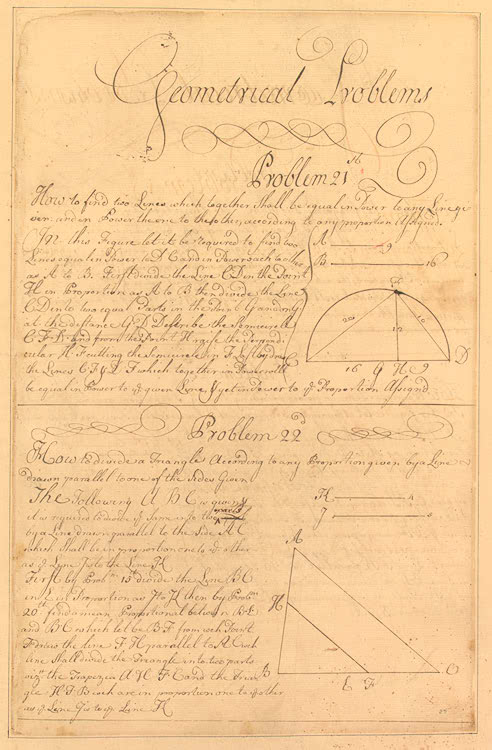
A page from young George Washington’s copybook. Photo credit: Library of Congress. 

     Although the Virginia of the first half of the eighteenth century has many of the aspects of a frontier, constant contact with Europe made it a home of many cultured people. The father of Washington when a boy spent twelve years in England. He sent the two elder brothers of George to Oxford. He might have followed had his father lived. As it was, he had the instruction of an English schoolmaster, and later of a Huguenot clergyman, who taught him the graces of polite society. His youthful copybooks show that he was trained and trained in these things until he became proficient. There was no accident and no miracle, but just hard work. 

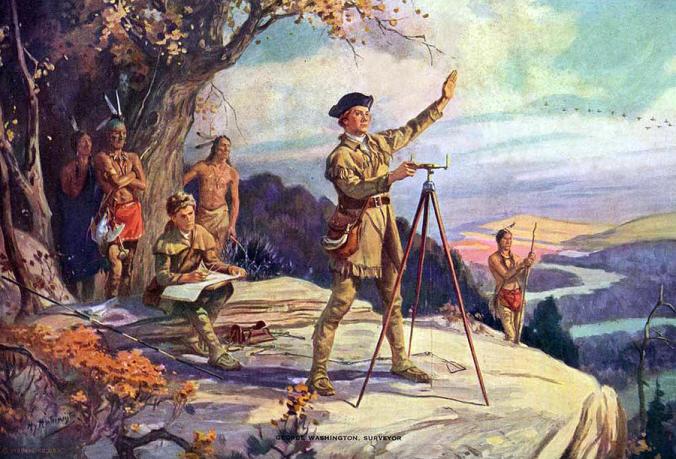
     The death of his father left him with the slender portion that customarily went to a younger son. All about him lay an uncharted wilderness. To bring land under order and law and advance his own fortunes he became a surveyor. His expeditions into distant woodlands in charge of a squad of men, where they must shelter and feed themselves for weeks at a time, the necessity for methodical accuracy involved in the undertaking, were the finest kind of preparation for his future campaigns. He learned how to estimate distance and location and see the military possibilities of wide reaches of country. 

     Likewise, Washington became a soldier by personal contact and painstaking study. After about the age of seventeen he lived much at Mount Vernon with his elder brother, Lawrence, who had been a captain of militia under Admiral Vernon in the Cartagena campaign and later a major and adjutant general of his district. He placed the young man under the instruction of old army officers who taught him fencing and the manual of arms. So proficient did the pupil become that before he was twenty he was appointed a major. 

george-washington-young-surveyor-everett

     The same kind of progress accounts for his political training. His father was a member of the Virginia House of Burgesses. His brother Lawrence held the same office. On the great estate below Mount Vernon lived Sir William Fairfax, collector of customs for the district, and president of the King’s council, so that in office he ranked next to the governor of the colony. A little below George Mason had a large plantation. This neighbor was a statesman of great ability and an earnest and consistent advocate of popular rights and local self-government. While these men were somewhat older than Washington, they were his constant companions. When he was but twenty-six he was himself elected to the House of Burgesses. He had to make a campaign to win his seat. His political career began at the bottom. For a number of years he was reelected, and had the opportunity at Williamsburg to take a prominent part in all the political action of the stirring period before the Revolution. No doubt he heard Patrick Henry make that speech which was interrupted with cries of ‘treason.’ During his time he was serving on committees, helping prepare documents and organize associations for the protection of the rights of the Colonies. In very early life Washington came to be a practical politician. 

     The same background appears in his business training. His father was an important business man, widely engaged in agriculture, mining iron ore, and at times took command of a sailing vessel. In those days there was little division of labor, and each estate was practically self-sustaining. Nearly everything that was necessary for food, clothing, and shelter was produced where used. Disposal of surplus made the planter his own merchant, exchanging his produce in England for what he could not raise at home. Successful operation on a broad scale of such enterprises required a man of affairs. That was the atmosphere of his early home. All through life his decisions were influenced by his great business experience. 

     When he was only twenty he found himself one of the executors and the residuary legatee of the will of his brother Lawrence. From that time on he had charge of all his father had left him, helping his mother care for her property, and had the management of the Mount Vernon estate of his deceased brother and ultimate ownership of it, besides his duties as major of militia and adjutant general of a district extending over a number of counties. The production of the soil, of the fisheries, of the mill, as well as the supplies for a great many servants and for a considerable force of militia, all passed through his hands. 

     In general culture Washington must have learned much from Thomas, Baron Fairfax, who came here in 1746 to have oversight of his vast estates which were managed by Sir William Fairfax. He was the holder of an ancient title of nobility, literary, an associate of Addison, a mature man of the world who lived and died a loyalist. He often employed the young surveyor and had him much in his company at his manor house and at his forest retreat. Washington had that rare faculty of being able to absorb what was best in the persons and things with which he came in contact and to disregard the rest. He applied himself to learning and applied his learning to living. He was a disciple of application. 

     Such was the preparation of George Washington, when, at the age of twenty-one, on the last day of October 1753, he set out to carry a letter from the Governor of Virginia to the French commander, warning him not to trespass on the country around the present city of Pittsburgh. The rest of his life belongs to history. 

     From this time on Washington was a leader in the great plan for the making of America. While New England wanted to be safe from attack from Canada, Virginia and her neighbors wanted to expand into the Ohio Valley. They saw it as a business venture. It was for that reason that Washington was sent to dislodge the French. That expedition started the Seven Years’ War, which finally brought all of North America, except the old Spanish possessions on the south and west, under British rule. The route to the western waterways was opened to the enterprise of settlement. 

Washington_1772

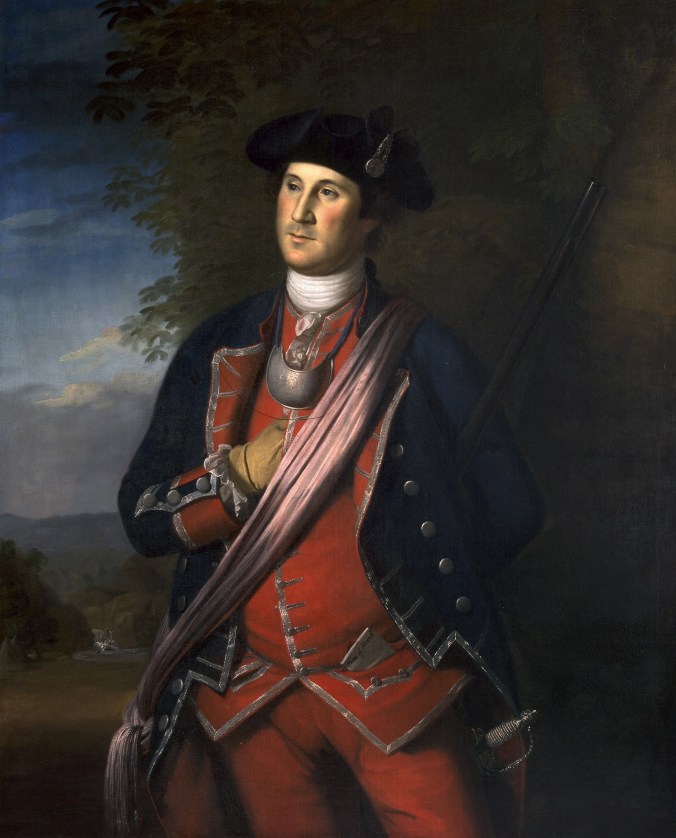
Washington by Charles Wilson Peale (1772). Colonel Washington was 40 years of age. 

     Following the end of the war, in 1763, there was a dozen years of agitation concerning the taxation and commerce of the Colonies. As a man of business, responsible for much property, engaged in exports and imports, Washington grasped the full significance of events, and with a deliberation that made his decisions the final word of the people took the patriots’ side. While it is impossible to say that he thus early had a plan for his country that he finally put into operation, it is a fact that all of the plans of consequence thereafter adopted by the country to the end of his life were the result of his approval and support. 

     When he went to the Congress at Philadelphia he wore his uniform. He knew that the issues meant war and he knew that war meant independence or annihilation. It was his plan for independence, which was for long periods solely dependent on his resolution and military skill, that finally prevailed. 

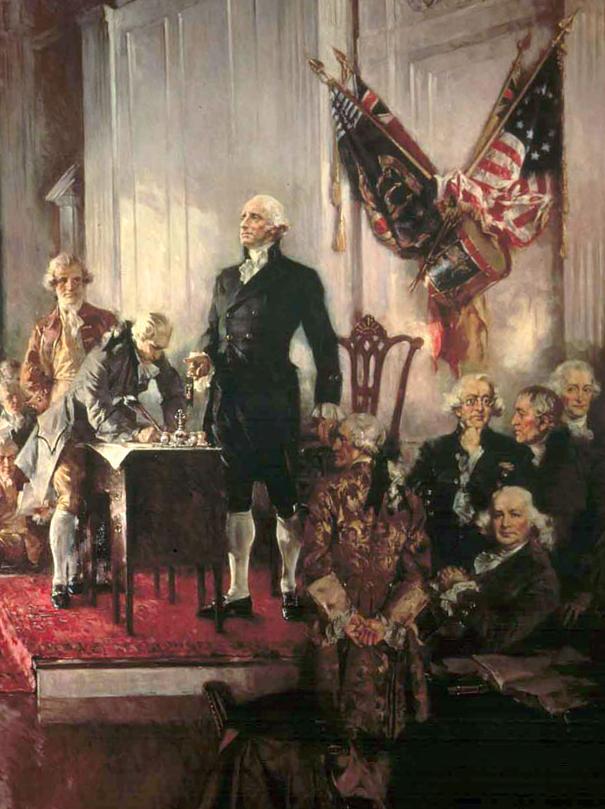
     When peace came, turning his attention to agriculture and commerce, he saw that the regions beyond the Alleghenies could only be held by economic ties dependent on transportation. He thought a canal up the Potomac was necessary. That meant the cooperation of several States. When a convention was called for this purpose it was found to be inadequate, and was dissolved, to be replaced by a national convention, called for the purpose of establishing a Federal Government. When it met, not only because he was the leading citizen but the leading nationalist, Washington was chosen to preside over it. The result was a proposal for the Constitution and the Union. As the war could not have been won without him, so the Constitution could not have been adopted without him. The Nation has since been governed in accordance with his plan. 

George_Washington_at_the_Philadelphia_Convention

Closer view of Washington, presiding officer of the gathering, from the famous Howard Chandler Christy 1940 Signing of the Constitution.

     It is one thing for a people to go through the form of adopting a constitution, but it is quite another to put it into successful and permanent operation. Our form of government was new to human experience. All the rest of the world thought it could not last. It was inevitable and absolutely necessary for Washington to be made the first President. Without his ability, his prestige, and his character, it is probable our Government might have broken up before it had a fair start. He made it a success because of his firm belief in the principle of government. He had had enough experience so that he knew the necessity of exercising all of the sovereign authority which the new Constitution provided. But his plan was for the exercise of the authority which the people themselves had created. His constant desire was to administer their Government. 

     Too little emphasis has been placed on his faith in a government of the people. When in the confusion and bankruptcy of the closing months of the Revolution, the Army started a movement to make him king, he promptly denounced it. He wanted a government of the people, but he wanted it to be a real government capable of governing. Law and order were his gospel. He sympathized with his soldiers and the people in their distress and sought to relieve them by legal means, but he would fight usurpation of a mob as readily as usurpation of a monarch. 

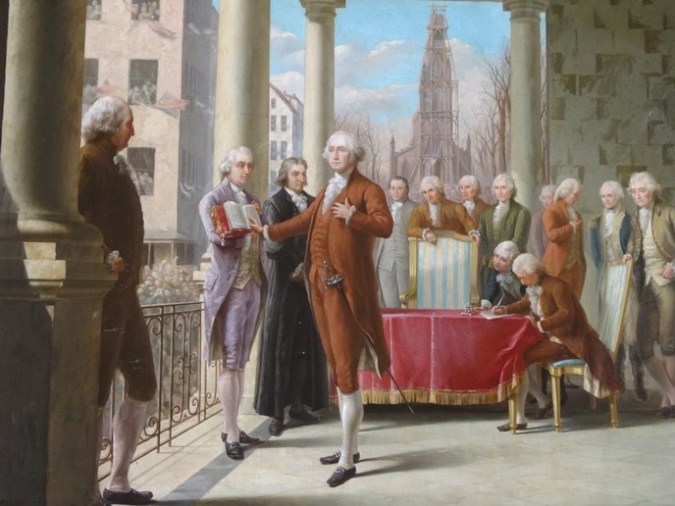
     When he took office, the most pressing requirements of the new Government and the people were financial. It was here that the sound business experience and the judgment of Washington were of supreme importance. He knew how to deal with questions of taxation, commerce, and credit. For working out the details he had Hamilton as his Secretary of the Treasury, but his were the final decisions. 

GW-oathNY

Washington depicted taking the Presidential oath of office, March 4, 1789, Federal Hall, New York. He was 57. Photo credit: National Park Service. 

     To provide funds, import duties, and internal-revenue taxes were levied. When some people in Pennsylvania resisted payment with force the Army was sent to execute the law. The debts of the States, contracted for national defense, were assumed. To facilitate the operations of the Treasury in collection and disbursing funds and maintaining credit operations a national bank was established. His policy was to strengthen the National Union sufficiently to make it a complete reality without encroaching on the States. He had seen enough of the futility of a government without authority when he commanded the Army. 

     His foreign policy was independence, peace, justice, and neutrality. Public clamor could not induce him to become involved in the French Revolution. He signed the treaty with England that was at first so unpopular and made a treaty with Spain, opening the Mississippi, because he knew both were beneficial to our commerce. 

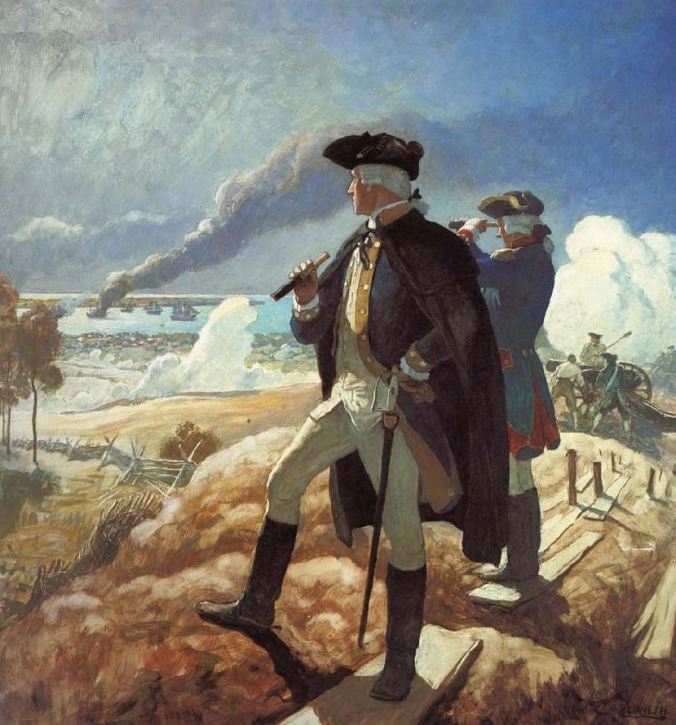
Wyeth Washington at Yorktown

Wyeth’s portrait of Washington

     Finally, he summed up his political creed in his Farewell Address. He believed in liberty and the Union unhampered by national jealousies. He urged respect for authority and obedience to law. Education, religion, and morality he considered necessary supports of free institutions. Careful maintenance of the public credit by a sparing use of it, impartial justice to all nations, permanent alliance with none, and adequate national defense were some of the important points in the wise plan for future action which he presented to his countrymen. 

     Washington had a deep understanding of human nature and a profound loyalty to the truth. He had the best political judgment and was the best soldier of his time. His permanent success as a statesman was due to his ability to apply business principles to political needs. Our country has never made a mistake when following his counsel. 

Happy Birthday, Mr. President! 

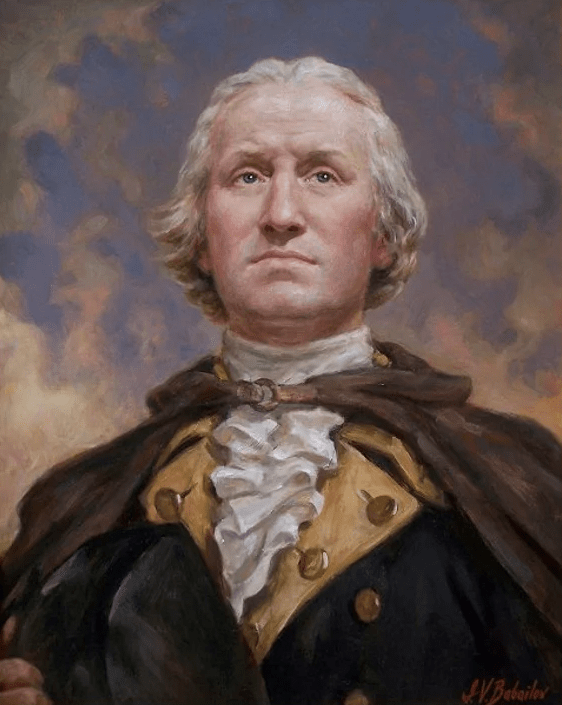
BelovedCountry-IB-GW

My Beloved Country — George Washington, based on the Houdon sculpture, oil portrait by Igor V. Babailov. Photo credit: Igor Babailov. 

On Beginnings and Endings, Part 2

“Great men are the ambassadors of Providence sent to reveal to their fellow men their unknown selves. To them is granted the power to call forth the best there is in those who come under their influence…No man was ever meanly born. About his cradle is the wondrous miracle of life. He may descend into the depths, he may live in infamy and perish miserably, but he is born great. Men build monuments above the graves of their heroes to mark the end of a great life, but women seek out the birthplace and build a shrine, not where a great life had its ending but where it had its beginning, seeking with a truer instinct the common source of things not in that which is gone forever but in that which they know will again be manifest. Life may depart, but the source of life is constant” — Calvin Coolidge, Women’s Roosevelt Memorial Association, New York, January 23, 1921

Rutherford Birchard Hayes 

  • Born October 4, 1822, in Delaware, Ohio. Father Rutherford and mother Sophia, Vermont shopkeepers, had left the Green Mountain State for central Ohio in 1817. Loss would strike early with father Rutherford’s death just ten weeks before the future President’s arrival. Raised by his mother, “Rud” and sister Fanny were the two of four Hayes children who survived childhood. Their two-story house on Williams Street in Delaware fell into neglect and was finally acquired by Standard Oil in 1921, which only afterward discovered its historical nature as a Presidential birthplace. Standard Oil put up the first $500 and offered to sell it back to the town if the remaining $7,500 could be raised. The effort failed to attract enough support and only $4,760 was raised. The home was demolished in 1926 and the lot turned into a gas station, as it is today. The Daughters of the American Revolution, at that same time, put up the plaque that serves as the oldest of now three markers in the town to “Rud” Hayes. An imposing 7-foot bronze of Hayes now stands at the corner of Sandusky and Williams Streets and a plaque in honor of Delaware’s now remembered son marks the connection. Hayes stock is certainly on the rise.
  • Rutherford B. Hayes died on January 17, 1893, at Spiegel Grove, Fremont, Ohio. The place that above all others would constitute home for Hayes and his family was the great house in Fremont, Ohio. Begun by the President’s uncle Sardis Birchard in 1859, to serve as a summer retreat to spend time with his nephew and family, it took five years to complete due to the scarcity of materials during the war. With three boys and four more to come, joined by one sister (though two boys would die in childhood), the Hayes clan needed space and lots of potential for exploration.
  • Something about Spiegel Grove reflects this irrepressible energy. There are lots of surprises to be discovered there too, more than you would think could be found in quiet Fremont. Sardis’ inclusion of a wrap-around verandah was especially delightful to his nephew and family. “Rud” spent the next twenty years adding on, making changes, planning further and installing new pieces to the place. The walnut and butternut staircase ascending to a 360-degree view of the property, put in as he prepared to leave the Presidency and retire, was part of how the house grew to meet transition. Where to fit his now 12,000-volume library became another impetus to expansion. It was during the last set of changes, in 1889, however, with the creation of more bedrooms and other spaces for the grandchildren, that former First Lady Lucy Hayes died. By then the 8-room original had mushroomed into a 31-room mansion. Hayes would stay and find comfort in the great house where so many joys had been shared. Like Tyler’s Sherwood Forest, a pet cemetery resides there too. He passed quietly among family and was first placed alongside her at the public cemetery in Fremont. In 1916, with the construction of the Hayes Museum near the home, they were reinterred together, with stones of Vermont granite (brought from the old Hayes homestead in Dummerstown, Vermont), beneath a wooded knoll on the grounds, a feature on the property they particularly loved.

James Abram Garfield 

  • Born November 19, 1831, in a log cabin built by his father Abram at Orange Township, Ohio. The last President to begin life between the walls of a cabin, Garfield would (like Hayes before him) never know his father, losing him in the first few months after his birth. His mother Eliza would raise him and the two would remain close for the rest of his life, Eliza surviving him by seven years. A testament to the changes of time, a replica of the Garfield cabin stands in Moreland Hills, the modern designation for old Orange Township, now a suburb of Cleveland.
  • As the appeal of “front porch” campaigns gained steam after early iterations by William Henry Harrison and others, Garfield built effectively on that concept. It seems to be especially a favorite approach among our Ohio Presidents, the campaigns of McKinley and Harding being even better-known practitioners of this homely, approachable style toward voters. As such, the Garfield home in Mentor, Ohio, which the press called Lawnfield (as they camped out on the front lawn while covering his Presidential campaign), continues to this day as the clearest view into the man, his family, and at least some of the qualities that brought him to the White House. Bought in 1876, “Mentor Farm” (as the Garfields called it) transitioned in the future President’s hands from 8 to 20 rooms and it was from here that Crete (Lucretia, his wife) established the Memorial Library in his honor, a precedent taken up by nearly every President contemporary to him and since. A voracious reader, Garfield combined real scholarship with selfless public service. His tenure may have been cut short but his legacy lives.
  • James A. Garfield died on September 19, 1881, at Elberon, New Jersey. Underscoring the agony that was the summer of 1881, we come to the site of a seaside cottage that now no longer stands, being torn down almost immediately after it failed to furnish the hoped for recovery of the President, shot eleven weeks earlier. Only a stone marker designates where the cottage stood, placed there through the lobbying efforts of twelve year old Bruce Frankel in 1961, who succeeded after four years of undeterred focus to remember the man once sincerely beloved by the nation. It is suitable that a boy gave the moving power to such a remembrance.
  • The imposing Garfield Memorial, rising as a sandstone sentinel above Lake Erie, in Cleveland’s Lake View Cemetery gives us a measure of how the nation once felt about him. Designed by George Keller, the Memorial was dedicated in the presence of former President Hayes, sitting President Harrison, and future President McKinley. Garfield’s body was solemnly interred within on that Memorial Day in 1890. Combined with Keller’s Gothic design, terra cotta panels by Caspar Bubel and a statue of Garfield by Alexander Doyle complete the story that endures here for all to witness.

Chester Alan Arthur 

  • Born October 5, 1829, in Fairfield, Vermont. Or, at least, we think so. Chester Arthur, it seems, draws controversy even still. The rumors at the time of his political notoriety that he was born on the Canadian side of the border continue to brood in the debate over where he was, in fact, born. The land on which the house originally sat was presented to the state of Vermont in 1903. The house, no longer there by that time, would be reconstructed in 1953, using old photographs of the original but, as often happens, further research found not only does this structure not correlate with the home in which Arthur was born (it was actually the second place the Arthur family lived following his arrival) but even the year was changed in his own accounts. His father, William, was an Irish immigrant to Canada who met and married Vermont-born Malvina Stone. “Chet” was actually the fifth of nine children, a preacher’s son.
  • Chester A. Arthur died on November 18, 1886, in New York City. He spent most of his life in Manhattan, living at 123 Lexington Avenue. It bears little resemblance inside or out to how it was when the President made this place home but, as often occurred when Arthur was involved, it once had a grand presence. It was where he took the oath of office when word of Garfield’s death came to his door on September 20, 1881. And it was in the privacy of his Lexington Avenue residence that he surrendered to the illness (what would later come to light as Brights’ disease) he knew was taking him to rejoin his late wife, Ellen, in eternity. Arthur is buried among family in the Albany Rural Cemetery in Menands, New York. Ephraim Keyser, in 1889, crafted a fine bronze sculpture of an angel placing a bronze palm leaf over the dark granite sarcophagus that contains his body. A bronze of Arthur himself stands in Madison Square in New York, installed there in 1898.
  • He had made good, done better than nearly everyone expected and proved faithful to a trust America believed he did not possess. He demonstrates the transformative power of integrity, whether the Office changes the man or the man resolves to do what is right, whatever he has been in the past. President Arthur deserves better than he has received from historians. That, too, is beginning to change.

Stephen Grover Cleveland

  • Born March 18, 1837 in the Manse (parsonage) of the Presbyterian Church in Caldwell, New Jersey. Born to Reverend Richard and Ann Cleveland and named for the preacher who preceded Richard at Caldwell, “Big Steve” was (like his Presidential predecessor, Chester Arthur) the fifth of nine children. Like many minister’s families, they did not stay in one place too long: leaving Caldwell, they soon found their way to Fayetteville and then Clinton, before Grover ventured on alone to Buffalo. His uncle there, Lewis Allen, would prove instrumental in the trajectory of Cleveland’s life, convincing him to stay and make a future there. Friends who remain long after a President’s service is done are true friends indeed. Grover kept a devoted number of them and it was that nucleus which began the process to acquire and preserve the parsonage in 1907, while Cleveland was still alive. The site would open to the public in 1913 and continues as the most enduring location dedicated to Cleveland’s memory today. Like in Fillmore’s case, there is not as much in Buffalo (or any other of the many places, for that matter, with a Cleveland connection) as there should be to this honorable, big-hearted, and courageous man. Maybe that is about to change.
  • It strikes the observer as interesting, even curious, that Presidents of certain marked similarities, at times, seem to follow in pairs. Of course, contrasts abound…we have Adams and Jefferson, Buchanan and Lincoln, TR and Taft, Ike and JFK. But we also see the parallels: Hayes and Garfield, both Ohioan veterans, both fatherless but both raised by stalwart mothers; Arthur and Cleveland, both preacher’s sons, both adopted New Yorkers, both fond of good company and both bachelor-Chief Executives (Arthur, who remained a widower while, in Grover’s case, was only a bachelor at the start of his first term); and Harrison and McKinley, both Ohioan commanders of volunteer units, both operating variations of the homespun, log cabin-front porch motif, and both discovering what it was like to follow Grover Cleveland’s bulldog-like tenacity in the Presidency.
  • Grover Cleveland died on June 24, 1908, at Westland in Princeton, New Jersey. Named for the Princeton University Professor (Andrew F. West) who, more than any other, facilitated his move to Princeton, the house had been designed by Robert Stockton in 1856. The President, always on the look for where to settle his growing family next, obtained the residence in 1896, just before pulling up stakes in Washington for the last time. He would improve the place, endear himself to Princeton’s students, add a pool table on the ground floor, and thoroughly relish their new life near the University. Never having gone to college, Grover prized not only improving the mind and body but of constructing sound character. He knew it was not enough to be intellectual, the real test was in the quality of manhood and womanhood given proper place in the development of young people. Cleveland’s body rests in the Princeton Cemetery. Though his wife, Frances, married again, her body rests beside his at Princeton. On either side of them, are daughters Ruth (who perished in 1904) and Marion (who joined them there in 1977). Daughter Esther and sons Richard and Francis are buried elsewhere. It seems fitting that Grover and Frank are, as they were in life, surrounded by children.

Benjamin Harrison 

  • Born August 20, 1833, at “The Big House” on his grandfather’s property in North Bend, Ohio. The grand home no longer stands but a marker identifies where the property once sprawled overlooking the Ohio River on its winding path west. Benjamin’s grandfather, President William Henry Harrison, and father, John Scott Harrison, are buried near the old site atop Mt. Nebo. Grandson Benjamin, though born a Buckeye, would become a Hoosier, as he began a new life in Indianapolis in 1854, less than two hours to the northwest.
  • The rising lawyer chose the still wide open northern outskirts of Indianapolis for a new home that would encourage the migration north of the city’s leading citizens. On North Delaware Street, just past I-65, the Benjamin Harrison Presidential Site is now virtually at the geographic center of Indianapolis today. Construction began in 1874 and was completed the following year, though originally without the front porch that would belong seamlessly with the home once it was added in 1896, only after Harrison had returned to private life. Continuing the “front porch” campaign tradition of predecessors like Garfield and successors like McKinley, Harrison actually gave his political speeches  for President to crowds gathered in the street in front of his home, demonstrating how to accomplish the same style without a literal front porch on which to deliver.
  • Benjamin Harrison died March 13, 1901 in Indianapolis. He passed away at home, in the quiet of his bedroom on the second floor of the beautiful house on Delaware Street. He, like John Tyler and Millard Fillmore, would lose his first wife and marry again. As such, his body rests a short distance away at the well-known Crown Hill Cemetery in Indianapolis, joined by first wife Carrie and second wife Mary.

William McKinley

  • Born January 29, 1843, in Niles, Ohio. Sometimes, beginnings and endings experience a tumultuous separation before reunion brings the pieces again together. Such has been the case with President McKinley’s birth home. The six-room double house was rented by the parents of the future President to fit a family that would grow to nine children. The President’s father, born in Pennsylvania, worked in pig iron and labored to feed four boys and five girls before the McKinleys moved on to Poland, Ohio, when young William was nine. McKinley and his mother later returned only once to the site at which time he gave a speech to the crowds gathered there to welcome him. Almost everything changed about the house, the lot it rested upon, and the town of Niles itself. The home became a store then was split into two to make way for a series of banks on the site. The half in which McKinley was born moved to Riverside Park. The other half went to Franklin Alley to begin life as a shop for manufacturing rotary press parts. By 1901, Riverside Park had failed and the half-house there languished. The two would actually be rescued and rejoined in 1909 to find renewed attraction as a Presidential tour site at Tibbetts Corners thanks to Mrs. Lulu Mackey, at what is now the intersection of Robbins Avenue and Route 422. An enthusiast for all things McKinley, she gathered a wide collection of memorabilia from across the years relating to the 25th President, including artifacts from McKinley’s time in Canton.
  • The dedication of the McKinley Birthplace Memorial in downtown Niles by 1917, however, upstaged the home, which sadly, burned in 1937, four years after Mrs. Mackey’s death. As the original site of the home on Main Street passed through a series of banks, the original location was once again claimed for the reconstruction (along the original plan of the double-house) of a McKinley birthplace. The McKinley Birthplace Home and Research Center finally came to fruition in 2003.
  • William McKinley died September 14, 1901, in Buffalo, New York. Having attended the Pan-American Exposition in Buffalo, he decided to return later to provide an opportunity for the many attendees to see and greet him once more before the President’s departure. Entering the Temple of Music on the afternoon of September 6, McKinley left it wounded and when the medical tent there failed to furnish adequate care, the President was rushed to the home of John G. Milburn, a civic leader in Buffalo and leading attorney (who had been McKinley’s host during the visit) on Delaware Street. The press camped on the street, the police attempted to cordon off the area from the curious and McKinley succumbed to infection in the wound eight days later. Vice President Theodore Roosevelt, just down the same Delaware Avenue in Buffalo at the home of Ansley Wilcox, would be administered the oath of office upon confirmation of McKinley’s death. The Wilcox House still stands and is open for tours. The Milburn House, however, is now no more. After being converted to apartments in 1919, it is now the parking lot for a local high school. A marker is the only sign of the history that happened there. Being the third President to fall by assassination, it would permanently change the status quo when it came to security provisions and Presidential protection. It would begin an aspect of the Secret Service’s work for which it is most famous.
  • The final resting place of President McKinley is in Canton, the city that was home for so many years. The sword-shaped design of the McKinley National Memorial, dedicated in 1907, was the work of Harold Van Buren Magonigle, the creator of the Liberty Memorial in Kansas City. A gently cascading pool running 575 feet was meant, in combination with the stairs leading up to the mausoleum, to symbolize the blade which had struck down yet another martyred President. The pool was removed in 1951 and yet the domed resting place of McKinley is no less moving a sight to behold today. It stands solemnly on a hill adjacent to the McKinley Presidential Library and Museum.

Theodore Roosevelt

  • Born October 27, 1858, in Manhattan. The brownstone home at No. 28 East 20th Street had been occupied by the Roosevelts for four years when Theodore was born. They would continue there until 1872 when commercial properties began crowding out residential spaces, pushing them further uptown. Ultimately, that process would overtake No. 28 and replace it with a retail shop in 1916. The Women’s Roosevelt Memorial Association would acquire the property after TR’s death in 1919. The move to restore and protect the birthplace became preeminently vital and it was one of the first women to become an architect, Theodate Pope Riddle, who replicated the home from its exact counterpart, No. 26 (still extant at the time but ironically demolished to make room for the Birthplace Museum) in 1922 and 1923. Rededicated in 1923, Edith Roosevelt and other members of the large family provided wonderful pieces for its refurbishment. It began the process that brought the birthplace site to its current 1865 condition, the year young TR watched from the windows to witness the sober advance of the Lincoln funeral procession.
  • Theodore Roosevelt died January 6, 1919, at his home, Sagamore Hill, in Oyster Bay (now Cove Neck), New York. The ground purchased by Roosevelt in 1884, with the vision to design a Queen Anne home there for his wife Alice Hathaway Lee Roosevelt to be named “Leeholm,” all changed with her sudden death that year and he sought solace in the Dakotas. Returning refreshed and remarrying Edith Carow in 1886 rekindled that original concept and TR, as with most of his projects, poured into its completion. Appropriating the Algonquin for chief, he designated the place the Roosevelt family would make home, Sagamore Hill. It would be the summer White House each year of his administration, placing the expansive residence in a unique role on the stage of history beyond the notoriety of its owner. It would be, after all, from where TR helped negotiate stages of the peace talks and settlement discussions between Japanese and Russian diplomats worked out at Portsmouth, New Hampshire, for which he would be awarded a Nobel Peace Prize in 1906. TR’s body rests at last nearby in the small Youngs Memorial Cemetery at Oyster Bay Cove.

William Howard Taft

  • Born September 15, 1857, in Cincinnati, Ohio. Like Hayes before him, Taft’s ties to Vermont are only one generation removed, his father Alphonso coming from Townshend in the Green Mountain State. Like many a pioneering Vermonter, however, he went west. Alfonso would find opportunity in Cincinnati in 1838, and with it the 3-year old Greek Revival house up on Mount Auburn, high off the humid, mosquito-infested, sometimes unhealthy waterfront in town. There, “Bill” came into the world nineteen years later. The property reflected the beauty of the heights but also the mix of rural and urban living as Cincinnati’s development continued to creep up from the river. It would play host to many of Ohio’s foremost personalities of the Gilded Age, including fellow Ohioan James Garfield, underscoring the house shared more than one Presidential connection. It was in their father’s library that the family spent much of their time, no doubt inspiring the children with the love of books and self-improvement through the written word.
  • William H. Taft died March 8, 1930, at his home in Washington, D. C. Reaching his lifelong ambition to become Chief Justice of the Supreme Court in 1921, the only President to also serve in that capacity, found relief after an extended decline in health at his home, 2215 Wyoming Avenue NW, what much later has become the home of the Syrian embassy. A man who never really wanted the Presidency, he was a conscientious Chief Executive and left much more impact on the Office and the modern Presidency than is usually recognized. He deserves much better than the disappointment with which TR enshrouded him. As if being the head of two branches of government was not enough, he adds to them another, the first President to be buried at Arlington. The only other President is John F. Kennedy. James Earle Fraser completed the 14-foot dark mahogany granite headstone with gold leaf inscription in 1932. Taft is due for a new appraisal.

Thomas Woodrow Wilson

  • Born December 28, 1856, at the Manse (Presbyterian parsonage) in the Gospel Hill district of Staunton, Virginia. Designed by Reverend Rufus W. Bailey, founder of Augusta Female Seminary, and built by John Fifer of Augusta County (the father of a future Governor of Illinois), the manse is a practical expression of the Greek Revival style, with straight, inflexible lines. The effort to acquire the birthplace as a Presidential site began after his death in 1924 through the trustees of Mary Baldwin College. Approval of the Presbyterian Church for its sale to the college came in 1925 and care for the site continued until the formation of an organization who would take on its preservation and Wilson’s legacy. The Woodrow Wilson Birthplace Foundation began in 1938, restoration of the home began in 1940 and in 1941 President Franklin Delano Roosevelt dedicated the home with all the hope Wilson had embodied in life.
  • Woodrow Wilson died February 3, 1924, at his home in Washington, D. C. The first President to make Washington a permanent residence, Wilson chose Embassy Row, the line of diplomatic homes that often partakes of a very colorful history of occupants. Designed and constructed in 1915 by Waddy Butler Wood in the Georgian Revival style, the home was a continuous residence for Mrs. Wilson until her death in 1961, when she bequeathed it to the National Trust for Historic Preservation. As such, it contains quite a collection of materials. In keeping with the traditions of the Washington National Cathedral (in respectful imitation of Westminster Cathedral in London), the Wilsons are interred together (at least President and the second Mrs. Wilson, the first lies at Myrtle Hill Cemetery in Rome, Goergia) there. Wilson’s body was moved from the Bethlehem Chapel to the nave of the Cathedral in 1956, on the centennial of his birth. The couple now rest in what is called the Wilson Bay on the grounds.

Warren Gamaliel Harding

  • Born November 2, 1865, in Bloomington Grove, Ohio. The first President to be born after the War that pitted states North and South against each other, Harding began life in an inconspicuous farm house built in 1856. The house was torn down in 1896 and only a stone marker and sign remain beside State Route 97 to guide visitors to the site now. Harding would move to Marion less than an hour away and become a successful newspaper editor, the first member of the Fourth Estate to enter the White House. For all his shortcomings, he does not deserve the infamy heaped upon him. Much was accomplished of significant good in his tenure, on both the domestic and foreign policy fronts. The Budget Bureau overhaul of federal finances, the resolution of unsettled issues left from the Great War, the beginning of a reversal of the segregation of the civil service imposed by Wilson, and the pardon of political prisoners jailed by the Justice Department, were just some of the matters taken up and handled by Harding and the team he assembled. It all began with the platform afforded by the revitalization of the “front porch” campaign method that Harding adopted with incredible success. His home at Marion provided what is perhaps the last great expression of this long-standing tradition. The beautiful home, in which the Hardings lived from 1891 to 1921 (when they left for Washington), was first opened in 1926 to display only a select few rooms and artifacts. In 1965, the home was restored to its 1900 appearance. Through the collaboration of the Harding Home Presidential Site, Ohio History Connection, and Marion Technical College, the home is currently being restored to its 1920 appearance and a newly constructed Presidential Library and Museum set to be opened in September of this year, just in time for the centennial of Harding’s Presidential landslide.
  • Warren G. Harding died on August 2, 1923, in Room 8064 on the eighth floor of the Palace Hotel in San Francisco. On a grueling speech tour of Alaska and the West coast, Harding collapsed and rendered his last breath on that August evening while Florence, his wife, read to him. It became the sixth time a President had died in office, and the fourth time the stirring sight of a Presidential funeral train returned a son to Ohio. Lying in state in the Capitol, the journey brought Harding’s body home to Marion to await internment in the Marion Cemetery Receiving Vault. Both Hardings now rest in the last of the ornate tombs built for our Presidents. Completed in 1927 according to the winning design of Henry Hombostel, Eric Fisher Wood and Edward Mellon (chosen by national competition), the memorial imitates the circular structures of Greek and Roman antiquity. The Hardings were reinterred in the midst of the circle of pillars upon its completion and the site dedicated in 1931 not only by President Hoover but former President Coolidge. The sealed sarcophagi retain the open-air quality they requested, beneath the sun and stars where the two were content to be.

John Calvin Coolidge

  • Born July 4, 1872 (the only President born on that most auspicious of days), in the small living quarters attached to Cilley’s Store in Plymouth Notch, Vermont. Named for his father, who owned and operated the store at the time, Calvin Coolidge would return frequently to the small village of his birth to rest and reconnect with the anchor of family memory, work on the farm, and life away from the illusions and delusions of politics. Sister Abbie would join the family almost three years later, in 1875. The next year, the family of four would move to a house just across the road, what would become the site of one of America’s most inspiring scenes in the early morning hours of August 3, 1923, when father Coolidge administered the Presidential oath of office to his son. The Homestead, as it would be called, received a lot of work inside and out over time. Coolidge’s father added the iconic front porch, attached the barn for the horses, built the 2-story front bay, and other improvements. Coolidge’s later additions would be removed to restore the home to its earlier appearance. The cheese factory, operated by the family, remains active and the Church, Wilder House (where Coolidge’s mother grew up), and Store continue to perpetuate the enduring nature of the Notch’s unique, intangible charm. Nestled as it always was between the hills (hence a notch), the surrounding land, preserved open and untouched by the President’s son John, includes the Wilder Barn, the Museum & Education Center (launched in 1972 and expanded in 2010), a blacksmith shop, the garden maintained by Coolidge’s stepmother as well as other remarkable things to explore along the way. Further down the road is the farm of Coolidge’s grandparents and, heading in the opposite direction, the cemetery where rest not only members of the Coolidge family but other pioneering inhabitants of old Vermont.
  • Calvin Coolidge died on January 5, 1933, at The Beeches in Northampton, Massachusetts. Having moved from the beloved half-duplex they had rented for most of their lives on Massasoit Street, the Coolidges in post-Presidency simply could not live as normal, inconspicuous citizens any longer where they had been. They had tried and finding the searing light of press and public attention unremitting, they decided to move. They would not so reorder their existence as to leave Northampton but they would seek a larger property with the isolation of woods and a gate to discourage the sudden appearance of visitors peering in their windows or tourists constantly driving by to stare at them…or worse, get out and want attention. So when a house set well off the street on Hampton Terrace with six acres became available, the Coolidges bought it. Nothing about the home was typical of Northampton, or the Coolidges for that matter, but it had privacy and space for all the possessions they now had to find room for after leaving the White House. The President would laconically declare: “It is easier to get into the White House than out of it.” Moreover, the new house had a view that could be enjoyed without advertising to neighbors or passersby that a former President was there at all. The Beeches gave them what they could never have on Massasoit Street: the return of peace and quiet. Coolidge would meet death preparing to shave that unseasonably springlike day in January. Grace would return from a short walk to town and find him already gone, ready to do what she had first seen him comically engaged in doing almost three decades earlier. Following simple services in Northampton, a small number of close friends accompanied the family to the northward trek back to Plymouth. There, understated as Cal wanted it, remains his headstone, with only the Presidential seal to indicate any important personage rests there. His body is flanked by wife Grace, son Calvin Jr. (who preceded them), and son John with daughter-in-law Florence joining his mother and father and the older members of the family, all together again in eternity.