
The American Red Cross National Headquarters as they appeared in 1922.
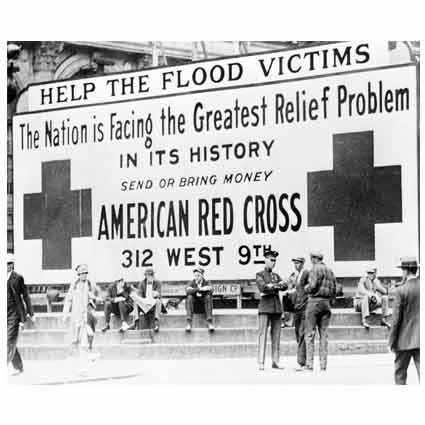
President Coolidge took his place before the seventh annual convention of the American Red Cross the evening of October 3, 1927. A nationwide hookup, beginning its time slot at 7:30 to be ready for the President’s address at 8 p.m. had already been prepared. The central focus on everyone’s minds was the disastrous flooding of the past summer that had left so many dead, displaced, and otherwise distraught over what remained ahead not only for disaster relief assistance but picking up the pieces in the aftermath.
Standing on the site dedicated by President Wilson for the Red Cross Headquarters back in March 1915, Coolidge had proved his remarkable skills as a disaster relief fundraiser yet again, first exhibited in response to the devastating earthquake that hit Japan in 1923, shortly after he had taken office. Cal would continue to encourage the vital work of the Red Cross to the very end of his tenure. Mistakenly portrayed as a cheapskate by some over the years, Coolidge supported the extensive work taken on by the American Red Cross, including its part in the cornerstone dedication of the Women’s World War I Memorial Building in Washington. The structure would be intended for the use of the D. C. Chapter of the Red Cross. He would attend the ceremonies, held the next year (May 1928), helping former First Lady Edith Wilson dedicate the site in honor of the ladies who had served in so many ways during the late conflagration. But more than, he had a great deal to commend when it came to the Red Cross’ role in mitigating the suffering and meeting the various needs of those forever changed by the Mississippi River Floods of 1927.

President Coolidge and former First Lady Edith Wilson dedicating in May 1928 the new cornerstone for the Women’s World War I Memorial Building completed in 1930.
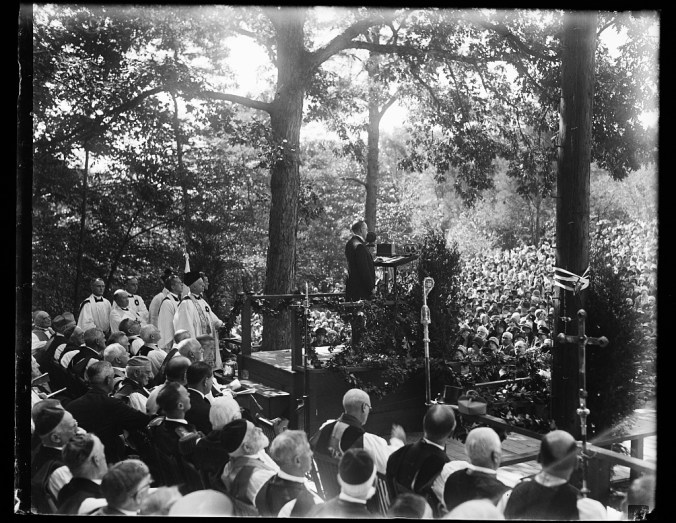
The President took to the podium and spoke crisply into the microphones that carried his message to nearly every radio in the country. Coolidge began:
Members of the American Red Cross:
The past months have been times of great activity on the part of our organization. For the fiscal year which ended June 30 relief was extended in 20 different disasters which occurred abroad. Nearly $643,000 was devoted to foreign work. In the same year $8,216,893 was expended in relieving about 690,000 people as a result of 77 domestic disasters. In this sum only about $3,000,000 of the Mississippi flood fund is included, but it does cover $4,480,000 used for relief and rehabilitation due to the storm in Florida, which occurred last year. Including the $3,000,000 expended on the Mississippi flood, the aggregate amount used at home and abroad in the charitable work of this organization in the 12 months referred to amounts to about $16,000,000.
The main work of the present season has been caused by the Mississippi flood. While high water in this basin has been of constant recurrence, the rise this year was 2 or 3 feet above any other record from Cairo to the Gulf of Mexico, a distance of over a thousand miles. Dikes were broken down in 145 places, submerging over 20,000 square miles, involving 174 counties in parts of 7 States. The means of communication were entirely interrupted, much livestock was destroyed, and homes of more than 700,000 persons were flooded. It is estimated that about 250 people were drowned.
The Red Cross established its first flood-relief camp in Arkansas on March 28. In April the situation steadily grew worse. When, on April 21, the city of Greenville, Miss., was inundated, it was realized that a serious catastrophe was impending. The following day the full organization of the Red Cross was placed in action. I issued a proclamation asking the people to contribute $5,000,000 for its work. I named a committee of the Cabinet to see that all the resources of the Government were made available. Secretary Hoover, as a member of the central committee of the Red Cross, was placed in charge of operations. Cooperation and coordination were assured through his general direction and leadership, ably assisted by James L. Feiser, acting chairman of the Red Cross in the absence abroad of Judge Payne. Accompanied by Gen. Edgar Jadwin, Chief of Engineers of the War Department, they left for Memphis on April 23. They have made four trips since, spending a total of about 75 days in the flooded area. The Secretary of War has also been on the scene of the disaster.
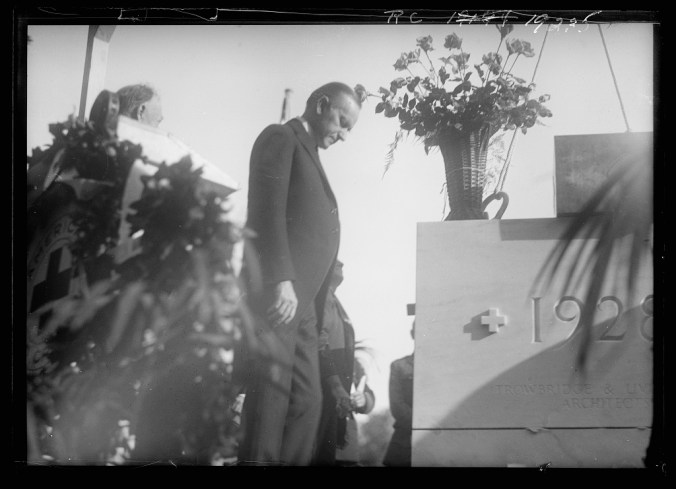
President Coolidge at the cornerstone dedication the following year. Photo credit: Library of Congress.
The story is one of the fine chapters in American history – a record of generous response to a call for funds, of the high devotion to duty by those engaged in saving life and relieving distress,and of endurance and courage shown by the people of the stricken area. The North and the South have been brought closer together in the bonds of sympathy and understanding. The heart of an entire nation has been quickened.
I issued a second call for an additional five million dollars on May 2, and our country quickly responded. Without further request, the Red Cross fund has now reached a total of over $17,000,000. The money in hand is sufficient to carry the relief still required and the reconstruction plans, already under way, well beyond January 1.
There were many deaths from drowning prior to April 22, but so efficiently was the relief extended that less than half a dozen persons lost their lives thereafter, although the perils were very great. The health of the refugees was so well guarded that there were more births than deaths in the concentration camps. A recent medical survey of the districts affected shows that, generally speaking, disease is less prevalent now than in previous years. This affliction may have proved a blessing in disguise. Undoubtedly the people have learned lessons of sanitation and health which will not be forgotten. The lands have been enriched by deposits of river mud, and many of the farmers, supplied with a better quality of seeds than used before, have been astonished by the size of the crops they have been able to grow since the waters subsided. New buildings will be better than the old. The advantages will remain. And, finally, we propose to solve the problem of flood control so such a situation may never again have to be met. In the solution we shall advance our system of inland waterways.
The $17,000,000 contributed to the Red Cross for Mississippi flood relief by no means represents the total expenditures. It is extremely difficult to estimate the value of the services, the equipment, and the supplies given by the Federal Government, but it probably amounted to about $7,000,000. Of course, a great deal of the equipment will be salvaged.
The railroads in the affected area responded superbly. They provided thousands of box car for shelter, gave free transportation for works and materials – all at an approximate cost of $3,000,000. Other large corporations were most generous. In addition there were important contributions from the States affected and from a variety of organizations in various parts of the country and personal services given by thousands of volunteer workers.

President Coolidge begins the annual Red Cross membership drive in 1923, being pinned by Miss Janet Moffett, daughter of Admiral (and MOH recipient) William A. Moffett.
Never before have so may governmental departments been used in the disaster relief work. The War Department had former experience in working with the Red Cross and was familiar with the Mississippi through its Engineer Corps. This department not only did what was possible to hold the levees intact but provided tents, cots, blankets, stoves, and clothing from various depots to the value of $3,000,000. Rescue work was organized in four districts, each under an Army engineer. Marine and aerial activity was coordinated in a most effective way. The Army and the Navy furnished more than 50 airplanes. Without the plane and the radio, the fatalities and destruction would have been much greater. They worked together, collecting and transmitting information, scouting for refugees, and transporting rescue workers and placing in needed points in the quickest possible time medicines and other emergency supplies. A fleet of 1,000 boats, large and small, was used. It came from the Navy, the Army Engineers, the Coast Guard, the Lighthouse Service, and the Coast and Geodetic Survey under the supervision of the Department of Commerce, the Mississippi River Commission, the Inland Waterways Corporation, and other sources.
The Navy contributed 21 airplanes, which covered a total of 100,000 miles, 2 tugs, 16 radio sets, some motor boats, 59 officers, and 155 men. In addition to the work of its Coast Guard, the Treasury Department put its Public Health Service to work on the many serious problems. Nineteen medical officers and four sanitary engineers, thoroughly experienced in public health emergency work and familiar with the localities, at once were placed at the service of the State health officers. Nurses were provided, also about $60,000 worth of equipment and medical supplies, including vaccines and serums. A protective sanitary program has been mapped out, in which the Public Health Service is cooperating with the State and local authorities in 19 counties in 7 States for a period of 18 months, until such authorities can assume the full burden. Of an estimated expenditure of $1,000,000 for the fiscal year 1928, the Public Health Service has agreed to pay $262,000, and to furnish about $200,000 more for 1929. The Rockefeller Foundation is helping to finance the balance of the cost. This work will be of lasting benefit to that country.
The Coast Guard, under the supervision of the Treasury, took up its traditional work for those overwhelmed by the waters. It had 128 boats and 647 officers and men in service, and manned and operated 40 additional boats. This force helped other agencies in rescuing victims of the flood, transporting officers and workers, distributing supplies, salvaging livestock and property, and establishing and operating telephone and telegraph and radio communication.
The Farm Loan Board, through its intermediate credit banks, assumed a very important service in the work of reconstruction. It was realized that money was needed to enable the farmers to replant their crops, to assist local industries with working capital, and protect the local banks. An emergency finance corporation with local capital of $500,000 was organized in each of the States of Louisiana, Arkansas, and Mississippi. At my suggestion to Lewis E. Pierson, its president, the Chamber of Commerce of the United States secured the doubling of this capital through the subscriptions of financiers in other States. The intermediate credit banks have undertaken to discount loans made on this capital of $3,000,000 under terms that will provide total credit resources of $12,000,000. As over a considerable area replanting this year has been impossible, it is suggested that the finance corporations be continued to assist in the 1928 crop operations.
The Department of Agriculture cooperated through the extension forces employed jointly by it and the State agricultural colleges. These agents assisted in moving persons and livestock out of the flooded area and aided the Red Cross in determining certain measures of rehabilitation, the kinds of seeds to be bought, and the best methods of planting. The home-demonstration agents were most useful in the refugee camps and in giving advice on home problems to be faced later by the farmers. The Post Office Department had a difficult problem in handling the mail, which it met most acceptably. The Veterans’ Bureau was also of great assistance.

In addition to this participation of the National Government we must not fail to remember the services rendered by the States themselves through their militia, health, and other departments, and by the American Legion. To mention all the industries and organizations which played a helpful part would make an almost interminable list.
So well had the situation been composed by July 12 that the flood relief headquarters, originally established at Memphis and later moved to New Orleans, were transferred to national headquarters here in Washington.
Over 600,000 people have been dependent on the Red Cross for food, clothing, and medical assistance. While nearly 280,000 insisted upon remaining in their water-logged homes, where the task of caring for them was tremendous, 330,000 were transferred to the Red Cross refugee camps, one of which contained as many as 20,000 persons.
When the floods receded the refugees were returned to their homes. Then began the no less important work of rehabilitation and reconstruction, with specially constituted State commissions to work in cooperation with the Red Cross. This included furnishing shelter and household goods where necessary, repairs to buildings, livestock, agricultural implements, and seeds. Out of a crop acreage of about 4,500,000 which was flooded, 1,622,000 acres have been replanted through the assistance of the Red Cross. The crops include cotton, corn, oats, soy beans, peas, wheat, sweet potatoes, alfalfa, and garden truck. Over 100,000 families have been rehabilitated. Now, all except 8 per cent of the people affected are able to provide for themselves.

President Coolidge, Cabinet officers and staff with Red Cross leaders, 1923.
The people of the South are most appreciative of the assistance given to their stricken States. In my capacity as President of the United States, and as head of the American Red Cross, I wish to extend the highest commendation and thanks of the country to the members of the Cabinet, to all Government officials and employees, to the officers and staff of the Red Cross, to the thousands of volunteers, and to other persons and agencies for the unselfish contribution of time and substance to this great humanitarian work in the Mississippi Valley. But, in our admiration for the stupendous work done there, we must not forget that the Red Cross organization has functioned efficiently throughout the year in every emergency call and in all of its regular activities.
Much glory has been added to our Red Cross emblem. More and more it is coming to be recognized universally as the symbol of love, sympathy, and charity for all those in suffering and distress. Its benign influence reaches out to touch and soften our daily lives, dispelling envy and malice, so that we think less of self and more of others, bringing more of peace on earth and good will toward men.


 The Importance of the Obvious