On Our Own Ships

shipping1

We have been all too long oblivious to the duty which we owe to ourselves as a nation. It cannot be a sound business policy to employ our competitors to transport our production to market. It cannot be a sound business policy to neglect this second line of our naval defense.

No nation ever long maintained a place in the world without a merchant marine. No nation has ever failed to grow great and powerful that had the advantage of such foreign trade as ours when borne in its own ships. This great prize cannot be developed without effort. It cannot be secured without expense.
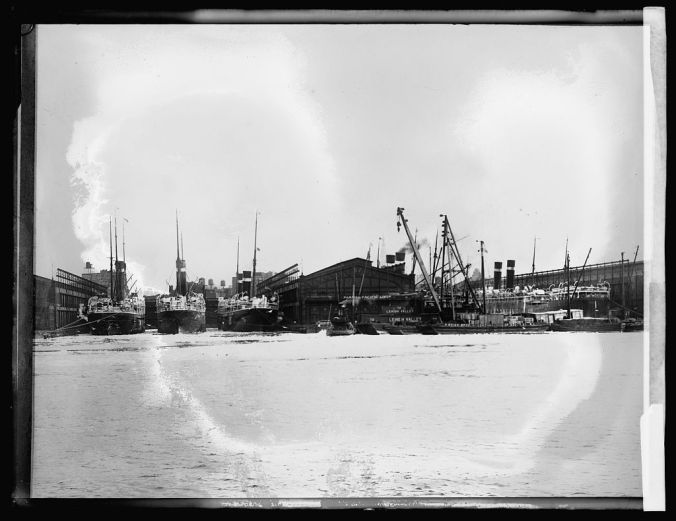
mmservice-1920

Some ships of the merchant marine, 1920
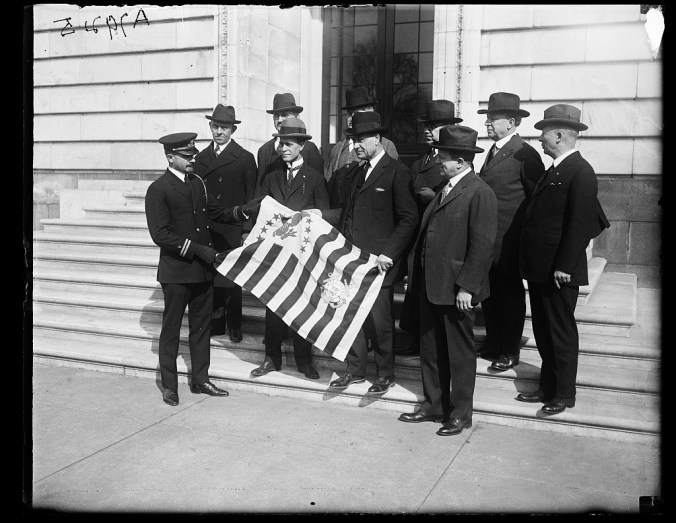
WLJones-USCG-1924

The Jones Act, sponsored by Wesley L. Jones of Washington State, passed into law two summers before Coolidge’s speech at Portland, continues to draw sharp critics on all sides of the issue. Its repeal, long sought, has not yet succeeded. The Act maintains that shipping between U. S. ports must be: (1) Made in America, (2) Owned by American citizens, and (3) Have a crew 3/4 American. The arguments on both sides have long been exchanged but there are also good reasons for maintaining our own ships carrying our own goods to the markets interested in buying them. For Coolidge (as for Jones), the cheapest answer is not necessarily the best one. 

Portland-Yard

Portland, Oregon’s Peninsula Yard, 1915. The Jones Act of 1920 had the effect of joining Portland’s shipping to the Territory of Alaska’s markets and supply needs. The Act firmly placed reliance throughout territories like Alaska and Hawaii on American ships over those of foreign suppliers. 

If the people want it they must be prepared to pay for it, but the rewards of security, of prosperity, of those commercial relationships which make for the peace of the world and for the advancement of an enlightened civilization will repay us many fold. 

— Vice President Calvin Coolidge, excerpt of speech at Portland, Oregon, August 15, 1922

Navy_Marine_Memorial

The Navy-Merchant Marine Memorial was originally designed by San Francisco architect Harvey W. Corbett way back in 1922. It would be sculpted by Ernesto Begni del Piatta, who died in 1939 before its completion. 

On Standards

CC-AllenField-7-27-1920

The law alone cannot establish standards, that must be done by the people themselves. If all honor is to be given to wealth and place, there is bound to be an unending clash of interests. But if service be made the standard, if men are judged not by what they have, but by what they are, if they will cease putting all the emphasis on what they are going to get and more of it on what they ought to do, if they will refrain from giving the entire attention to the material side of life and live more in accord with their intellectual, social, and moral nature, if they will apply the teachings of religion, the discord and discontent will give place to harmony. No one has ever proposed any other practical remedy [to our political problems].

— Calvin Coolidge, excerpt of speech before Presbyterian General Assembly, May 21, 1922

On Power and Pledges

Page 1-4

But the fact that there is evil abroad, that there are those who are bent on wickedness and that their efforts oftentimes prevail, that there are limitations, is no reason for losing faith in the right. The fact that obligations may be disregarded, that pledges may be broken, is no reason for losing faith in honor and integrity. There are those those who argue that if government has sometimes been a means of oppression, that therefore government should be abolished, that if property has sometimes made its possessors selfish and cruel, that therefore property should be abolished. They argue, perhaps unconsciously, that if power has been misused by some, that power therefore should be abolished. The plain fact is that power cannot be abolished, nor can government and property, which are a species of power. Wherever mankind exists, these exist. Our only remedy is to regulate their use and strengthen the disposition to employ them all not for oppression but for service. 

This is but stating the condition into which mankind is born. This is but recognizing those restraints which are created by his very existence. We do not live in an imaginary life. We live in a real life. The individual may occasionally and temporarily secure an advantage for which he has made no return, but this is always impossible for society. Whatever it has, it must create itself. It is an entire delusion to look for a state of freedom, a system of government, an economic organization, under which society can be relieved from the necessity of effort. To be the beneficiaries of civilization is not easy, but hard. Those who promise an existence of ease are not raising mankind up, they are pulling them down. The greater freedom that men acquire, the better government they maintain, the higher economic condition they reach, the more difficult, the more laborious must be their lot. It is not a life of ease that will ever attract men, but the possession of power which comes from achievement, and the possession of character which is the result of sustained effort in well doing…

— Calvin Coolidge, excerpt of address before the Presbyterian General Assembly, May 21, 1922