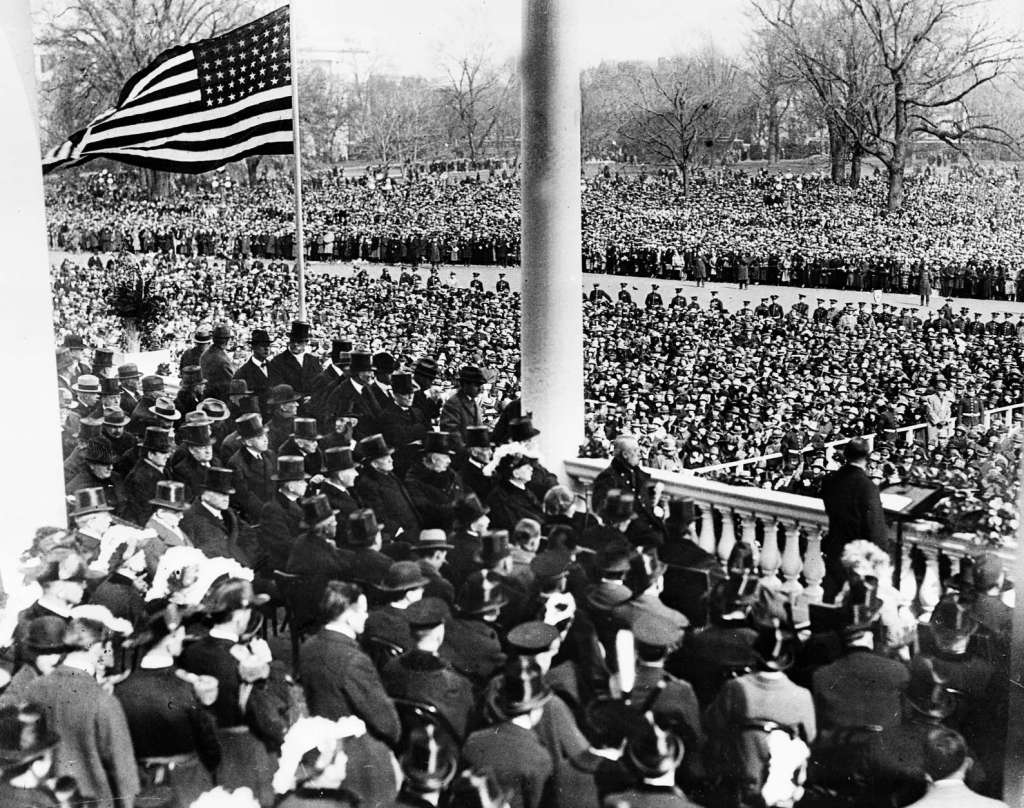
It was ninety-six years and three days ago that the ever-prescient Calvin Coolidge spoke these words over the radio from the White House, just ahead of the 1924 election. It is here reproduced in its entirety:
The people of our country are sovereign. They have no right to say they do not care. They must care!
The institutions of our country rest upon faith in the people. No decision that the people have made in any great crisis has ever shown that faith in them has been misplaced. It is impossible to divorce that faith which we have in others from the faith which we have in ourselves. The right action of all of us is made up of the right action of each one of us. Unless each of us is determined to meet the duty that comes to us, we can have no right to expect that others will meet the duties that come to them. Certainly we cannot expect them so to act as to save us from the consequences of having failed to act. The immediate and pressing obligation for tomorrow is that each one of us who is qualified shall vote. That is a function which cannot be delegated, which cannot be postponed. The opportunity will never arise again. If the individual fails to discharge that obligation, the whole nation will suffer a loss from that neglect.
America, more thoroughly than any other country, has adopted a system of self government. Sometimes we refer to it as the rule of the people. Certainly it is a system under which there is every opportunity for self government and every encouragement for the people to rule. Ours has been described as a government of public opinion. Of course, public opinion functions all the time. It no doubt has its influence on the actions of the executive and legislative branches of our Government, and even though it be imperceptible on any given occasion it is probably, as time passes, reflected in the courts. But all the influence of public opinion, all the opportunity for self government through the rule of the people, depends upon one single factor. That is the ballot box. If the time comes when our citizens fail to respond to their right and duty, individually and collectively, intelligently and effectively at the ballot box on election day, I do not know what form of government will be substituted for that which we at present have the opportunity to enjoy, but I do know it will no longer be a rule of the people, it will no longer be self government. The people of our country are sovereign. If they do not vote they abdicate that sovereignty, and they may be entirely sure that if they relinquish it other forces will seize it, and if they fail to govern themselves some other power will rise up to govern them. The choice is always before them, whether they will be slaves or whether they will be free. The only way to be free is to exercise actively and energetically the privileges, and discharge faithfully the duties which make freedom. It is not to be secured by passive resistance. It is the result of energy and action.
To live up to the full measure of citizenship in this nation requires not only action, but it requires intelligent action. It is necessary to secure information and to acquire education. The background of our citizenship is the meeting house and the school house, the place of religious worship and the place of intellectual training. But we cannot abandon our education at the school house door. We have to keep it up through life. A political campaign can be justified only on the grounds that it enables the citizens to become informed as to what policies are best for themselves and for their country, in order that they may vote to elect those who from their past record and present professions they know will put such policies into effect. The purpose of a campaign is to send an intelligent and informed voter to the ballot box. All the speeches, all the literature, all the organization, all the effort, all the time and all the money, which are not finally registered on election day, are wasted.
We are always confronted with the question of whether we wish to be ruled by all the people or a part of the people, by the minority or the majority; whether we wish our elections to be dominated by those who have been misled, through the presentation of half truths, into the formation of hasty, illogical and unsound conclusions; or whether we wish those to determine the course of our Government who have through due deliberation and careful consideration of all the factors involved reached a sound and mature conclusion. We shall always have with us an element of discontent, an element inspired with more zeal than knowledge. They will always be active and energetic, and they seldom fail to vote on election day. But the people at large in this country are not represented by them. They are greatly in the minority. But their number is large enough to be a decisive factor in many elections, unless it is offset by the sober second thought of the people who have something at stake, whether it be earnings from in vestment or from employment, who are considering not only their own welfare, but the welfare of their children and of coming generations. Our institutions never contemplated that the conduct of this country, the direction of its affairs, the adoption of its policies, the maintenance of its principles, should be decided by a minority moved in part by self-interest and prejudice. They were framed on the theory that decisions would be made by the great body of voters inspired by patriotic motives. Faith in the people does not mean faith in a part of the people. It means faith in all the people. Our country is always safe when decisions are made by a majority of those who are entitled to vote. It is always in peril when decisions are made by a minority.
Lately we have added to our voting population the womanhood of the nation. I do not suppose that George Washington could be counted as one who would have favored placing upon the women of his time the duty and responsibility of taking part in elections. Nevertheless he had seen a deep realization of the importance of their influence upon public affairs at the time when we were adopting our Federal Constitution, that he wrote to one of them as follows:
“A spirit of accommodation was happily infused into the leading characters of the continent and the minds of men were gradually prepared, by disappointment, for the reception of a good government. Nor could I rob the fairer sex of their share in the glory of a revolution so honorable to human nature, for indeed, I think our ladies are in the number of the best patriots America can boast.”
The praise of Washington was none too high. Without doubt the intuition of the women of his day was quick to reveal what a high promise the patriotic efforts of Washington and his associates held out for the homes and for the children of our new and unfolding republic. What was then done by indirect influence is now possible through direct action. The continuing welfare of the home, the continuing hope of the children, are no longer represented by an expectation. Experience has made them the great reality of America. If the women of that day were willing to support what was only a vision, a promise, surely in this day they will be willing to go to the ballot box to support what has become an actual and permanent realization of their desires.
But the right to vote is conferred upon our citizens not only that they may exercise it for their own benefit, but in order that they may exercise it also for the benefit of others. Persons who have the right to vote are trustees for the benefit of their country and their countrymen. They have no right to say they do not care. They must care! They have no right to say that whatever the result of the election they can get along. They must remember that their country and their countrymen cannot get along, cannot remain sound, cannot preserve its institutions, cannot protect its citizens, cannot maintain its place in the world, unless those who have the right to vote do sustain and do guide the course of public affairs by the thoughtful exercise of that right on election day. They do not hold a mere privilege to be exercised or not, as passing fancy may move them. They are charged with a great trust, one of the most important and most solemn which can be given into the keeping of an American citizen. It should be discharged thoughtfully and seriously, in accordance with its vast importance.
I therefore urge upon all the voters of our country, without reference to party, that they assemble tomorrow at their respective voting places in the exercise of the high office of American citizenship, that they approach the ballot box in the spirit that they would approach a sacrament, and there, disregarding all appeals to passion and prejudice, dedicating themselves truly and wholly to the welfare of their country, they make their choice of public officers solely in the light of their own conscience. When an election is so held, when a choice is so made, it results in the real rule of the people, it warrants and sustains the belief that the voice of the people is the voice of God.
 The Importance of the Obvious