On Entering the Presidency

“On the night of August 2, 1923, I was awakened by my father coming up the stairs calling my name. I noticed that his voice trembled. As the only times I had ever observed that before were when death had visited our family, I knew that something of the gravest nature had occurred…He had been the first to address me as President of the United States…He placed in my hands an official report and told me that President Harding had just passed away. My wife and I at once dressed.

     “Before leaving the room I knelt down and, with the same prayer with which I have since approached the altar of the church, asked God to bless the American people and give me the power to serve them.”

The new President’s first thought was to express sympathy to Mrs. Harding and the nation, already beginning to mourn over the late President. Those messages being sent, Coolidge turned to consider the proper form of oath to be taken immediately.

     “Having found this form in the Constitution I had it set up on the typewriter and the oath was administered by my father in his capacity as a notary public, an office he had held for a great many years.”

The President, standing in the Homestead sitting room at 2:47 in the morning on August 3rd, described the scene six years later in retirement,

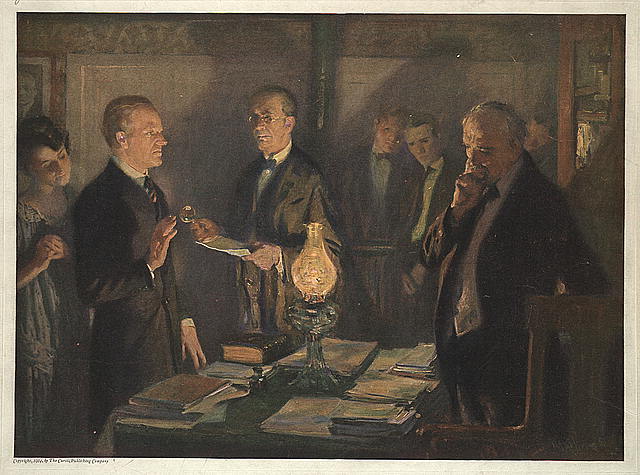
     “The oath was taken…by the light of the kerosene lamp, which was the most modern form of lighting that had then reached the neighborhood. The Bible which had belonged to my mother lay on the table at my hand…Besides my father and myself, there were present my wife, Senator [Porter] Dale, who happened to be stopping a few miles away, my stenographer [Erwin C. Geisser], and my chauffeur [Joseph McInerney].”

In the painting below, is there someone standing in the doorway to the kitchen? How many people do you see?
$(KGrHqV,!rMFHQubHDETBR7C)75ehw~~60_3

     “The picture of this scene has been painted with historical accuracy by an artist named [Arthur I.] Keller, who went to Plymouth for that purpose. Although the likenesses are not good, everything in relation to the painting is correct.”

Scholar and “Coolidge personator,” Jim Cooke, will be reenacting this simple yet solemn ceremony in a few short hours at the Homestead. The gravity and candor of what happened this night ninety years ago remains with us even now. It illustrates the modesty of our system in providing continuity that no other blueprint among human governments has matched. Mr. Cooke’s excellent account of that night, entitled “Dramatis Personae: Plymouth Notch, Vermont” in volume 13 of The Real Calvin Coolidge (1998) presents the best account of this historic transition of power in the most unlikely of places, Plymouth Notch, Vermont. Mr. Cooke presents the enduring mysteries of this night also: from what happened to the typed, signed and notarized oaths to who was actually present in that room. Even now, after all these years, mystery shrouds the occasion. Coolidge, ever an observer of the smallest details, endorses the historical accuracy of Keller’s portrait and gives us all a window into that place and time when Providence raised up the kind of leader President Adams desired ever to occupy the White House.
On Courage and Trust

As America stands poised to face another threat to “shut down” the government (as if that would be harmful), while approaching the initial penalties on individuals by unaffordable health care, a few in the Beltway are realizing what we have known all along: It will not work for anyone now and generations not yet born are to suffer for it. To defund it now, when the Act has already secured the majority of its revenue sources, prompts us to ask, where was the stand to withhold the first dime from this assault on sanity when it originally came to the Congress? Where was the courage among our representatives then? The House has been granted the power to grant appropriations by the Constitution. The House needs to exercise the check on bad laws already in its power. Joining in the implementation of such measures, to any degree, only reinforces the lack of confidence in our system to work as it ought.

The Wall Street Journal on July 21 identified the source of the problem as larger than political bickering or failure to be bipartisan. Too many of both parties have agreed on more than they have disagreed so that principles are rejected for political expediency. Few things are as repulsive to Americans as this manifestation of cowardice in their elected officials. The problem is a pervasive lack of trust. When no one stands up and lives consistent with integrity and moral clarity, it is no wonder no one is inspired to rely on anyone in Washington. It seems no institution, no traditional authority, no individual is untouched by either a severe moral failure or dereliction of responsibilities. The aspiring candidate for mayor of New York City is but a small instance of a vast deficit of confidence in our leaders.

The absence of so essential a component to the health and strength of society is not because government has failed to do enough. Government, of both parties, has already done too much. Moreover, government has repeatedly collaborated to reap this historic lack of credibility in it. Fear, instead of a principled courage, has brought us here now. We do not trust government to find the exit of a brown paper bag and once that trust is lost, the collapse of authority is not far behind unless the people reassert their sovereign will.

Former President Coolidge, observing the calamity of distrust in his day, said,

     Fear is not only contagious, but reaches our representatives. It affects the neighbors and has its reaction on the officeholders. That will be the great difficulty with the Congress and with all the state legislatures. Something is the matter with the country, and they will all feel an irresistible temptation to try to provide a remedy. That would be fine if they had any such power. But only the people themselves have the power to work out of their difficulties, which they can best do without legislative interference.

     The trouble is that efforts will be made to save a situation by legislation when no legislation can save it. In general we may expect to see many proposals to increase expenditures of public money when high national and higher local taxes have been a great contributing factor to the present situation. When the country needs the courage and confidence that relief from high taxes would give, increasing appropriations only add to the discouragement. What a refreshing spectacle it would be if a little band of officeholders would announce they were ready to risk defeat by resisting these unsound proposals! The whole country would rally to their support.

Indeed, we would.

                         Image

On Food

                              Image

Lee Ping Quan (pronounced ‘Chew-ah-n’) served as head steward and chef for the Presidential yacht Mayflower during the Harding and Coolidge administrations. Reaching twenty years of service just before the vessel itself was retired, Quan moved to New York City. Once there he finally achieved his dream, opening his own restaurant that featured the flavor and excellence of his cooking for the Coolidges. They were his favorite First Family and he would become one of their most cherished friends. Quan was one of the few allowed in with the family to mourn over young Calvin. He would remain steadfastly loyal to the Coolidges even in retirement. It was Quan who meticulously worked on the President’s birthday cake every year. He made sure that these cakes not only made the trip to Northampton perfectly but also arrived just before dinnertime. It was also Quan who created the masterful wedding cake of John and Florence in September 1929, passing along some of the groom’s favorite recipes to the young bride. But it was also Quan who gave Florence the traditional hanfu, Chinese robes specially embroidered with blessings for the couple’s future.

Quan’s account of his years with the Coolidges was published in 1939 under the title “To A President’s Taste.” Including the recipes of several entrees, The grand opening of Quan’s restaurant met with a series of mishaps and disappointments that brought the master cook low as he trudged home that evening. Looking through his mail, however, he found one letter instantly recharged his spirits. Never one to overlook the individuals others took for granted, the former President had written to Quan:

      My dear Quan:

            Mrs. Coolidge and I wish you every success with your restaurant. We shall always remember how kind you were to us when you were on the U. S. S. Mayflower, and how well you fed us. Yours,

                      Calvin Coolidge

Armed with this letter he went back to his staff the next day and from then on they never forgot that a President had honored them with special regard for their success. It was a trust they dare not take lightly. They lived up to that confidence in their excellence. Coolidge friends and acquaintances would eat there in order to taste the legendary cuisine of the Mayflower.

Both Mrs. Jaffray and Colonel Starling have noted Calvin’s propensity for “nibbling” throughout the day. It is Quan who observed the Coolidges’ other tastes,

     “President Coolidge…liked quail very much. Mrs. Coolidge was fond of capon-capon with a stuffing of almonds. The President fancied curried veal with condiments. But I think he liked my jelly roll better than anything. For breakfast he enjoyed sausages–fine pork sausages fit for a king–with waffles. And he used to eat them with a special maple syrup sent him from Vermont in five-gallon tins…I’m sure President Coolidge preferred my jelly roll best. He had a very sweet tooth.”