True business represents the mutual organized effort of society to minister to the economic requirements of civilization. It is an effort by which men provide for the material needs of each other. While it is not an end in itself, it is the important means for the attainment of a supreme end. It rests squarely on the law of service. It has for its main reliance truth and faith and justice. In its larger sense it is one of the greatest contributing forces to the moral and spiritual advancement of the race.
— Calvin Coolidge, excerpt from an address on “Government and Business” delivered before the New York Chamber of Commerce, November 19, 1925
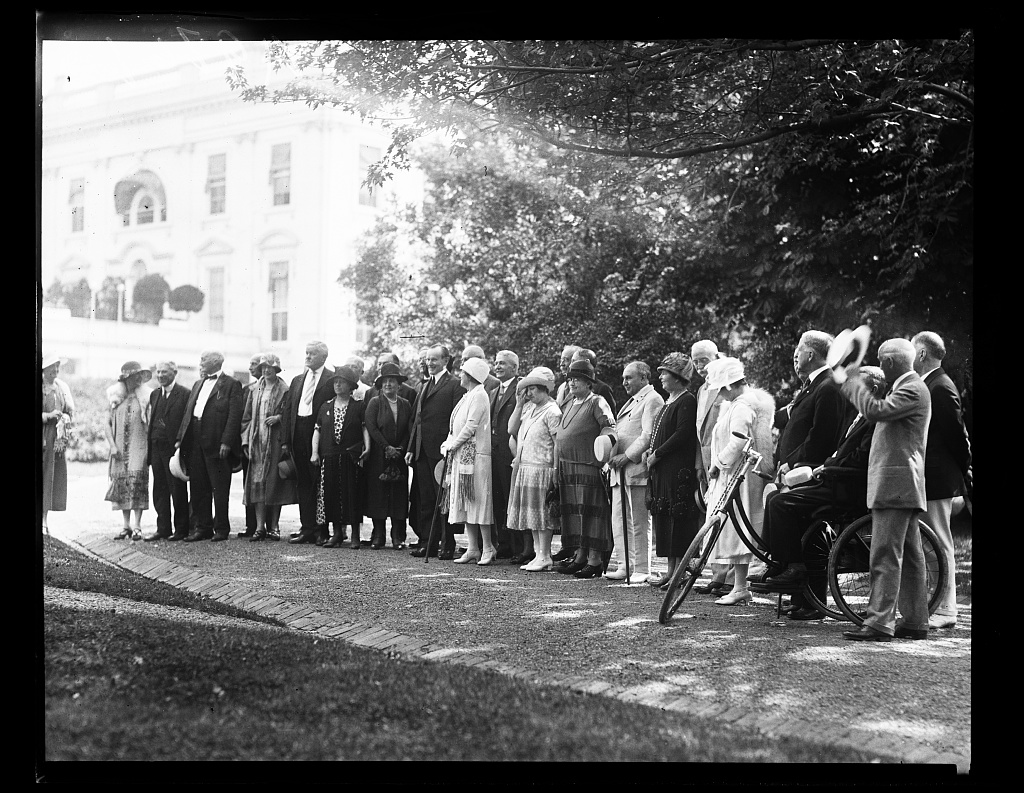
President Coolidge welcoming riverboat operator & hero, Tom Lee, earlier that same year (May 1925). Photo credit: Library of Congress.
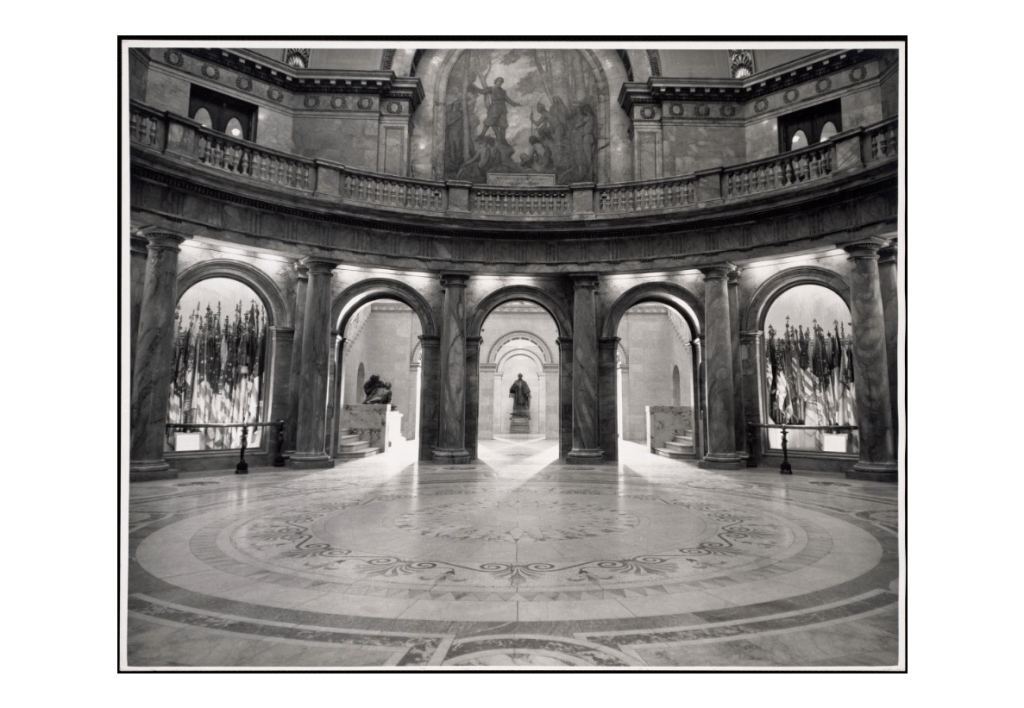
Hall of Flags, Boston. Photo credit: George Dow, 1964.
Officers and men of the United States Army:¹
In this room through which we are accustomed to pass with uncovered heads, you present today these flags which you have carried with so much credit to yourselves and your country and always to victory. These flags represent not only those who have borne and honored them, but those who may see them and be inspired by them in the years to come, not only those who gaze upon them now, but those who may gaze upon them with appreciation, as we do today.
We are here to welcome the return of these flags as a memorial of a momentous period in our history. These flags are to remain not only as a memento of the history which is made today, but as an earnest of the history which is to come. Today you bear the voice of the Commonwealth in appreciation of the splendid service which you have rendered.
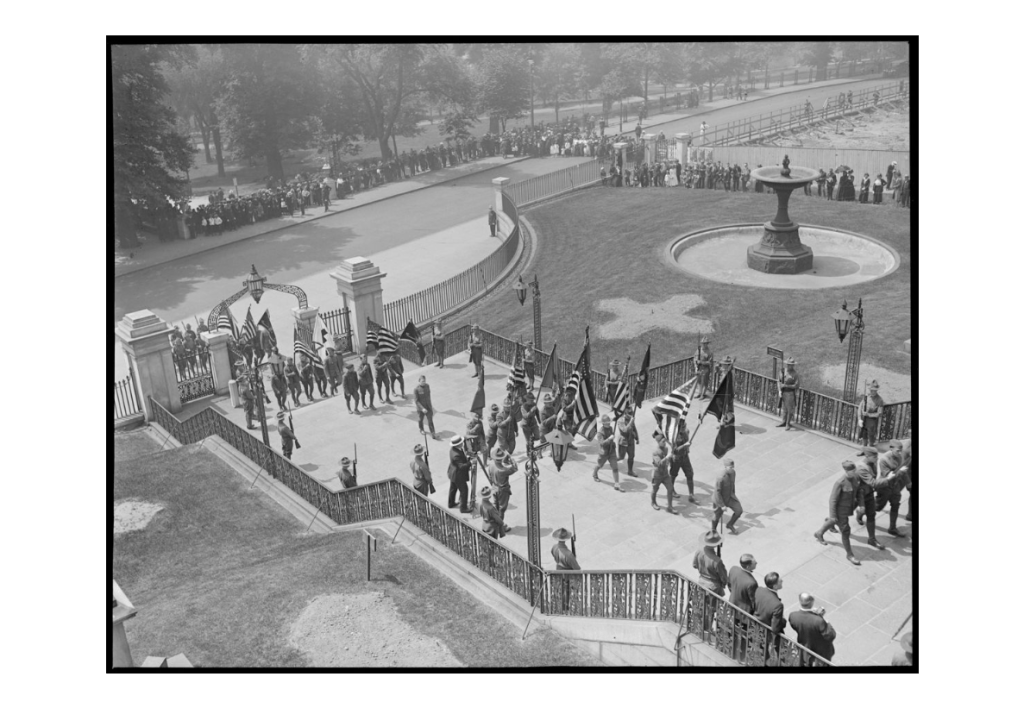
Members of the 26th Infantry Division (“Yankee Division”) ascending the steps to the Hall of Flags, June 14, 1919. Photo credit: Leslie Jones Collection.
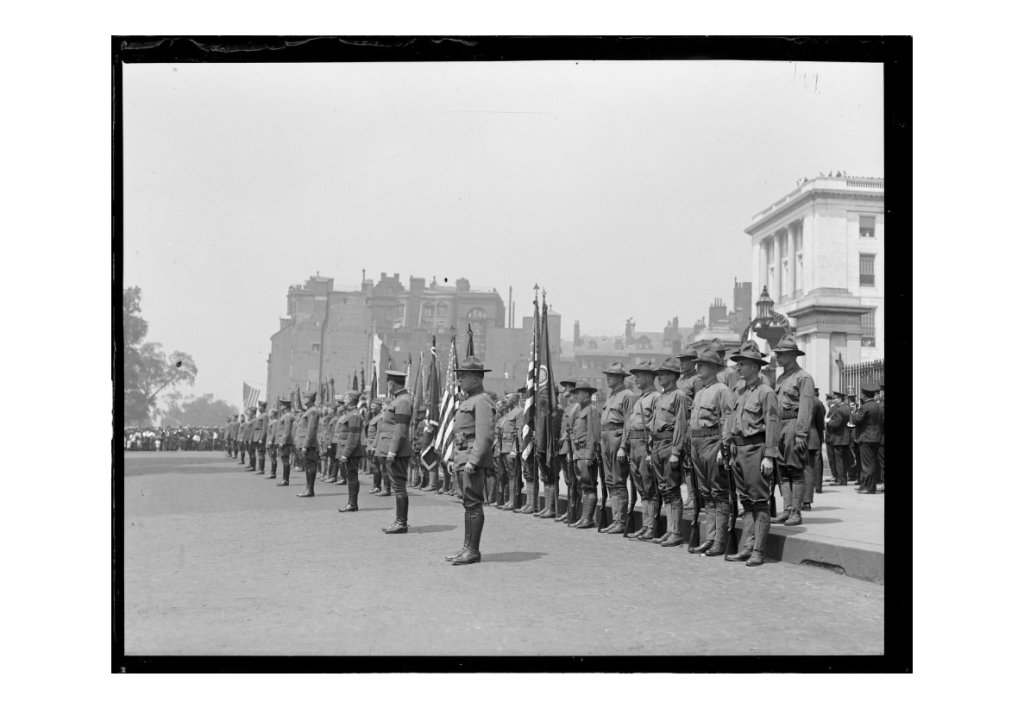
The “Yankee Division” formed in ranks at the Hall of Flags, June 14, 1919. Photo credit: Leslie Jones Collection.
It is a privilege to me to be here on this day, and to extend the recognition of the Commonwealth for your patriotic achievements by which you have honored your state not only, but also your whole country. Today it is a happy circumstance that you can represent America and the American spirit. It is worthy of the best in our past history. I recall the lines of the poet:
‘Elect and thrice blest the Roman
Who sees Rome’s happiest day;
Who sees that long victorious throng
Wind down the sacred way
And round the bellowing forum;
And through the suppliant’s grove
Up to the everlasting gates
of Capitolian Jove.’²
It is the true American spirit which you represent today and which you have illustrated and honored in the war.
I accept these colors in behalf of the Commonwealth of Massachusetts. I accept them from you who have come back to us from the war where they were borne and honored. They will remind all in the future of the devotion of the sons of the Commonwealth and they will be to all an inspiration to great achievements in the future.
— Governor Calvin Coolidge, address in the Hall of Flags, June 14, 1919
¹ The 26th Infantry Division (YD, “Yankee Division”), the second division of the American Expeditionary Force to arrive in France following the First Division, the 26th would be the first National Guard unit organized, trained, and sent overseas. The YD spent 210 days in combat between landing in September 1917 and returning in March 1919, earned six campaign streamers for participation in the Champagne-Marne, Aisne-Marne, St. Mihiel, Meuse-Argonne offensives, the invasion of Ile de France, and Lorraine campaign. The YD also earned U. S. and French citations on nineteen occasions and included two posthumous recipients (PFC Dilboy and PFC Perkins) of the Medal of Honor.
² “The Prophecy of Capys” from The Lays of Ancient Rome (1842) by Thomas B. Macaulay
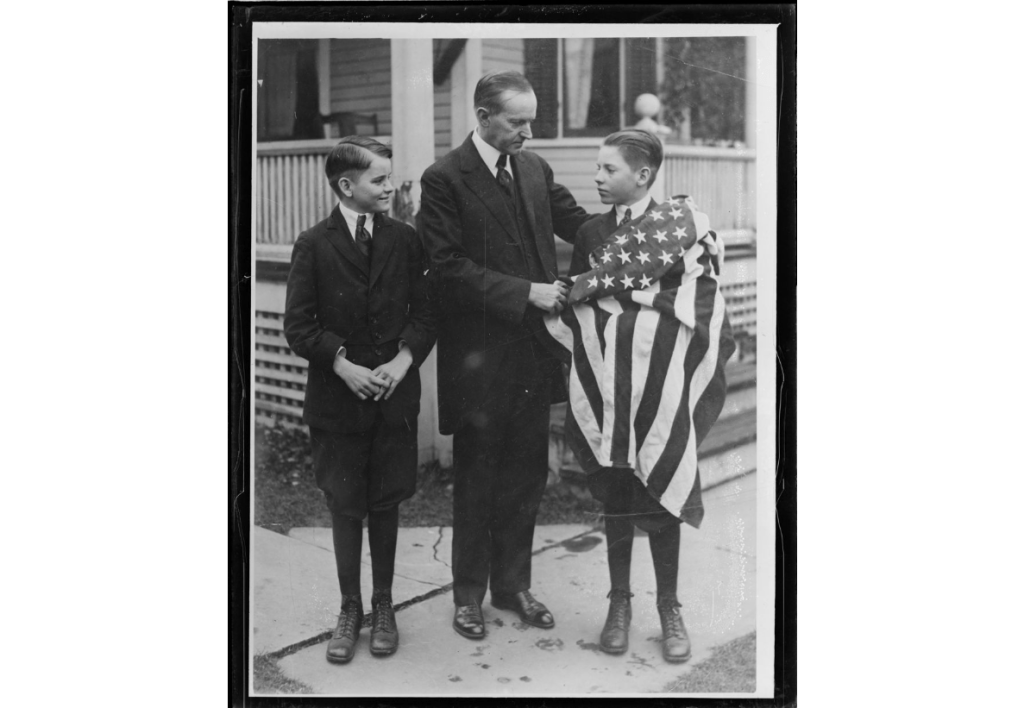
Happy Flag Day!
Calvin Coolidge and his sons, John (right) & Calvin Jr. (left), on Flag Day, 1919. Photo credit: Leslie Jones Collection.
America cannot live on past glory alone. The work of a nation has never yet been done.
‘Right forever on the scaffold,
Wrong forever on the throne,
But that scaffold sways the future,
And behind the dark unknown
Standeth God within the shadow,
Keeping watch above his own.’¹
That the Pilgrims braved exile in a wilderness across the sea; that the Thirteen Colonies endured the sacrifices of a seven years’ revolutionary war; that the men of the North poured out their blood to preserve the Union, all the gleaming pages of our history, give us no title to luxurious ease, no freedom from conflict, no assurance of an effortless existence.
‘Lo, all the pomp of yesterday
Is one with Nineveh and Tyre.’²
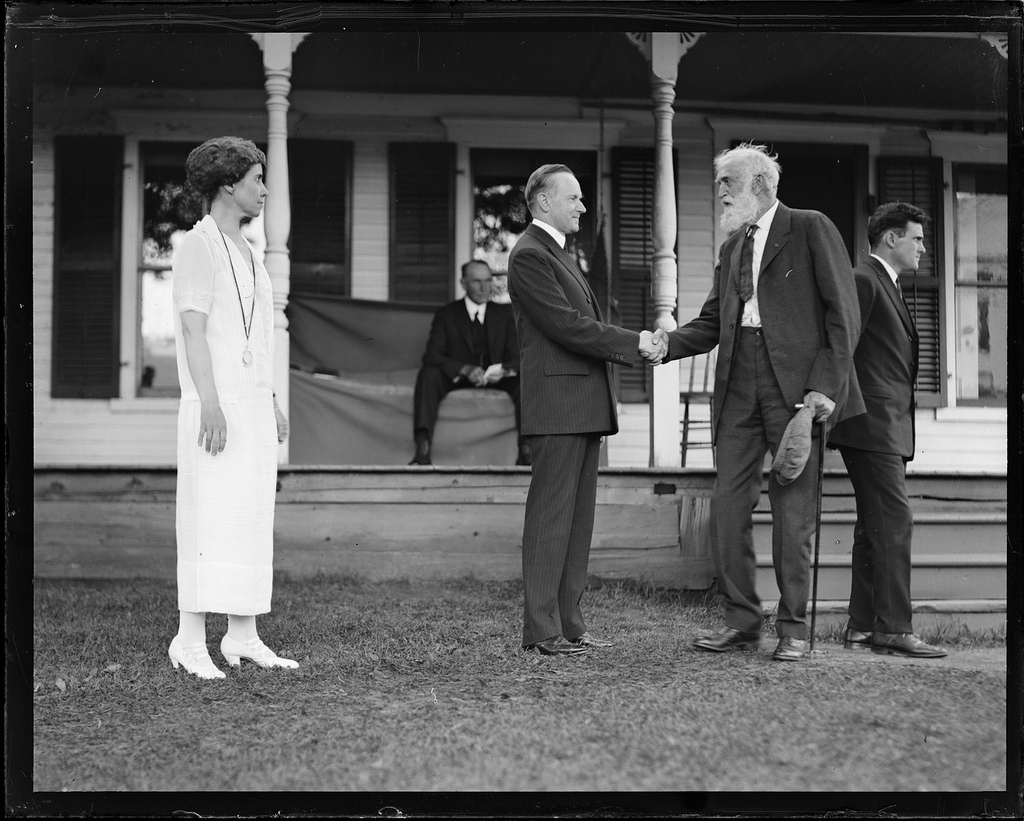
The Coolidges receiving a veteran of ’61 at Plymouth Notch. Photo credit: Leslie Jones Collection.
We must have the resolution now to dare and do; we must have the spirit now to overcome, which inspired the men who followed [John] Carver, Washington, and Lincoln. Of course we look to the past for inspiration, but inspiration is not enough. We must have action. Action can come only from ourselves; society, government, and state, call it what you will, cannot act; our only strength, our only security, lies in the individual.
American institutions are builded on that foundation. That is the meaning of self-government, the worth and the responsibility of the individual. In that America has put all her trust. If that fail, democracy fails, freedom is a delusion and slavery must prevail.
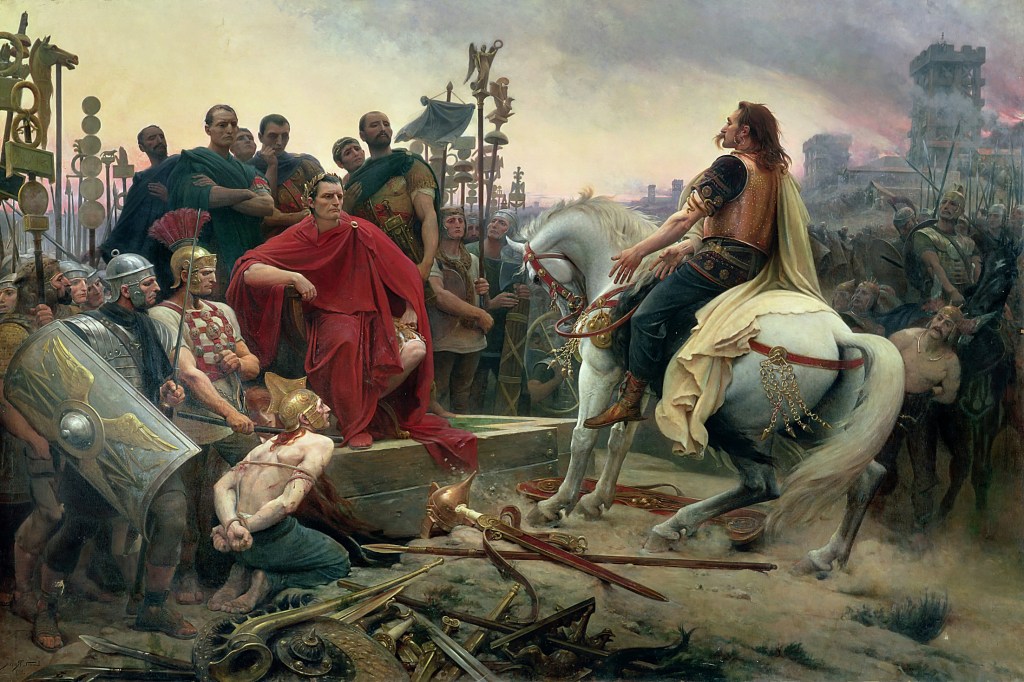
We have come to the time when we must prove ourselves. The great crisis is at hand. Had Washington, or Lincoln, or McKinley failed, the torch of liberty would have been dimmed but not extinguished. Failure now means the night of despotism, it means that another Caesar is to rule, another Praetorian Guard will sell the purple to the highest bidder.
Vercingetorex throws down his arms at the feet of Julius Caesar by Lionel Noel Royer, 1899
But we are not to fail. The individual is responding. Ten millions of our youth have enrolled. Evasion is almost negligible. The wealth of the Nation has volunteered. All the material and men for war are forthcoming.
In recognition of what you have done, of what you are ready to dare, of that last full measure of devotion you are offering to your country, I have been given the privilege of presenting to you this guidon, donated by one of your Lowell citizens. It is presented not to your commanding officer, not to some worthy color bearer, but to every individual of your Battery B. Take it. Bear it for America, for Truth and Freedom, ‘Truth coming from whatsoever source and Freedom knowing no bounds but those which Truth has set.’
— Lieutenant Governor Calvin Coolidge, on the presentation of a silk guidon to Battery B, 2nd Field Artillery, at Lowell, Massachusetts, June 15, 1917.
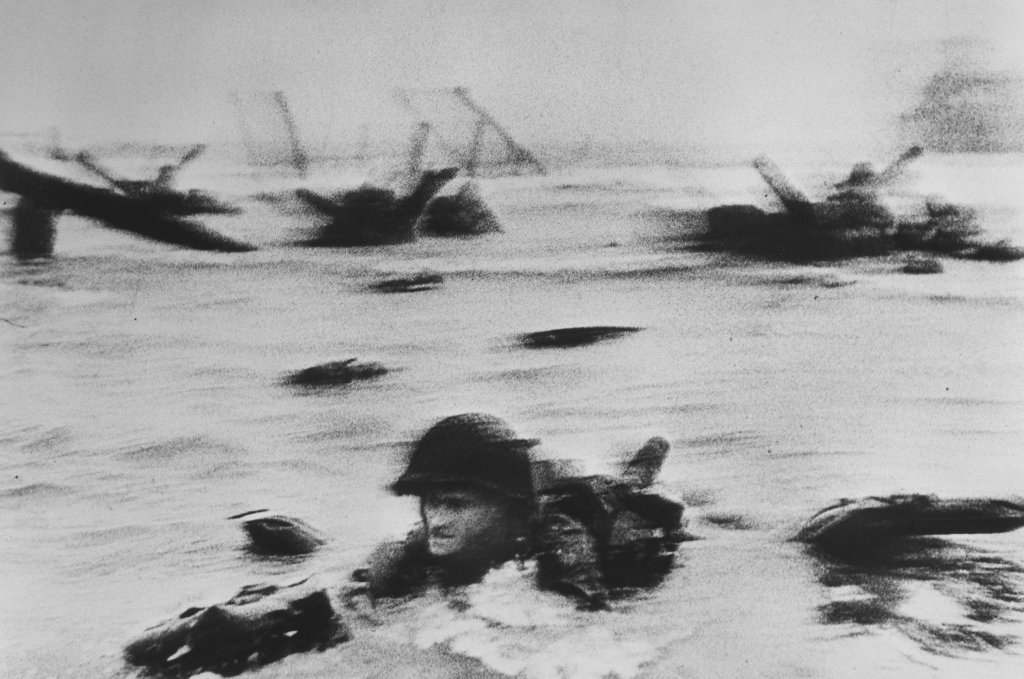
D-Day (June 6, 1944) remained almost twenty-seven years in the future but Coolidge reminds us, looking ahead to some of the most intense fighting of the Great War, that our freedom can end when we cease to fight for it. May we not forget.
¹ “The Present Crisis” by James Russell Lowell, 1845; The poem opens with the lines:
‘When a deed is done for Freedom, through the broad earth’s aching breast Runs a thrill of joy prophetic, trembling on from east to west, And the slave, where’er he cowers, feels the soul within him climb To the awful verge of manhood, as the energy sublime Of a century bursts full-blossomed on the thorny stem of Time.’

 The Importance of the Obvious