On Presidential Limits

The custom of two terms established by President Washington was faithfully preserved for one hundred and fifty-one years until the precedent was broken by Franklin Delano Roosevelt, winning his third term in 1940. Coolidge had been gone seven years by that time. F. D. R.  would be elected for a fourth term in 1944 and die in office the following April. The twenty-second Amendment was ratified in February 1951 in order to formally establish the original two-term limit as part of the Constitution.

Looking back on his five and a half years as President, Coolidge offered some enduring insights on the need for Presidential limits. This is not only exemplified by the term of office custom, which is now law, but the necessity to respect the Office, honor the limits of its power and guard against its delusory sense of greatness. This risk is not unique to the Presidency; one’s approach to authority on any level is just as prone to abuse and self-deception.

Coolidge, never buying the notion that he was a great man, held each responsibility with the humility of one who could handle what was expected of him without pretentiousness or “muscle-flexing.” He made the difficult look easy but his ability to lead came from discipline, training and perspective not arrogance or condescension. He had this to say about limits,

…[I]rrespective of the third-term policy, the presidential office is of such a nature that it is difficult to conceive how one man can successfully serve the country for a term of more than eight years.

     While I am in favor of continuing the long-established custom of the country in relation to a third term for a President, yet I do not think that the practice applies to one who has succeeded to part of a term as Vice President. Others might argue that it does, but I doubt if the country would so consider it…

     …A President should not only not be selfish, but he ought to avoid the appearance of selfishness. The people would not have confidence in a man that appeared to be grasping for office.

     It is difficult for men in high office to avoid the malady of self-delusion. They are always surrounded by worshipers. They are constantly, and for the most part sincerely, assured of their greatness.

     They live in an artificial atmosphere of adulation and exaltation which sooner or later impairs their judgment. They are in grave danger of becoming careless and arrogant.

     The chances of having wise and faithful public service are increased by a change in the presidential office after a moderate length of time.

     In the higher ranges of public service men appear to come forward to perform a certain duty. When it is performed their work is done. They usually find it impossible to readjust themselves in the thought of the people so as to pass on successfully to the solution of new public problems.

     An examination of the records of those Presidents who have served eight years will disclose that in almost every instance the latter part of their term has shown very little in the way of constructive accomplishment. They have often been clouded with grave disappointments.

     While I had a desire to be relieved of the pretensions and delusions of public life, it was not because of any attraction of pleasure or idleness.

     We draw our Presidents from the people. It is a wholesome thing for them to return to the people. I came from them. I wish to be one of them again…Our country does not believe in idleness. It honors hard work. I wanted to serve the country again as a private citizen.
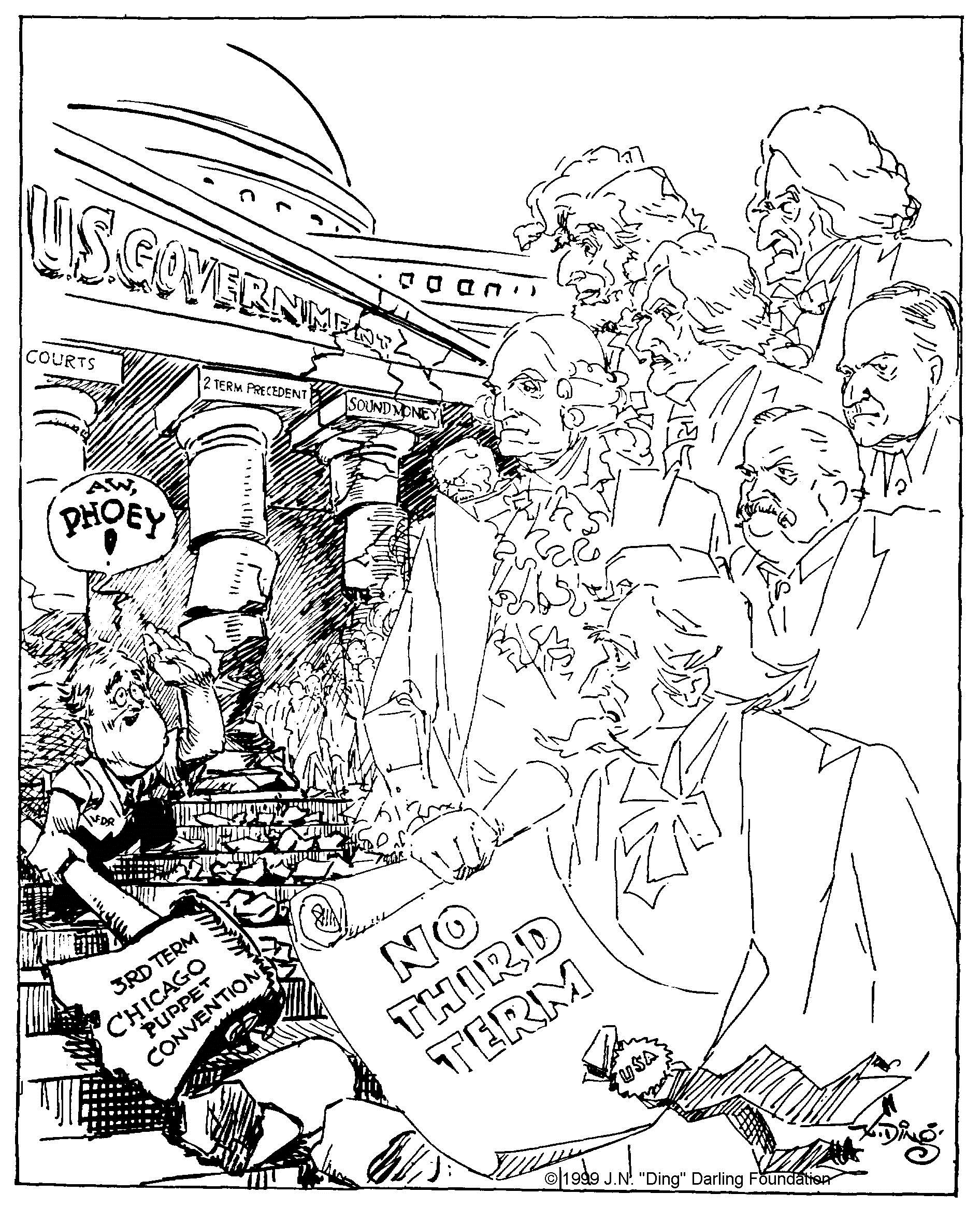
ImageIn this editorial depiction by J. N. “Ding” Darling entitled, “Just a whole lot of nobodies who never knew nothin’,” published October 15, 1940, the cartoonist conveys F. D. R.’s destructive disregard of our institutions and traditions. It is a suitable tribute that, among the “ghosts” of past Presidents arrayed against Roosevelt, Calvin Coolidge is conspicuously among them (L to R: Washington, Lincoln, Jefferson, Jackson, Cleveland and Coolidge stand in the foreground, with Theodore Roosevelt and the rest of those Presidents who have gone on, standing in the background). Coolidge’s warnings echo even now.

On Separate Classes

jb_jazz_coolidge_3_e

“There is yet another manifest disposition which has preyed on the weakness of the race from its infancy, denounced alike by the letter and the spirit of the Constitution, and repugnant to all that is American, the attempt to create class distinctions. In its full development this means the caste system, wherein such civilization as exists is rigidly set, and that elasticity so necessary for progress, and that recognition of equality which has been the aim and glory of our institutions, are destroyed and denied. Society to advance must be not a dead form but a living organism, plastic, inviting progress. There are no classes here. There are different occupations and different stations, certainly there can be no class of employer and employed. All true Americans are working for each other, exchanging the results of the efforts of hand and brain wrought through the unconsumed efforts of yesterday, which we call capital, all paying and being paid by each other, serving and being served. To do otherwise is to stand disgraced and alien to our institutions. This means that government must look at the part in light of the whole, that legislation must be directed not for private interest but for public welfare, and that thereby alone will each of our citizens find their greatest accomplishment and success” — Governor Calvin Coolidge, formally accepting Republican nomination as Vice-President, July 27, 1920.

More than ten years later, in the midst of economic downturn, Garet Garrett would echo the same point through his column in the Saturday Evening Post. In articles like, “There Goes Mine,” written in 1932, Garrett attacks the fallacy that economic classes are both fixed and permanent. He refers to the resentment during depressions of car ownership and how confidence in one’s ability to move upward from poverty to prosperity remains entirely within each person’s reach. Coolidge and Garrett both understood that liberty means opportunity, an opportunity that is not coincidental but directly due to our unique political and economic system as founded. Margaret Thatcher, the late British prime minister, grasped the significance of this truth better than have many Americans. She observed that when opportunity is maximized, class distinctions diminish and the disparity between “rich” and “poor” decreases, contrary to every economic “expert.”

As all three realized, however, the opposite holds true every time socialism is allowed to set policy, be it locally or nationally. For the Left, as Thatcher noted, it is better for the poor to stay poor “provided the rich were less rich.” Such a view summarizes modern liberalism. It is the Left’s animus against success and its vested interest in perpetual victim-hood which drive its agenda. It is never about rising to higher aspirations or striving for greater ideals. It is about exchanging our independence for the security they provide, a security of marginal existence.

Coolidge, Garett and Thatcher all knew what the Left denies to this day: policies that maximize individual opportunity remove class distinctions automatically and enable equality on the basis of each person’s determination and potential. Modern liberals would have us all equally poor, feeling guilty of ever rising above the marginal, dependent and miserable and call that “progress.” Incapable of fixing the problems Coolidge’s policies addressed, all that is left for modern liberalism is to keep the class warfare going, to provoke violence, and to project its failures onto those striving to heal and reunite us with the freedom of a truly classless society envisioned by our Framers.

Garet-Garrett margaret-thatcher

On Political Satire

Image

On January 4, 1928, Will Rogers, the era’s renowned cowboy comedian-columnist, led a radio hookup that featured participants all across the country, including the famous Al Jolson and the influential Paul Whiteman and his orchestra. It is interesting that both Jolson and Whiteman profoundly inspired many Americans (from Duke Ellington and Billie Holiday to Dick Clark and Bing Crosby) to launch their talents on the public stage. Whiteman was known as the “King of Jazz” while Jolson provided a sense of common identity and respect between minorities, immigrants and “Anglo-Saxons” through his black-face performances. Derided now, Jolson was loved across the demographics then. Will Rogers led this colorful gathering of talent to advertise Dodge automobiles.

As he continued the broadcast, in his characteristic drawl, he said, “Radio fans, I have a friend in Washington who on account of what the Automobiles have done for his Economy wants to speak to you, Mr. Coolidge, all right Mr. Coolidge go ahead…”

Rogers then employed a clever impersonation of the President’s “Vermont twang” and style of expression, ribbing Coolidge with this nonsensical series of comments:

     Ladies and Gentlemen, I am supposed to deliver a message every year on the condition of the country, I find the County as a WHOLE prosperous. I don’t mean by that, that the WHOLE country is prosperous, But as a WHOLE, its prosperous, That is its prosperous as a WHOLE. A WHOLE is not supposed to be prosperous, There is not a WHOLE lot of doubt about that…

Rogers, continuing to replicate Coolidge’s voice went on to political events in succinct and casual snippets, mentioning Mellon at Treasury, the Congress, “Smart Boy” Dwight Morrow and “Lindberg.” Rogers wrapped it up with a reference to Coolidge’s “I do not choose to run” statement from the previous year and how Prohibition was going.

All seemed fine until a few days later when Rogers dined at the home of Speaker Nicholas and his wife, Alice Roosevelt Longworth. To Rogers’ shock he learned of a New York Times piece chastising the comedian for “going too far” when it came to Presidential satire. He had even confused and angered some listeners who took issue with a President endorsing Dodge vehicles. Immediately, he sent a profuse letter of apology to both Mr. and Mrs. Coolidge, ending with the line with characteristic lack of punctuation, “If there ever was a sad Comedian, I am one, and I do ask all the forgiveness that its in your and Mrs. Coolidges power to give, Yours most respectfully, Will Rogers.”

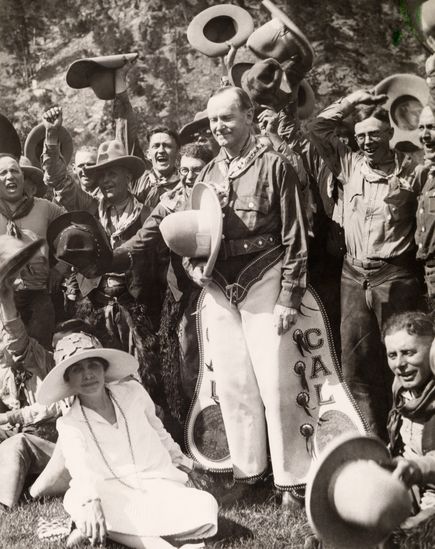
The President, who responded to criticism directed at him the previous year for wearing that silly cowboy outfit including customized chaps with, “It is good for people to laugh,” wrote this kind and sensible reply to the ashamed comedian:

     THE WHITE HOUSE

     Washington

                                                                                                      January 11, 1928

     My dear Mr. Rogers:-

     Your letter has just come to me. I hope it will cheer you up to know that I thought the matter of rather small consequence myself though the office was informed from several sources that I had been on the air. I wish to assure you that your note makes it all plain that you had no intention save harmless amusement.

     I hope you will not give the affair another troubled thought. I am well aware how nicely you have referred to me so many times.

                                                                                                      Cordially yours,

                                                                                                      Calvin Coolidge

As Lawrence E. Wikander, former Curator of the Coolidge Room at Forbes Library, has noted in his article, “Will Rogers and Calvin Coolidge” in The Real Calvin Coolidge, volume 13, “Even a slight acquaintance with the President would convince one that would not send such a warm letter if he were offended” (p.14). Yet that is exactly what biographers have done since 1939! Each seems oblivious to this letter and Coolidge’s explicit dismissal of any offense taken. Such is one of the many persistent Coolidge myths to continue in spite of the facts.

As Mr. Wikander points out, Rogers not only considered the matter closed…he would impersonate Coolidge again and in the coming years after the White House regularly chided Coolidge with public satire. They would meet in March of 1930 at the dedication of Coolidge Dam in Arizona and remain clearly on the warmest of terms.

This obscure incident of political satire from eighty-five years ago illustrates how far the culture has gone. Instead of continuing the progress evident in Coolidge’s day, the culture has become more restrictive, seemingly incapable of laughing at itself, “choosing” to take offense rather than embracing the healthy sense of proportion that events warrant.

It is forgotten what a long road of passionate political expression has been traversed in our country. When President Washington received Chief Justice Jay back from Great Britain following the negotiation of an unpopular treaty with the recently vanquished “Mother Country,” Jay observed he could travel back to the capital by the lights of likenesses of him burned in effigy. Everything from death threats to obscene acts were directed against President Bush, an experience shared by numerous Presidents before him.

Infinitely less has been done by the rodeo clown at the Missouri State Fair. Yet, in spite of the enthusiastic reaction from those who were in the audience…it is “racist,” “hateful” and “intolerant” to lampoon the President. Apparently he is to be held above criticism, however comedic. It is a grave loss to our liberty when political correctness is awarded the power to silence the most harmless of satirical performances while destroying the individual who utters anything not approved by government authorities. What is left of our freedom to express political opinion when satire is no longer allowed?

Image