On Preemptive Involvement Abroad

Image

“Nations which are torn by dissension and discord, which are weak and inefficient at home, have little standing or influence abroad. Even the blind do not choose the blind to lead them. Foreign peoples are certainly going to seek assistance only from those who have demonstrated their capacity to maintain their own affairs efficiently. If we desire to be an influence in order and law, tranquility and good will in the world, we must be determined to make sufficient sacrifices to live by these precepts at home. We can be a moral force in the world only to the extent that we establish morality in our own country. — President Coolidge, May 30, 1927.

“I wish crime might be abolished; but I would not therefore abolish courts and police protection. I wish war might be made impossible but I would not leave my country unprotected…” — Coolidge in a Letter to the National Council for Prevention of War, July 23, 1924 (cited from ‘The Mind of the President,’ pp.235-6).

“America represents the greatest treasure that there is on earth, the greatest power that there is to minister to the welfare of mankind; to leave it unprepared and unprotected is not only to disregard the national welfare, but to be no less than guilty of a crime against civilization” — May 30, 1923

“America stands ready to bear its share of the burdens of the world, but it cannot live the life of other peoples, it cannot remove from them the necessity of working out their own destiny. It recognizes their independence and the right to establish their own form of government, but America will join no nation in destroying what it believes ought to be preserved or in profaning what it believes ought to be held sacred” — February 22, 1922

If we are sincere in our expressed determination to maintain tranquility at home and peace abroad, we must not neglect to lay our course in accordance with the ascertained acts of life. We know that we have come into possession of great wealth and high place in the world. There is scarcely a civilized nation which is not our debtor. We are sufficiently acquainted with human nature to realize that we are oftentimes the object of envy. Unless we maintain sufficient forces to be placed at points of peril when they arise, thereby avoiding for the most part serious attack, there would be grave danger that we should suffer from violent outbreaks, so destroying our rights and compromising our honor that war would become inevitable. It is to protect ourselves from such danger that we maintain our national defense. Under this policy it is perfectly apparent that our forces are dedicated solely to the preservation of peace…We have sufficient reserve resources so that we need not be hasty in asserting our rights. We can afford to let our patience be commensurate with our power” — May 30, 1927, emphasis added.
On Mistaken Identity

Circulated around Washington through the 1920s, this apocryphal story of mistaken identity, is recounted by one of Chief Justice Taft’s earliest biographers:

“One day during the administration of President Coolidge, the Chief Justice happened to drop his cane just as a small boy of about seven came by. The boy picked up the cane and handed it politely to Taft, who thanked him with the radiant warmth which was so characteristic.

     ‘I met the nicest old gentleman on the bridge today,’ said the youngster to his mother when he reached home. ‘He dropped his cane and I picked it up. He was very, very fat!’

     “The mother recognized Taft in the description. ‘That was a very famous man,’ she told her son. ‘He used to be president of the United States.’

     “A day or two later they met again.

      ‘I know who you are!’ said the boy. ‘You used to be President Coolidge!’ “ (Pringle 964).

While the amiable Chief Justice was a frequent visitor to the Coolidge White House, he shared in the impression of even those closest to Coolidge who felt the chill from time to time that resulted from giving the President unsolicited advice. Taft, who knew the weight and obligations of the Presidency better than anyone close to Coolidge, never let incidentals like this get in the way of his friendship with Calvin and Grace.

Having met in 1914, Coolidge and Taft always kept the highest respect for one another, as the exchange below illustrates. Writing to his father, Coolidge said of Taft, “what he said was so much like what I had said that I sent him a copy of my address he sent me the enclosed letter which you may return to me, also an autograph copy of his book on Popular Government…” In that enclosed letter, Taft, characteristically self-effacing, told Coolidge, “I have read what you said to the Senate upon your taking the Chair [Coolidge’s famous January 7, 1914 speech], and it is so fine that I thank you for sending it to me and for giving me an opportunity to read it. It strikes a chord in my heart that responds to every word. I have pleasure in sending you a little volume that has been published of ten lectures which I have delivered on Popular Government and also three addresses that I have made which are not included in the book, to file away, with the certainty that there is nothing in them which says as well as you have said it the truth with respect to government, but that there is also nothing in them which differs in spirit from that which you have said” (“Your Son, Calvin Coolidge,” Edward C. Lathem, Montpelier: Vermont Historical Society, 1968, pp.126-7).

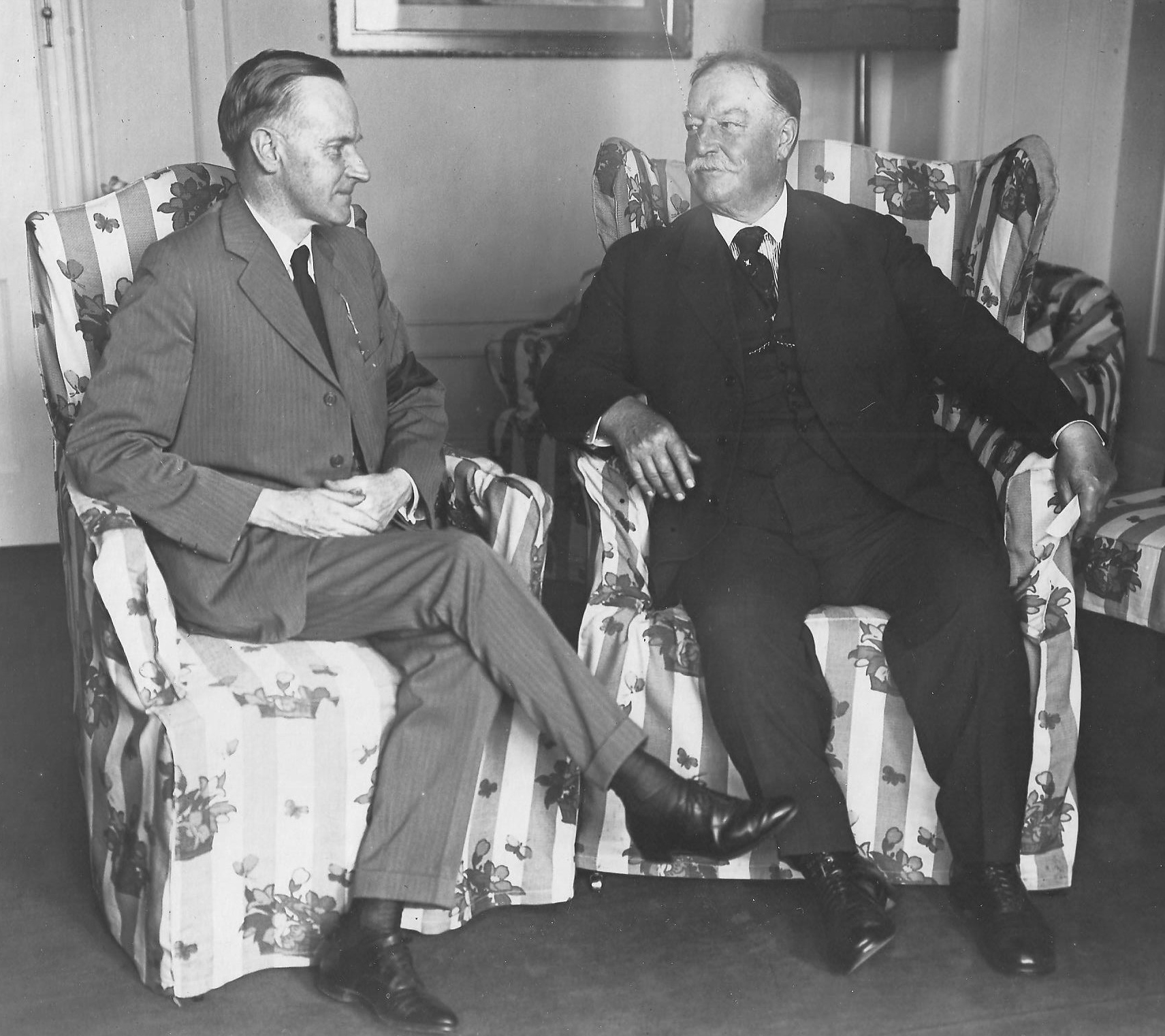
President Coolidge meeting with Chief Justice Taft at the New Willard Hotel within the first week of succeeding to the Presidency, August 1923.

President Coolidge meeting with Chief Justice Taft at the New Willard Hotel within the first week of succeeding to the Presidency, August 1923.

On Labor

In Robert A. Woods’ fascinating little book entitled, “The Preparation of Calvin Coolidge,” the author recounts the numerous ways Coolidge advanced American labor. Coolidge backed policies that improved conditions for everyone, not merely one interest group over that of another. Through cutting state executive government down from 120 agencies to 19, Coolidge enabled the people of Massachusetts to keep more of their wages every week for themselves instead of sending up increasing quantities in taxes to Boston. He supported the decrease of work hours because it helped those who worked…not simply those who led unions, even though, ironically, it originally had the firm opposition of organized manufacturers. Known for his principled stand for law and order, he not only backed Commissioner Curtis for refusing to reinstate 19 police officers after they led most of the department on strike in September 1919. Having become affiliated with the American Federation of Labor, in violation of long-standing department regulations, their duty to the public became secondary to an ideological allegiance that already brought them in conflict with their sworn obligation.

Any or all of these three instances could have alienated political friends, forced Coolidge out of office or worse, led to a violent series of repercussions around the state, even the country.

1919 was hardly a peaceful year, despite the War’s end. But this was not all he encountered since the Lawrence textile and phone operators strikes could have blown into larger conflicts as well. They did not spiral out of control principally because of sound leadership. It is through good leadership that complex and seemingly insurmountable obstacles are resolved with clear and consistently applied principles. Coolidge, known by everyone for his fairness, gave partiality to none. He adhered to the law, even when it might cost him personally or politically. As such, he gained the support of those who saw past the bias and political agendas of those calling for violence, social upheaval, nationwide strikes and economic change for its own sake.

He continually lauded the glory of work. As Coolidge would observe on Labor Day in 1919, “Workmen’s compensation, hours and conditions of labor are cold consolations, if there be no employment. And employment can be had only if some one finds it profitable. The greater the profit, the greater the wages.” Such a truth needs no clearer illustration than where we stand in September 2013. If only the realization of Coolidge’s day, that “we can take from one class and give to another class” is never going to fix the problem. The problem only aggravates, as it did then, when class warfare rhetoric convinces Americans to expect fairness without freedom for all and benefits without the work to earn them.

Coolidge recognized the right to form unions by mutual agreement. Without consent, both unions and arbitration of disagreements were impossible to reconcile “with the right of individual freedom,” which could never be surrendered to any effort to equalize labor. He saw a clear distinction of responsibility when it came to those performing a service to the public, be it policemen, telephone operators or (in Reagan’s case) air traffic controllers.

This is why Coolidge told labor leaders on September 1, 1924, “Of course employment affecting public safety and public necessity is not private employment, and requires somewhat different treatment.” Those who work in public unions are not simply serving themselves, as Coolidge said on April 21, 1919, “There is another principle involved which has received very little attention, and that is the obligation that exists on those who enter the public service to continue to furnish such service even at some personal inconvenience. This obligation reaches to the highest officer or government official to the humblest employee. The public has rights which cannot be disregarded.” Such is why Coolidge endorsed resolution by peaceful arbitration — not the coercion of strikes, violence and disregard of law and orderly behavior — when disagreements occur. The “us” versus “them” rhetoric only proved increasingly hollow as tax reduction and constructive economy revealed the property owners and the laborer to be one and the same.

The emphasis on what one is entitled, rather than what one owes, misses both the importance and increased opportunity hard work affords to each person. No short cut exists. One cannot demand the fruits of toil without the effort to acquire them. The welfare of all, made clear from the earliest experiments in socialism by Plymouth colony, is never achieved by the many enjoying the rewards earned by a few. Work and the ability to keep its results have proven, through centuries of human experience, to be the means toward progress, the agency of mutual prosperity, and the continuance of civilization.

It is why Coolidge, in his address to the leaders of labor, said this,

“America recognizes no aristocracy save those who work. The badge of service is the sole requirement for admission to the ranks of our nobility. These American policies should be continued. We have outlawed all artificial privilege. We have had our revolution and our reforms. I do not favor a corporation government, a bank government, a farm government or a labor government. I am for a common-sense government by all the people according to the American policy and under the American Constitution. I want all the people to continue to be partakers in self government.”

With Coolidge, his actions matching his words, we can know that he meant it.

Image