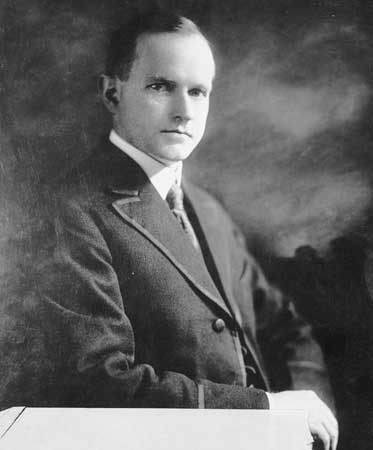
It is readily discovered that shy people are not reticent with everyone all the time. There is usually at least one subject that draws even the most introverted soul out to talk freely, openly and uninterruptedly. We know meeting new people was difficult for the shy Mr. Coolidge. As one of his earliest biographers describes, American history touched the Vermonter so profoundly that merely mentioning the obscurest pilgrim, pioneer or adventurer would provoke “Silent Cal” to speak volumes. Roland Sawyer, who had served in the Massachusetts General Court with Coolidge, recounts this instance during one of their weekly train rides home from Boston,
Personal shyness, Yankee reticence, mental pre-occupation, Vermont reserve–these all combined to make Mr. Coolidge no travelling companion for anyone, in the average sense of the word.
Imagine the surprise one day among that group of legislators, when Cal unbuckled and for a cool half four talked as much as the average man. Now it all happened in this wise. Cal asked me to ‘sit in a minute’ on a matter of Hampshire county legislation, and after a brief discussion of the various points, Cal turned as usual to light another cigar, and look from the car window. We were just entering the old town of Rutland in central Massachusetts. Here had lived Rufus Putnam, a Revolutionary soldier, legislator, and one of the pioneers of the settlement of Ohio. I chanced to make some remark about the career of Col. Putnam, and, without removing his eyes from the window, Cal began to talk. Now I have ever had a keen interest in Massachusetts and New England colonial history, and have considerable information, and can carry on a conversation upon the matter with fair intelligence. And so I ventured some ideas upon some of the earliest customs of the colonial people: of their courage and other qualities. And Cal came back–and for a full half hour we talked about the pioneers of New England and the Middle West; of old customs and events; of the heroism of the men and women who were founders of America. Before we knew it, so engrossed were we in our talk, we had reached Hudson, where an influx of passengers broke into our seats, and I went back to my colleagues, to find an excited group of men who wanted to know, ‘What in the devil ails Cal this morning?’
Sawyer answers their question in the biography,
Now what had happened was this–Cal had found a kindred spirit, who was interested in, and full of admiration for that group of pioneers in whom he was so interested, and for whom he felt such admiration; and there sprang up for a time an intellectual and spiritual fellowship which was strong enough to break the bonds of a native reticence (Cal Coolidge, President, pp. 95-96).
What America is and in what way it stands as the exception to the rule of human history inspired him to express in volumes the admiration he held in his mind and heart. This admiration was not merely some “revisionist” nostalgia, it was honest appreciation of real history and what it had to teach. Moreover, this admiration was shared by Mr. Sawyer himself, who, though politically a Socialist, could still genuinely agree that America’s story furnished reason to love and learn from it.
America’s story is worth repeating. It is truly a great story. It deserves to be recounted in our time with the same honesty and respect for what so many men and women accomplished in order to give us America’s exceptional inheritance.


 The Importance of the Obvious