Jason Noble Pierce: On the Memory of a Good Boy

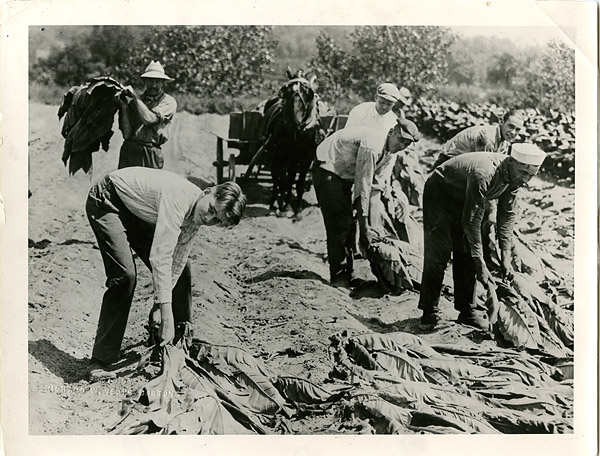
Cal Jr picking tobacco 1923

Cal Jr. at work on local tobacco fields, summer of 1923

Cal Jr. at work on local tobacco fields, summer of 1923. Courtesy of Forbes Library.

As noted earlier this month, July tragically marks the ninetieth anniversary of young Calvin Jr.’s death from sepsis. The life so rapidly taken was immeasurably felt throughout the country. America loved the Coolidges, and the youngest had a particularly special place in the hearts of young and old alike. He had consistently demonstrated a perspective and character that seemed to go beyond his sixteen years.

Attempting to convey the deep impression left upon him by Calvin’s life, Jason Noble Pierce turned the thoughts of those gathered to what Calvin Jr. meant to so many as Pierce addressed the Marble Collegiate Reformed Church in downtown Manhattan the Sunday after the young man’s death. “Every one was disposed to love him,” Pierce would recall. “His youthful life attracted irresistibly. Many people who had never seen Calvin told me that they loved him because of the picture they had seen. Calvin had through all his life the very genuine spirit of religion.” He was not as some boys who go and play “church” because his parents insist or because they live in the public eye. Calvin Jr. sought the One who reveals Himself not merely on tablets of stone but whose writing lives on the heart and in the mind. Young Calvin saw the importance of what is unseen, the preeminence of what is eternal while everything else of this temporal world fades away.

A postcard view of the Marble Collegiate Reformed Church building, Manhattan, where Jason Noble Pierce eulogized young Calvin Coolidge Jr. the first Sunday after his death.

An 1890s postcard view of the Marble Collegiate Reformed Church building, Manhattan, where Jason Noble Pierce eulogized Calvin Coolidge Jr. the first Sunday, July 13, 1924, after the young man’s death.

Granted permission by Mrs. Coolidge to recite an excerpt of the last letter young Calvin had written, Dr. Pierce recounted what the boy had said about one man who had recently discovered a remedy with which to handle his diabetes. Calvin wrote: “He sure was lucky in the time he chose for having diabetes.” Then, the young man reflected, “That last is surely a foolish statement and one that is often made, for we do not believe that life is as happy as death. That’s what Christ told us.”

When Dr. Pierce turned to his efforts that past week to console the grieving President, he said, “I told Mr. Coolidge that in this sickness God was the consulting doctor trying vainly to tell his colleagues here below how to save this life because they were not able perfectly to know God’s laws and that diseases which are fatal today are healed tomorrow.” The discovery of the antibiotic properties of penicillin remained four years in the future while marketable production would not occur until the 1940s. Impossible to know these facts at the time, Mr. Coolidge looked at his preacher and responded, “That may all be true, but what would heaven be like, if it were made up only of old men and old women.” Struck silent by what he had just heard, Dr. Pierce realized that the father possessed the same unshakable measure of faith as his son. It was then, restraining tears himself, that the preacher told the congregation, “That was the time to thank God that in the hour of affliction our great President had no bitterness in his heart and was able to realize he had made a priceless gift, however unwilling must be his sacrifices.”

As the gathering succumbed to tears, Dr. Pierce endeavored to quantify what had given Calvin Jr. so powerful an impact. Finally, the preacher concluded with an encouragement that resonates through these nine decades. Whether we are parents or children, Calvin Jr. inspires us still not merely in the memory of a good young man but with an introspective look at the kind of parents and children or men and women we are, whether faith to us is some useless anachronism or perhaps a rote abstraction in a “church” somewhere or whether faith genuinely lives within us, whether we see the things that are Unseen, as Calvin’s father once put it.

It was, after all has been said, “the religious faith of this lad” that “made him what he was…And as I had the privilege in the intimacy that comes between pastor and parishioners, I saw that the life of young Calvin was a wonderful testimony of obedience.” Remembering all the quiet and unassuming occasions of Calvin’s genuine integrity and example, especially when no one was looking, the preacher concluded, “Here was little lad who never questioned his parents’ direction, but obeyed. That grief-stricken father could only think during those last days of Calvin Jr. as ‘my little boy.’ The doctors said one of the great helps through these days was that it had been Calvin’s life habit to give perfect obedience. Here was a little lad who was winsome and brave, and I imagine that is what Jesus was. Do you know the staff at the White House, who have been through the deaths of some of our Presidents and ex-Presidents, said the mass of small telegrams and telephones that came in after the death of this boy surpassed that received on any other occasion? The lad was a soldier, as brave as brave could be.” Calvin Jr. is rightly remembered for the goodness and strength he exemplified. In his estimation, however, this was no reason to boast of any surpassing excellence in him personally. He was but seeking to place first things first, developing less of material power and more of spiritual power. By first aspiring to walk humbly with God and then serve not be served, both father and son remain testaments to the abiding importance of what is essential and eternal.

Both Calvins, in front of the old home at 21 Massasoit Street, Northampton, 1920

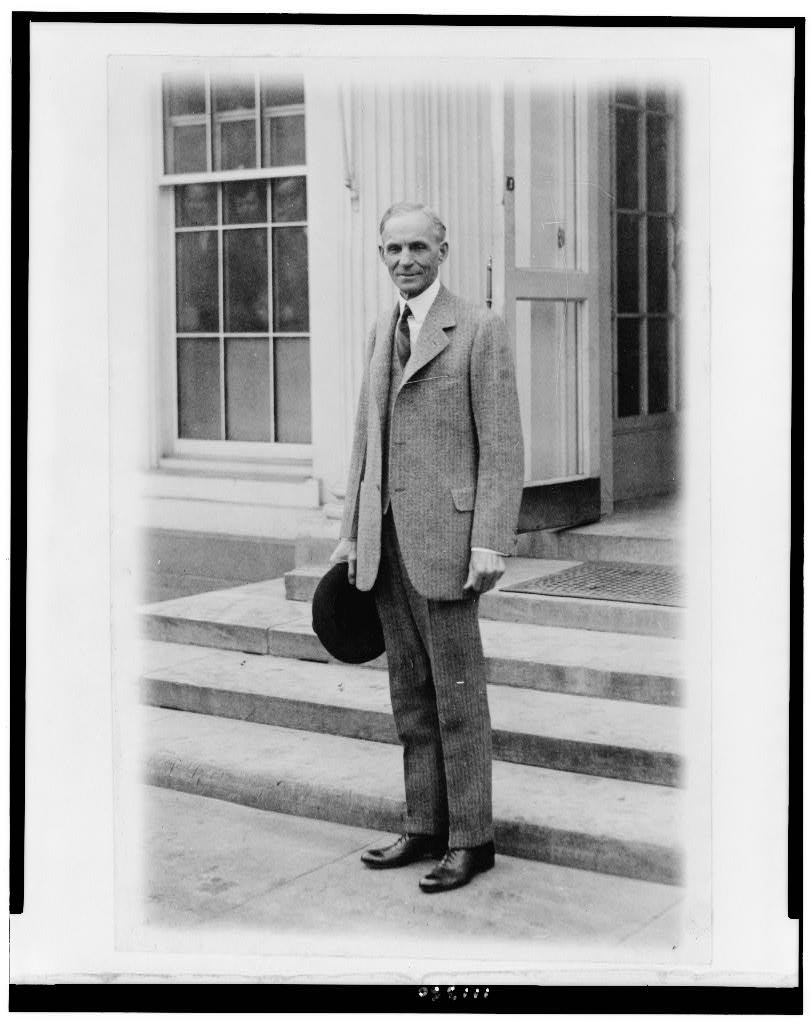
Both Calvins, in front of the old home at 21 Massasoit Street, Northampton, 1920

Calvin gravesites

On “What It Means to Be a Boy Scout”

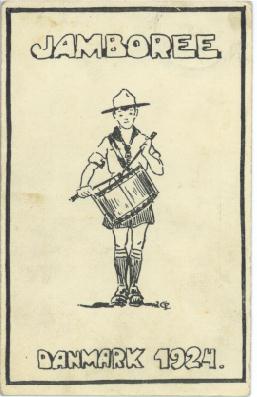
Jamboree 1924

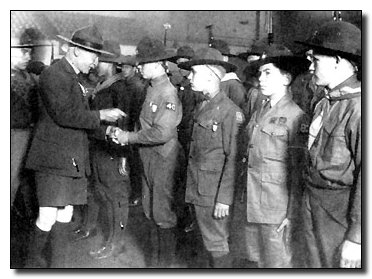
Lieutenant-General Baden-Powell, founder of the international Scout movement and "Chief Scout of the World" awards Merit Badges to some of the American boys competing in the canoe, obstacle course and baseball competitions at the Jamboree.

Lieutenant-General Baden-Powell, founder of the international Scout movement and “Chief Scout of the World” awards Merit Badges to some of the American boys competing in the canoe, obstacle course and baseball competitions at the Jamboree.

An aerial view of the thousands of Scout organizations from around the world taking part in the Jamboree at Copenhagen.

An aerial view of the thousands of Scout organizations from around the world taking part in the Jamboree at Copenhagen.

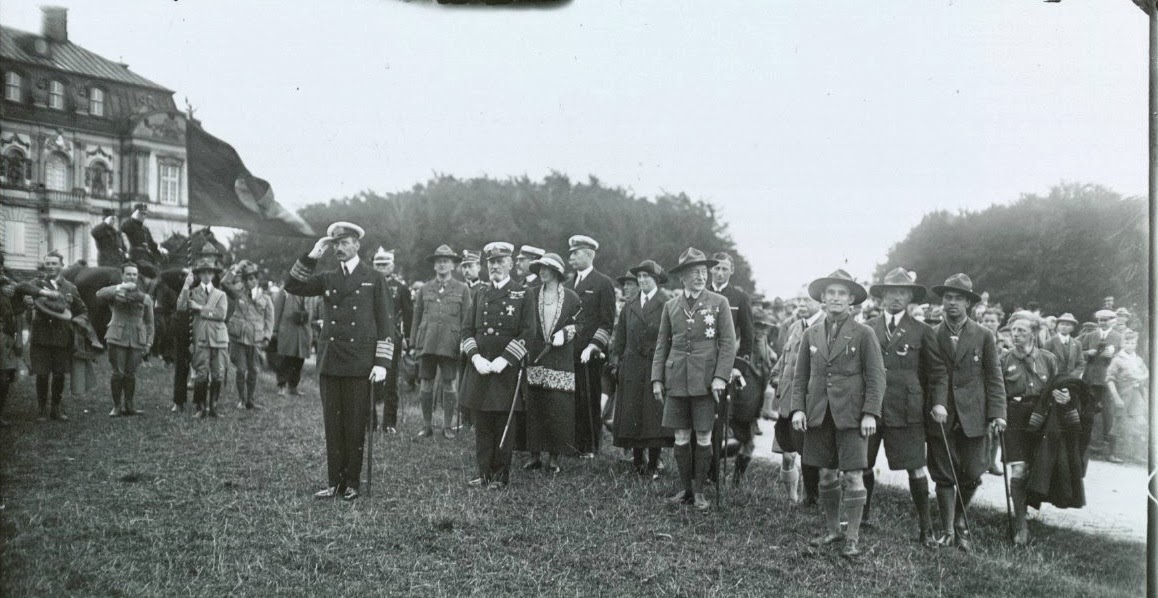
King Christian X and the Danish royal family inaugurate events at which the 53 boys President Coolidge addressed participate through August 1924. The boys, representing all 48 states in the Union, would go on to win first place with 181 points, the King's victory cup and a successful introduction of the game of baseball to the other boys.

King Christian X and the Danish royal family inaugurate events at which the 53 boys President Coolidge addressed participate through August 1924. The boys, representing all 48 states in the Union, would go on to win first place with 181 points, the King’s victory cup and a successful introduction of the game of baseball to the other boys.

When President Coolidge took up the receiver of his candlestick telephone ninety years ago today, it had been eighteen days since his youngest boy, Calvin Jr., had been swept into eternity at the age of sixteen. The President, however, did not shut himself off despite his grief. Instead, on this particular day, Coolidge directed time to impart counsel to the young men of the Boy Scouts, of whom Calvin Jr. had been a member, as they gathered for dinner aboard the steamship Leviathan in New York harbor, July 25, 1924. The boys, 53 of them in number, had been chosen to represent America at the Second World Scout Jamboree to be held in Copenhagen, Denmark in August.

As the 250 guests sat aboard the steamship ninety years ago, the unmistakable voice of President Coolidge came across the amplifiers via telephone with a clarity that would impress deeply upon the boys’ consciousness in the weeks and years that followed. Many of them would fondly recall the inspiration his words gave them not only throughout their journey but through the rest of their lives.

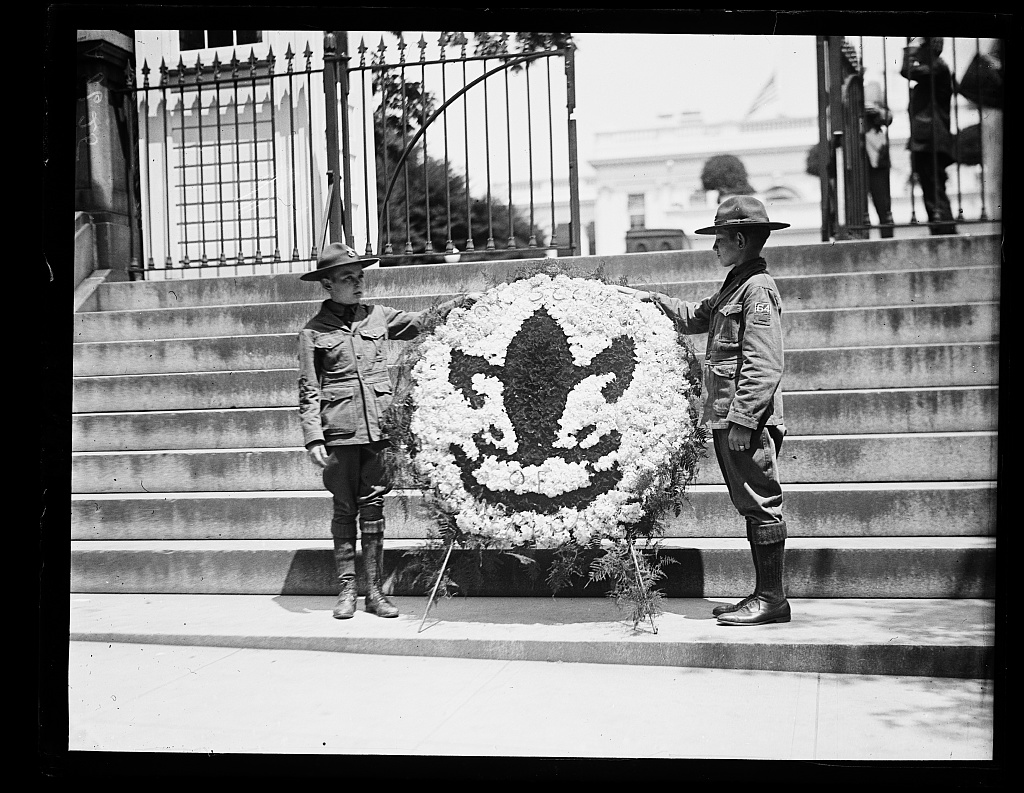
Robert Fulton, left, and Louis Paulin present a wreath to the Coolidge family, in memory of Calvin Jr., on behalf of the Boy Scouts of America, 1924.

Robert Fulton, left, and Louis Paulin present a wreath to the Coolidge family, in memory of Calvin Jr., on behalf of the Boy Scouts of America, 1924.

The Boy Scouts, having lost their fellow Scout, Calvin Jr., had been omnipresent that second week in July, presenting a wreath to young Calvin’s family, accompanying the Marines and sailors who guarded the body and helping to bear his casket to the tomb in Plymouth. It was supremely fitting that President Coolidge express not only his gratitude but his regard for the parents and young men who would give so much to the betterment of others, as Calvin would have done.

From "President Coolidge and His Boys," an article written by W. H. Clagett, featured in the October 1923 issue of Boys' Life.  Writing to the Boy Scouts of America president, Colin H. Livingstone, on August 16, 1923, President Coolidge not only accepted the honorary leadership of the organization but also commended the work it accomplished, writing, "Both my sons are Scouts, and my observation of the benefits they have derived from their affiliation has strengthened my conviction of [Scouting's] usefulness."  Source: http://scoutingmagazine.org/issues/0010/d-wwas.html.

From “President Coolidge and His Boys,” an article written by W. H. Clagett, featured in the October 1923 issue of Boys’ Life.
Writing to the Boy Scouts of America president, Colin H. Livingstone, on August 16, 1923, President Coolidge not only accepted the honorary leadership of the organization but also commended the work it accomplished, observing, “Both my sons are Scouts, and my observation of the benefits they have derived from their affiliation has strengthened my conviction of [Scouting’s] usefulness.” Source: http://scoutingmagazine.org/issues/0010/d-wwas.html.

The President identified three fundamentals of the Scouts shared by America’s institutions. He spoke,

“There was no Boy Scout organization in my boyhood, but every boy who has the privilege of growing up on a farm learns instinctively the three fundamentals of scouthood.

“The first is a reverence for nature. Boys should never lose their love of the fields and the streams, the mountains and the plains, the open places and the forests. That love will be a priceless possession as your years lengthen out. There is an instructive myth about the giant Antaeus. Whenever in a contest he was thrown down, he drew fresh strength from his mother, the earth, and so was thought invincible. But Hercules lifted him away from the earth and so destroyed him. There is new life in the soil for every man. There is healing in the trees for tired minds and for our overburdened spirits, there is strength in the hills, if only we will lift up our eyes. Remember that nature is your great restorer.

“The second is a reverence for law. I remember the town meetings of my boyhood, when the citizens of our little town met to levy taxes on themselves, and to choose from their own number those who should be their officers. There is something in every town meeting, in every election, that approaches very near to the sublime. I am thrilled at the thought of my audience tonight, for I never address boys without thinking, among them may be a boy who will sit in the White House. Somewhere there are boys who will be presidents of our railroads, presidents of colleges, of banks, owners of splendid farms and useful industries, members of Congress, representatives of our people in foreign lands. That is the heritage of the American boy.

“It was an act of magnificent courage when our ancestors set up a nation wherein any boy may aspire to anything. That great achievement was not wrought without blood and sacrifice. Make firm your resolution to carry on nobly what has been so nobly begun. Let this nation, under your influence, be a finer nation. Resolve that the sacrifices by which your great opportunities have been purchased will be matched by a sacrifice, on your part, that will give your children even a better chance.

“The third is a reverence for God. It is hard to see how a great man can be an atheist. Without the sustaining influence of faith in a divine power we could have little faith in ourselves. We need to feel that behind us is intelligence and love. Doubters do not achieve; skeptics do not contribute; cynics do not create. Faith is the great motive power, and no man realizes his full possibilities unless he has the deep conviction that life is eternally important, and that his work, well done, is a part of an unending plan.

“These are not only some of the fundamentals of the teachings of the Boy Scouts, they are the fundamentals of our American institutions. If you will take them with you, if you will be living examples of them abroad, you will make a great contribution toward a better understanding of our country, and receive in return a better understanding of other countries; for you will find in foreign lands, to a very large extent, exactly what you carry there yourselves. I trust that you can show to your foreign associates in the great scout movement that you have a deep reverence for the truth and are determined to live by it; that you wish to protect and cherish your own country and contribute to the well being, right thinking and true living of the whole world.”

As the boys embarked on the first of many great life adventures, they would carry the President’s words with them. They would not only win first place among the boys of 30 other nations participating in the events at Copenhagen, they would share a discipline and reverential character for the outdoors, law and God with the rest of the world. They would exemplify the best of America and the moral fundamentals impressed upon them by President Coolidge would stay with them forever.

Photographed here during the 16th Annual National Council of Boy Scouts, May 1, 1926 (two years after his telephone message), President Coolidge would present the first Silver Buffalo Awards in recognition of distinguished service in the Scouts, saying, “The more I have studied this movement, its inception, purposes, organization, and principles, the more I have been impressed. Not only is it based on the fundamental rules of right thinking and acting, but it seems to embrace in its code almost every virtue needed in the personal and social life of mankind. It is a wonderful instrument for good. If every boy in the United States could be placed under the wholesome influences of the Scout program, and should live up to the Scout Oath and rules, we would hear fewer pessimistic words as to the future of our nation.”

Photographed here during the 16th Annual National Council of Boy Scouts, May 1, 1926 (two years after his telephone message), President Coolidge would present the first Silver Buffalo Awards in recognition of distinguished service in the Scouts, saying, “The more I have studied this movement, its inception, purposes, organization, and principles, the more I have been impressed. Not only is it based on the fundamental rules of right thinking and acting, but it seems to embrace in its code almost every virtue needed in the personal and social life of mankind. It is a wonderful instrument for good. If every boy in the United States could be placed under the wholesome influences of the Scout program, and should live up to the Scout Oath and rules, we would hear fewer pessimistic words as to the future of our nation.”