On the Unlearned and Historical Perspective

“It is characteristic of the unlearned that they are forever proposing something which is old, and, because it has recently come to their own attention, supposing it to be new. Into this error men of liberal education ought not to fall. The forms and processes of government are not new. They have been known, discussed, and tried in all their varieties through the past ages. That which America exemplifies in her Constitution and system of representative government is the most modern, and of any yet devised gives promise of being the most substantial and enduring.

“It is not unusual to hear arguments against our institutions and our Government, addressed particularly to recent arrivals and the sons of recent arrivals to our shores. They sometimes take the form of a claim that our institutions were founded long ago; that changed conditions require that they now be changed. Especially is it claimed by those seeking such changes that these new arrivals and men of their race and ideas had no hand in the making of our country, and that it was formed by those who were hostile to them and therefore they owe it no support…But scholarship answered ignorance. The learned and patriotic research of men of the education of Dr. James J. Walsh and Michael J. O’Brien, the historian of the Irish American Society, has demonstrated that a generous portion of the rank and file of the men who fought in the Revolution and supported those who framed our institutions was not alien to those who are represented here…

“In these days of violent agitation scholarly men should reflect that the progress of the past has been accomplished not by the total overthrow of institutions so much as by discarding that which was bad and preserving that which was good; not by revolution but by evolution has man worked out his destiny. We shall miss the central figure of all progress unless we hold to that process now. It is not a question of whether our institutions are perfect. The most beneficent of our institutions had their beginnings in forms which would be particularly odious to us now. Civilization began with war and slavery; government began in absolute despotism; and religion itself grew out of superstition which was oftentimes marked with human sacrifices. So out of our present imperfections we shall develop that which is more perfect. But the candid mind of the scholar will admit and seek to remedy all wrongs with the same zeal with which it defends all rights…

“The long and toilsome processes which have marked the progress of the past cannot be shunned by the present generation to our advantage. We have no right to expect our portion something substantially different from human experience in the past. The constitution of the universe does not change. Human nature remains constant. That service and sacrifice which have been the price of past progress are the price of progress now…the evidence was never so overwhelming as now that men and nations must live rationally or perish. The defenses of our Commonwealth are not material but mental and spiritual” — Governor Calvin Coolidge, Commencement at Holy Cross College, June 25, 1919.

Benedict Joseph Fenwick, the founder of Holy Cross, established in 1843.
Benedict Joseph Fenwick, the founder of Holy Cross, established in 1843.

James A. Healy, valedictorian in the class of 1849, was the first black Catholic bishop in the United States. Two of his younger brothers attended the College as well.

James Augustine Healy, valedictorian in the class of 1849, was the first black Catholic bishop in the United States. Two of his younger brothers attended the College as well.

Justice Clarence Thomas, alumnus of Holy Cross College, class of 1971.

Justice Clarence Thomas, alumnus of Holy Cross College, class of 1971.

Frank Waterman Stearns, long-time friend of the Coolidges, at home in Swampscott. His papers now rest in the special collections of Holy Cross College.

Frank Waterman Stearns, long-time friend of the Coolidges, at his home in Swampscott. Many of his papers now reside in the special collections of Holy Cross College.

President of Holy Cross College, when Governor Coolidge delivered the commencement address to both the graduates of 1919 and underclassmen, James J. Carlin would see the College grow and expand from 1918 to his departure in 1924 for work in the Philippines.

Reverend James J. Carlin, President of Holy Cross College when Governor Coolidge delivered this commencement address in June 1919. Carlin would see the College continue to grow during his tenure from 1918 to his departure in 1924, to take on work in the Philippines.
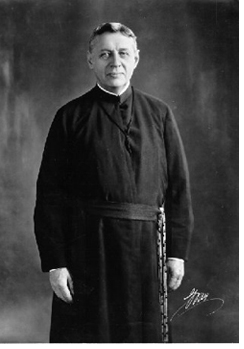
The Most Reverend Joseph N. Dinand, President of Holy Cross in the years leading up to the War, 1911-1918 and during most of Coolidge's administration, 1924-1927. It was President Dinand who largely built up the College's great library, which bears his name today.

The Most Reverend Joseph N. Dinand, President of Holy Cross in the years leading up to the War, 1911-1918 and during most of Coolidge’s administration, 1924-1927. It was President Dinand who largely built up the College’s great library, which bears his name today.
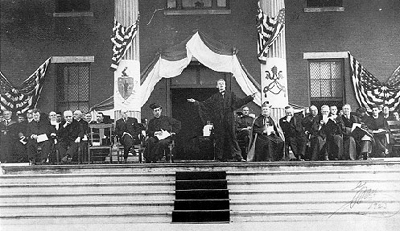
Here is a scene from the commencement in 1923. When Governor Coolidge spoke to those gathered on these grounds five years before, the men of Holy Cross had already proven to be an expression of patriotic duty, as many of those who would have graduated sooner, were among the first to volunteer for military service. Not only this, however, the young men to whom Coolidge directed his address that summer of 1919 did not all spring from long-established families, but mirrored the rich differences and opportunities America has made possible for everyone. Most of the young men Coolidge addressed were from Irish, Italian, French, Slavic, and even Lithuanian roots. Coolidge, keenly aware of both the College's excellent past and accomplished present, saw America in miniature. This great success was not an anomaly, it was the norm because here freedom and opportunity came not through ancestry or blood but through diligence and perseverance, competence and ability. Having taken up the full burden of citizenship, the young men of Holy Cross demonstrated what it means to know (as Coolidge would express it years later) the "high estate" of American citizenship, "the peer of kings."

Here is a scene from the commencement in 1923. When Governor Coolidge spoke to those gathered on these grounds five years before, the men of Holy Cross had already proven to be an expression of patriotic duty, as many of those who would have graduated sooner, were among the first to volunteer for military service. Not only this, however, the young men to whom Coolidge directed his address that summer of 1919 did not all spring from long-established families, but mirrored the rich differences and opportunities America had made possible for the most recent arrivals. While most of the young men Coolidge addressed were of Irish ancestry, students could also claim Italian, French, Slavic, and even Lithuanian roots. Coolidge, keenly aware of both the College’s excellent past and accomplished present, saw America in miniature. This great success was not an anomaly, it was the norm because here freedom and opportunity came not through ancestry or privilege but through diligence and perseverance, competence and ability. Having taken up the full burden of citizenship, the young men of Holy Cross demonstrated what it meant to know (as Coolidge would express it years later) the “high estate” of American citizenship, “the peer of kings.”

Coolidge Meets Gene Tunney, November 19, 1927

After beating World Champion Jack Dempsey for the second time that fall of 1927, former Marine and then-current World Heavyweight Boxing Champion, Gene Tunney, was brought to meet President Coolidge at the White House. The story of their meeting, recounted in newspapers at the time, reads…

Santa Ana Register, 11-19-1927, page 8. Courtesy of newspapers.com.

Santa Ana Register, 11-19-1927, page 8. Courtesy of http://www.newspapers.com.

It is an interesting similarity that after winning all but 1 of his fights, including his second defense of the World Heavyweight Title the following year, Mr. Tunney, like the man he met in the White House, quietly walked away. Like Coolidge, he remained undefeated, at the peak of his success and content with what he had accomplished.

Gene Tunney at the National Library of Ireland's Long Room Library, Trinity College, Dublin, August 24, 1928.

Gene Tunney at the National Library of Ireland’s Long Room Library, Trinity College, Dublin, August 24, 1928.

Tunney was a voracious reader. Here he is taking a few moments in training for his rematch against Dempsey to read and think.

Tunney was a voracious reader, who loved the classics. Here he is taking a few moments in training for his rematch against Dempsey to read and think.

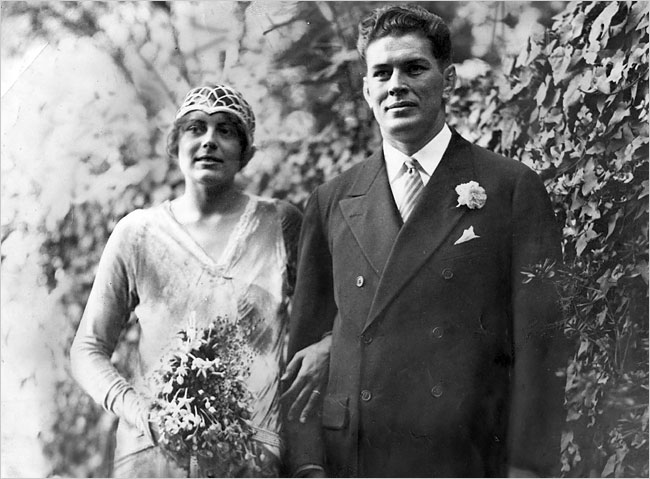
Gene Tunney married Polly Lauder upon his retirement from the ring, October 3, 1928. One of the great romantic matches of the 1920s, the Tunneys were married for 50 years, until his death at age 81 in 1978. She would live to see age 100, passing in 2008.

Gene Tunney married Polly Lauder upon his retirement from the ring, October 3, 1928. One of the great romantic matches of the 1920s, the Tunneys were married just over 50 years, until his death at age 81 in November 1978. She would live to see age 100, passing in April of 2008.

It would be well to learn from the example of Tunney and Coolidge, men in very different work but who, having fought and won, kept humility, perspective and a healthy measure of contentment for life’s seasons. After all, they knew, there was a time for every purpose under heaven:

“A time to plant,

And a time to pluck what is planted…

“A time to break down,

And a time to build up…

“A time to gain,

And a time to lose;

“A time to keep,

And a time to throw away;

“A time to tear,

And a time to sew;

“A time to keep silence,

And a time to speak;

“A time to love,

And a time to hate;

“A time of war,

And a time of peace”

— Ecclesiastes 3:3-6

On Mount Rushmore

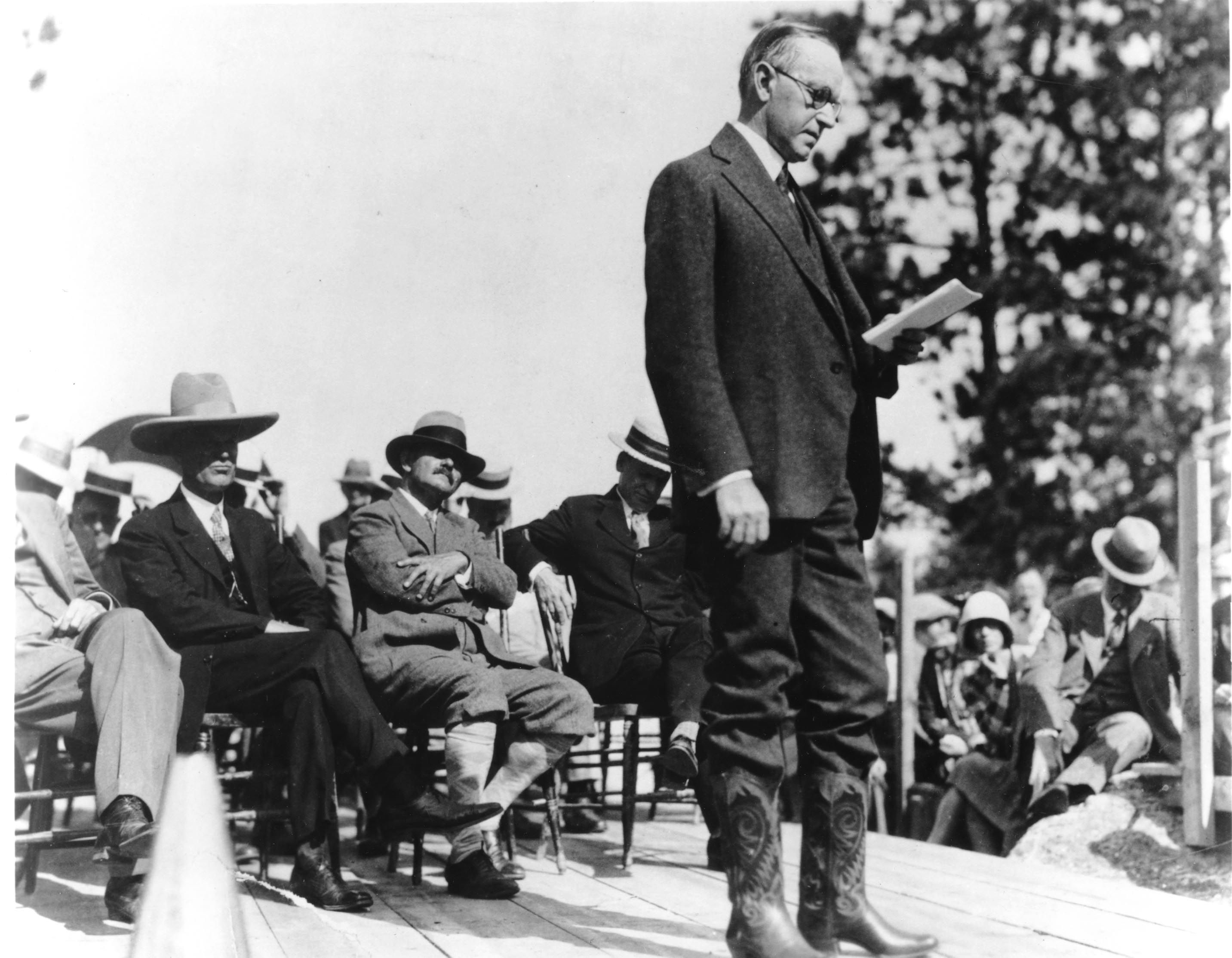
President Coolidge dedicates the site that will be the Mount Rushmore Memorial, August 10, 1927. Flamboyant sculptor, Gutzon Borglum is seated cross-legged directly behind the standing President.

President Coolidge dedicates the site that will be the Mount Rushmore Memorial, August 10, 1927. Flamboyant sculptor, Gutzon Borglum is seated cross-legged directly behind the standing President. Coolidge will sign Public Law 805 creating the Mount Rushmore National Memorial and the Commission overseeing the project on February 25, 1929. The law provided a system of matching funds whereby private donations up to $250,000 would be matched by appropriations allocated by the rest of the states through the Federal government. Strings attached to that money by Washington would not be allowed, however, while fifty percent of the cost would have to be carried by individual investment. The project aspired not only to honor America’s ideals but to live by them.

Sunday, August 10, will mark the eighty-seventh anniversary of the dedication of Mount Rushmore by President Calvin Coolidge. As the late Rex Smith points out, however, in his great account of The Carving of Mount Rushmore, this was neither the first nor the last dedication of so remarkable a site. The President had already come to South Dakota two months before, who better than he could underscore the importance of its continuation and symbolism? Riding to the foot of the mountain on horseback, decked out in the gifts the people of South Dakota had so generously presented to him that summer, President Coolidge came to honor not merely what Borglum and his team would sculpt but what the Almighty had already wrought there.

It was proper that Washington would begin the design, followed by Jefferson, Lincoln and finally, Theodore Roosevelt. Washington embodied the very character of America, giving the “highest aspirations” of our constitutional system form and solidity. “He stands as the foremost disciple of ordered liberty, a statesman with an inspired vision” unmatched by any other since. It was Jefferson “whose wisdom insured that the Government which Washington had formed should be entrusted to the administration of the people.” Emphasizing the centrality of self-government, Jefferson confirmed both its practicality and permanence, Coolidge reminded his audience. Even through purchase of the Louisiana Territory, Jefferson “gave new guarantees to the rule of the people.” The nation having been established and its “dedication to popular government” confirmed, it remained for Lincoln to prove the resilience of the Union and the power of its commitment to freedom to all. It was Lincoln who carried the Founder’s principles to their logical conclusions. To the work of these three was added the efforts of Theodore Roosevelt. “To political freedom he strove to add economic freedom,” Coolidge proclaimed, building the path of the Panama Canal that connects east with west and realizes the purpose of Columbus’ voyage in search of economic opportunity.

Mount Rushmore, as it appeared before carving began

Mount Rushmore, as it appeared before carving began

Work officially began on October 4, 1927. Here Borglum has measured out the site for what will be the first of four busts.

Work officially began on October 4, 1927. Here Borglum has measured out and begun to clear the site for what will be the first of four busts.


Majestic as this mountain would be — still to be carved that summer of 1927 — Coolidge saw more there than a bald rock-face. He saw the deep impressions of what would be there one day and, even more importantly, what those depictions meant. It was “a distinctly national monument,” Coolidge said, because it carried far more than the eye would behold, it would be a “picture of hope fulfilled.” It was suitable that this location — in the very heart of the country — would bring people together in the future to glimpse something more than mortal likenesses. What this memorial testified to was nothing less than eternal truths that endure immutable and unshakable despite what men attempt to do to them. “They will know that the figure of these Presidents has been placed here because by following the truth they built for eternity. The fundamental principles which they represented have been wrought into the very being of our Country. They are steadfast as these ancient hills.” People may attempt to do violence to those principles, intending their dismantlement and eradication, but, even more permanent than the Mount, they withstand time itself because they are eternally true whatever upheaval society experiences.

America’s “genius for self-government” did not come from some genetic or material superiority to the rest of the world, Coolidge declared. It came from the indestructible life of individual liberty. Only when it dies in the hearts and minds of individuals does it disappear, and then, only until ordered liberty is kindled again in the spirit and soul. Many do not understand America, Coolidge observed. “They do not understand the economic progress of our people. It is true that we have had the advantage of great natural resources, but those have not been exclusively ours. Others have been equally fortunate in that direction. The progress of America has been due to the spirit of the people. It is in no small degree due to that spirit that we have been able to produce such great leaders. If coming generations are to maintain a like spirit, it will be because they continue to support the principles which these men represented. It is for that purpose that we erect memorials. We can not hold our admiration for the historic figures which we shall see here without growing stronger in our determination to perpetuate the institutions which their lives revealed and established.”

Approached by Borglum to compose a timeline to be carved into the rock beside the Presidents, Coolidge lent his talents for expression with a conscientious concern for historical accuracy to the project. It all ended abruptly, however, when Borglum published his own error-riddled revision of what then-former President Coolidge had written -- without bothering to notify him of his actions. As the press began to mistake what Borglum had written for Coolidge's original prose, Cal suspended any further participation. Since the law passed to form the Rushmore Memorial stipulated only Coolidge's words could be used for the Entablature, the idea was scrapped...almost. It would be years until a contest would recognize the winner of an Entablature essay, featured today on a bronze plaque inside the viewing facility at the foot of the mountain.

Approached by Borglum to compose a timeline to be carved into the rock beside the Presidential heads, Coolidge lent his talents for expression with a conscientious concern for historical accuracy to the project. It all ended abruptly, however, when Borglum published his own error-riddled revision of what then-former President Coolidge had written — without bothering to notify him of his actions. As the press began to mistake what Borglum had written for Coolidge’s original prose, Cal suspended any further participation. Since the law passed to form the Rushmore Memorial stipulated that only Coolidge’s words could be used for the Entablature, the idea was scrapped…almost. It would be years until a contest in 1935 would recognize William Burkett as the winner of the best Entablature essay. His work can be seen on a bronze plaque, installed in 1975, inside the viewing facility at the foot of the mountain.

It was hardly surprising that so new a state as South Dakota led the way toward this important work. It did not require the most populous state to stir a remembrance of what America is and means, it came from those who, yet endowed with that pioneering courage and rugged perseverance, made never-before-accomplished things reality. It confirmed “that the old American spirit still goes where our people go, still dominates their lives, still inspires them to deeds of devotion and sacrifice. It is but another illustration of the determination of our people to use their material resources to minister to their spiritual life. This memorial will be another national shrine to which future generations will repair to declare their continuing allegiance to independence, to self-government, to freedom and to economic justice.” The memorial at Rushmore would remind those who came to see it of those timeless standards as long as their real meaning lived in the human spirit. No mortal could blot out the truth or erase the validity of such transcendent intangibles as had formed the foundations of America’s experience. President Coolidge could not have known where the country would be in 2014 but of this, he was certain: those foundational truths had struck something far deeper and lasting than the granite and mica of that Mount in South Dakota. The rocks of Rushmore but signify the preeminence and perpetuity of ideals even more majestic, solid and enduring.

rushmore