On the Power of Radio

Addressing the four hundred plus delegates from over seventy nations gathered to open the International Radiotelegraphic Conference on October 4, 1927, President Coolidge, who had signed the Radio Act (helping to bring order and room for growth in radio communications) earlier that year, offered his assessment of the medium’s progress and future potential. He said,

“Ladies and Gentlemen:

“It is my privilege to extend to the delegates to this conference a most cordial welcome on behalf of the people of the United States. Seldom has a more representative world conference assembled. The presence here of delegates from so large a proportion of the nations of the earth is of itself sufficient evidence of the importance which will attach to your deliberations. The large number of subjects to be considered is at once apparent when it is remembered that there has been no conference of this nature for about fifteen years. Meantime there have been many improvements in transmitting and receiving radio messages and a perfectly tremendous expansion in their use.

“It is scarcely thirty years ago that the transmission of intelligence by radio began. For almost twenty-five years it was largely confined to Government use, mostly in navigation. Within the past five or six years has come the enormous popular development which has brought the radio receiving set into such general use in the home and the construction of so many privately controlled broadcasting stations. The chief marvel and usefulness of this modern invention lies in the instantaneous service it is able to render over great areas of the earth’s surface, using as its medium of transmission only the natural elements of the atmosphere. In military defense, in navigation, in commerce, in education, in musical and theatrical entertainment it has come to play a great part in the life of our people.

“Communication is one of the important supports of civilization. If we glance at any of the backward portions of the earth we shall see at once that methods for the transmission of intelligence are lacking. In such places there are few and poorly constructed highways, railroads are lacking, telephone and telegraph lines do not exist, newspapers do not circulate, the radio is unknown, and, finally, there is almost nothing in the way of post-office service. These are the necessary equipments for a people desiring to live according to modern standards and become partakers in modern progress. I believe that the radio holds great promise of reaching into these dark places of the earth because the cost of its installation and maintenance will represent almost nothing in comparison with the cost of the other means of communication. To use it does not even require an elementary education of reading and writing. Its main weakness appears to me to lie in the fact that it produces no permanent record for future consideration.

“An instrument of such far-reaching magnitude, fraught with so great a power for good to humanity, naturally requires national and international regulation and control, to the end that there may be the most perfect order and the largest possible uniformity in its use and enjoyment. It is to consider methods and rules for securing these results that this conference has been called. I commend to you the adoption of the policy of candid discussion, generous conciliation, and wide cooperation. This is a field where it will be exceedingly easy for a single nation to render uncertain and useless a broad area of surrounding territory, greatly to the disadvantage of itself and all others concerned. A large opportunity exists for an economic treatment of radio problems through standardization. A uniformity of action among different peoples is always a most important step in advance.

“In many fields our country claims the right to be the master of its own independent development. It cordially concedes the same right to all others. But in the radio field the most complete development, both at home and abroad, lies in mutual concession and cooperation. Your main endeavor will be to discover the rules which will be for the mutual advantage of all those who are connected with this great industry and who are the users of this means of communication.

“This conference recognizes that the radio has become a great influence in the world. Like every invention which increases the power of man it may be used for good or for evil. It can serve the cause of understanding and friendship among people and among nations, or it can be used to create ill will and dissension. The world will not be benefited by this increase in the scope of its power unless there is corresponding increase in moral development. Your main object will be to raise this great industry into the realm of beneficent public service.

“Those of you who are present here from foreign lands I trust may gain a deep appreciation of the cordial friendship which this country entertains toward all of you. I hope you may have the opportunity of coming into closer contact with the life of our people, that you may secure a helpful knowledge of our commercial and political institutions, and that out of the deliberations of this conference there may come an increased power for the service of humanity.”

The Conference of radio entrepreneurs, broadcasters, producers, inventors, advertisers, and regulators would not only revise the regulations governing radio communications under the new law but would do much to foster a place for where it had all began: the amateur owners, operators and innovators. Creating the ten-meter band on a world-wide basis, and new spaces on the dial for broadcasting, the members who heard Coolidge that day were keeping radio’s openness, opportunity and creativity without making future progress impossible. Had they not done so, participants would have spilled into other frequencies and listeners would not have found much of anything coherent, useful or entertaining on the airwaves. The medium simply would have succumbed to chaos and never known the power Coolidge saw possible in its development as he stood before those men and women on that October afternoon eighty-seven years ago.
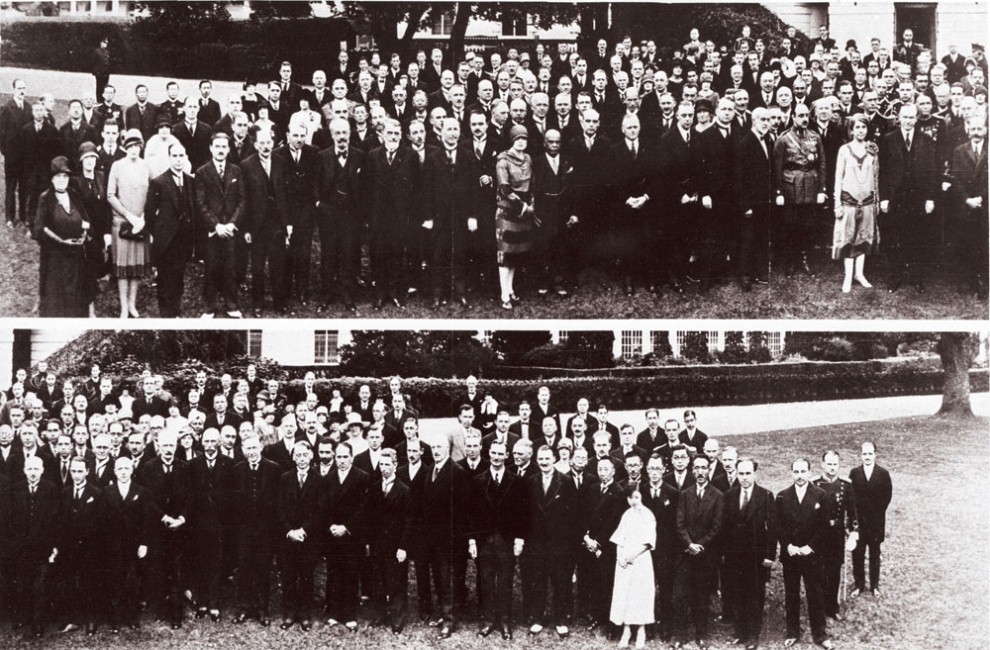
The delegates of the International Radiotelegraphic Conference, October 4, 1927, split in two photographs. Notice who stands in their midst in the top shot: President and Mrs. Coolidge.
The delegates of the International Radiotelegraphic Conference, October 4, 1927, split in two photographs. Notice who stands in their midst in the top shot: President and Mrs. Coolidge.

On Why Blaming America Is A Mistake: Some of Cal’s Answers to Her Critics

CC Portrait (2)“The world to-day is filled with a great impatience. Men are disdainful of the things that are and are credulously turning toward those who assert that a change of institutions would somehow bring about an era of perfection. It is not a change that is needed in our Constitution and laws so much as there is need of living in accordance with them. The most fundamental precept of them all — the right to life, liberty, and the pursuit of happiness — has not yet been brought into universal application. It is not our institutions that have failed, it is our execution of them that has failed…”

“No power can ever be brought into existence which will relieve of obligations. The sole opportunity for progress lies in their faithful discharge. There is no reason for Americans to lack confidence in themselves or in their institutions. Let him who doubts look about him. Let him consider the power of his country, its agriculture, its industry, its commerce, its development of the arts and sciences, its great cities, its enormous wealth, its organized society, and let him remember that all this is the accomplishment of but three centuries” — July 6, 19221

“The ancient ideals of human brotherhood, of service, the application of the Golden Rule, of peace on earth and good will toward men, are idle dreams, unless they can be translated into practical action. It is necessary, on the one hand. to avoid the illusions of the visionaries, and on the other hand, the indifference of the selfish. Each individual and each nation owe their first duty to themselves. Beyond that, there is the obligation of the strong to serve the weak, but to administer such service in a way that will not destroy or degrade by making mendicants, but will restore and strengthen by making character. It is the policy which helps in an emergency, but realizes that, finally, each individual and each nation must work out their own destiny” — September 24, 19232

“There has been abroad many times some criticism of our Government, of our people, and our ways, but that has demonstrated, I think, that when they are in real trouble and real difficulty over there, they turn to us as a nation that will be fair with them–one in whose judgment and in whose character they can rely; and notwithstanding differences that have seemed to exist, they are willing to abide by the faith that they have in us, and I think it is a very substantial accomplishment” — December 11, 19233

“Believing in our Nation thoroughly and unreservedly, confident that the evidence of past and present justifies that belief, it is our one desire to make America more American. There is no greater service that we can render the oppressed of the earth than to maintain inviolate the freedom of our citizens” — November 2, 19184

“On what nations are at home depends what they will be abroad. If the spirit of freedom rules in their domestic affairs, it will rule in their foreign affairs. The world knows that we do not seek to rule by force of arms, our strength is in our moral power. We increase the desire for peace everywhere by being peaceful. We maintain a military force for our defence, but our offensive lies in the justice of our cause. We are against war because it is destructive. We are for peace because it is constructive. We seek concord with all nations through mutual understanding. We believe in treaties and covenants and international law as a permanent record for a reliable determination of action. All these are evidences of a right intention. But something more than these is required, to maintain the peace of the world. In its final determination, it must come from the heart of the people. Unless it abide there, we cannot build for it any artificial lodging place. If the will of the world be evil, there is no artifice by which we can protect the nations from evil results. Governments can do much for the betterment of the world. They are the instruments through which humanity acts in international relations. Because they cannot do everything, they must not neglect to do what they can. But the final establishment of peace, the complete maintenance of good will toward men, will be found only in the righteousness of the people of the earth. Wars will cease when they will that they shall cease. Peace will reign when they will that it shall reign” — April 22, 19245

“The encouraging feature of our country is not that it has reached our destination, but that it has overwhelmingly expressed its determination to proceed in the right direction” — March 4, 19256

“Our country, our people, our civil and religious institutions may not be perfect, but they are what we have made them” — June 30, 19307

“The higher our standards, the greater our progress, the more we can do for the world” — July 23, 19308

“Why, two upstarts from Amherst were in Washington before breakfast one morning to tell me how we should handle the Nicaraguan trouble! I didn’t waste much time on them. Seemed to me, my information and that of the State Department was better than the information at the disposal of Amherst underclassmen. There’s too ready a hearing abroad for Americans who make a habit of criticizing their own country” — 19309

“They say we are not ‘doing our part.’ They mean we are not doing their dirty work, using our army and navy to lick those they don’t happen to like at the moment. Why, if England, for instance, was in our position today she would ‘take charge of Civilization for the benefit of Humanity’ within forty-eight hours!” — 193010

“America follows no such delusion as a place in the sun for the strong by the destruction of the weak. America seeks rather, by giving of her strength for the service of the weak, a place in eternity” — June 17, 191811

“There are criticisms which are merited, there always have been and there always will be; but the life of the nation is dependent not on criticism but on construction, not on tearing down but on building up, not in destroying but in preserving. If the American Revolution meant anything, it meant the determination to live under a reign of law. It meant the assertion of the right of the people to adopt their own constitutions, and when so adopted the duty of all the people to abide by them. The colonists of that day had had enough of the reign of force. They had had enough unlawful usurpation of their government, enough of the domination of a military force quartered in their midst. They wanted to escape from the rule of a force imposed from without and live in accordance with the light of reason which comes from within. That is the real mark of progress. That is the true liberation of mankind. Those who now, under any form or for any purpose, seek to substitute for the reign of public law their own private desire, or any species of force, coercion, or intimidation, are not in harmony with the aims of the great Virginians. The industrial life of the nation cannot stand except on the recognition and observance by everybody connected with it of the fundamental precepts of American institutions. Nothing will ever be settled unless it be settled in accordance with them. Any other attempt will have as its result nothing but confusion, destruction, anarchy, and failure” — July 6, 192212

___________________________________________________________
1 Calvin Coolidge, The Price of Freedom: Speeches and Addresses, Fredonia Books, Amsterdam, 2001, pp.180, 181.

2 C. Bascom Slemp, The Mind of the President: As Revealed by Himself in His Own Words, Doubleday, Page & Company, Garden City, 1926, p.19.

3 Howard H. Quint and Robert H. Ferrell, eds. The Talkative President: The Off-The-Record Press Conferences of Calvin Coolidge, University of Massachusetts Press, Amherst, 1964, p.181.

4 Calvin Coolidge, Have Faith in Massachusetts: A Collection of Speeches and Messages, Gray Rabbit Publications, Brooklyn, New York, 2011, p.75.

5 Slemp, p.26.

6 Calvin Coolidge, Supplement to the Messages and Papers of the Presidents Covering the Second Administration of Calvin Coolidge March 4, 1925 to March 4, 1929, Bureau of National Literature, New York, p.9488.

7 Edward Connery Lathem, ed., Calvin Coolidge Says: Dispatches Written by Former President Coolidge and Syndicated to Newspapers in 1930-1931, Calvin Coolidge Memorial Foundation, Plymouth, 1972, p.69.

8 Ibid, p.89.

9 Edward Connery Lathem, ed. Meet Calvin Coolidge: The Man Behind the Myth, Stephen Greene Press, Brattleboro, 1960, p.176-177.

10 Ibid, p.177.

11 Have Faith, p.60.

12 Price of Freedom, pp.181-182.

On Tax Policy and the Breakdown of Self-Government

CC with Thomas W. Page, President of the National Tax Association, 1925, which since 1907 dedicated itself to a proper understanding and sound appraisal of public finance, tax theory and their consistent and prudent application to public policy.

CC with Thomas W. Page, President of the National Tax Association, 1925, which since 1907 dedicated itself to a proper understanding and sound appraisal of public finance, tax theory and their consistent and prudent application to public policy.

“The wisest and soundest method of solving our tax problem is through economy. Fortunately, of all the great nations this country is best in a position to adopt that simple remedy…The collection of any taxes which are not absolutely required, which do not beyond reasonable doubt contribute to the public welfare, is only a species of legalized larceny. Under this republic the rewards of industry belong to those who earn them. The only constitutional tax is the tax which ministers to public necessity. The property of the country belongs to the people of the country. Their title is absolute. They do not support any privileges class; they do not need to maintain great military forces; they ought not to be burdened with a great array of public employees…

“The method of raising revenue ought not to impede the transaction of business; it ought to encourage it. I am opposed to extremely high rates, because they produce little or no revenue, because they are bad for the country, and, finally, because they are wrong. We can not finance the country, we can not improve social conditions, through any system of injustice, even if we attempt to inflict it upon the rich. Those who suffer the most harm will be the poor. This country believes in prosperity. It is absurd to suppose that it is envious of those who are already prosperous. The wise and correct course to follow in taxation and all other economic legislation is not to destroy those who have already secured success but to create conditions under which every one will have a better chance to be successful…”

“These questions involve moral issues. We need not concern ourselves much about the rights of property if we will faithfully observe the rights of persons. Under our institutions their rights are supreme. It is not property but the right to hold property, both great and small, which our Constitution guarantees. All owners of property are charged with a service. These rights and duties have been revealed, through the conscience of society, to have a divine sanction. The very stability of our society rests upon production and conservation. For individuals or for governments to waste and squander their resources is to deny these rights and disregard these obligations. The result of economic dissipation to a nation is always moral decay” — Calvin Coolidge, March 4, 1925

“One insidious practice which sugar-coats the dose of Federal intrusion is the division of expense for public improvements or services between state and national treasuries. The ardent States Rights advocate sees in this practice a vicious weakening of the state system. The extreme federalist is apt to look upon it in cynical fashion as bribing the states into subordination. The average American, believing in our dual-sovereignty system, must feel that the policy of national doles to the states is bad and may become disastrous. We may go on yet for a time with the easy assumption that ‘if the states will not, the nation must.’ But that way lies trouble…”

“If these principles are sound, two conclusions follow. The individual and the local, state, and national political units ought to be permitted to assume their own responsibilities. Any other course in the end will be subversive both of character and liberty. But it is equally clear that they in their turn must meet their obligations. If there is to be a continuation of individual and loca self-government and of state sovereignty, the individual and the locality must govern themselves and the state must assert its sovereignty. Otherwise these rights and privileges will be confiscated under the all-compelling pressure of public necessity for a better maintenance of order and morality. The whole world has reached a stage in which, if we do not set ourselves right, we may be perfectly sure that an authority will be asserted by others for the purpose of setting us right” — May 30, 1925.