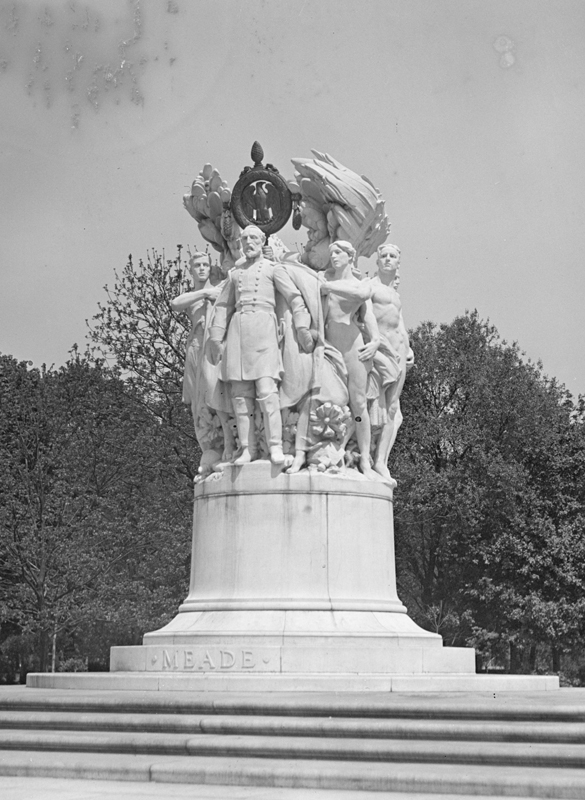
The George Gordon Meade Memorial, dedicated here by President Coolidge on October 19, 1927, before highway construction in the 1960s required removal and relocation to its current location in front of the Federal Courthouse in Washington. Sculpted by Charles Grafly, the statue of General Meade is flanked by six allegorical figures, with Loyalty to his right and Chivalry to his left (both removing his battle cloak), and also including Fame, Progress, Military Courage, and Energy, what the artist believed comprised greatness in a general. The gold finial above Meade’s head bears the seal of the state of Pennsylvania. Courtesy of Histories of the National Mall.
Appointed a mere three days before the scouts of armies north and south would encounter each other in the fields around Gettysburg, General George Gordon Meade would go on to deliver defeat to the great forces of Robert E. Lee after three days of intense fighting. Criticized for failing to pursue the honorable armies of the South to crush them once for all, Meade allowed their solemn retreat. Yet, General Meade retained his responsibilities as commander of the Army of the Potomac, when lesser men had seen Lincoln’s wrath and been summarily dismissed. Meade would continue leading the Army under the direction of Lieutenant General Grant through the Overland Campaign, the fight to Richmond and through Lee’s final surrender at Appomattox, less than two years later.
Known as “Old Snapping Turtle” for his quick temper, Meade remained in the fight and at the helm because of his unique measure of character, focus, and perseverance. Unfortunately disparaged by the onslaught of politics that ensued between the army and Washington following the tide turned at Gettysburg, Meade would barely live to see his old commander, Ulysses Grant, elected to the Presidency in 1872. Calvin Coolidge was then barely over four months old. It would be President Coolidge, however, who agreed to dedicate the memorial given to the United States by Meade’s adopted home of Pennsylvania in October of 1927. The ground had been broken in the presence of Coolidge’s predecessor, President Harding, and was finally completed after five years. Though many had passed on, some remained from those dark yet honor-graced times to be present on that day to finally recognize and remember a worthy fellow soldier and honorable American.
Of General Meade, Coolidge said, “The more we study the history of the war in which he fought, the more General Meade stands out as a responsible and reliable commander. Others may have had more dash, though none surpassed him in courage. He did not engage himself in leading hopeless charges. He was, rather, a general who kept himself sufficiently informed as to the movements of his enemy and made such preparation and wise disposition of his own troops that hopeless charges were not necessary. It can not be said that he always won, but he experienced very little of defeat. His personality was well rounded out. If it appeared to possess no lofty peaks, it was not marred by any deep depressions. If he was sometimes quick of temper, he was eminently sound of judgment. He was a solid and substantial man, one who inspired confidence, one who could be trusted. The victor of Appomattox assigned to him the second place among his generals. History has revealed that the estimate was none too high. General Lee is reported to have ranked him even higher, saying, ‘Meade, in my judgment, had the greatest ability. I feared him more than any man I ever met upon the field of battle.’
Throughout his life General Meade was a man of deep religious conviction. When he entered the service he said, ‘I go into the field trusting to God to dispose of my life and actions in accordance with my daily prayer that His will, not mine, shall be done.’ Throughout his entire military career he constantly acted in harmony with that sentiment. Time and again, in his letters and statements, he acknowledged his dependence upon Divine Providence. Like most great soldiers he was devoted to peace, not war. He even hesitated to regard those who supported the southern cause in the light of enemies, even reproving his own men for glorying in their defeat, which he would reserve for the case of a foreign foe.”
Quite a eulogy for the man who did his duty when occasion called for him and yet held tenaciously to peace as his foremost ambition. Could there be a better representation of true patriotism?
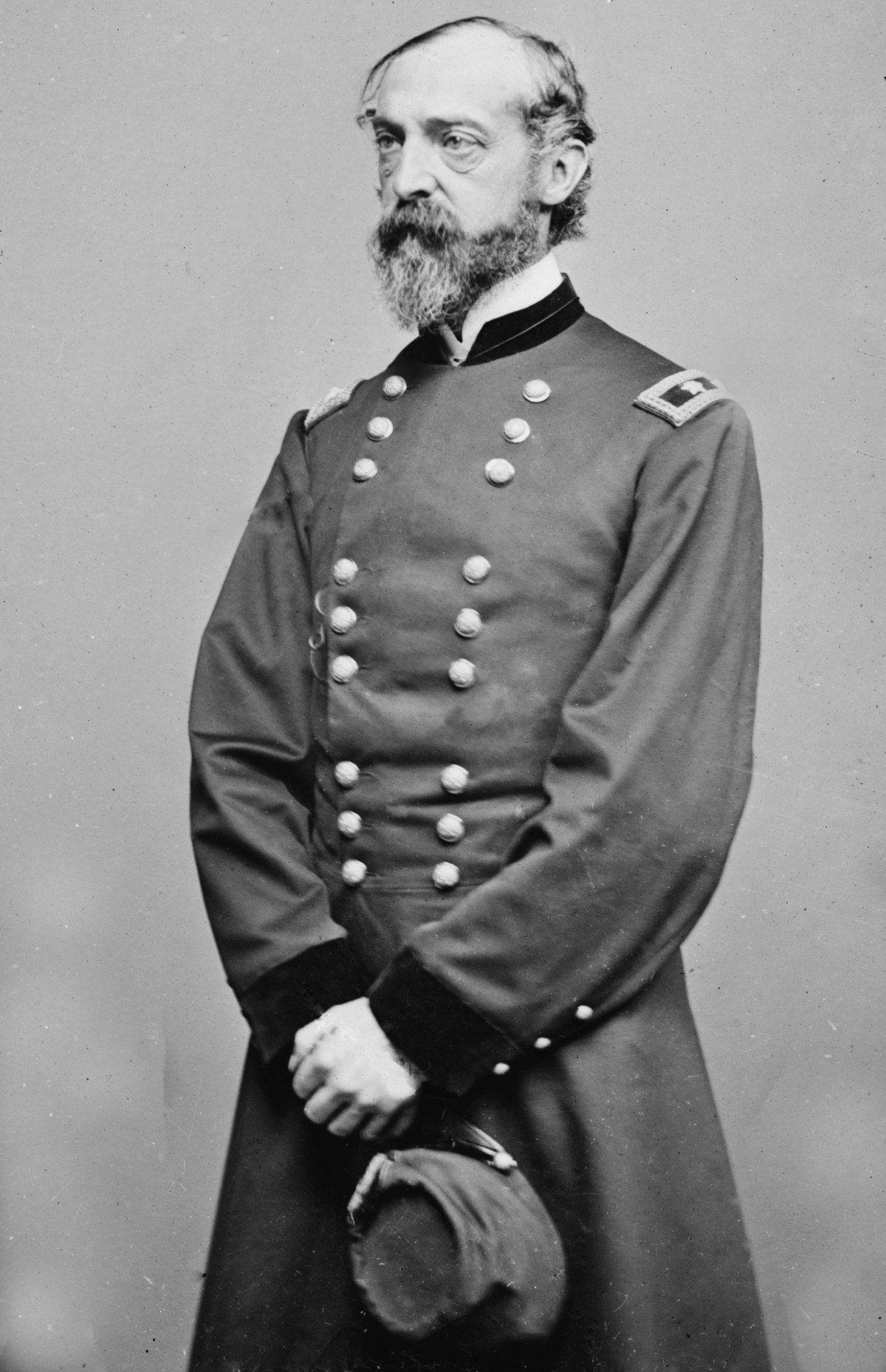
General George G. Meade by Matthew Brady
 The Importance of the Obvious