On Where the Republicans Go From Here

CC closeup

They can start by returning to Coolidge. This is especially important when it comes to his thoughts on winning. For Coolidge, it was not enough to prevail at the ballot box, the person had to possess a victor’s mindset.

“When a political party has been decisively defeated at the polls, the question naturally arises whether it will ever regain the support of a majority of the voters. The answer to this question depends upon the party itself. Defeat does not destroy a party, nor does success at any particular election insure a long life. If the principles which it represents and the policies which it advocates are sound and timely a party will survive indefinitely” — Calvin Coolidge, “Political Parties,” Saturday Evening Post, published posthumously

Before the new Congress hastens to pass a flurry of new laws, presenting a package of agenda items that are going to “fix” the mess, rather than repeal and stop it, they should consider what Coolidge encouraged his father to do, after being newly elected to the Vermont Senate, “It is much more important to kill bad bills than to pass good ones…See that the bills you recommend from your committee are so worded that they will do just what they intend and not a great deal more that is undesirable. Most bills can’t stand that test.” First, Republicans, do no harm. Stop the bleeding and then we can treat the wounds. The best course of action right now is saying “no,” being a force of negation, a resistance, an opposition, a confrontational stand against the destructive agenda being implemented these last six years. That is more than enough. America doesn’t need new construction before the wrecking ball has first been decommissioned and the debris cleared away. Don’t be afraid to say “no,” whatever others say about you. This, above all else, is what the people of this country both want and need. Take Coolidge’s advice and put first things first.

“Parties do not maintain themselves. They are maintained by effort. The government is not self-existent. it is maintained by the effort of those who believe in it. The people of America believe in American institutions, the American form of government and the American method of transacting business” — Address to the Republican Commercial ‘Travelers’ Club in Boston, April 10, 1920. The real challenge is just beginning with no small work demanded of us, an engaged citizenry, to make sure our employees in Washington do what we sent them to accomplish. We invite disaster if we walk away, tune out and trust someone else to manage our government responsibly for us. Such an attitude is why the country stands at the brink.

“Unless those who are elected under the same party designation are willing to assume sufficient responsibility and exhibit sufficient loyalty and coherence, so that they can cooperate with each other in the support of the broad general principles, of the party platform, the election is merely a mockery, no decision is made at the polls, and there is no representation of the popular will” — Inaugural Address, March 4, 1925

The Republican landslide yesterday must translate into more than magnanimously sharing authority with the losing side, as fired Majority Leader Harry Reid intones. If the electorate wanted these losers to help govern, they would not have lost their elections. Republicans then better act like the principled victors they are. The decisive win witnessed this week is not some plea from voters for more “bipartisan reaching across the aisle,” ending “deadlock,” avoiding “government shutdown” at all costs, and, in short, reverting to business as usual.  Elections mean something. Elections must result in clear direction and disciplined implementation of the principles and policies for which the people send their chosen representatives. Coolidge understood that partisanship had a vital function in our system. Sharp contrast of party principles was just as essential after the election as beforehand. The people had to see practiced what they voted to obtain or else the entire system would be a mockery. To dilute, suppress or ignore the principles to which they pledged is both a betrayal of the election process and a gag imposed on the decisions made by the sovereign people. The popular will has given the GOP a very coherent mandate to repeal Obamacare, defund the President’s agenda, stop amnesty, secure the border and stand unshakable on limited government, economic not bureaucratic growth, religious freedom, individual opportunity, and the integrity of our institutions and traditions.

Coolidge makes it plain: “There are many who are accustomed to consider partisanship and practical politics as something considerably at variance with the public welfare. This may sometimes be true. Parties represent political power, and power is always subject to abuse. But it is a mistake to blame the instrument because it is wrongfully used. If there is blame, it should be attached to those who have been guilty of the wrong and not to the innocent instruments which have been used for such purposes. The organization of parties in the United States has been the means by which the people have preserved their liberties, restrained the arbitrary powers of their governments and made effective the popular will. There is no substitute for their action under a system by which the people rule.”

The same oath which constrains the Executive, also obligates the Legislative Branch. When there is wrongdoing, the duty of all rests squarely on where Coolidge knew it to be: on the support and defense of the Constitution. These are not mere words. When the Constitution is under assault, defending all its provisions is just as necessary when the offender is the President himself. The power of impeachment is the legal and Constitutional remedy sanctioned by our system. It is hardly some recent device conceived in racism, animated by bigotry. It is a lawful check upon anyone who would claim arbitrary or dictatorial powers over the consent of the governed and the other co-equal branches of the government we have established. As Coolidge said when the scandals of his predecessor came to light, “I do not propose to sacrifice any innocent man for my own welfare, nor do I propose to retain in office any unfit man for my own welfare. I shall try to maintain the functions of the government unimpaired, to act upon the evidence and the law as I find it, and to deal thoroughly and summarily with every kind of wrongdoing.”  The incoming Congress should likewise adopt that Coolidgean resolve.

No American election can ever be a real victory for the whole people of this country — the only demographic which counts — if it fails, as Coolidge warned, to implement the agenda for which the victors, not the losers, were sent. This may mean excluding the other side from committee chairmanships and other spoils of victory, it may mean principled criticism of administration policy, and it may even mean a resolute prosecution of genuine wrongdoing in very high places, at great personal cost. Yet, it would mean a victory for law and liberty — perhaps, even for the future of the country — and that is no greater a price paid already by generations living and dead who fought to be worthy of the name “American.”

Coolidge Landslide!

The Coolidge Campaign Family. L to R, front row: Dawes, Grace, CC, Mrs. Dawes, Frank Stearns, Campaign Chairman William M. Butler, Cal Jr. and John. Courtesy of the Library of Congress.

The Coolidge Campaign Official Family. L to R, front row: Dawes, Grace, CC, Mrs. Dawes; second row: Frank Stearns, Campaign Chairman William M. Butler; back row: Cal Jr. and John. Courtesy of the Library of Congress.

“I haven’t any specific reports about any states. My reports indicate that I shall probably carry Northampton. That is about as far as I can go into details. That is based more on experience” — Calvin Coolidge, when asked about returns for the upcoming election of 1924.

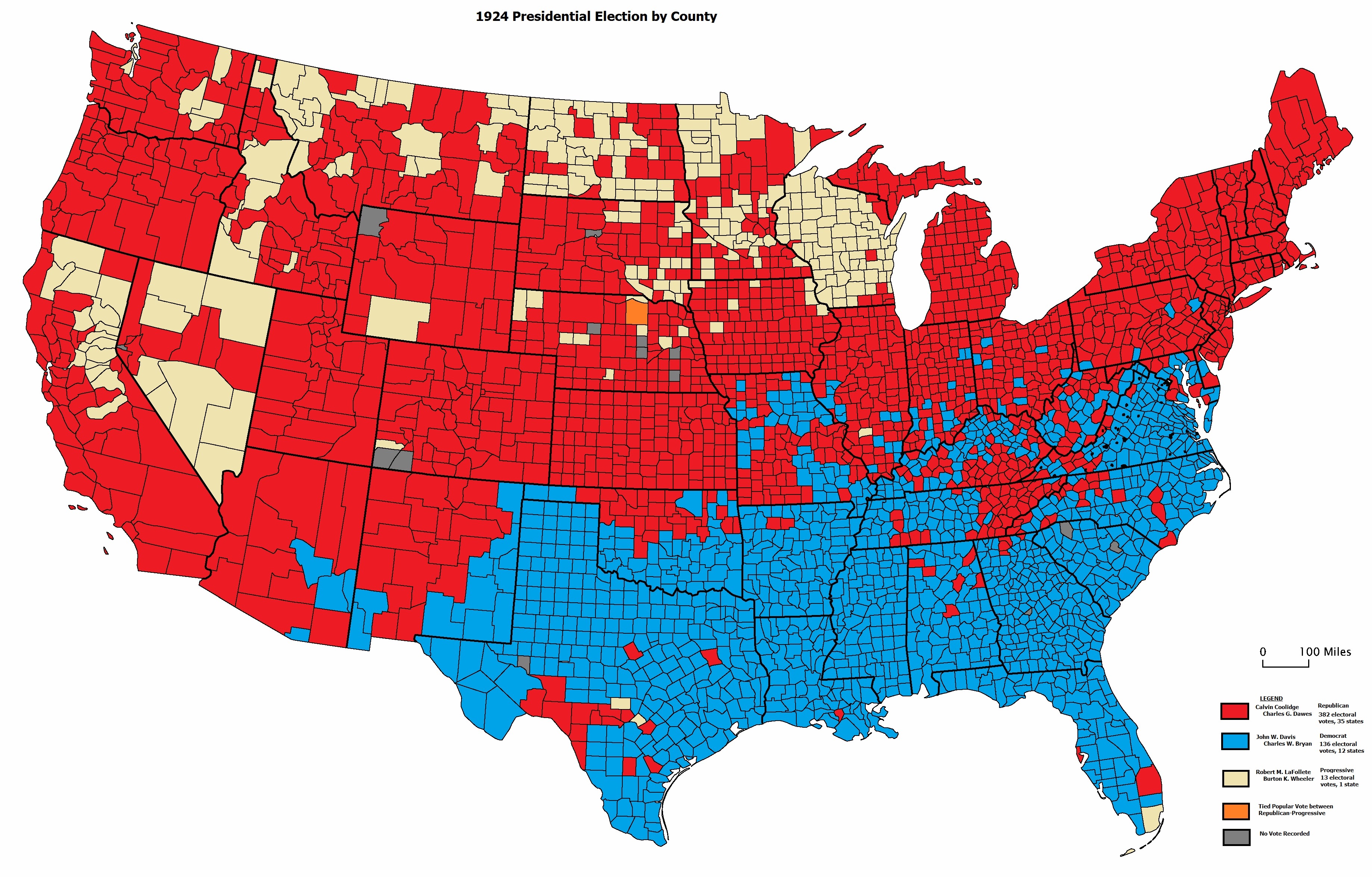
This electoral map not only underscores Coolidge's landslide but also the demographic differences under the 1920 Census from political conditions now. The Solid South, not nearly as solid as it appeared after Harding and Coolidge back-to-back victories, would continue to crack and finally shatter after four more years of Coolidge Prosperity. Hoover, piggybacking on Cal's record, would see six more states added to the "red" column: TX, OK, TN, VA, NC and FL.

This electoral map not only underscores Coolidge’s landslide but also the demographic differences under the 1920 Census compared to political conditions now. The Solid South, not nearly as solid as it appeared after Harding and Coolidge back-to-back victories, would continue to crack and finally shatter after four more years of Coolidge Prosperity. Hoover, piggybacking on Cal’s record, would see six more states added to the “red” column: TX, OK, TN, VA, NC and FL.

County-by-county breakdown of 1924 Election can be found in The Presidential Vote, 1896-1932 by Edgar E. Robinson.

County-by-county breakdown of the 1924 Election can be found in The Presidential Vote, 1896-1932 by Edgar E. Robinson.

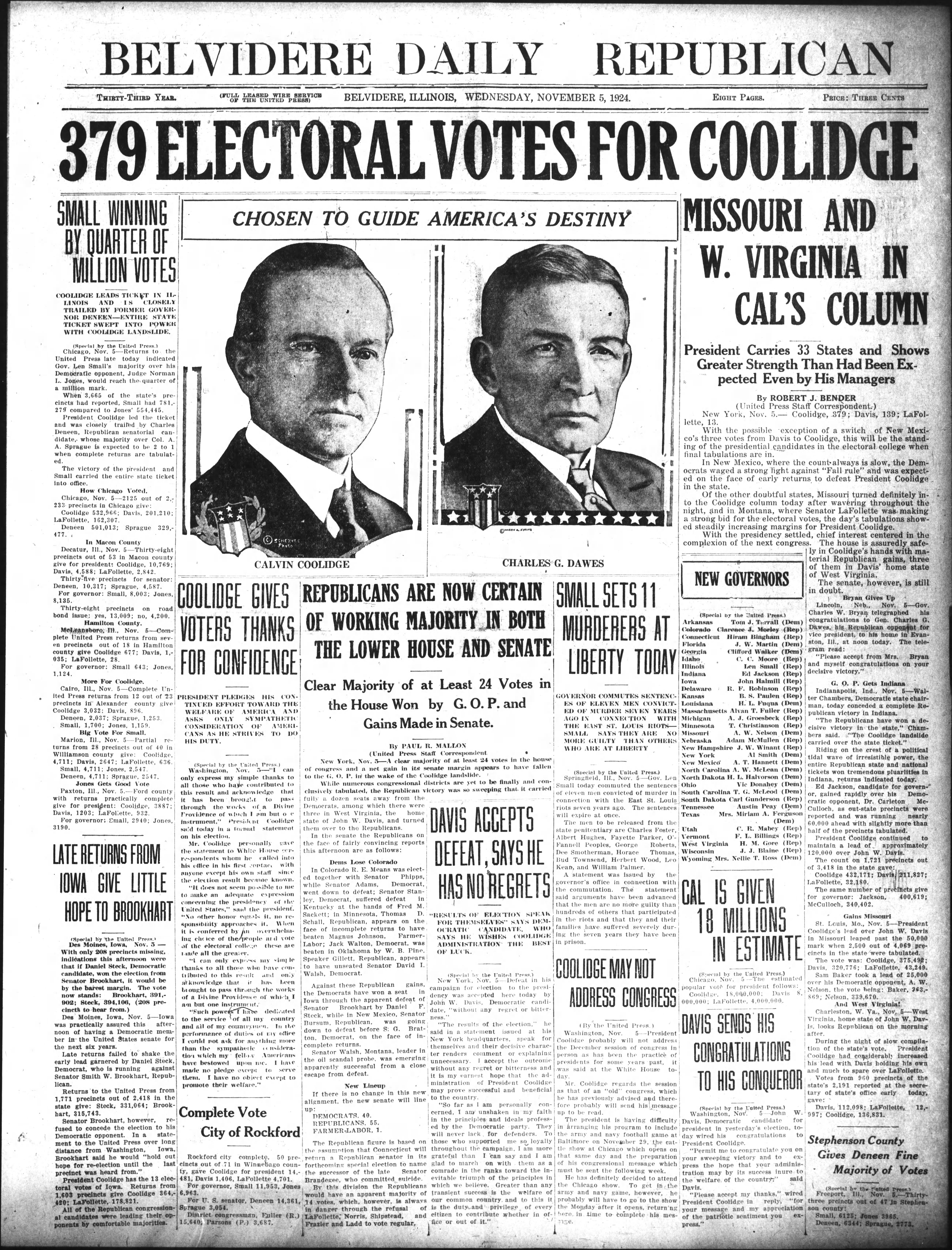
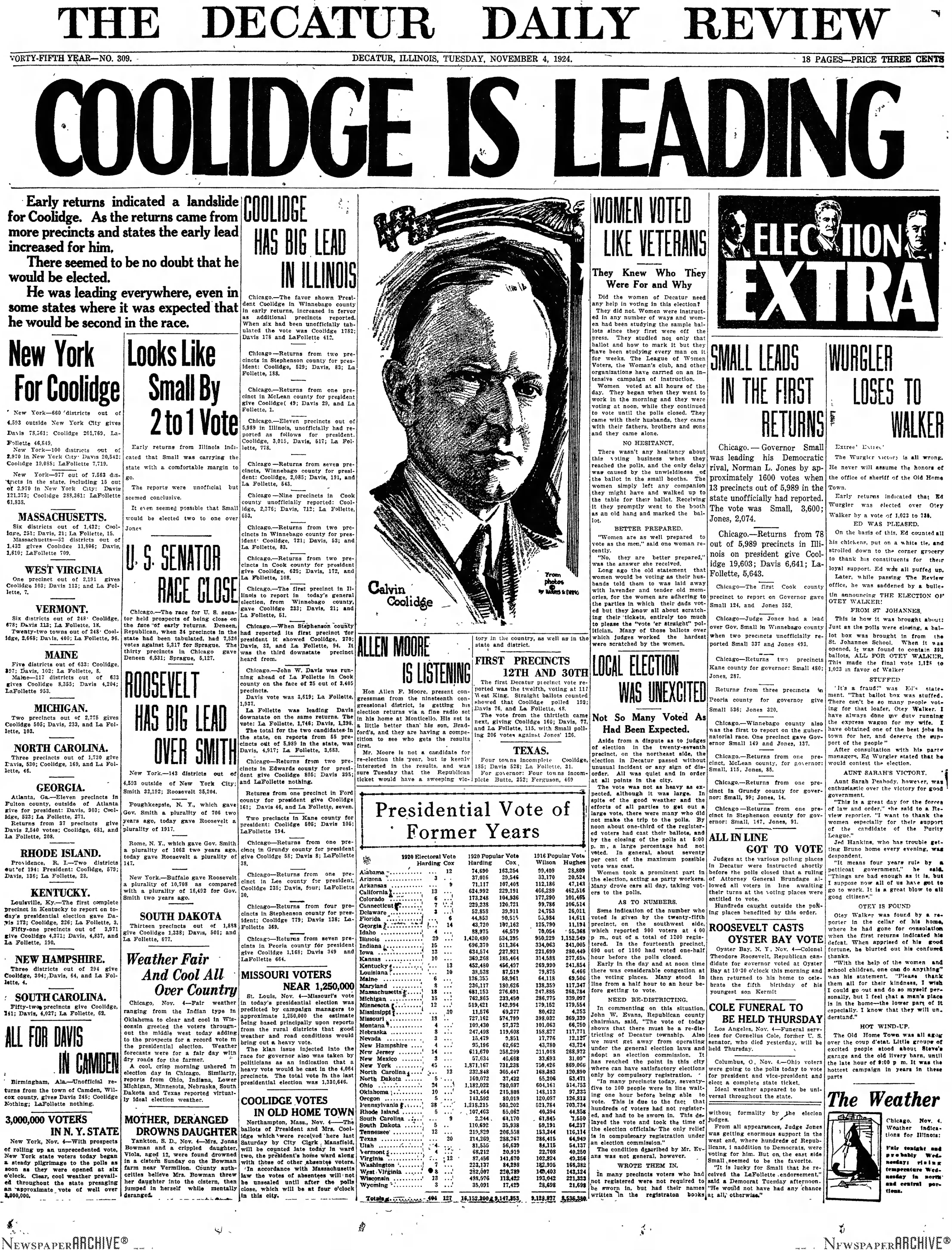
As the maps illustrate above, Cal undersold but over-delivered, promising (with characteristic wit) only his adopted hometown, in what experience bears out should have been impossible: A Republican landslide when the vote is split three ways. The fact that this election was neither thrown into the House, as feared by many at the time, nor siphoned to the Democrat Davis speaks to the strength of Coolidge’s victory. Had the Republican vote not been split, the outcome would have been even stronger. It still stands as one of the most decisive electoral wins in our history. America genuinely loved Coolidge and what he stood for — debt and tax reduction, limited government, return to the normalcy of constitutional law and order, and economic growth — resonating with voters across the spectrum. Women, participating in their second Presidential election since the passage of the Nineteenth Amendment four years before, maintained a fifty-percent turnout rate (Encyclopedia of American Political Parties and Elections, Sabato and Ernst 476), while American Indians, enfranchised nationwide for the first time, also participated in the vote. Coolidge continued to exploit the fissures in the Solid South, winning Kentucky for the GOP for the first time since 1896. This is all the more impressive considering Coolidge’s prospects were dismissed by the establishment of his day a year before.

Courtesy of Newspapers.com.

The paper, rushed to print before Nevada’s outcome was known, would not include 3 more electoral votes (11,243 votes statewide for Coolidge) until the following day. Courtesy of Newspapers.com.

Courtesy of Newspapers.com.

Courtesy of Newspapers.com.

On Our Time for Choosing

Governor Coolidge at formal ceremonies on Boston Common, 1919. Courtesy of Leslie Jones Photography.

Governor Coolidge at formal ceremonies on Boston Common, 1919. Courtesy of Leslie Jones Photography.

It was on this day in 1919 that Governor Calvin Coolidge stood before voters and framed the central principles at issue in the election the following Tuesday. His ability to both identify and distill down the essential components of public problems was renowned. He possessed a talent for cutting through the peripheral and inconsequential minutiae to isolate the material facts in otherwise complicated political conflicts. As he humbly put it in his Autobiography, no doubt with this particular address on his mind, “The issue was nothing less than whether the law which the people had made through their duly authorized agencies should be supreme. This issue I took to the people in my campaign for reelection as Governor…I felt at the time that the speeches I made and the statements I issued had a clearness of thought and revealed a power I had not before been able to express, which confirmed my belief that, when a duty comes to us, with it a power comes to enable us to perform it…My faith that the people would respond to the truth was justified.”

On the evening of November 1, 1919, before those gathered at Tremont Temple in downtown Boston, the Governor spoke these most timely words, not only to the people of Massachusetts but for the people of all the States. It is important to keep in mind that when Coolidge refers to government, his first thought is not to Washington but foremost to the governance of the States and our authority at its most local, and personal, level. Living under the Wilson-Palmer regime, however, Coolidge understood that the truth of his observations reached even to those residing in the Nation’s Capital lured in by the President’s false notions of progress. He said,

“Revelation has not ceased. The strength of a righteous cause has not grown less. The people of Massachusetts are patriotic before they are partisan, they are not for men but for measures, not for selfishness but for duty, and they will support their Government. Revelation has not ceased and faith in men has not failed. They cannot be intimidated, they cannot be coerced, they cannot be deceived, and their sovereignty is not for sale.

“When this campaign is over it will be a rash man who will again attempt to further his selfish interests by dragging a great party name in the mire and seeking to gain the honor of office by trafficking with disorder. The conduct of public affairs is not a game. Responsible office does not go to the crafty. Governments are not founded upon an association for public plunder but on the cooperation of men wherein each is seeking to do his duty.

“The past five years have been like an earthquake. They have shaken the institutions of men to their very foundations. It has been a time searchings and questionings. It has been a time of great awakenings. There has been an overpowering resolution among men to make things better…We have a deep conviction that ‘resistance to tyranny is obedience to law.’ And on that conviction we have stood for three centuries. Time and experience have but strengthened our belief that it is sound.

“But like all rules of action it only applies to the conditions it describes. All authority is not usurped authority. Any government is not tyranny. These are the counterfeits. There are no counterfeits of the unreal. It is only of the real and true that men seek to pass spurious imitations.

“There are among us a great mass of people who have been reared for generations under a government of tyranny and oppression. It is ingrained in their blood that there is no other form of government. They are disposed and inclined to think our institutions partake of the same nature as these they have left behind. We know they are wrong. They must be shown they are wrong.

“There is a just government. There are righteous laws. We know the formula by which they are produced. The principle is best stated in the immortal Declaration of Independence to be ‘the consent of the governed.’ It is from that source our Government derives its just powers and promulgates its righteous laws. They are the will of the people, the settled conviction derived from orderly deliberation, that take on the sanctity ascribed to the people’s voice. Along with the binding obligation to resist tyranny goes the other admonition, that ‘obedience to law is liberty’ — such law and so derived.

“These principles, which I have but lightly sketched, are the foundation of American institutions, the source of American freedom and the faith of any party entitled to call itself American. It constitutes truly the rule of the people. It justifies and sanctifies the authority of our laws and the obligation to support our Government. It is democracy administered through representation.

“There are only two other choices, anarchy and despotism–Russia, present and past. For the most part human existence has been under the one or the other of these. Both have failed to minister to the highest welfare of the people. Unless American institutions can provide for that welfare the cause of humanity is hopeless. Unless the blessings of prosperity, the rewards of industry, justice and liberty, the satisfaction of duty well done, can come under a rule of the people, they cannot come at all. We may as well abandon hope and, yielding to the demands of selfishness, each take what he can.

“We had hoped these questions were settled. But nothing is settled that evil and selfish men can find advantage for themselves in overthrowing. We must eternally smite the rock of public conscience if the waters of patriotism are to pour forth. We must ever be ready to point out the success of our country as justification of our determination to support it…

“Will men realize their blessing and exhibit the resolution to support and defend the foundation on which they rest? Having saved Europe are we ready to surrender America? Having beaten the foe from without are we to fall victim to the foe from within? All of this is put in question by the issue of this campaign. That one fundamental issue is the support of the Government in its determination to maintain order. On that all of these opportunities depend.

“There can be no material prosperity without order. Stores and banks could not open. Factories could not run, railways could not operate. What was the value of plate glass and goods, the value of real estate in Boston at three o’clock, A.M., September 10? Unless the people vote to sustain order that value is gone entirely. Business is ended. On order depends all intellectual progress. Without it all schools close, libraries are empty, education stops. Disorder was the forerunner of the Dark Ages.

“Without order the moral progress of the people would be lost. With the schools would go the churches. There could be no assemblages for worship, no services even for the departed, piety would be swallowed up in viciousness.

“I have understated the result of disorder. Man has not the imagination, the ability to overstate it. There are those who aim to bring about exactly this result. I propose at all times to resist them with all the power at the command of the Chief Executive of Massachusetts.

“Naturally the question arises, what shall we do to defend our birthright? In the first place everybody must take a more active part in public affairs. It will not do for men to send, they must go. It is not enough to draw a check. Good government cannot be bought, it has to be given. Office has great opportunities for doing wrong, but equal chance for doing right. Unless good citizens hold office bad citizens will. People see the office-holder rather than the Government. Let the worth of the office-holder speak the worth of the government. The voice of the people speaks by the voice of the individual. Duty is not collective, it is personal. Let every inhabitant make known his determination to support law and order. That duty is supreme.

“That the supremacy of the law, the preservation of the Government itself by the maintenance of order, should be the issue of this campaign was entirely due to circumstances beyond my control. That anyone should dare to put in jeopardy the stability of our Government for the purpose of securing office was to me inconceivable. That any one should attempt to substitute the will of any outside organization for the authority conferred by law upon the representatives of the people had never occurred to me. But the issue arose by action of some of the police of Boston and it was my duty to meet it. I shall continue to administer the law of all the people…

“Those who are attempting to wrench the scepter of authority from the representatives of the people, to subvert the jurisdiction of her laws, are the enemies not only of progress, but of all present achievement, not only of what we hope for, but of what we have.

“This is the cause of all the people, especially of the weak and defenseless. Their only refuge is the protection of the law. The people have come to understand this. They are taking the deciding of this election into their own hands regardless of party. If the people win who can lose? They are awake to the words of Daniel Webster, ‘nothing will ruin the country if the people themselves will undertake its safety; and nothing can save it if they leave that safety in any hands but their own.’

“My fellow citizens of Massachusetts, to you I commend this cause. To you who have added the glory of the hills and plains of France to the glory of Concord and Bunker Hill, to you who have led when others faltered, to you again is given the leadership. Grasp it. Secure it. Make it decisive. Make the discharge of the great trust you now hold an example of hope for righteousness everywhere, a new guarantee that the Government of America shall endure.”

Governor Coolidge marches past the State House, Boston, June 14, 1919. Courtesy of Leslie Jones Photography.

Governor Coolidge marches past the State House, Boston, June 14, 1919. Courtesy of Leslie Jones Photography.