
The Coolidges with their rambunctious chow, Blackberry, surrounded by admiring fellow Americans on the steps of the General Store in Plymouth Notch, summer 1931. Courtesy of the Yankee Publishing Collection.
The Coolidges with their rambunctious chow, Blackberry, surrounded by admiring fellow Americans on the steps of the General Store in Plymouth Notch, summer 1931. Courtesy of the Yankee Publishing Collection.

In retirement, private citizen Mr. Coolidge wrote to the incoming President of New York Life Insurance Company, Thomas A. Buckner, reiterating that no special treatment be given to him as a member of the Board. He must be like anyone else, tasked to meet whatever need for service he was deemed fit to render. If Buckner judged someone else better qualified for an assignment or receipt of a favor, humble Cal made sure in this letter that the job ought to go to that man every time, never out of deference to him as a former President. He insists, “Of course, I should be delighted to do anything you want. You can always keep in mind that I am not in search of any kind of an honor and anytime you think someone on the Board would like something, I hope you will always give it to them in preference to me.” Such was not calculated ingratiation, such was simply Calvin’s way however high he rose in this world’s responsibilities. In his eyes, the higher one rose demanded heavier obligation to give more not rest on the greatness of the position, past or present.
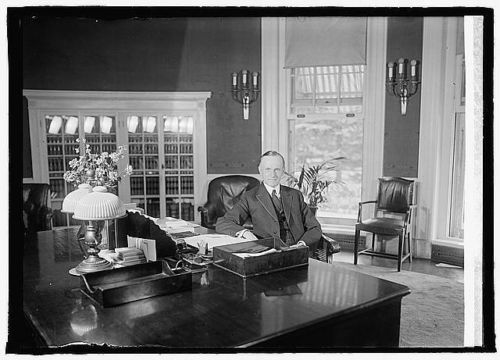
As tax policy comes to the forefront, and especially the search for new “revenue sources,” it is worthwhile reflecting on President Coolidge’s thoughts on the Constitution’s limited power to tax, when he said on December 8, 1925,
“It is a fundamental principle of our country that the people are sovereign. While they recognize the undeniable authority of the state, they have established as its instrument a Government of limited powers. They hold inviolate in their own hands the jurisdiction over their own freedom and the ownership of their own property. Neither of these can be impaired except by due process of law. The wealth of our country is not public wealth, but private wealth. It does not belong to the Government, it belongs to the people. The Government has no justification in taking private property except for a public purpose. It is always necessary to keep these principles in mind in the laying of taxes and in the making of appropriations. No right exists to levy on a dollar, or to order the expenditure of a dollar, of the money of the people, except for a necessary public purpose duly authorized by the Constitution. The power over the purse is the power over liberty.“
 The Importance of the Obvious